
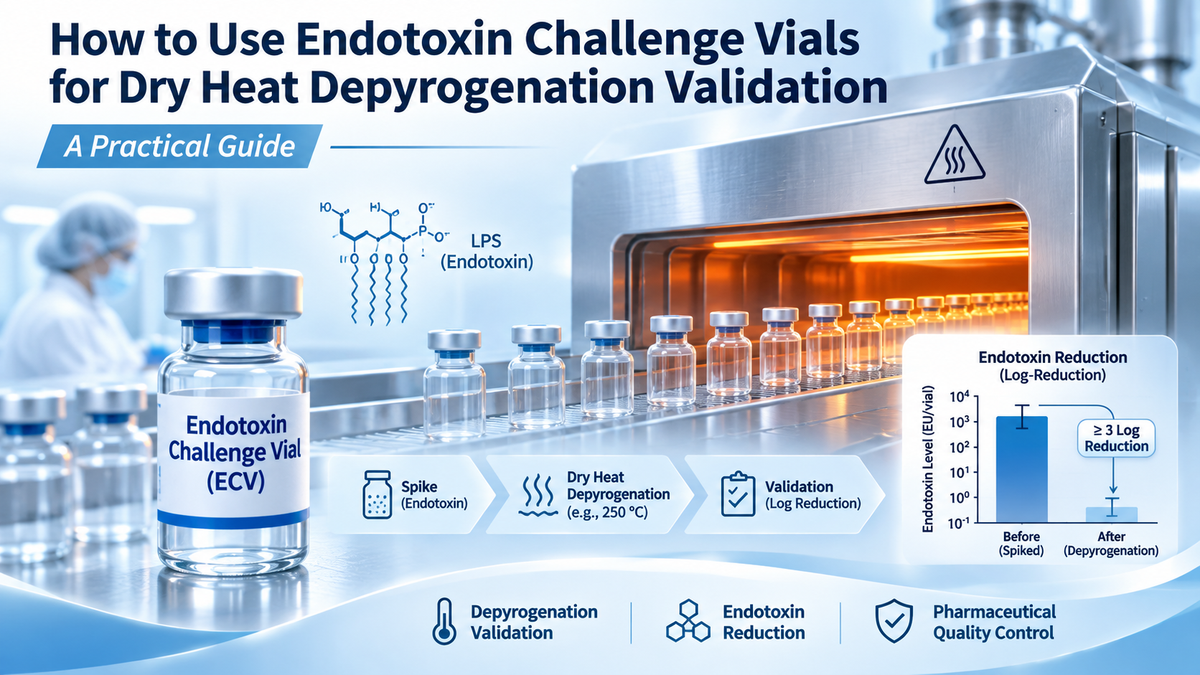
Endotoxin Challenge Vials (ECVs) are essential tools for evaluating the effectiveness of dry heat depyrogenation processes in pharmaceutical manufacturing. Containing a characterized amount of bacterial endotoxin, ECVs provide a measurable challenge for determining whether depyrogenation equipment can achieve the intended reduction in endotoxin activity. Proper validation involves selecting suitable indicators, establishing untreated controls, positioning ECVs at representative locations, executing the thermal cycle, recovering residual endotoxin, and calculating logarithmic reduction. This article provides a practical overview of ECV-based dry heat depyrogenation validation, including experimental considerations, analytical testing methods, acceptance criteria, troubleshooting, and regulatory expectations.
1. Introduction
Bacterial endotoxin contamination is an important quality concern in pharmaceutical manufacturing, particularly for injectable drugs and other sterile preparations.
Endotoxins are primarily associated with lipopolysaccharides (LPS) found in the outer membranes of Gram-negative bacteria. These substances can remain biologically active even after the originating microorganisms have been destroyed.
Therefore, conventional sterilization does not necessarily ensure sufficient endotoxin reduction.
Dry heat depyrogenation is widely used to reduce endotoxin activity on heat-stable pharmaceutical components, including glass vials, ampoules, and certain manufacturing equipment.
However, simply exposing materials to elevated temperatures does not establish that a process consistently achieves its intended depyrogenation performance.
Endotoxin Challenge Vials (ECVs) provide a standardized means of evaluating this performance.
By comparing recoverable endotoxin activity before and after thermal treatment, laboratories can determine whether a defined dry heat cycle achieves the required reduction under established processing conditions.
2. Understanding Endotoxin Challenge Vials
Endotoxin Challenge Vials are specially prepared containers containing a characterized quantity of bacterial endotoxin.
They are commonly used as endotoxin indicators during the qualification of dry heat depyrogenation processes.
ECVs generally contain purified bacterial lipopolysaccharide deposited onto or within an appropriate glass container.
The challenge level is expressed in Endotoxin Units (EU), which quantify endotoxin activity relative to established reference standards.
2.1 Why Are ECVs Necessary?
Dry heat depyrogenation validation requires evidence that the treatment effectively reduces endotoxin activity.
Temperature measurements alone cannot directly demonstrate endotoxin reduction.
ECVs complement physical measurements by providing a biological-material challenge whose residual activity can be measured analytically.
When used with temperature mapping and heat penetration studies, they support a more comprehensive evaluation of depyrogenation performance.
2.2 Understanding the 3-Log Reduction Requirement
A commonly applied acceptance criterion for dry heat depyrogenation validation is a reduction of at least three logarithmic units in endotoxin activity.
A 3-log reduction corresponds to a 1,000-fold decrease or 99.9% reduction.
For example, if the initial recoverable endotoxin activity is 10,000 EU/vial, a residual level of 10 EU/vial represents a 3-log reduction.
The applicable acceptance criteria should always be established in the approved validation protocol according to the process and relevant regulatory requirements.
3. Preparation Before ECV Validation
Successful ECV validation begins with appropriate planning, indicator selection, and equipment qualification.
3.1 Selecting Suitable Endotoxin Challenge Vials
The selected ECVs should contain a characterized endotoxin challenge sufficient to demonstrate the intended reduction.
Important selection criteria include:
Documented endotoxin activity per vial
Suitable container material and configuration
Compatibility with the intended dry heat process
Established endotoxin extraction and recovery characteristics
Availability of relevant manufacturer documentation
Appropriate storage conditions and expiration dating
Manufacturer instructions should be reviewed before incorporating indicators into a validation study.
3.2 Reviewing Equipment Qualification
Before performing endotoxin challenge testing, the depyrogenation equipment should undergo appropriate qualification activities.
These generally include installation qualification (IQ), operational qualification (OQ), and performance qualification (PQ).
Temperature distribution studies help identify differences in thermal conditions throughout the equipment.
Heat penetration studies evaluate the thermal exposure experienced by the processed materials.
Together, these investigations support the identification of representative worst-case conditions.
3.3 Establishing the Validation Protocol
The validation protocol should define the study objectives, processing parameters, sampling locations, analytical procedures, and acceptance criteria.
Important parameters may include operating temperature, exposure duration, conveyor speed, container configuration, equipment loading, and sample recovery conditions.
The number of indicators and qualification runs should be scientifically justified according to the equipment and validation strategy.
4. Step-by-Step Procedure for Using ECVs
Although specific procedures depend on the indicator manufacturer and equipment design, the following workflow describes the general principles of ECV-based dry heat depyrogenation validation.
Step 1: Establish Untreated Control Indicators
Untreated ECVs are used to establish the recoverable endotoxin activity before processing.
These controls are essential because the amount of endotoxin recovered from an indicator may differ from its nominal challenge value.
The untreated indicators should be processed using the qualified extraction and analytical procedure.
Recovered activity provides the baseline against which treated indicators are evaluated.
Control results should meet the recovery criteria established in the validation method.
Step 2: Position ECVs at Representative Locations
ECVs are placed in selected locations within the depyrogenation equipment.
Placement should be guided by temperature distribution, heat penetration, and worst-case assessments.
For batch dry heat ovens, potential considerations include shelf locations, loading arrangements, and areas where heat penetration may be less effective.
For continuous depyrogenation tunnels, relevant factors include conveyor position, container size, belt speed, and temperature distribution across the heating zone.
The selected positions should represent challenging conditions rather than simply convenient locations.
Step 3: Perform the Dry Heat Depyrogenation Cycle
Once the indicators have been positioned, the equipment is operated according to the predefined validation cycle.
Dry heat depyrogenation processes use elevated temperatures to reduce bacterial endotoxin activity.
The effectiveness of treatment depends on the actual thermal exposure achieved by the processed articles.
Although temperatures around 250°C are commonly associated with certain pharmaceutical glassware depyrogenation processes, the appropriate cycle must be established and validated for the specific application.
Critical parameters should be recorded throughout the study.
For continuous tunnels, these may include conveyor speed, temperature profiles, airflow conditions, and material residence time.
For batch ovens, loading configuration, exposure duration, temperature uniformity, and heat penetration are particularly relevant.
Step 4: Recover Residual Endotoxin
After completion of the depyrogenation cycle, the treated ECVs are collected according to the approved protocol.
Residual endotoxin is extracted using the qualified recovery procedure.
The procedure may involve an appropriate endotoxin-free extraction medium and controlled mixing conditions, depending on the indicator design.
Recovery conditions should follow the manufacturer's instructions and the established analytical method.
Care should be taken to prevent contamination during sample handling.
Step 5: Measure Endotoxin Activity
Recovered samples are analyzed using an appropriate bacterial endotoxin testing method.
Common analytical approaches include:
Gel-Clot LAL Assay
This method detects endotoxin through an endotoxin-dependent clotting reaction. It can support qualitative or semiquantitative measurements when the assay sensitivity is appropriate.
Chromogenic LAL Assay
Chromogenic methods measure the generation of a colored reaction product following endotoxin-dependent enzymatic activation.
They support quantitative determination within an established analytical range.
Turbidimetric LAL Assay
Turbidimetric methods monitor changes in optical turbidity during the LAL reaction.
Kinetic measurements can be used to calculate endotoxin activity from an appropriate calibration curve.
The selected assay should provide sufficient sensitivity and demonstrate acceptable method suitability for the samples being evaluated.
Step 6: Calculate Endotoxin Log Reduction
After determining endotoxin activity in treated and untreated indicators, the reduction is calculated.
The standard equation is:
Log Reduction = log₁₀ (Initial Recoverable Endotoxin / Residual Endotoxin)
For example:
|
Parameter |
Endotoxin Activity |
|
Untreated control |
10,000 EU/vial |
|
Treated ECV |
5 EU/vial |
|
Calculated reduction |
3.30 log |
|
Percentage reduction |
Approximately 99.95% |
In this example, the process achieves more than a 3-log reduction.
If the residual activity falls below the validated quantitation limit, the result should be expressed using a scientifically justified analytical limit.
Step 7: Evaluate and Document Validation Results
The calculated endotoxin reductions are compared with the predefined acceptance criteria.
A successful study should demonstrate that the process consistently achieves the required reduction at all designated challenge locations.
The final validation report should document the indicator specifications, sample locations, process parameters, control recovery results, analytical findings, calculations, deviations, and overall conclusions.
5. ECV Validation in Dry Heat Ovens and Depyrogenation Tunnels
Although both systems use dry heat, their validation considerations differ.
|
Parameter |
Batch Dry Heat Oven |
Continuous Depyrogenation Tunnel |
|
Processing mode |
Batch operation |
Continuous operation |
|
Main thermal variables |
Temperature and exposure time |
Temperature and conveyor residence time |
|
Loading considerations |
Shelf placement and load configuration |
Container arrangement and conveyor loading |
|
Important studies |
Heat distribution and penetration |
Thermal profiling and heat penetration |
|
ECV placement |
Defined worst-case locations |
Representative challenged conveyor positions |
|
Validation objective |
Demonstrate effective batch depyrogenation |
Demonstrate effective continuous depyrogenation |
For both systems, ECV studies should complement physical equipment qualification.
6. Common Problems During ECV Validation
Several challenges may affect the reliability of ECV-based depyrogenation studies.
6.1 Low Endotoxin Recovery
Poor recovery from untreated controls can compromise the initial challenge measurement.
Possible causes include adsorption of endotoxin to container surfaces, unsuitable extraction conditions, or incomplete sample recovery.
The extraction method should be evaluated, and manufacturer guidance should be consulted when recovery falls outside the specified range.
6.2 Inconsistent Test Results
Variability between replicate indicators may result from differences in thermal exposure, recovery procedures, analytical performance, or indicator characteristics.
Investigations should consider each of these potential sources rather than assuming that the depyrogenation equipment is responsible.
6.3 Insufficient Endotoxin Reduction
A reduction below the predefined acceptance criterion may indicate inadequate thermal exposure or another process-related issue.
Potential contributing factors include inappropriate cycle settings, unfavorable loading patterns, insufficient heat penetration, or variations in equipment performance.
Corrective actions should be based on a documented investigation followed by appropriate repeat validation.
6.4 Analytical Interference
Substances introduced during extraction or sample preparation may inhibit or enhance LAL assay reactions.
Appropriate method suitability testing and controls are necessary to establish reliable endotoxin measurements.
7. Regulatory and GMP Considerations
Dry heat depyrogenation validation should follow applicable pharmaceutical quality standards and established regulatory guidance.
USP General Chapter ⟨1228.5⟩ discusses endotoxin indicators used to evaluate depyrogenation processes.
FDA guidance for aseptic processing also addresses endotoxin challenge studies and the demonstration of at least a 99.9% reduction in endotoxin activity.
Important validation considerations include documented worst-case processing conditions, representative loading configurations, suitable positive controls, and reliable analytical recovery.
The validation strategy should be appropriate for the intended product, manufacturing equipment, and applicable regulatory jurisdiction.
8. Best Practices for Reliable ECV Validation
To improve the consistency and scientific reliability of endotoxin challenge studies, laboratories should adopt a systematic validation approach.
First, use characterized ECVs that are suitable for the intended processing conditions.
Second, establish reliable untreated-control recovery before interpreting the performance of treated indicators.
Third, combine ECV challenge studies with appropriate thermal mapping and heat penetration measurements.
Fourth, use qualified analytical methods with sufficient sensitivity to evaluate the intended reduction.
Finally, maintain complete documentation of sample handling, processing parameters, analytical results, and deviations.
These practices support reproducibility and improve confidence in the conclusions of depyrogenation validation studies.
9. Conclusion
Endotoxin Challenge Vials play an important role in validating dry heat depyrogenation processes used in pharmaceutical manufacturing.
By providing a characterized endotoxin challenge, ECVs allow laboratories to quantify the reduction in endotoxin activity achieved by a defined thermal cycle.
Successful application requires careful indicator selection, representative placement, suitable untreated controls, qualified endotoxin recovery, and reliable analytical testing.
When combined with temperature mapping, heat penetration studies, and documented acceptance criteria, ECV testing provides valuable evidence supporting the effectiveness of dry heat depyrogenation processes.
A scientifically justified validation strategy helps pharmaceutical manufacturers maintain consistent process performance and strengthen endotoxin contamination control.
Frequently Asked Questions (FAQs)
1. How are Endotoxin Challenge Vials used in depyrogenation validation?
ECVs are exposed to a defined depyrogenation cycle, after which residual endotoxin activity is measured and compared with untreated controls to calculate the achieved reduction.
2. What is the required endotoxin reduction for dry heat depyrogenation?
A reduction of at least 3 logarithmic units, equivalent to 99.9%, is a commonly applied benchmark. Specific acceptance criteria should follow the applicable requirements and approved validation protocol.
3. Can ECVs be used in both dry heat ovens and depyrogenation tunnels?
Yes. Suitable ECVs can be used in both systems, although indicator placement and processing parameters must reflect their different operating characteristics.
4. Why are untreated ECV controls necessary?
Untreated controls establish the recoverable initial endotoxin activity, providing a reliable baseline for calculating the reduction achieved during processing.
5. Which analytical methods can be used to test ECVs?
Gel-clot, chromogenic, and turbidimetric LAL assays may be suitable when the selected method meets the required analytical sensitivity and method suitability criteria.
6. Does successful ECV testing confirm sterilization?
No. ECVs evaluate endotoxin reduction. Sterilization effectiveness involves separate microbial inactivation considerations, although a validated dry heat process may be designed to accomplish both objectives.
For laboratory and applicable pharmaceutical process-validation use only. Follow the ECV manufacturer's instructions, approved validation procedures, and relevant quality requirements.


