
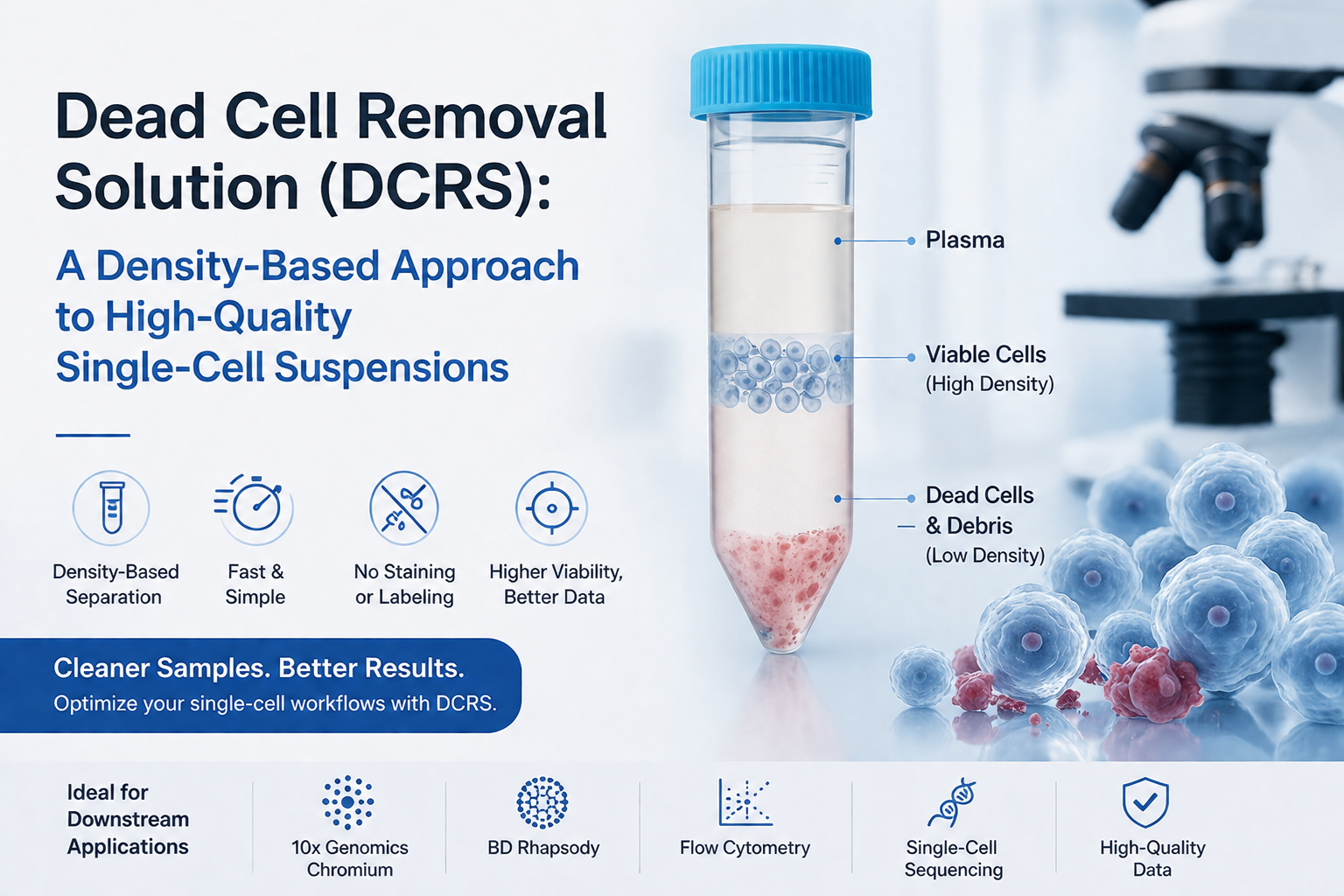
In modern biomedical research, especially in single-cell sequencing, flow cytometry, and primary tissue analysis, sample quality is often the single most important determinant of downstream data quality. One of the most persistent challenges researchers face is the presence of dead cells, debris, and heterogeneous cell populations after tissue dissociation.
The Dead Cell Removal Solution (DCRS) is designed to address this critical bottleneck through a fundamentally different mechanism compared to traditional viability stains or flow cytometry-based sorting. Instead of labeling or detecting dead cells, DCRS physically separates them based on density differences, offering a fast, instrument-independent cleanup step that can be integrated seamlessly into existing workflows.
Why Dead Cell Removal Matters in Single-Cell Workflows
Dead cells are not just inactive biological remnants—they actively interfere with experimental accuracy. In platforms such as:
· 10x Genomics Chromium
· BD Rhapsody
· Flow cytometry systems
dead cells can:
· Release intracellular RNA and DNA, increasing background noise
· Form aggregates with viable cells
· Bias cell-type representation
· Reduce cell capture efficiency
· Increase doublet rates in droplet-based systems
As a result, improving viability and removing dead cells before analysis is essential for generating reliable, high-resolution datasets.
How DCRS Works: Density-Based Separation Instead of Labeling
Unlike viability dyes or fluorescence-activated cell sorting (FACS), DCRS uses a physical property—cell density—to achieve separation.
After centrifugation, the system forms a layered environment where:
· Viable cells (higher density, intact membranes) remain in the enriched fraction
· Dead cells (lower density due to membrane disruption and cytoplasmic leakage) migrate away from the viable cell layer
· Debris is partially excluded depending on size and density characteristics
This approach eliminates the need for:
· Fluorescent labeling
· Antibody staining
· Flow cytometry instrumentation
Key Advantage
DCRS functions as a pre-analytical cleanup step, rather than a data-filtering step. This fundamentally improves input material quality before it reaches analytical platforms.
Where DCRS Fits in Your Workflow
A major strength of DCRS is its simplicity of integration. It is typically used:
After tissue dissociation and before downstream analysis
A standard workflow looks like this:
1. Tissue dissociation into single-cell suspension
2. Optional red blood cell lysis using FG-BA3311 (if blood-rich tissue)
3. DCRS density-based cleanup
4. Downstream processing (sequencing or flow cytometry)
For blood-contaminated tissues, the recommended sequence is especially important:
· First: RBC removal
· Then: DCRS purification
This ensures that both erythrocytes and dead nucleated cells are efficiently reduced before analysis.
Optimized Protocol Conditions
DCRS performance depends on strict adherence to validated centrifugation parameters:
· Temperature: 4°C
· Speed: 700 × g
· Time: 20 minutes
These conditions are optimized to ensure:
· Stable gradient formation
· Efficient separation of viable vs. non-viable cells
· Minimal stress on intact cells
Deviations (such as room temperature processing or altered centrifugal force) may reduce separation efficiency, resulting in incomplete removal of dead cells or residual debris in the final suspension.
Handling High-Debris Samples
While DCRS is highly effective for separating dead cells from viable populations, it is not primarily designed as a general debris filtration system.
In samples with:
· High extracellular matrix contamination
· Large tissue fragments
· Severe mechanical dissociation artifacts
an additional pre-cleanup step is recommended before DCRS.
This ensures optimal performance and prevents debris from interfering with density-based separation.
For complex tissues, users are encouraged to consult technical support for protocol optimization.
Kit Formats and Throughput Considerations
DCRS is available in multiple kit sizes to accommodate different experimental scales:
· 10-reaction kit (25 mL total volume)
· 40-reaction kit (high-throughput format)
Each reaction follows a 1:1 mixing ratio between DCRS and the cell suspension. However, the actual number of samples per kit depends on:
· Cell concentration
· Suspension volume per sample
· Experimental design (e.g., replicate number or multiplexing strategy)
Because of this variability, calculating usage efficiency in advance is recommended for high-throughput studies.
DCRS vs. Viability Staining and Cell Sorting
Traditional approaches for removing dead cells typically rely on:
· Fluorescent viability dyes
· Flow cytometry gating strategies
· Fluorescence-activated cell sorting (FACS) 
While effective, these methods have limitations:
· Require specialized instruments
· Increase processing time
· May introduce mechanical stress to cells
· Depend on operator expertise
In contrast, DCRS offers:
· Instrument-independent operation
· Fast, centrifuge-based workflow
· No labeling or staining required
· Compatibility with downstream platforms
This makes it particularly valuable for labs processing large numbers of samples or working in settings where flow cytometry access is limited.
Impact on Downstream Applications
High-quality single-cell suspensions are essential for reproducible results in modern omics workflows. By reducing dead cells prior to analysis, DCRS helps improve:
· Cell viability percentages
· Library complexity in sequencing experiments
· Cell capture efficiency
· Reduction of ambient RNA contamination
· Overall data resolution and interpretability
This is especially important in sensitive applications such as tumor profiling, immunology studies, and rare cell population analysis.
Summary
The Dead Cell Removal Solution (DCRS) provides a simple yet powerful alternative to conventional viability-based cleanup methods. By leveraging density-based separation, it eliminates the need for labeling, sorting, or complex instrumentation, making it a practical pre-processing step for modern single-cell workflows.
Its key advantages include:
· Fast, centrifuge-based operation
· No staining or antibodies required
· Compatibility with major single-cell platforms
· Improved downstream data quality
· Scalable kit formats for different throughput needs
As single-cell technologies continue to advance, upstream sample quality control will remain a defining factor in experimental success. DCRS offers a robust solution to ensure that only the most viable and representative cells move forward into analysis—where they belong.
FireGene, light your research with passion, innovation, and profession.


