
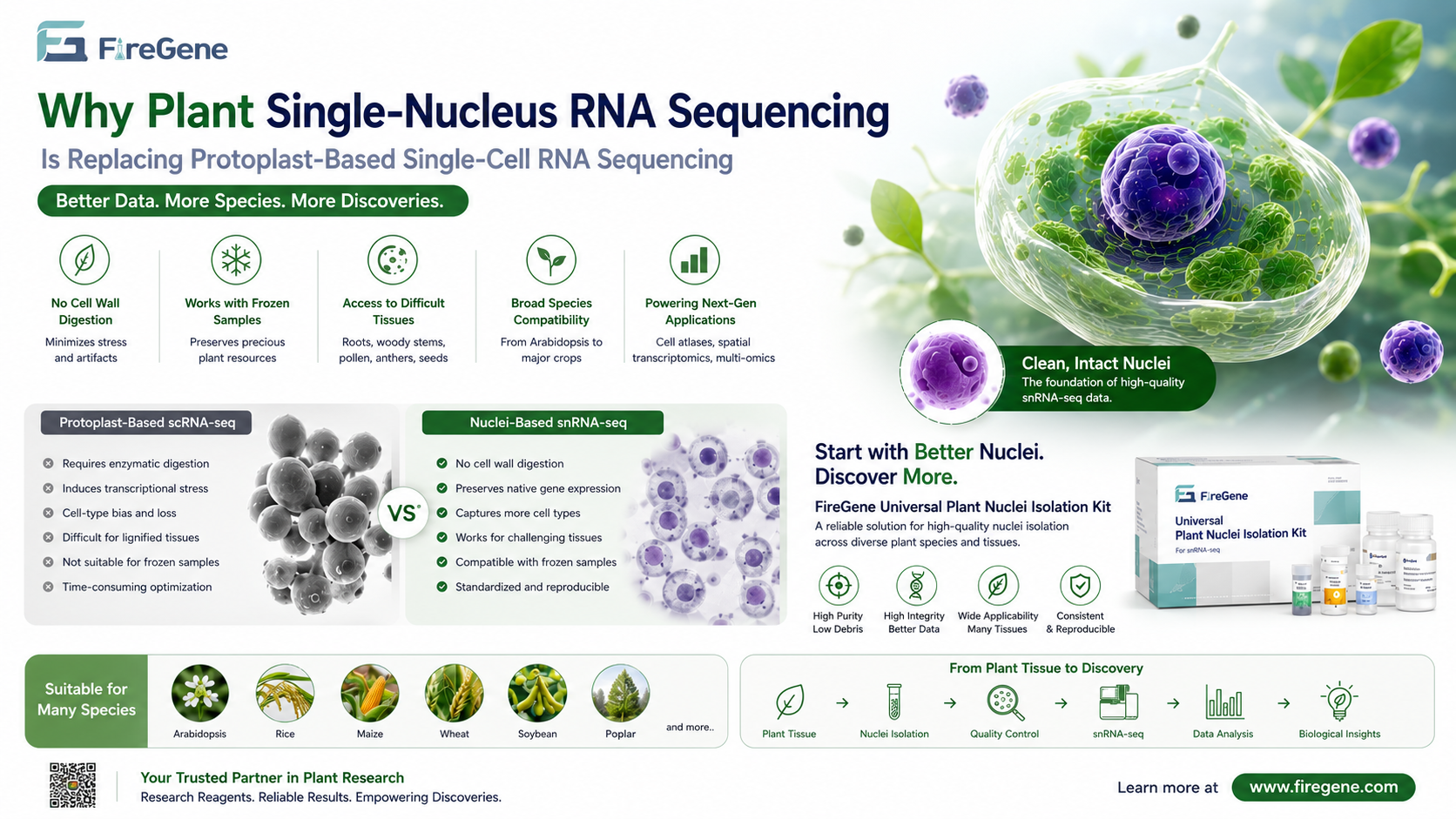
A Practical Guide to Plant Nuclei Isolation for High-Quality Transcriptomics Across Diverse Plant Species
Over the past decade, single-cell RNA sequencing (scRNA-seq) has fundamentally transformed biological research by allowing scientists to investigate gene expression at cellular resolution. While animal single-cell technologies rapidly became routine, plant researchers faced a unique obstacle that continues to distinguish plant biology from mammalian systems—the presence of a rigid cell wall.
Unlike animal tissues, plant cells cannot be directly separated into individual viable cells without first removing the cell wall. Consequently, early plant single-cell studies relied heavily on protoplast isolation, in which enzymatic digestion removes the surrounding cell wall before sequencing.
Although this approach enabled the first generation of plant single-cell atlases, researchers soon recognized significant technical limitations. Enzymatic digestion can induce stress-response pathways, alter native transcriptional profiles, selectively lose fragile cell populations, and prove ineffective for lignified or highly differentiated tissues.
As plant genomics enters the era of large-scale transcriptomic atlases, these limitations have driven a major shift toward single-nucleus RNA sequencing (snRNA-seq).
Rather than isolating intact cells, snRNA-seq profiles RNA directly from isolated nuclei. This strategy bypasses many challenges associated with protoplast preparation while enabling transcriptomic analysis across a much broader range of plant tissues and species.
Today, single-nucleus sequencing is rapidly becoming the preferred workflow for numerous applications, including developmental biology, crop improvement, stress biology, plant immunity, epigenomics, and spatial transcriptomics.
At the center of this transition lies one critical experimental step:
High-quality plant nuclei isolation.
For laboratories pursuing reproducible transcriptomic data, obtaining clean, intact nuclei has become just as important as selecting the sequencing platform itself.
A Major Shift in Plant Transcriptomics
Only a few years ago, most published plant single-cell studies depended almost entirely on protoplast isolation.
Typical workflows involved:
- Cell wall digestion
- Protoplast purification
- Cell counting
- Viability assessment
- Single-cell sequencing
While successful for species such as Arabidopsis thaliana, these protocols often required extensive optimization for every new tissue type.
Researchers working with maize, rice, wheat, soybean, poplar, or woody plants frequently encountered problems including:
- Low protoplast yield
- Poor cell viability
- Uneven enzyme digestion
- Cell-type bias
- Batch-to-batch variability
These challenges limited the broader adoption of plant single-cell technologies.
Recent advances in sequencing chemistry and computational analysis have accelerated the transition toward nuclei-based workflows, which largely eliminate the need for complete cell wall digestion.
As a result, an increasing number of high-impact studies published in Nature, Cell, Plant Cell, and Genome Biology now utilize snRNA-seq rather than traditional protoplast-based scRNA-seq.
Why Researchers Are Moving Away from Protoplast Isolation
The shift toward nuclei sequencing is driven by biology rather than technology.
Although protoplast preparation remains valuable for certain applications, researchers have identified several inherent limitations.
Transcriptional Stress Responses
Generating protoplasts typically requires prolonged enzymatic digestion using cellulase and pectinase.
During this process, plant cells experience substantial physiological stress.
Numerous studies have demonstrated that stress-related pathways may become activated before sequencing, potentially altering native gene expression profiles.
Consequently, some observed transcriptional changes may reflect sample preparation artifacts rather than genuine biological differences.
Cell-Type Bias
Not all plant cells digest equally well.
Young mesophyll cells generally release protoplasts efficiently.
In contrast, highly lignified tissues often remain resistant to enzymatic digestion.
Examples include:
- Mature stems
- Woody tissues
- Roots
- Developing seeds
- Vascular tissues
- Anthers
- Pollen
- Fibrous crop tissues
This selective recovery can distort cell population composition within downstream datasets.
Poor Compatibility with Frozen Samples
Many valuable research samples cannot be processed immediately after collection.
These include:
- Field-grown crops
- Breeding materials
- Biobank specimens
- Rare germplasm collections
- Multi-site collaborative studies
Because viable protoplast isolation generally requires fresh tissue, these valuable resources have historically been difficult to analyze using traditional scRNA-seq workflows.
Single-nucleus sequencing largely overcomes this limitation.
Difficulty Scaling Across Plant Species
Every plant species possesses unique cell wall characteristics.
Researchers often spend weeks—or even months—optimizing enzyme combinations for each new tissue.
By contrast, nuclei isolation workflows are generally more adaptable across diverse plant species, making them particularly attractive for large comparative studies.
Why Plant Single-Nucleus RNA Sequencing Is Becoming the New Standard
Rather than sequencing whole cells, snRNA-seq isolates nuclei while preserving endogenous nuclear RNA.
Although nuclei contain fewer transcripts than intact cells, modern sequencing platforms and computational pipelines have significantly improved sensitivity.
Today, nuclei sequencing offers several major advantages.
Broader Tissue Compatibility
Researchers can profile nuclei from tissues that are traditionally difficult to convert into protoplasts, including:
- Mature leaves
- Roots
- Woody stems
- Seeds
- Embryos
- Floral organs
- Pollen
- Anthers
This expanded compatibility has dramatically increased the range of biological questions that can be addressed using single-cell technologies.
Better Preservation of Native Gene Expression
Because nuclei isolation generally requires less extensive enzymatic digestion, transcriptomic profiles more closely reflect the biological state of the tissue at collection.
Reducing stress-induced transcriptional artifacts has become one of the strongest arguments for adopting snRNA-seq in modern plant research.
Improved Cross-Species Applications
One of the most exciting developments in recent years is the emergence of universal nuclei isolation workflows capable of supporting multiple plant species with minimal protocol modification.
For researchers studying diverse crops or conducting comparative genomics, standardized nuclei isolation greatly improves experimental reproducibility.
For laboratories seeking a standardized workflow, the FireGene Universal Plant Nuclei Isolation Kit provides a streamlined solution designed for high-quality nuclei preparation across a wide range of plant tissues for downstream snRNA-seq applications.
Plant snRNA-seq Workflow
Fresh or Frozen Plant Tissue
            │
            ▼
Mechanical Homogenization
            │
            ▼
Nuclei Release
            │
            ▼
Plant Nuclei Isolation
            │
            ▼
Nuclei Quality Assessment
            │
            ▼
Single-Nucleus RNA Sequencing
            │
            ▼
Cell Type Identification
Transcriptomic Analysis
Plant Atlas Construction
Why High-Quality Nuclei Isolation Matters
Regardless of sequencing platform, every successful snRNA-seq experiment begins with one fundamental requirement:
A clean, intact, and representative nuclei suspension.
Poor nuclei preparation may lead to:
- Broken nuclei
- Organelle contamination
- Chloroplast carryover
- Cellular debris
- RNA degradation
- Reduced nuclei recovery
- Increased background noise
- Lower sequencing sensitivity
In contrast, standardized nuclei isolation improves both sequencing consistency and downstream biological interpretation.
Why Universal Plant Nuclei Isolation Has Become a Research Priority
One of the most significant developments in plant transcriptomics over the past two years has been the transition from species-specific nuclei isolation protocols to universal plant nuclei isolation workflows.
Historically, nearly every published protocol required optimization for each plant species. A protocol developed for Arabidopsis thaliana often performed poorly when applied to rice, maize, wheat, soybean, or woody species because of substantial differences in tissue structure, cell wall composition, and secondary metabolite content.
This lack of standardization created several challenges:
- Lengthy protocol optimization
- Poor reproducibility between laboratories
- Variable nuclei yield
- Inconsistent nuclei integrity
- Increased sequencing costs
- Difficulty comparing datasets across species
As collaborative projects become increasingly common, researchers are placing greater emphasis on standardized sample preparation methods that can be applied across multiple plant species with minimal modification.
Consequently, universal plant nuclei isolation has become one of the fastest-growing areas in plant genomics.
Applications Across Diverse Plant Species
One of the greatest strengths of nuclei-based sequencing is its remarkable flexibility.
Unlike protoplast isolation—which frequently requires tissue-specific enzyme cocktails—nuclei isolation can often be adapted to a wide variety of plant species using a consistent workflow.
Recent studies have successfully applied snRNA-seq to numerous species, including:
Arabidopsis
As the model organism for plant biology, Arabidopsis thaliana remains the benchmark for developing new transcriptomic technologies.
Single-nucleus sequencing has enabled researchers to investigate:
- Root development
- Leaf differentiation
- Meristem organization
- Vascular tissue specification
- Plant hormone signaling
Compared with traditional protoplast workflows, nuclei isolation reduces preparation-induced transcriptional artifacts while preserving native cellular diversity.
Rice (Oryza sativa)
Rice remains one of the world's most important cereal crops and has become a major focus of single-cell research.
Recent studies have applied snRNA-seq to investigate:
- Grain development
- Root architecture
- Reproductive tissues
- Stress responses
- Nutrient transport
- Disease resistance
Particularly for reproductive tissues such as pollen and anthers, nuclei isolation offers significant advantages because complete protoplast generation can be technically difficult and highly variable.
Maize (Zea mays)
Maize possesses highly differentiated tissues that frequently present challenges for enzymatic digestion.
Researchers increasingly employ nuclei sequencing to study:
- Leaf development
- Endosperm differentiation
- Root cell specification
- Ear development
- Stress adaptation
The ability to process mature tissues without extensive enzymatic digestion has substantially expanded experimental possibilities.
Wheat
Compared with Arabidopsis, wheat contains a larger and more complex genome.
Its fibrous tissues also complicate conventional protoplast preparation.
Single-nucleus sequencing enables researchers to investigate developmental programs and environmental responses without relying on aggressive digestion protocols.
Soybean
Soybean research increasingly incorporates snRNA-seq to understand:
- Nitrogen fixation
- Root nodulation
- Seed maturation
- Abiotic stress
- Plant immunity
Improved nuclei isolation workflows support more consistent transcriptomic profiling across diverse developmental stages.
Why Difficult Plant Tissues Benefit Most from Nuclei Isolation
Perhaps the greatest advantage of snRNA-seq is its compatibility with tissues that have historically been difficult—or nearly impossible—to analyze using protoplast-based methods.
Examples include:
Mature Leaves
Older leaves contain thicker cell walls and abundant chloroplasts.
Generating intact protoplasts often requires prolonged enzymatic digestion, increasing the likelihood of stress-induced transcriptional changes.
Nuclei isolation significantly reduces processing time while maintaining transcriptomic integrity.
Roots
Plant roots contain multiple specialized tissues with varying digestion efficiencies.
Selective recovery during protoplast isolation may introduce cell-type bias.
Nuclei sequencing helps recover a broader representation of root cell populations.
Woody Stems
Lignified stems represent one of the most challenging tissues for traditional single-cell analysis.
Because nuclei can be released without complete cell wall digestion, snRNA-seq has opened new opportunities for studying wood formation and vascular development.
Seeds and Embryos
Developing seeds contain fragile tissues surrounded by protective structures.
Nuclei isolation minimizes mechanical disruption while preserving developmental information.
Pollen and Anthers
Interest in reproductive biology has increased dramatically over the past few years, particularly in crop breeding and hybrid seed production.
However, pollen grains and anther tissues are notoriously difficult to process using conventional protoplast workflows.
Single-nucleus sequencing provides an attractive alternative for profiling these specialized tissues while reducing preparation complexity.
For researchers working with challenging reproductive tissues, standardized nuclei isolation can improve workflow consistency before downstream sequencing.
The FireGene Universal Plant Nuclei Isolation Kit is designed to support high-quality nuclei preparation from a broad range of plant tissues, including difficult-to-dissociate samples commonly encountered in plant genomics research.
Frozen Plant Samples Are Expanding Research Possibilities
Another important reason for the growing adoption of snRNA-seq is its compatibility with frozen samples.
Many valuable plant materials cannot be processed immediately after harvesting.
Examples include:
- Field trial collections
- Seasonal sampling campaigns
- International collaborations
- Germplasm repositories
- Rare mutant collections
- Long-term storage samples
Traditional protoplast isolation generally requires fresh tissue with high cellular viability.
In contrast, nuclei isolation can often be successfully performed using frozen materials, greatly expanding experimental flexibility.
This capability is particularly important for large-scale crop research programs where synchronized processing of hundreds of samples is impractical.
Why Sample Quality Determines Sequencing Quality
Modern sequencing platforms generate enormous quantities of data.
However, sequencing instruments cannot compensate for poor sample preparation.
Regardless of sequencing chemistry, high-quality datasets depend on:
- Intact nuclei
- Minimal debris
- Low organelle contamination
- Consistent nuclei concentration
- High RNA integrity
Poor-quality nuclei suspensions frequently lead to:
- Reduced nuclei recovery
- Increased background noise
- Chloroplast RNA contamination
- Lower gene detection
- Reduced sequencing sensitivity
Conversely, standardized nuclei isolation supports cleaner libraries, more reliable clustering, and improved biological interpretation.
For this reason, many sequencing core facilities now recommend optimizing nuclei preparation before investing in expensive downstream sequencing.
Researchers seeking a dependable Plant Nuclei Isolation Kit from an experienced research supplier increasingly prioritize standardized workflows that reduce experimental variability while supporting reproducible transcriptomic studies.
The FireGene Universal Plant Nuclei Isolation Kit has been developed to simplify this critical step and integrate seamlessly into modern plant snRNA-seq workflows.
Plant Cell Atlas Projects Are Accelerating the Adoption of snRNA-seq
One of the defining trends in plant biology is the rapid development of comprehensive Plant Cell Atlases. Similar to the Human Cell Atlas initiative in biomedical research, these projects aim to map every cell type within a plant organ, developmental stage, or even an entire species.
Recent studies have already generated high-resolution cell atlases for Arabidopsis roots, rice panicles, maize ears, and developing embryos, revealing previously unknown cell populations and transcriptional programs. These datasets are transforming our understanding of plant development, stress adaptation, and crop improvement.
As atlas-scale studies expand from thousands to millions of nuclei, reproducibility becomes increasingly important.
Even small differences in sample preparation can introduce batch effects that complicate data integration across experiments or research institutions.
For this reason, standardized nuclei isolation protocols are becoming an essential component of modern plant atlas projects.
Beyond Transcriptomics: Plant Multi-Omics Is Driving New Sample Preparation Standards
Plant genomics is rapidly moving beyond conventional RNA sequencing.
Increasingly, researchers combine transcriptomic data with complementary technologies, including:
- Single-nucleus ATAC-seq
- Multiome sequencing
- Spatial transcriptomics
- Chromatin accessibility profiling
- DNA methylation analysis
- Proteomics
These integrated approaches provide a more comprehensive understanding of plant gene regulation.
However, every downstream technology shares one common requirement:
High-quality nuclei.
Unlike conventional bulk sequencing, multi-omics workflows are particularly sensitive to sample quality.
Broken nuclei, chloroplast contamination, cellular debris, or degraded RNA may negatively influence multiple datasets simultaneously.
Consequently, many laboratories now optimize nuclei isolation before investing in expensive downstream sequencing experiments.
Plant Spatial Transcriptomics Is Creating New Opportunities
Spatial transcriptomics represents another rapidly growing field in plant biology.
Rather than simply measuring gene expression, spatial technologies preserve positional information within intact tissues.
Researchers are now applying spatial transcriptomics to investigate:
- Leaf patterning
- Root zonation
- Floral development
- Seed maturation
- Vascular organization
- Stress-induced tissue remodeling
When combined with single-nucleus sequencing, spatial transcriptomics enables scientists to identify not only which genes are expressed, but also where those genes function within complex plant tissues.
This complementary workflow is expected to become increasingly important in crop science, developmental biology, and precision breeding over the coming years.
Best Practices for High-Quality Plant Nuclei Isolation
Although individual protocols vary depending on species and tissue type, several practical principles consistently improve nuclei quality.
Process Samples Under Cold Conditions
Maintaining low temperatures throughout the isolation procedure helps preserve RNA integrity and minimizes degradation.
Whenever possible, pre-chill buffers, homogenizers, tubes, and centrifuges before beginning the workflow.
Minimize Mechanical Damage
Excessive grinding or vigorous pipetting may rupture nuclei.
Gentle homogenization generally improves nuclei integrity while reducing debris generation.
Remove Large Tissue Fragments
Filtering homogenized samples through an appropriate mesh helps eliminate large debris before downstream purification.
This improves nuclei recovery and reduces background contamination.
Optimize Nuclei Purification
A dedicated nuclei isolation workflow helps remove:
- Cell wall fragments
- Chloroplast contamination
- Cytoplasmic debris
- Broken organelles
- Protein aggregates
Cleaner nuclei suspensions typically result in higher-quality sequencing libraries.
For laboratories seeking a standardized workflow across multiple plant species, the FireGene Universal Plant Nuclei Isolation Kit provides a streamlined solution designed for modern plant transcriptomics research.
Perform Quality Control Before Sequencing
Before loading nuclei onto a sequencing platform, researchers should routinely evaluate:
- Nuclei concentration
- Nuclei integrity
- Aggregate formation
- Debris levels
- Chloroplast contamination
- RNA quality
Early quality assessment helps avoid costly sequencing failures and improves overall experimental reproducibility.
Why Researchers Choose FireGene as Their Plant Research Supplier
As plant single-cell technologies become increasingly standardized, laboratories are looking beyond sequencing platforms and placing greater emphasis on reliable sample preparation reagents.
A trusted plant research supplier should provide products that combine:
- Consistent batch-to-batch performance
- Straightforward workflows
- Broad species compatibility
- High reproducibility
- Compatibility with leading sequencing platforms
The FireGene Universal Plant Nuclei Isolation Kit has been developed specifically for researchers performing plant single-nucleus sequencing across diverse tissue types and experimental applications.
Typical applications include:
- Plant single-nucleus RNA sequencing (snRNA-seq)
- Plant transcriptomics
- Plant cell atlas construction
- Crop genetics
- Plant developmental biology
- Plant stress biology
- Plant immunity research
- Spatial transcriptomics
- Multi-omics studies
For researchers searching online for a dependable Plant Nuclei Isolation Kit Supplier, FireGene provides research-grade reagents designed to support high-quality nuclei preparation while integrating seamlessly into existing laboratory workflows.
Recommended Workflow
Fresh or Frozen Plant Tissue
            │
            ▼
Cold Mechanical Homogenization
            │
            ▼
Release of Intact Nuclei
            │
            ▼
Plant Nuclei Isolation & Purification
            │
            ▼
Nuclei Quality Assessment
            │
            ▼
snRNA-seq / snATAC-seq / Multiome
            │
            ▼
Cell Atlas Construction
Spatial Transcriptomics Integration
Biological Interpretation
Frequently Asked Questions (FAQ)
1. Why is single-nucleus RNA sequencing becoming more popular than protoplast-based single-cell RNA sequencing?
Single-nucleus RNA sequencing (snRNA-seq) eliminates the need for complete cell wall digestion, reducing preparation-induced stress responses while enabling transcriptomic analysis of mature, lignified, frozen, and difficult-to-dissociate plant tissues. It also supports more consistent sample preparation across diverse plant species.
2. Can snRNA-seq be performed on frozen plant samples?
Yes. One of the major advantages of snRNA-seq is its compatibility with frozen tissues. This allows researchers to analyze archived samples, field collections, breeding materials, and collaborative research specimens that cannot be processed immediately after harvesting.
3. Which plant species are suitable for nuclei isolation?
Modern plant nuclei isolation workflows have been successfully applied to numerous species, including:
- Arabidopsis thaliana
- Rice (Oryza sativa)
- Maize (Zea mays)
- Wheat (Triticum aestivum)
- Soybean (Glycine max)
- Poplar
- Sorghum
- Tomato
- Tobacco
- Other monocot and dicot species
Universal nuclei isolation workflows continue to expand compatibility across additional crop species.
4. Which plant tissues are particularly suitable for snRNA-seq?
Plant nuclei isolation is especially advantageous for tissues that are difficult to process using traditional protoplast methods, including:
- Mature leaves
- Roots
- Woody stems
- Developing seeds
- Embryos
- Floral organs
- Pollen
- Anthers
- Meristems
- Vascular tissues
5. Why is nuclei quality so important?
High-quality nuclei are essential for obtaining reliable sequencing results.
Poor nuclei preparation may lead to:
- Low nuclei recovery
- Broken nuclei
- RNA degradation
- Chloroplast contamination
- Cellular debris
- High background noise
- Reduced gene detection
- Lower sequencing sensitivity
Investing time in proper nuclei isolation often saves significant downstream sequencing costs.
6. Can plant nuclei isolation be combined with other omics technologies?
Absolutely.
High-quality nuclei preparations are compatible with numerous downstream applications, including:
- Single-nucleus RNA sequencing (snRNA-seq)
- Single-nucleus ATAC-seq (snATAC-seq)
- Multiome sequencing
- Spatial transcriptomics
- Chromatin accessibility studies
- Epigenomics
- Cell atlas projects
7. How can researchers improve nuclei quality?
Several best practices consistently improve nuclei isolation:
- Keep all reagents and samples cold.
- Minimize mechanical stress during homogenization.
- Remove large tissue debris before purification.
- Use a standardized nuclei isolation protocol.
- Perform nuclei quality assessment before sequencing.
8. Why choose a dedicated Plant Nuclei Isolation Kit?
General laboratory buffers may work for some species, but plant tissues vary considerably in cell wall composition, secondary metabolites, and tissue architecture.
A dedicated Plant Nuclei Isolation Kit helps standardize sample preparation, reduce variability, and improve reproducibility across experiments and species.
Conclusion
Plant transcriptomics is entering a new phase.
Rather than asking whether single-cell technologies can be applied to plants, researchers are now focused on how to generate the highest-quality datasets across increasingly diverse tissues and species.
This shift has accelerated the adoption of single-nucleus RNA sequencing, which offers greater flexibility, improved compatibility with difficult tissues, reduced preparation-induced artifacts, and broader applicability to frozen samples and large-scale comparative studies.
At the same time, advances in spatial transcriptomics, multi-omics integration, and Plant Cell Atlas initiatives are placing even greater demands on sample preparation quality.
Regardless of the sequencing platform or downstream analytical pipeline, one principle remains unchanged:
High-quality sequencing begins with high-quality nuclei isolation.
For researchers studying plant development, crop improvement, stress biology, reproductive biology, or systems genomics, standardized nuclei isolation provides a solid foundation for generating reproducible, biologically meaningful data.
As the demand for robust plant single-cell technologies continues to grow, investing in optimized nuclei preparation is no longer simply a technical refinement—it is becoming a fundamental requirement for modern plant genomics.
Explore the FireGene Universal Plant Nuclei Isolation Kit
Whether you are profiling Arabidopsis roots, rice panicles, maize leaves, wheat seedlings, or challenging reproductive tissues such as pollen and anthers, standardized nuclei preparation can significantly improve downstream sequencing quality and experimental reproducibility.
The FireGene Universal Plant Nuclei Isolation Kit has been developed to simplify nuclei isolation across diverse plant species while supporting high-quality applications including:
- Plant single-nucleus RNA sequencing (snRNA-seq)
- Plant transcriptomics
- Plant Cell Atlas projects
- Spatial transcriptomics
- Single-nucleus ATAC-seq
- Multiome sequencing
- Crop genetics
- Plant developmental biology
Learn more about the FireGene Universal Plant Nuclei Isolation Kit here:
👉 https://firegene.com/products/plant-nuclei-isolation-kit-snrna-seq?_pos=1&_sid=ced7b25b8&_ss=r
As a trusted Plant Research Supplier, FireGene is committed to providing research-grade sample preparation solutions that help scientists obtain cleaner nuclei, improve sequencing consistency, and accelerate discoveries in modern plant biology.
References
- Long Y, et al. Single-cell and single-nucleus transcriptomics in plants: recent advances and future perspectives. Plant Methods.
- Shaw R, Tian X, Xu J. Single-cell transcriptome analysis in plants: opportunities and challenges. Annual Review of Plant Biology.
- Denyer T, et al. Spatiotemporal developmental trajectories in the Arabidopsis root revealed using single-cell RNA sequencing. Nature.
- Zhang T, et al. A single-nucleus transcriptomic atlas of rice development. Nature Plants.
- Satterlee JW, et al. Plant stem cell organization and differentiation revealed by single-cell genomics. The Plant Cell.
- 10x Genomics. Single Cell Gene Expression & Single Nucleus Best Practices Guide.
- Plant Cell Atlas Consortium. Toward a comprehensive Plant Cell Atlas.
- Xu X, et al. Advances in plant spatial transcriptomics and multi-omics technologies. Trends in Plant Science.
- EMBO Journal. Recent advances in plant single-cell and single-nucleus sequencing technologies.
- Genome Biology. Emerging computational methods for plant single-cell and single-nucleus transcriptomics.
FireGene Single-Cell Sample Prep
Looking for validated dissociation kits?
FireGene's tissue dissociation kits are optimized for specific organ types — brain, tumor, liver, GI, reproductive, and more. Validated for 10x Genomics Chromium and BD Rhapsody workflows.


