
Introduction
High-quality single-cell suspensions are essential for modern cellular and molecular biology workflows, particularly in applications such as single-cell RNA sequencing (scRNA-seq), flow cytometry (FACS), spatial transcriptomics, and primary cell culture. However, tissue dissociation inevitably produces a heterogeneous mixture containing viable cells, apoptotic cells, necrotic debris, extracellular matrix fragments, and free nucleic acids.
Among these contaminants, dead and dying cells present one of the most significant technical challenges. They release intracellular RNA and proteins, increase background signal, interfere with antibody binding, and reduce the accuracy of downstream quantification. In microfluidic-based single-cell platforms, excessive debris can also lead to channel clogging and reduced capture efficiency.
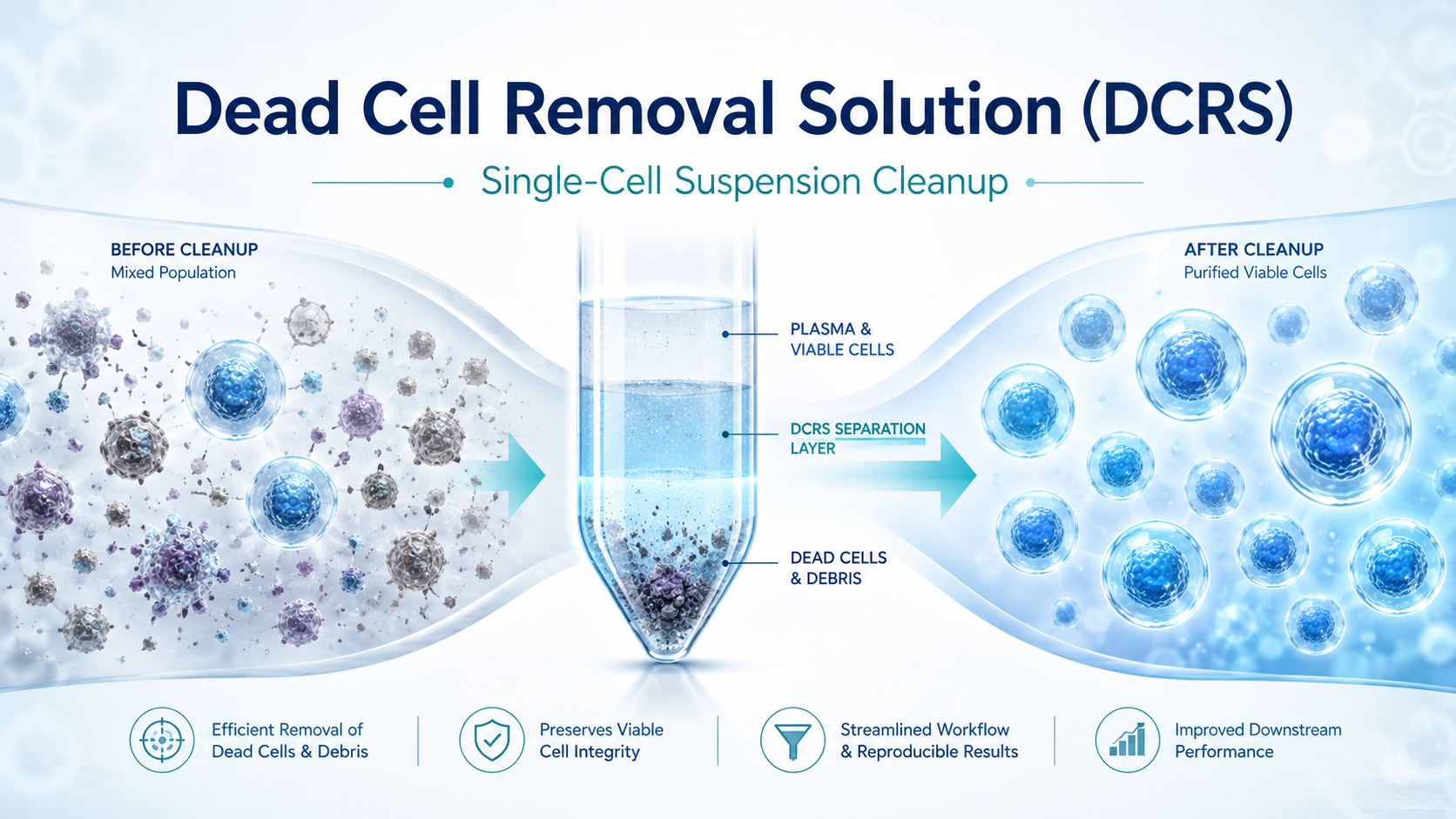
The Dead Cell Removal Solution (DCRS) is a specialized reagent system designed to address these issues by selectively removing non-viable cells and enriching intact, functional cell populations. It provides a rapid, reproducible, and gentle method for improving sample quality without requiring complex instrumentation.
Principle of Operation
The DCRS system is based on physical and physicochemical separation principles, primarily leveraging differences between viable and non-viable cells. While specific formulations vary by manufacturer, most systems rely on one or more of the following mechanisms:
1. Density-Based Separation
Dead cells often exhibit altered density due to membrane rupture, cytoplasmic leakage, or osmotic imbalance. During centrifugation in a density-adjusted medium:
· Viable cells maintain structural integrity and settle into a defined fraction
· Dead cells and debris either pellet abnormally or remain at the interface depending on system design
2. Differential Sedimentation
Viable cells exhibit predictable sedimentation behavior under controlled centrifugal force, while apoptotic or fragmented cells show irregular sedimentation kinetics. This difference enables physical separation without antibody labeling.
3. Selective Aggregation (Optional Systems)
Some formulations incorporate polymers or ionic components that preferentially aggregate dead cells or debris, enhancing their removal during centrifugation.
Importantly, DCRS avoids harsh chemical lysis or antibody-dependent depletion, preserving transcriptional and proteomic integrity of live cells.
Workflow Overview
The Dead Cell Removal Solution is designed for simplicity and compatibility with standard laboratory centrifugation equipment.
Step 1: Sample Preparation
Prepare a high-quality single-cell suspension using enzymatic or mechanical dissociation methods appropriate for the tissue type. To ensure optimal performance:
· Filter through 40–70 µm mesh to remove aggregates
· Maintain cells in cold, calcium- and magnesium-free buffer when possible
· Avoid prolonged storage prior to processing
Step 2: Reagent Mixing
Resuspend the cell pellet in a recommended buffer such as PBS or RPMI supplemented with 2–5% serum. Combine the suspension with DCRS reagent according to optimized ratios provided by the system protocol.
Uniform mixing is critical for reproducible separation performance.
Step 3: Centrifugation-Based Separation
Centrifuge the mixture under defined conditions (commonly 300–800 × g for 5–10 minutes, depending on sample type and system design).
During this step:
· Viable cells are enriched in the target fraction
· Dead cells and debris are segregated into pellet or interface layers
Step 4: Fraction Collection
Carefully collect the viable cell-enriched fraction without disturbing debris-rich layers. Gentle pipetting is recommended to preserve cell integrity.
Step 5: Washing and Recovery
Wash recovered cells using isotonic buffer to remove residual separation medium. A second centrifugation step may be performed for higher purity requirements.
Step 6: Quality Assessment
Evaluate cell viability and purity using:
· Trypan blue exclusion assay
· AO/PI fluorescence staining
· Flow cytometry viability dyes (e.g., 7-AAD, PI, Annexin V-based panels)
Performance Benefits
The use of Dead Cell Removal Solution significantly enhances multiple parameters of single-cell workflow performance:
Increased Viability
Typical improvements in viable cell percentage range from moderate (70–80%) to high purity (>90–95%), depending on starting material quality.
Reduced Background Noise
Removal of lysed cellular components decreases ambient RNA contamination, improving transcriptomic accuracy in scRNA-seq datasets.
Improved Flow Cytometry Resolution
Lower debris levels reduce nonspecific scattering signals, enabling clearer gating and identification of rare populations.
Enhanced Microfluidic Compatibility
Cleaner suspensions reduce clogging risk in droplet-based platforms and improve capture efficiency.
Higher Reproducibility
Standardized cleanup improves consistency across samples, experiments, and operators.
Applications
DCRS is widely applicable across biomedical and translational research workflows:

Single-Cell RNA Sequencing (scRNA-seq)
Improves library quality by reducing ambient RNA contamination and increasing viable cell capture rates.
Flow Cytometry and Cell Sorting
Enhances signal clarity, improves population separation, and supports rare cell detection.
Tumor Microenvironment Studies
Particularly useful for necrosis-rich tumor biopsies where debris levels are high.
Neuroscience and Brain Tissue Processing
Reduces myelin-associated debris and fragmented neuronal material.
Gastrointestinal and Liver Tissue Analysis
Supports purification of epithelial and immune populations from highly enzymatic digestion conditions.
Primary Cell Culture
Improves cell attachment efficiency and proliferation by removing apoptotic contaminants.
Limitations and Considerations
While DCRS improves sample quality, several technical considerations must be acknowledged:
· Partial cell loss is expected, especially for fragile or low-density populations
· Over-processing may bias population distribution
· Does not replace optimized tissue dissociation protocols
· Extremely small debris or apoptotic bodies may not be fully eliminated
· Performance depends heavily on starting sample quality
Therefore, DCRS should be viewed as a downstream optimization tool rather than a corrective substitute for poor upstream preparation.
Storage and Handling
To ensure consistent performance:
· Store according to manufacturer specifications (typically 2–8°C or room temperature depending on formulation)
· Avoid repeated freeze–thaw cycles
· Protect from microbial contamination
· Mix gently before use to ensure homogeneity
· Use within recommended shelf-life after opening
Conclusion
The Dead Cell Removal Solution (DCRS) provides a streamlined and efficient approach for improving single-cell suspension quality by selectively removing non-viable cells and debris. By enhancing viability, reducing background noise, and improving compatibility with downstream analytical platforms, it plays a critical role in modern single-cell workflows.
Its simplicity, reproducibility, and compatibility with standard laboratory equipment make it a valuable addition to any laboratory engaged in high-resolution cellular analysis. Whether applied in scRNA-seq, flow cytometry, or primary cell research, DCRS enables more reliable data generation and improved biological interpretation of complex tissues.
FireGene, light your research with passion, innovation, and profession.


