
Introduction
Brain tissue dissociation is a critical but technically challenging step in neuroscience research. Mechanical and enzymatic digestion of mammalian brain tissue often produces complex suspensions containing viable cells, nuclei, myelin fragments, lipid debris, and apoptotic bodies.
These contaminants significantly interfere with downstream applications such as single-cell RNA sequencing (scRNA-seq), flow cytometry, and cell sorting, reducing data quality and experimental reproducibility.
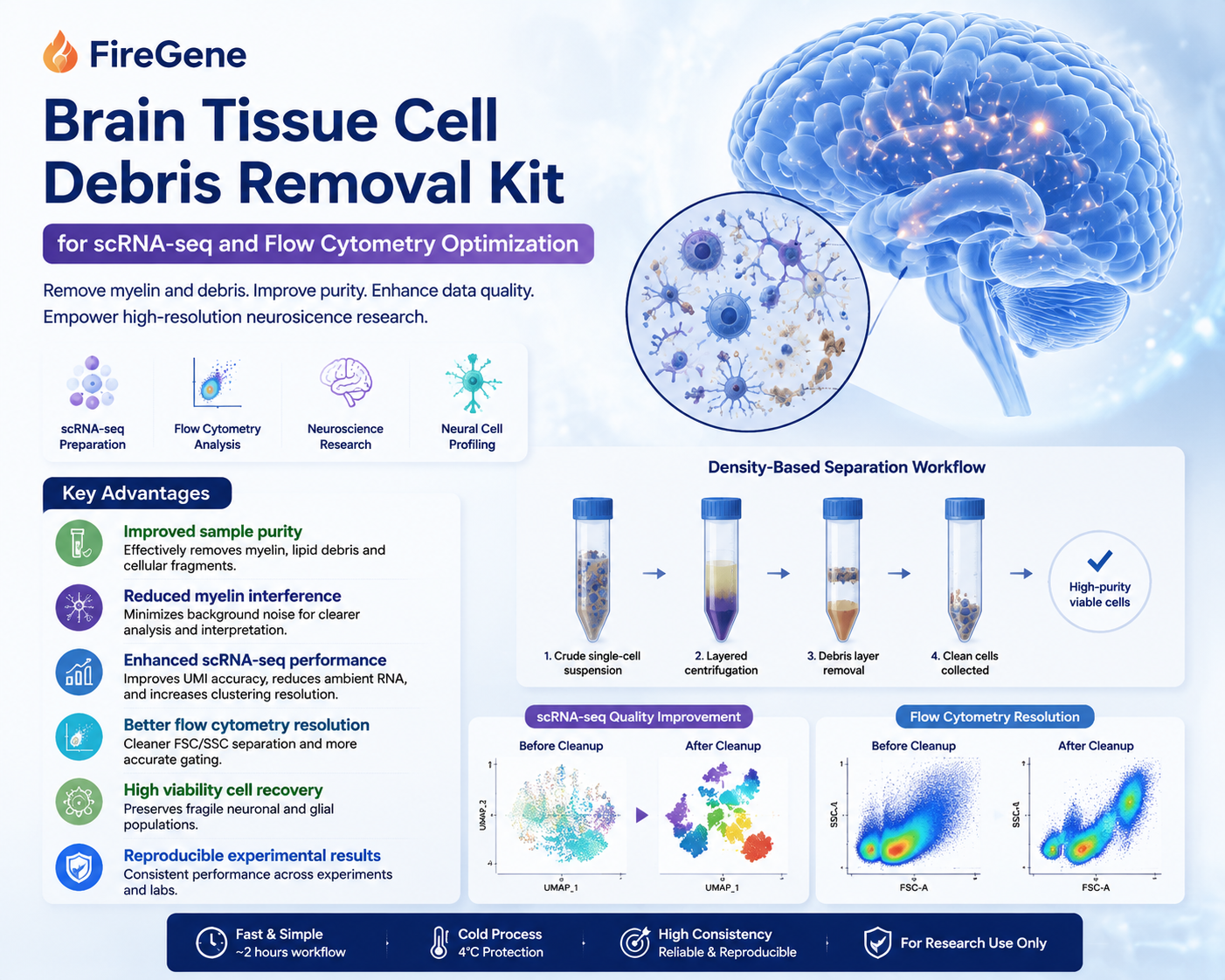
The FireGene Brain Tissue Cell Debris Removal Kit for Single-Cell Cleanup is designed to solve this problem by providing a standardized, density-based separation workflow that efficiently removes debris while preserving viable single cells.
Background Information
Brain tissue is highly enriched in lipid-rich structures, especially myelin. During dissociation, these structures break down into fine debris that is difficult to remove using standard filtration methods.
Common contaminants include:
· Myelin fragments and lipid particles
· Dead and apoptotic cells
· Neuronal process debris (axons and dendrites)
· Extracellular matrix residues
If not properly removed, these impurities can lead to:
· High background noise in scRNA-seq datasets
· Poor resolution in flow cytometry scatter plots
· Increased doublet and multiplet rates
· Reduced cell viability estimates
· Lower reproducibility across experiments
A dedicated debris removal step is therefore essential for high-quality brain single-cell workflows.
Product Overview
The FireGene Brain Tissue Cell Debris Removal Kit provides a practical and reproducible solution for improving the quality of brain-derived single-cell suspensions prior to downstream applications.
Core Workflow Includes:
· Brain Tissue Cell Debris Removal Solution
· Layered density centrifugation
· Debris layer separation and removal
· Cell washing and resuspension
· Optional red blood cell lysis
· Optional 20 μm filtration for clumping control
· Final quality control step
Research Areas
· Neuroscience research
· Brain tissue dissociation workflows
· Neuroinflammation studies
· Neurodegenerative disease research
· Glial and neuronal cell biology
· Single-cell biology
· Flow cytometry assay development
· Translational neurobiology

Key Applications
· Brain tissue cell debris removal
· Single-cell suspension purification
· Flow cytometry analysis and sorting
· Single-cell RNA sequencing preparation
· Cell counting and viability assessment
· Neural cell population profiling
Workflow Summary
1. Brain tissue dissociation
2. Preparation of crude single-cell suspension
3. Layered centrifugation with debris removal solution
4. Density-based separation of viable cells and debris
5. Removal of debris-containing fraction
6. Washing and resuspension
7. Optional RBC lysis or filtration
8. Final QC before downstream analysis
Scientific Principle
The kit uses density-based separation technology, separating components based on buoyant density differences:
· Viable cells → higher density, pellet or mid-layer
· Myelin/lipid debris → low density, upper layer
· Cellular fragments → intermediate fraction
This physical separation avoids harsh chemical treatment, preserving:
· RNA integrity
· Cell viability
· Native transcriptional profiles
Advantages

· Improved sample purity
· Reduced myelin interference
· Enhanced scRNA-seq performance
· Better flow cytometry resolution
· High viability cell recovery
· Reproducible experimental results
Frequently Asked Questions (F&A / FAQ)
Q1: What is the FireGene Brain Tissue Cell Debris Removal Kit used for?
It is used to remove myelin, lipid debris, and cellular fragments from brain-derived single-cell suspensions to improve downstream applications such as scRNA-seq and flow cytometry.
Q2: Why is debris removal necessary for brain tissue samples?
Brain tissue contains high levels of lipid-rich myelin and fragile neuronal structures. During dissociation, these break into debris that interferes with sequencing quality and flow cytometry accuracy.
Q3: When should the kit be used in the workflow?
It should be used after brain tissue dissociation and before downstream applications such as single-cell sequencing or flow cytometry analysis.
Q4: Can this kit improve scRNA-seq data quality?
Yes. It reduces ambient RNA contamination, increases UMI accuracy, improves clustering resolution, and enhances transcriptomic interpretation.
Q5: What is the recommended centrifugation condition?
3000 × g for 20 minutes at 4°C using a horizontal centrifuge.
Q6: Does the kit affect cell viability?
No. The density-based separation is designed to preserve viable cells while removing debris.
Q7: Is filtration always required after processing?
No. A 20 μm filtration step is optional and only recommended when cell clumping or aggregation is observed.
Q8: Can this kit be used for flow cytometry?
Yes. It significantly improves FSC/SSC resolution, reduces debris interference, and enhances gating accuracy.
Q9: What downstream applications are supported?
It supports scRNA-seq, flow cytometry, cell counting, neural cell profiling, and neuroinflammation studies.
Q10: What makes this kit different from standard filtration methods?
Unlike simple filtration, this kit uses density-based separation, which effectively removes myelin and fine lipid debris that typically pass through filters.
Q11: Is this method compatible with fragile neuronal cells?
Yes. The workflow is designed to preserve fragile neuronal and glial populations while removing debris.
Q12: Can this kit be used in neurodegenerative disease research?
Yes. It is widely applicable in Alzheimer’s, Parkinson’s, and other CNS disorder studies requiring high-quality single-cell suspensions.
Conclusion
The FireGene Brain Tissue Cell Debris Removal Kit provides a reliable and standardized approach for improving brain-derived single-cell suspensions. By efficiently removing myelin and debris, it enhances data quality across flow cytometry and single-cell sequencing applications.
As neuroscience research moves toward higher-resolution and multi-omics platforms, high-purity single-cell preparation is a critical prerequisite for accurate and reproducible results.
FireGene, light your research with passion, innovation, and profession.


