
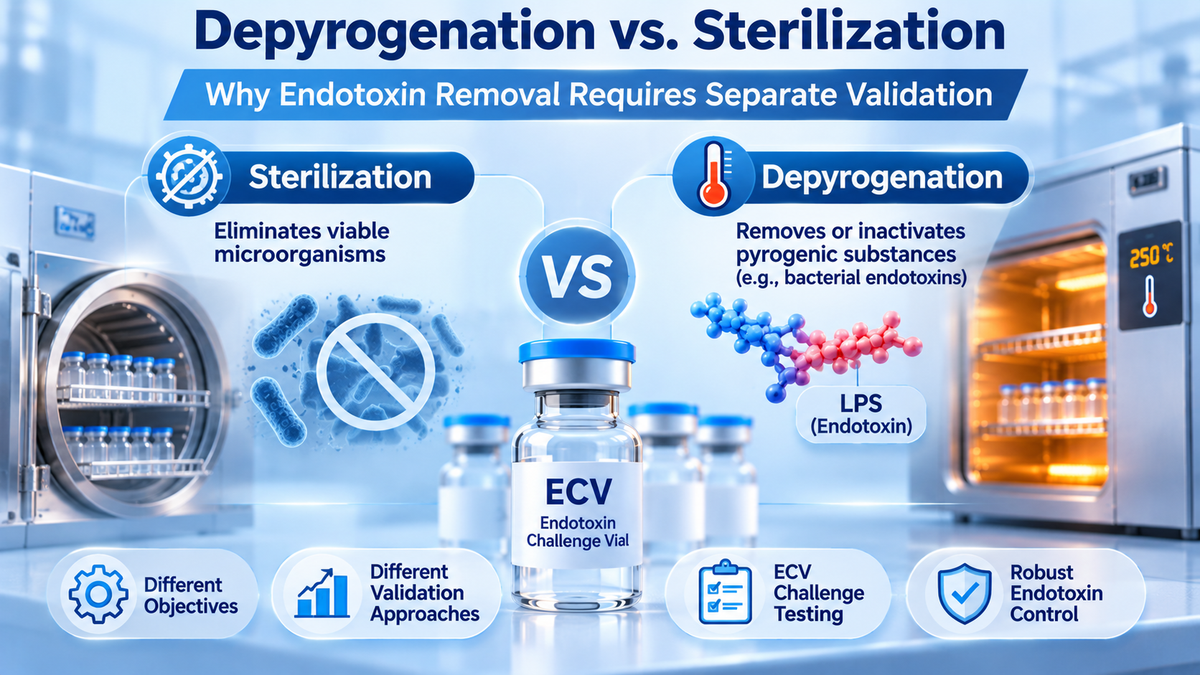
Sterilization and depyrogenation are fundamental processes in pharmaceutical contamination control, but they address different types of hazards. Sterilization is designed to eliminate viable microorganisms, while depyrogenation focuses on removing or inactivating pyrogenic substances, particularly bacterial endotoxins. Because endotoxins can remain biologically active after microbial destruction, successful sterilization does not necessarily demonstrate effective endotoxin reduction. Pharmaceutical manufacturers must therefore establish suitable validation strategies for microbial inactivation and endotoxin control. This article examines the scientific principles underlying sterilization and depyrogenation, compares their applications and validation requirements, and discusses the role of Endotoxin Challenge Vials (ECVs), dry heat treatment, and bacterial endotoxin testing in pharmaceutical quality assurance.
1. Introduction
Microbial contamination and bacterial endotoxin contamination are critical quality concerns in pharmaceutical manufacturing, particularly for injectable medications, sterile formulations, and products intended for direct contact with blood or sensitive tissues.
Although sterilization and depyrogenation are frequently discussed together, they represent distinct contamination control processes.
Sterilization is intended to eliminate viable microorganisms, including bacteria, fungi, and resistant microbial spores. Depyrogenation, by contrast, aims to eliminate or reduce pyrogenic substances capable of triggering fever and inflammatory responses.
Bacterial endotoxins are among the most important pyrogenic contaminants encountered in pharmaceutical production.
These substances originate from the outer membranes of Gram-negative bacteria and consist primarily of lipopolysaccharides (LPS). Unlike viable microorganisms, endotoxins may retain biological activity after bacterial death.
As a result, a pharmaceutical product can meet applicable sterility requirements while still containing unacceptable levels of bacterial endotoxin.
This distinction explains why sterilization alone cannot be regarded as sufficient evidence of endotoxin control.
Understanding the differences between these processes is essential for selecting appropriate manufacturing technologies, designing validation studies, and establishing effective contamination control programs.
2. Understanding Sterilization in Pharmaceutical Manufacturing
Sterilization is a validated physical or chemical process intended to render a product or material free from viable microorganisms.
Its effectiveness depends on the sterilization technology, microbial resistance, processing conditions, and characteristics of the materials being treated.
2.1 Moist Heat Sterilization
Moist heat sterilization uses saturated steam under controlled conditions to inactivate microorganisms.
The process is commonly employed for heat-stable pharmaceutical equipment, selected aqueous products, and manufacturing components.
Its effectiveness depends on factors such as temperature, exposure time, steam quality, and heat penetration.
Moist heat is effective for microbial inactivation when properly validated. However, conventional steam sterilization conditions do not necessarily provide adequate endotoxin reduction.
2.2 Dry Heat Sterilization
Dry heat sterilization uses elevated temperatures to inactivate microorganisms through thermal damage.
The method is suitable for selected heat-resistant materials, including glassware, metal components, and certain pharmaceutical manufacturing accessories.
Dry heat processes may also achieve substantial endotoxin reduction when sufficiently severe conditions are established.
Nevertheless, demonstrating microbial inactivation does not automatically establish that the process achieves the intended level of depyrogenation.
2.3 Sterilizing Filtration
Sterilizing-grade filtration is commonly used for pharmaceutical solutions that cannot tolerate terminal heat sterilization.
Suitable membrane filters retain microorganisms under validated operating conditions.
However, conventional sterilizing-grade filters are not generally designed to remove soluble bacterial endotoxins.
Endotoxin molecules or aggregates may pass through the membrane depending on their physicochemical properties and the filtration system.
Therefore, sterilizing filtration should not be assumed to provide effective endotoxin removal without specific supporting validation evidence.
3. What Is Depyrogenation?
Depyrogenation refers to the destruction, inactivation, or removal of pyrogenic substances from materials or pharmaceutical preparations.
Pyrogens are substances capable of inducing fever or related inflammatory responses.
Bacterial endotoxins are particularly important because they are associated with Gram-negative bacteria and can remain present after microbial inactivation.
3.1 Structure and Properties of Bacterial Endotoxins
Bacterial endotoxins consist primarily of lipopolysaccharides containing three principal structural regions.
Lipid A forms the hydrophobic component associated with much of the biological activity of endotoxin.
Core oligosaccharide connects lipid A to the outer polysaccharide region.
O-antigen contributes to the structural diversity of lipopolysaccharides among bacterial species and strains.
The molecular organization and physicochemical properties of LPS contribute to its persistence under many conventional microbial sterilization conditions.
Consequently, processes intended specifically for endotoxin control must be evaluated according to their ability to reduce measurable endotoxin activity.
3.2 Dry Heat Depyrogenation
Dry heat depyrogenation is widely used for heat-stable pharmaceutical components, particularly glass vials, ampoules, and certain manufacturing materials.
The process exposes materials to elevated temperatures for controlled periods.
Sufficient thermal exposure can induce structural and chemical changes in endotoxin molecules, reducing their measurable biological activity.
The effectiveness of dry heat depyrogenation depends on multiple factors, including processing temperature, exposure time, heat distribution, material properties, and equipment configuration.
Because these variables influence the achieved reduction, each process requires an appropriately justified validation strategy.
3.3 Depyrogenation by Rinsing
Some pharmaceutical components cannot tolerate high-temperature treatment.
For suitable applications, controlled rinsing and cleaning procedures may be used to remove endotoxin contamination from surfaces.
The effectiveness of these procedures depends on the selected cleaning medium, material characteristics, contamination level, and rinsing conditions.
Such methods must demonstrate that the required endotoxin reduction can be achieved consistently.
3.4 Other Endotoxin Reduction Technologies
Additional endotoxin control approaches may involve chromatography, adsorption, membrane-based separation, or other purification techniques.
These technologies are particularly relevant to pharmaceutical ingredients and biological products that are sensitive to elevated temperatures.
Each approach requires validation appropriate to the material, process, and intended endotoxin limits.
4. Major Differences Between Sterilization and Depyrogenation
Sterilization and depyrogenation differ primarily in the contaminants they target and the evidence required to demonstrate process effectiveness.
|
Parameter |
Sterilization |
Depyrogenation |
|
Primary objective |
Eliminate viable microorganisms |
Remove or inactivate pyrogenic contaminants |
|
Main target |
Bacteria, fungi, and microbial spores |
Bacterial endotoxins and other relevant pyrogens |
|
Common methods |
Moist heat, dry heat, filtration, radiation, gaseous sterilization |
High-temperature dry heat, rinsing, selected purification methods |
|
Validation focus |
Microbial inactivation or removal |
Reduction in endotoxin or pyrogenic activity |
|
Typical indicators |
Biological indicators, where appropriate |
Endotoxin indicators, including ECVs |
|
Performance assessment |
Method-specific microbial acceptance criteria |
Endotoxin reduction or established contamination limits |
|
Common applications |
Sterile pharmaceutical manufacturing |
Glass container preparation and endotoxin control |

The distinction is particularly important when the same equipment or thermal technology is capable of performing both functions.
For example, a properly validated high-temperature dry heat cycle may achieve microbial sterilization and endotoxin reduction simultaneously.
However, evidence of microbial inactivation alone does not establish adequate depyrogenation performance.
Each intended process objective must be supported by appropriate validation data.
5. Why Conventional Sterilization Does Not Guarantee Endotoxin Removal
5.1 Endotoxins May Remain After Microbial Inactivation
Sterilization destroys or removes viable microorganisms but does not necessarily eliminate all their structural components.
Lipopolysaccharides released from Gram-negative bacteria can remain present after the bacterial cells have been inactivated.
These residual endotoxins may retain measurable biological activity.
Consequently, a sterile material may still contain endotoxin contamination that exceeds acceptable limits.
5.2 Sterilization Conditions Target Different Performance Requirements
Sterilization cycles are designed to achieve defined levels of microbial inactivation.
The temperatures, exposure durations, or other processing parameters used for this purpose may not be sufficient to achieve the required endotoxin reduction.
For example, conventional steam sterilization processes are not generally considered reliable depyrogenation methods.
Although certain high-temperature dry heat conditions can reduce both microbial contamination and endotoxin activity, the effectiveness of each objective must be established through appropriate testing.
5.3 Biological Indicators Do Not Measure Endotoxin Reduction
Biological indicators are commonly used to evaluate microbial inactivation in sterilization processes.
They generally contain resistant microorganisms or spores selected for a particular sterilization technology.
Their response provides evidence of sterilization performance but does not directly measure endotoxin destruction.
Endotoxin indicators, including Endotoxin Challenge Vials, are designed to evaluate a different performance characteristic: reduction in measurable bacterial endotoxin activity.
Therefore, biological indicators and ECVs are not interchangeable validation tools.
5.4 Endotoxin Contamination Can Originate Before Sterilization
Bacterial endotoxins may enter pharmaceutical manufacturing processes through raw materials, water systems, equipment surfaces, packaging components, and microbial contamination during upstream processing.
Even if subsequent sterilization eliminates viable microorganisms, endotoxin residues may remain.
This emphasizes the importance of preventing endotoxin contamination rather than relying exclusively on downstream processing to eliminate it.
6. Why Endotoxin Removal Requires Separate Validation
The different objectives of sterilization and depyrogenation create a need for validation evidence specific to each process.
6.1 Sterilization Validation
Sterilization validation demonstrates that a process achieves the intended microbial inactivation or removal performance.
Depending on the technology, qualification may involve physical measurements, microbial challenge studies, biological indicators, and other method-specific evaluations.
These studies provide evidence of microbial control but do not necessarily demonstrate endotoxin reduction.
6.2 Depyrogenation Validation
Depyrogenation validation assesses whether a process effectively reduces endotoxin or other relevant pyrogenic contaminants.
For dry heat depyrogenation, validation commonly incorporates temperature mapping, heat penetration studies, representative loading conditions, endotoxin challenge testing, and analytical recovery measurements.
The objective is to establish that the process consistently achieves its predefined acceptance criteria under the intended operating conditions.
6.3 Understanding the 3-Log Endotoxin Reduction Principle
A commonly applied benchmark in dry heat depyrogenation validation is a reduction of at least three logarithmic units in endotoxin activity.
A 3-log reduction represents a 1,000-fold decrease, equivalent to a 99.9% reduction.
The calculation is expressed as:
Log Reduction = log₁₀ (Initial Recoverable Endotoxin / Residual Endotoxin)
Consider the following example:
|
Measurement |
Endotoxin Activity |
|
Untreated control |
10,000 EU/vial |
|
Treated indicator |
10 EU/vial |
|
Calculated reduction |
3.0 log |
|
Percentage reduction |
99.9% |
This example demonstrates a 3-log reduction.
However, acceptance criteria should be established according to the process, relevant regulatory requirements, and intended manufacturing application.
A universal 3-log criterion should not automatically be applied to every endotoxin removal technology.
7. The Role of Endotoxin Challenge Vials in Depyrogenation Validation
Endotoxin Challenge Vials (ECVs) are specially prepared containers containing a characterized bacterial endotoxin challenge.
They are commonly used as endotoxin indicators during qualification of dry heat depyrogenation equipment.
7.1 Principles of ECV Testing
ECV testing involves comparing recoverable endotoxin activity before and after exposure to a defined processing cycle.
The general workflow includes:
Selecting characterized ECVs appropriate for the intended process.
Establishing untreated controls to determine the recoverable initial endotoxin challenge.
Positioning indicators at representative locations within the equipment.
Exposing the indicators to the predefined depyrogenation cycle.
Recovering residual endotoxin from the treated indicators.
Measuring endotoxin activity using an appropriate analytical method.
Calculating logarithmic reduction and evaluating the results against established acceptance criteria.
7.2 Importance of ECVs in Pharmaceutical Validation
ECVs provide direct analytical evidence of endotoxin reduction.
Temperature monitoring alone cannot demonstrate how much endotoxin activity has decreased during processing.
Similarly, biological indicator testing does not directly evaluate endotoxin reduction.
ECVs complement equipment qualification by providing a measurable challenge that reflects the intended depyrogenation objective.
7.3 Applications of ECV-Based Validation
ECVs are commonly relevant to:
Pharmaceutical glass vial depyrogenation
Continuous depyrogenation tunnel qualification
Batch dry heat oven validation
Pharmaceutical container preparation
Process change assessments and requalification studies
Their use supports scientifically justified endotoxin control during pharmaceutical manufacturing.
8. Analytical Methods for Measuring Endotoxin Activity
Reliable endotoxin testing is essential for evaluating the performance of depyrogenation processes.
Limulus Amebocyte Lysate (LAL) methods have traditionally been used to measure bacterial endotoxin activity.
8.1 Gel-Clot LAL Method
The gel-clot method detects endotoxin through an enzymatic clotting reaction.
It is commonly used for qualitative or semiquantitative endotoxin assessment.
For ECV validation, the method must provide sufficient sensitivity to support the intended reduction measurement.
8.2 Chromogenic LAL Method
Chromogenic methods measure the generation of a colored reaction product following endotoxin-dependent enzymatic activation.
The resulting optical signal is related to endotoxin activity through an appropriate calibration curve.
These methods support quantitative measurements within a validated analytical range.
8.3 Turbidimetric LAL Method
Turbidimetric assays monitor changes in optical turbidity associated with the LAL clotting reaction.
Kinetic approaches use the time required to reach a defined reaction threshold to determine endotoxin activity.
8.4 Analytical Method Suitability
Regardless of the method selected, laboratories should evaluate potential inhibition, enhancement, and recovery effects.
Appropriate controls are necessary to confirm that the assay provides reliable measurements for the samples being tested.
In ECV studies, untreated-control recovery is especially important because it provides the baseline used to calculate endotoxin reduction.
9. Common Misconceptions About Sterilization and Depyrogenation
9.1 Sterility Means a Product Is Endotoxin-Free
Sterility and endotoxin contamination are separate quality attributes.
A sterile product may still contain bacterial endotoxin.
Therefore, passing a sterility test does not establish compliance with an applicable bacterial endotoxin limit.
9.2 Autoclaving Eliminates All Endotoxins
Conventional autoclaving is designed to inactivate microorganisms.
It should not be assumed to provide sufficient endotoxin removal or inactivation.
Separate endotoxin control measures may be necessary.
9.3 Sterilizing Filtration Removes Endotoxins
Sterilizing-grade filters are primarily intended to retain microorganisms.
They are not generally designed to remove dissolved endotoxin molecules.
Specialized removal technologies may be required for endotoxin-sensitive materials.
9.4 Biological Indicators Can Replace ECVs
Biological indicators evaluate microbial inactivation, whereas ECVs evaluate endotoxin reduction.
The two indicator types serve different validation purposes.
9.5 Sterilization and Depyrogenation Must Always Be Separate Processes
Although separate validation evidence is necessary, the two objectives can sometimes be achieved during the same processing cycle.
A suitably designed and validated dry heat process may provide both sterilization and depyrogenation.
The validation documentation should demonstrate the required performance for each objective.
10. Best Practices for Pharmaceutical Endotoxin Control
Effective endotoxin management requires an integrated approach that combines prevention, process control, validation, and analytical testing.
Raw material control: Incoming materials should be evaluated according to their contamination risks and intended pharmaceutical applications.
Water system management: Pharmaceutical water systems should be maintained and monitored to reduce microbial proliferation and endotoxin contamination.
Equipment cleaning: Manufacturing equipment should undergo appropriate cleaning procedures designed to control relevant contaminants.
Process qualification: Sterilization and depyrogenation processes should be validated according to their specific performance objectives.
Endotoxin challenge testing: Characterized ECVs can provide supporting evidence of dry heat depyrogenation effectiveness.
Analytical testing: Suitable bacterial endotoxin methods should be used to measure contamination levels and evaluate process performance.
Documentation: Complete records of qualification studies, analytical results, deviations, and corrective actions should be maintained.
These practices support consistent product quality and strengthen contamination control programs in pharmaceutical manufacturing.
11. Conclusion
Depyrogenation and sterilization are both fundamental to pharmaceutical manufacturing, but they address different contamination hazards.
Sterilization focuses on eliminating viable microorganisms, whereas depyrogenation aims to remove or inactivate pyrogenic substances, particularly bacterial endotoxins.
Because bacterial endotoxins may remain biologically active after microbial inactivation, successful sterilization does not necessarily demonstrate adequate endotoxin reduction.
Consequently, manufacturers must establish validation strategies that provide evidence appropriate to each intended process objective.
For dry heat applications, Endotoxin Challenge Vials offer a practical method for evaluating endotoxin reduction through characterized challenge studies and analytical measurements.
When combined with equipment qualification, temperature mapping, appropriate endotoxin recovery procedures, and scientifically justified acceptance criteria, ECV testing supports reliable depyrogenation validation.
Understanding the distinction between sterilization and depyrogenation helps pharmaceutical manufacturers develop more effective contamination control strategies and maintain consistent manufacturing quality.
Frequently Asked Questions (FAQs)
1. What is the main difference between sterilization and depyrogenation?
Sterilization eliminates viable microorganisms, while depyrogenation removes or inactivates pyrogenic substances, including bacterial endotoxins.
2. Does autoclaving remove bacterial endotoxins?
Conventional autoclaving conditions cannot be assumed to provide adequate endotoxin removal or inactivation. Additional endotoxin control measures may be required.
3. Can dry heat achieve both sterilization and depyrogenation?
Yes. A suitably validated high-temperature dry heat process may achieve both objectives when the required microbial and endotoxin reduction performance has been demonstrated.
4. Why are Endotoxin Challenge Vials used in depyrogenation validation?
ECVs contain a characterized endotoxin challenge that allows laboratories to evaluate the reduction in endotoxin activity following a defined depyrogenation process.
5. What does a 3-log endotoxin reduction mean?
A 3-log reduction corresponds to a 1,000-fold decrease in endotoxin activity, equivalent to a 99.9% reduction.
6. Can biological indicators replace ECVs?
No. Biological indicators evaluate microbial inactivation, while ECVs assess endotoxin reduction.
7. Why is endotoxin testing necessary for sterile pharmaceutical products?
Sterility testing does not directly measure bacterial endotoxin contamination. Endotoxin testing provides additional information necessary for evaluating compliance with applicable endotoxin limits.
For research, laboratory testing, and applicable pharmaceutical process-validation use only. Follow the manufacturer's instructions, approved validation protocols, and applicable quality requirements.


