
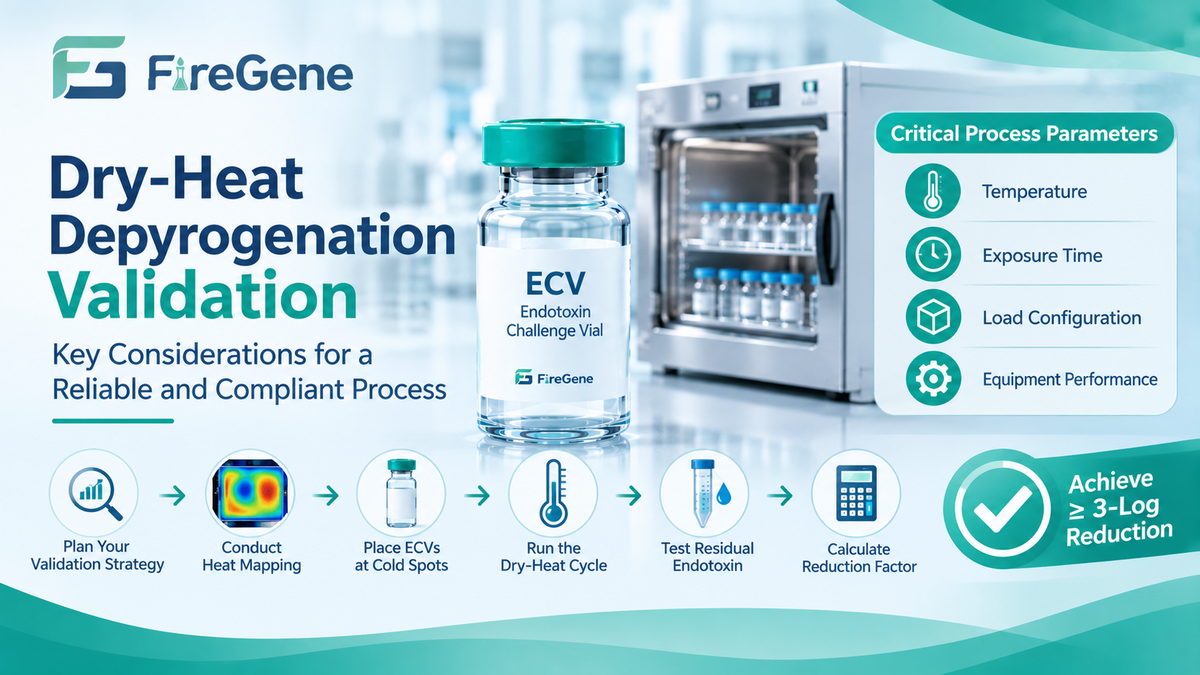
I. Why Cycle Parameters Matter in Depyrogenation
Dry-heat depyrogenation is widely used to reduce bacterial endotoxin activity on heat-stable materials, including glass containers, laboratory equipment, and selected pharmaceutical components.
However, operating a dry-heat oven at a high temperature does not automatically demonstrate that an effective depyrogenation process has been established.
A successful process must be supported by scientific evidence showing that the selected conditions are appropriate for the equipment, material, and actual production load.
According to USP General Chapter <1228.1>, dry-heat depyrogenation depends on thermal input, which is influenced by time and temperature. In practical validation work, load configuration and equipment performance must also be considered.
This is where an Endotoxin Challenge Vial (ECV) can provide valuable evidence of endotoxin reduction under defined process conditions.
II. Identify the Critical Process Parameters
Before establishing a dry-heat cycle, manufacturers should identify the parameters that may influence process performance.
1. Temperature
The selected temperature must be appropriate for the materials being processed and the intended depyrogenation objective.
The temperature displayed by the oven controller does not necessarily represent the temperature experienced by every item in the load.
Differences in airflow, chamber geometry, load density, and material characteristics can create temperature variations.
For this reason, calibrated temperature sensors and heat distribution studies are important parts of process evaluation.
2. Exposure Time
Exposure time determines how long the material experiences the defined thermal conditions.
For batch ovens, the relevant exposure period should be established using actual temperature records and the approved cycle definition.
For continuous depyrogenation tunnels, conveyor speed and the time that containers spend in the heating zone are important considerations.
A cycle should not be evaluated solely by its programmed duration. Actual exposure conditions must be documented.
3. Load Configuration
The load configuration can influence heat transfer and temperature uniformity.
Important considerations include:
-
Number of containers or components
-
Container size and material
-
Arrangement and spacing
-
Load density
-
Maximum and minimum loading conditions
-
Airflow restrictions
A cycle validated using one loading arrangement should not automatically be assumed suitable for a substantially different configuration.
4. Equipment Performance
The oven or tunnel should be qualified and maintained in a controlled state.
Temperature sensors, recording devices, controllers, and other relevant equipment should have appropriate calibration and maintenance records.
Equipment performance should be evaluated under conditions representative of the intended operation.
III. Establish the Validation Strategy Before Selecting the Cycle
A practical validation strategy begins with a clear understanding of the intended application.
Ask the following questions:
-
What materials or containers will be depyrogenated?
-
What is the maximum expected load?
-
What are the relevant equipment operating limits?
-
Which locations may experience the least favorable heating conditions?
-
What endotoxin reduction objective has been established?
-
Which analytical method will be used to measure residual endotoxin?
These questions help define the validation conditions before the cycle is finalized.
The objective is not simply to select a high temperature or long exposure time. It is to establish a reproducible process supported by documented evidence.
IV. Use Heat Distribution and Penetration Studies to Evaluate the Cycle
Heat distribution studies evaluate temperature variation throughout the chamber.
Heat penetration studies evaluate how effectively heat reaches the materials or containers being processed.
Both types of information can be important when evaluating actual production conditions.
For example, a chamber may demonstrate acceptable temperature uniformity when empty, but a loaded configuration may introduce additional thermal variation.
The maximum or otherwise justified worst-case load should therefore be considered when establishing the validation strategy.
Temperature mapping helps identify locations requiring additional investigation or monitoring.
V. Where ECV Fits into Cycle Validation
An Endotoxin Challenge Vial provides a defined endotoxin challenge that can be evaluated before and after a depyrogenation cycle.
The general approach involves:
-
Establishing the initial endotoxin activity of the ECV or an appropriate unheated control.
-
Placing ECVs at justified locations within the validation load.
-
Running the approved dry-heat cycle.
-
Reconstituting the heated ECVs using the specified procedure.
-
Measuring residual endotoxin activity using a suitable validated method.
-
Comparing the initial and residual activity.
The result provides evidence of endotoxin reduction under the tested conditions.
An ECV does not replace temperature mapping. Instead, it complements thermal studies by providing an endotoxin-specific challenge.
Learn more about FireGene Endotoxin Challenge Vials:
https://firegene.com/products/endotoxin-challenge-vial-ecv?variant=48118964650196
VI. Evaluate Whether the Cycle Is Adequately Supported
A successful validation should demonstrate that the selected process conditions are reproducible and appropriate for the intended load.
The evaluation should consider:
-
Actual temperature profiles
-
Exposure time
-
Load configuration
-
ECV initial activity
-
Residual endotoxin results
-
Analytical method suitability
-
Results from relevant challenge locations
-
Deviations and investigation outcomes
A 3-log reduction is a commonly referenced depyrogenation benchmark, representing a 1,000-fold reduction in endotoxin activity. However, the required acceptance criteria must be established according to the applicable process, protocol, and regulatory expectations.
VII. Reassess Cycle Parameters After Significant Changes
A previously validated cycle may require reassessment when important process conditions change.
Examples include:
-
Changes in oven or tunnel equipment
-
Changes in temperature settings
-
Changes in exposure time or conveyor speed
-
Changes in load size or configuration
-
Changes in container materials or dimensions
-
Changes that may affect airflow or heat transfer
A documented change-control assessment should determine whether additional studies or revalidation are necessary.
VIII. Conclusion
Establishing a reliable dry-heat depyrogenation cycle requires more than selecting a temperature and exposure time.
Temperature mapping, load evaluation, equipment qualification, and endotoxin challenge studies each contribute different evidence to the validation process.
By combining thermal data with ECV challenge results, manufacturers can develop a more complete understanding of process performance and its ability to reduce endotoxin activity.
Explore FireGene ECV solutions to support your depyrogenation validation studies.
https://firegene.com/products/endotoxin-challenge-vial-ecv?variant=48118964650196
References
-
USP General Chapter <1228.1>, Dry Heat Depyrogenation: https://doi.org/10.31003/USPNF_M8098_01_01
-
USP General Chapter <1228.5>, Endotoxin Indicators for Depyrogenation: https://doi.org/10.31003/USPNF_M10256_01_01
-
FDA, Pyrogen and Endotoxins Testing: Questions and Answers, March 2026: https://www.fda.gov/regulatory-information/search-fda-guidance-documents/pyrogen-and-endotoxins-testing-questions-and-answers
FireGene Endotoxin Testing
Ready to run your endotoxin assay?
FireGene offers a complete endotoxin testing toolkit — from TAL reagents and CSE standards to pyrogen-free consumables and LAL reagent water. All products are aligned with USP <85>, EP 2.6.14, and JP 4.01.


