
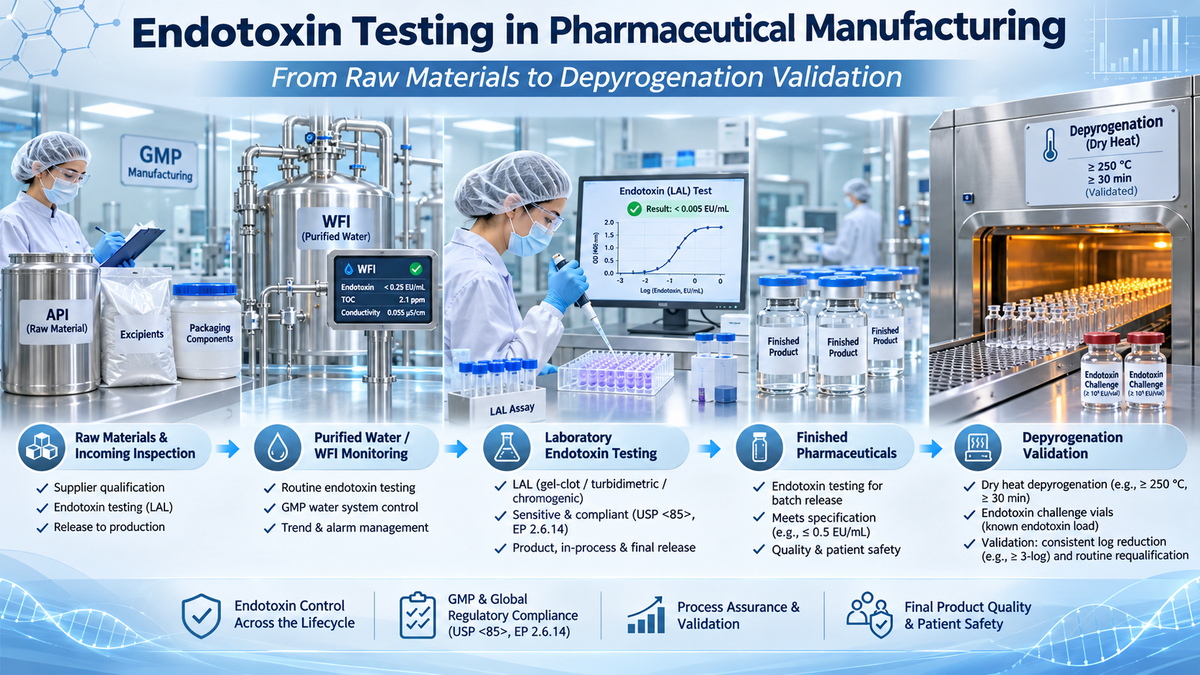
Bacterial endotoxin testing is an important component of pharmaceutical quality assurance, particularly in the manufacture of sterile and parenteral products. Endotoxin contamination can originate from raw materials, water systems, processing equipment, packaging components, and manufacturing environments. Because bacterial endotoxins may persist after microbial inactivation, sterilization alone cannot guarantee adequate endotoxin control. Effective pharmaceutical manufacturing therefore requires an integrated strategy that combines contamination prevention, appropriate analytical testing, process monitoring, and validated depyrogenation procedures. This article examines endotoxin control throughout the pharmaceutical production lifecycle, from incoming raw materials and water quality monitoring to in-process testing, finished product release, and dry heat depyrogenation validation using Endotoxin Challenge Vials (ECVs).
1. Introduction
Bacterial endotoxins are among the most important microbiological contaminants monitored in pharmaceutical manufacturing. These substances are primarily associated with lipopolysaccharides (LPS), which are major structural components of the outer membranes of Gram-negative bacteria.
When introduced into the bloodstream or other sensitive tissues at sufficiently high levels, endotoxins can stimulate inflammatory responses, fever, and potentially severe systemic reactions.
Unlike viable microorganisms, endotoxins can remain detectable and biologically active after many conventional sterilization procedures.
This characteristic creates a particular challenge in the manufacture of injectable drugs, biologics, and other products requiring stringent endotoxin control.
Effective endotoxin management must therefore extend beyond testing the finished pharmaceutical product.
Potential contamination sources must be identified and controlled throughout manufacturing, including incoming raw materials, pharmaceutical water systems, equipment, packaging components, and intermediate production stages.
A comprehensive endotoxin control strategy combines contamination prevention, scientifically justified testing, qualified analytical methods, and validated endotoxin reduction processes.
2. Why Endotoxin Control Matters in Pharmaceutical Manufacturing
Endotoxin contamination can affect pharmaceutical quality even when a product meets applicable sterility requirements.
A sterile product does not necessarily contain an acceptably low level of bacterial endotoxin.
This distinction arises because sterilization and depyrogenation address different contamination risks.
Sterilization is intended to eliminate or inactivate viable microorganisms, while depyrogenation aims to remove or destroy pyrogenic substances.
The principal objectives of pharmaceutical endotoxin control include:
Minimizing endotoxin contamination during manufacturing.
Protecting the quality and safety of parenteral products.
Identifying contamination risks in raw materials and processing systems.
Supporting analytical method suitability and product release testing.
Demonstrating the effectiveness of endotoxin reduction procedures.
Maintaining appropriate GMP documentation and process control.
Endotoxin testing also provides valuable information for investigating manufacturing deviations and monitoring process performance over time.
However, testing alone cannot prevent contamination. Effective control depends on suitable facility design, supplier qualification, water system management, equipment maintenance, and established manufacturing procedures.
3. Endotoxin Testing of Pharmaceutical Raw Materials
Raw materials are potential sources of bacterial endotoxin contamination, particularly when they originate from biological systems or undergo water-based manufacturing processes.
Materials may become contaminated during production, purification, packaging, transportation, or storage.
3.1 Raw Materials with Potential Endotoxin Risks
Examples of materials that may require endotoxin risk assessment include:
Active pharmaceutical ingredients (APIs).
Biological raw materials and fermentation-derived substances.
Recombinant proteins and peptides.
Pharmaceutical excipients.
Cell culture and fermentation media components.
Process buffers and aqueous solutions.
Selected packaging and product-contact materials.
The potential risk depends on the material's origin, manufacturing process, microbial controls, and intended application.
For example, recombinant proteins produced using Gram-negative bacterial expression systems may require particular attention to endotoxin removal and monitoring.
Similarly, naturally derived materials may contain endotoxin contamination associated with their biological source or handling conditions.
3.2 Raw Material Testing Strategies
A risk-based raw material control program may include supplier qualification, review of Certificates of Analysis, incoming material testing, and periodic verification.
Testing frequency and acceptance criteria should reflect the material's intended use and potential contribution to the final product's endotoxin burden.
Not every raw material requires the same testing approach.
Materials used in non-sterile applications may have different requirements from components intended for injectable pharmaceutical manufacturing.
3.3 Establishing Appropriate Endotoxin Limits
Raw material endotoxin limits should be established using a scientifically justified assessment.
Relevant considerations include the maximum quantity of material introduced into the manufacturing process, subsequent purification or removal steps, and the applicable finished product endotoxin specification.
Raw material limits should not simply be copied from unrelated products or assigned without considering the intended process.
For high-risk materials, endotoxin testing may be incorporated into supplier specifications and incoming quality control procedures.
4. Endotoxin Monitoring in Pharmaceutical Water Systems
Water is a critical utility in pharmaceutical manufacturing and a potential source of endotoxin contamination.
Different pharmaceutical water grades are used according to their intended applications.
4.1 Water for Injection (WFI)
Water for Injection is used in pharmaceutical applications requiring particularly stringent microbiological and endotoxin control.
WFI systems must be appropriately designed, qualified, maintained, and monitored.
Endotoxin control is especially important because Gram-negative bacteria associated with water systems can release endotoxins into the aqueous environment.
The commonly recognized pharmacopoeial bacterial endotoxin limit for bulk WFI is not more than 0.25 EU/mL.
This limit is specific to the relevant water specification and should not be applied automatically to every pharmaceutical product, process water grade, or manufacturing intermediate.
4.2 Common Sources of Water System Contamination
Potential causes of endotoxin contamination include:
Microbial growth and biofilm formation.
Inadequate system sanitization.
Poorly designed or stagnant piping sections.
Insufficient circulation.
Contaminated sampling equipment.
Ineffective storage and distribution controls.
Because endotoxins may remain after bacterial cells are destroyed, microbial control and endotoxin monitoring should be considered complementary activities.
4.3 Routine Water System Monitoring
A pharmaceutical water monitoring program commonly includes sampling at representative points of use and other locations identified through system qualification and risk assessment.
Monitoring may involve microbial enumeration, endotoxin testing where applicable, and trending of chemical and physical quality attributes.
Alert and action levels should be established to identify changes in system performance before they compromise product quality.
5. Endotoxin Testing During Pharmaceutical Manufacturing
In-process endotoxin monitoring provides additional opportunities to detect contamination before final product release.
This is particularly important for manufacturing operations involving biological materials, aqueous processing, or extended holding periods.
5.1 Critical Manufacturing Stages
Depending on process risk, endotoxin testing may be performed during:
Raw material solution preparation.
Buffer and formulation preparation.
Fermentation or cell culture processing.
Harvesting and purification.
Intermediate product holding.
Bulk drug substance production.
Final formulation and filling preparation.
Testing locations should be selected based on the manufacturing process and potential contamination pathways.
5.2 Endotoxin Control During Bioprocessing
Biopharmaceutical manufacturing may involve complex processing stages in which endotoxin contamination must be carefully controlled.
Purification processes can sometimes reduce endotoxin levels through mechanisms such as selective adsorption or separation.
However, endotoxin removal effectiveness depends on process chemistry, product characteristics, and operating conditions.
Certain membrane filtration procedures may help reduce endotoxin contamination, but conventional sterilizing-grade filtration should not be assumed to remove dissolved bacterial endotoxins.
Any process claimed to provide endotoxin reduction should be appropriately evaluated and, where necessary, validated.
5.3 In-Process Testing and Contamination Trending
In-process endotoxin testing can support investigation of unexpected contamination and provide information about the consistency of manufacturing operations.
Trend analysis may help identify recurring contamination sources, equipment-related problems, or changes in raw material quality.
The monitoring program should be documented and periodically reviewed as part of the pharmaceutical quality system.
6. Bacterial Endotoxin Testing Methods
Several analytical methods are available for measuring bacterial endotoxin activity.
The appropriate method depends on the sample matrix, required sensitivity, intended application, and applicable regulatory framework.
6.1 Gel-Clot LAL Assay
The gel-clot method is a traditional bacterial endotoxin testing technique based on the clotting reaction of Limulus Amebocyte Lysate.
A positive reaction is indicated by formation of a stable gel under specified assay conditions.
The method is commonly used for limit testing and reagent sensitivity verification.
6.2 Chromogenic LAL Assay
Chromogenic LAL assays measure endotoxin-dependent enzymatic activity through the generation of a colored reaction product.
The resulting optical signal can be used to estimate endotoxin activity relative to a suitable calibration curve.
Chromogenic methods are widely used for quantitative testing in pharmaceutical quality control laboratories.
6.3 Turbidimetric LAL Assay
Turbidimetric methods measure changes in optical turbidity associated with the endotoxin-dependent LAL reaction.
These assays can be performed using endpoint or kinetic measurement approaches.
Quantitative results are determined by comparing sample responses with calibrated endotoxin standards.
6.4 Recombinant Endotoxin Testing Methods
Recombinant Factor C (rFC) and other recombinant reagent-based methods provide alternatives to traditional animal-derived LAL reagents.
These approaches offer opportunities to reduce dependence on horseshoe crab-derived materials while maintaining analytical sensitivity when appropriately qualified.
USP General Chapter 〈86〉 addresses bacterial endotoxin testing using recombinant reagents.
In its updated 2026 guidance, the FDA acknowledged broader use of recombinant reagents and emphasized the need to verify analytical methods for their intended applications.
6.5 Comparison of Endotoxin Testing Methods
|
Method |
Detection principle |
Common application |
|
Gel-clot LAL |
Endotoxin-dependent clot formation |
Limit testing |
|
Chromogenic LAL |
Color-producing enzymatic reaction |
Quantitative endotoxin testing |
|
Turbidimetric LAL |
Change in turbidity |
Quantitative endotoxin testing |
|
Recombinant Factor C |
Recombinant endotoxin recognition and signal generation |
Quantitative endotoxin testing |
|
Other qualified recombinant methods |
Method-specific recombinant reaction systems |
Endotoxin detection and quantification |
Regardless of the selected method, suitability testing and appropriate analytical controls are essential.
7. Control Standard Endotoxin and Analytical Quality Control
Control Standard Endotoxin (CSE) is commonly used to support bacterial endotoxin testing.
CSE is a characterized endotoxin preparation, generally standardized against Reference Standard Endotoxin (RSE).
7.1 Preparation of Endotoxin Standards
CSE can be reconstituted and diluted to prepare known endotoxin concentrations.
These solutions are used for calibration, verification of analytical performance, and selected quality control procedures.
The assigned potency and relevant reagent compatibility information should be obtained from the product documentation.
7.2 Positive Product Control Testing
Pharmaceutical formulations may contain components that interfere with endotoxin detection.
A Positive Product Control (PPC) is prepared by adding a known endotoxin activity to the test sample.
The resulting recovery is evaluated to determine whether the sample causes inhibition or enhancement of the analytical reaction.
This step is particularly important for complex formulations containing proteins, detergents, salts, or other potentially interfering substances.
7.3 Maximum Valid Dilution
The Maximum Valid Dilution (MVD) defines the greatest permitted sample dilution at which the method remains capable of detecting endotoxin at the applicable product limit.
For commonly used formulations of the calculation:
MVD = (Endotoxin Limit × Sample Concentration) / Assay Sensitivity
The precise calculation and units depend on the expression of the endotoxin limit and the sample format.
Dilution may help overcome analytical interference, but it must remain within the calculated MVD and the qualified method conditions.
8. Finished Product Endotoxin Testing
Finished product endotoxin testing is an important component of quality control for relevant pharmaceutical products.
The required endotoxin limit depends on factors such as administration route, maximum dose, patient population, and applicable pharmacopoeial or product-specific requirements.
8.1 Establishing Endotoxin Limits
For many parenteral products, the endotoxin limit is calculated using:
Endotoxin Limit = K / M
Where:
K represents the applicable threshold pyrogenic dose of endotoxin.
M represents the maximum dose administered per kilogram of body weight within the relevant time period.
For many non-intrathecal parenteral applications, a commonly used K value is 5 EU/kg.
Different values or requirements may apply to intrathecal products, particular dosage forms, or specific clinical circumstances.
The resulting limit must be expressed in units appropriate to the product concentration and dosing information.
8.2 Finished Product Testing Considerations
Finished product testing should account for:
Representative sampling.
Appropriate sample preparation.
Method sensitivity.
Potential assay interference.
Product-specific endotoxin specifications.
Valid analytical controls.
Complete documentation and result review.
The FDA emphasizes that endotoxin limits should consider the maximum potential dose within the relevant dosing interval rather than relying on arbitrary product-independent limits.
9. Dry Heat Depyrogenation Validation
Endotoxin testing is also essential for verifying depyrogenation processes used to prepare heat-resistant pharmaceutical components.
Dry heat depyrogenation is commonly employed for glass vials, ampoules, and other thermostable materials.
9.1 Why Depyrogenation Validation Is Necessary
Conventional sterilization methods do not necessarily provide sufficient endotoxin reduction.
Consequently, pharmaceutical manufacturers must demonstrate that applicable depyrogenation processes achieve their intended performance.
Validation typically incorporates equipment qualification, thermal studies, process performance assessment, and endotoxin challenge testing.
9.2 Endotoxin Challenge Vials
Endotoxin Challenge Vials (ECVs) are prepared indicators containing a characterized endotoxin challenge.
They are used to evaluate endotoxin reduction after exposure to a defined depyrogenation process.
During validation, ECVs are placed at predetermined locations within the depyrogenation oven or tunnel.
These positions should be selected based on thermal mapping, loading configuration, and scientifically justified worst-case conditions.
After processing, residual endotoxin is recovered and measured using an appropriate analytical method.
9.3 The 3-Log Endotoxin Reduction Benchmark
A commonly established benchmark for pharmaceutical dry heat depyrogenation validation is a minimum 3-log reduction in endotoxin activity.
A 3-log reduction corresponds to a 1,000-fold decrease, equivalent to a 99.9% reduction.
The calculation is:
Log Reduction = log₁₀ (Initial Recovered Endotoxin / Residual Recovered Endotoxin)
For example, if untreated ECV controls provide a recovered endotoxin activity of 10,000 EU per vial and the treated indicators contain 10 EU per vial, the calculated reduction is:
log₁₀ (10,000 / 10) = 3.0
The process therefore demonstrates a 3-log reduction under the evaluated conditions.
Results must be based on appropriately qualified recovery and analytical measurements.
The nominal endotoxin challenge should not automatically be substituted for experimentally determined baseline recovery.
9.4 Important Validation Parameters
The following parameters may influence dry heat depyrogenation effectiveness:
Temperature distribution.
Heat penetration.
Exposure duration.
Equipment loading configuration.
Container size and geometry.
Conveyor speed in continuous tunnels.
Airflow and pressure conditions.
Endotoxin challenge placement.
Endotoxin recovery efficiency.
A suitable validation program should evaluate the parameters relevant to its equipment and manufacturing process.
10. GMP Requirements and Documentation
Pharmaceutical endotoxin control programs should be supported by appropriate documentation and quality management procedures.
Important elements include:
Supplier qualification and raw material specifications.
Water system qualification and monitoring.
In-process and finished product testing procedures.
Qualified endotoxin analytical methods.
Calibration and reagent traceability.
Depyrogenation validation protocols.
ECV challenge and endotoxin recovery records.
Investigation of deviations and out-of-specification results.
Periodic review and change control.
Regulatory guidance emphasizes scientifically justified sampling plans and testing strategies that consider contamination risks throughout manufacturing.
Acceptance criteria and testing frequencies should be established according to applicable requirements and the intended product or process.
11. FireGene Solutions for Pharmaceutical Endotoxin Control
Reliable testing materials support effective endotoxin monitoring and process validation.
FireGene provides a range of products for laboratory endotoxin testing and related quality control applications.
Endotoxin Challenge Vials (ECVs)
FireGene Endotoxin Challenge Vials are designed to support dry heat depyrogenation studies using characterized endotoxin challenge materials.
Potential applications include depyrogenation oven validation, continuous tunnel qualification, and endotoxin reduction studies.
Control Standard Endotoxin (CSE)
FireGene Control Standard Endotoxin supports preparation of endotoxin standards and analytical controls for compatible bacterial endotoxin testing methods.
Applications include assay calibration, positive product control testing, and selected analytical recovery studies.
Endotoxin Testing Consumables
FireGene also offers laboratory consumables intended for endotoxin-related workflows, including pyrogen-free tubes and vials.
Suitable consumables help reduce the risk of introducing extraneous endotoxin contamination during sample handling, dilution, and analytical testing.
Users should consult the specifications, Certificates of Analysis, and instructions for use applicable to each product.
12. Conclusion
Bacterial endotoxin control is a critical consideration throughout pharmaceutical manufacturing.
Contamination may originate from incoming raw materials, pharmaceutical water systems, processing equipment, intermediate manufacturing operations, or packaging components.
Because bacterial endotoxins can persist after microbial inactivation, successful endotoxin control requires more than conventional sterilization.
An effective strategy integrates risk-based material qualification, appropriate water monitoring, in-process testing, qualified analytical methods, and finished product quality control.
For heat-resistant pharmaceutical components, validated dry heat depyrogenation processes provide an additional means of reducing endotoxin contamination.
Endotoxin Challenge Vials and Control Standard Endotoxin support different but complementary aspects of this strategy.
By combining contamination prevention, reliable endotoxin measurement, and scientifically justified depyrogenation validation, pharmaceutical manufacturers can establish more robust endotoxin control programs and support consistent product quality.
Frequently Asked Questions
Why is endotoxin testing important in pharmaceutical manufacturing?
Endotoxin testing helps detect bacterial endotoxin contamination that may cause adverse pyrogenic reactions. It supports pharmaceutical quality control, product safety, and compliance with applicable specifications.
Which pharmaceutical raw materials require endotoxin testing?
Testing requirements depend on material origin, intended use, contamination risk, and the manufacturing process. Biological raw materials, selected APIs, excipients, and materials used for parenteral products may require particular attention.
Is sterility testing sufficient to confirm that a pharmaceutical product is free from endotoxins?
No. Sterility testing evaluates viable microbial contamination, while bacterial endotoxin testing measures endotoxin activity. A sterile product may still contain unacceptable endotoxin levels.
What is the difference between CSE and ECV?
Control Standard Endotoxin is primarily used for analytical endotoxin testing and assay controls, while Endotoxin Challenge Vials are prepared indicators used to evaluate depyrogenation process effectiveness.
What does 3-log endotoxin reduction mean?
A 3-log reduction indicates a 1,000-fold decrease in measured endotoxin activity, equivalent to a 99.9% reduction. It is an established benchmark for relevant pharmaceutical dry heat depyrogenation validation applications.
Can recombinant reagents replace traditional LAL methods?
Recombinant reagent-based methods may provide suitable alternatives when applicable regulatory requirements are addressed and the method is appropriately verified or validated for its intended use.


