
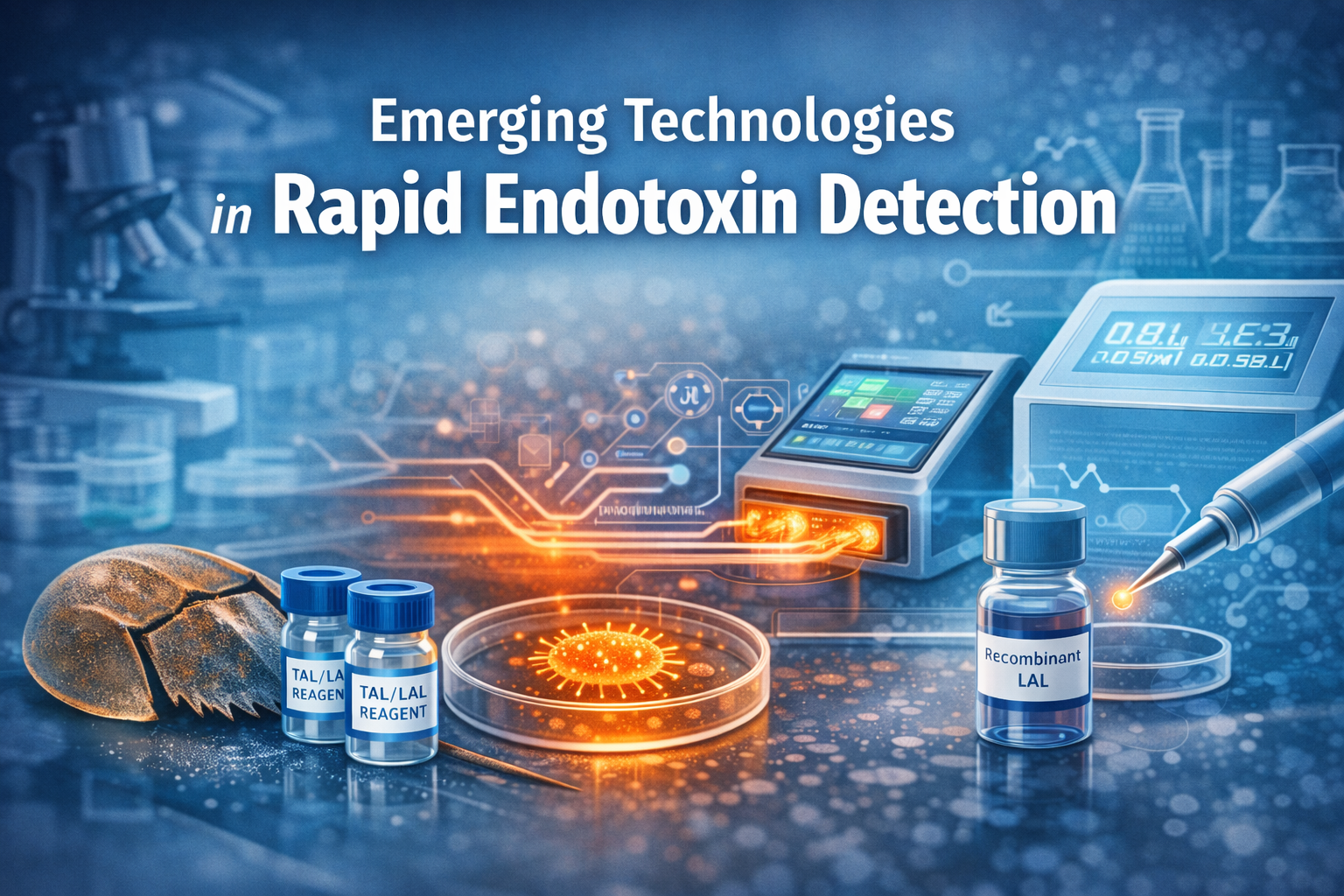
As pharmaceutical and biotechnology products grow more complex, the demand for rapid endotoxin detection has increased significantly. Modern manufacturing environments—especially those supporting biologics, vaccines, and cell & gene therapies—often operate under compressed timelines where traditional testing windows are no longer practical.
While TAL/LAL Reagent–based endotoxin testing remains the regulatory gold standard, a new generation of rapid and alternative technologies has emerged, aiming to reduce turnaround time, improve workflow efficiency, and address sustainability concerns. These technologies are reshaping conversations around bacterial endotoxin testing, but they are not replacing established methods overnight.
This article explores the most important emerging endotoxin detection technologies, evaluates their strengths and limitations, and explains why TAL/LAL testing continues to play a central role in validated, GMP-compliant environments.
I. Why Rapid Endotoxin Detection Is Gaining Momentum
I.i Accelerated Manufacturing Timelines
Advanced therapies often require release testing within hours rather than days. Autologous cell therapies, for example, may have no option for extended incubation or repeat testing.
As a result, manufacturers are seeking rapid endotoxin testing methods that can support:
-
Shortened batch release timelines
-
Real-time or near–real-time decision making
-
Reduced manufacturing bottlenecks
These pressures have driven innovation across the endotoxin testing landscape.
I.ii Increased Regulatory Scrutiny
At the same time, regulatory agencies continue to emphasize patient safety and data integrity. While speed is important, endotoxin detection must still meet strict expectations for accuracy, sensitivity, and validation.
Agencies such as the U.S. Food and Drug Administration continue to recognize TAL/LAL Reagent–based methods as the benchmark for bacterial endotoxin testing, requiring alternative technologies to demonstrate equivalency or suitability.
II. Overview of Emerging Endotoxin Detection Technologies
II.i Recombinant-Based Endotoxin Detection
Recombinant technologies use genetically engineered proteins that replicate the endotoxin-sensitive component of the horseshoe crab coagulation cascade.
Key advantages include:
-
Animal-free production
-
Improved lot-to-lot consistency
-
Alignment with sustainability initiatives
However, recombinant assays still rely on extensive validation and, in many cases, are compared directly against TAL/LAL testing during regulatory submissions.
II.ii Biosensor and Microfluidic Platforms
Recent advances in biosensor technology have enabled endotoxin detection through electrical, optical, or fluorescence-based signals. Microfluidic systems allow testing with extremely small sample volumes.
Potential benefits:
-
Very rapid response times
-
Integration with automated systems
-
Reduced reagent consumption
Despite their promise, many biosensor-based approaches remain limited to research or early-stage development due to challenges in robustness and standardization.
III. Rapid Kinetic Methods Within TAL/LAL Testing
III.i Optimization of Traditional TAL/LAL Reagent Systems
Not all innovation requires abandoning established methods. Significant progress has been made by optimizing TAL/LAL Reagent–based kinetic assays to deliver faster results.
Modern kinetic chromogenic and kinetic turbidimetric methods offer:
-
Shortened incubation times
-
High sensitivity at low endotoxin limits
-
Strong correlation with traditional BET data
These approaches allow laboratories to achieve rapid endotoxin detection while maintaining full regulatory acceptance.
III.ii Automation and High-Throughput Integration
Automated readers and software platforms have transformed how LAL testing is performed. When paired with high-quality TAL/LAL Reagents, automated systems deliver:
-
Improved reproducibility
-
Reduced operator variability
-
Seamless data capture and audit trails
For many GMP laboratories, this represents the most practical path to faster endotoxin testing without introducing regulatory risk.
IV. Comparing Emerging Technologies with TAL/LAL Reagent–Based Testing
IV.i Sensitivity and Specificity
One of the enduring strengths of TAL/LAL Reagent is its extraordinary sensitivity to bacterial endotoxins. Many emerging technologies aim to match this performance, but achieving equivalent specificity across diverse product matrices remains challenging.
TAL/LAL testing continues to serve as the reference method for:
-
Method validation
-
Inhibition and enhancement testing
-
Cross-platform comparability
IV.ii Regulatory Acceptance and Validation Burden
While innovation is encouraged, regulatory agencies require robust validation data before accepting new endotoxin detection methods.
Compared to newer technologies, TAL/LAL testing offers:
-
Decades of regulatory precedent
-
Clear pharmacopeial guidance
-
Lower validation risk for batch release
As a result, many manufacturers adopt emerging technologies cautiously, often using them alongside established TAL/LAL methods rather than as full replacements.
V. Sustainability and the Push for Alternatives
V.i Environmental Considerations
Sustainability has become a major driver of innovation in endotoxin testing. Manufacturers are increasingly evaluating supply chains, environmental impact, and long-term availability of testing reagents.
At the same time, responsible sourcing and controlled production of TAL/LAL Reagents have significantly improved, addressing many historical concerns.
V.ii Complementary, Not Competitive, Approaches
Rather than framing the conversation as “new versus old,” many laboratories now view emerging technologies as complementary tools.
In practice:
-
TAL/LAL testing remains the primary release method
-
Alternative technologies support process development or risk assessment
-
Comparative data strengthens overall quality strategies
VI. FireGene’s Perspective on Rapid Endotoxin Detection
At FireGene, we closely monitor emerging technologies in endotoxin detection while continuing to invest in the reliability of TAL/LAL Reagent–based solutions.
FireGene’s approach focuses on:
-
Supporting rapid kinetic LAL testing workflows
-
Ensuring consistent reagent performance across lots
-
Enabling automation and high-throughput testing
-
Assisting customers with method optimization and validation
By combining proven endotoxin testing methods with modern laboratory needs, FireGene helps customers achieve both speed and compliance.
VII. Future Outlook: Innovation Anchored in Trust
The future of endotoxin testing will undoubtedly include new technologies, faster workflows, and more sustainable practices. However, the industry’s reliance on TAL/LAL Reagents is unlikely to diminish in the near term.
Instead, innovation will continue to build on this trusted foundation—enhancing speed and efficiency without compromising patient safety or regulatory confidence.
Conclusion
Emerging technologies are transforming the landscape of rapid endotoxin detection, offering exciting possibilities for faster and more flexible testing. Yet, despite these advancements, TAL/LAL Reagent–based endotoxin testing remains the cornerstone of validated, GMP-compliant quality control.
By understanding the strengths and limitations of new approaches—and integrating them thoughtfully alongside proven LAL testing methods—manufacturers can confidently navigate the evolving demands of modern biopharmaceutical production.


