
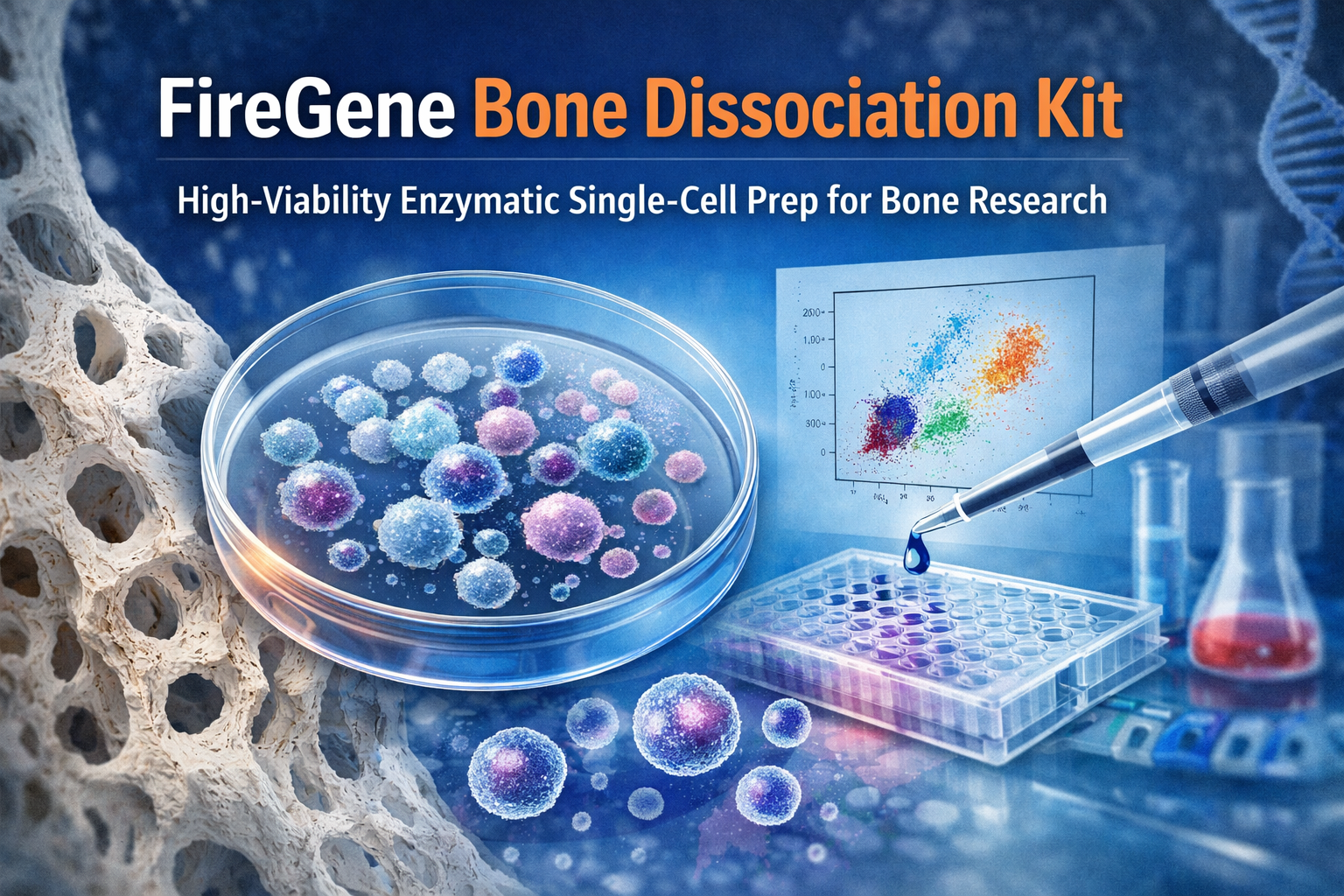
Abstract:Isolating high-quality single cells from bone tissue remains a major technical challenge due to its dense, mineralized extracellular matrix and cellular complexity. Reliable single-cell suspensions are essential for advanced downstream applications such as single-cell RNA sequencing (scRNA-seq), flow cytometry, and stem cell research. The FireGene Bone Dissociation Kit – Enzymatic Single-Cell Prep provides a specialized solution designed to efficiently and gently dissociate bone tissue using an optimized dual-enzyme system. This approach enables effective matrix breakdown while preserving cell viability and heterogeneity. The streamlined workflow ensures reproducible results and compatibility with a wide range of single-cell analyses. By maximizing viable cell yield and maintaining cellular diversity, this kit supports accurate profiling and accelerates research in bone biology, regenerative medicine, and disease modeling.
Keywords:Bone Dissociation Kit;Enzymatic Single-Cell Prep;Single-Cell RNA Sequencing;Bone Tissue Dissociation;High Viability Cell Isolation
Introduction: Revolutionizing Bone Tissue Research
Bone tissue is one of the most complex and challenging biological materials to study at the cellular level. Its dense extracellular matrix, combined with a mixture of bone marrow, stromal cells, and mineralized structures, makes isolating individual cells for analysis notoriously difficult. Yet, single-cell analysis has become a cornerstone of modern biomedical research, providing unprecedented insights into cell heterogeneity, developmental pathways, and disease mechanisms. Techniques such as single-cell RNA sequencing (scRNA-seq) and flow cytometry require high-quality, viable single-cell suspensions, but traditional mechanical or chemical dissociation methods often fall short, compromising cell viability and data quality.
The FireGene Bone Dissociation Kit – Enzymatic Single-Cell Prep addresses these challenges head-on. Designed specifically for bone tissue, this enzymatic kit enables researchers to efficiently break down the dense matrix while preserving the viability and diversity of the extracted cells. Unlike conventional approaches, which may damage delicate cell types or yield incomplete dissociation, the FireGene kit uses a carefully optimized dual-enzyme system. This ensures that a wide range of bone-derived cells—such as hematopoietic stem cells, stromal cells, and progenitor populations—can be recovered intact and ready for downstream analysis.
For researchers in bone biology, regenerative medicine, and disease modeling, the ability to obtain high-quality single-cell suspensions from bone tissue is transformative. It opens doors to more accurate profiling of cell populations, better understanding of bone-related diseases like osteoporosis and tumors, and more reliable results in experiments requiring live cells. By combining ease of use, reproducibility, and optimized enzymatic digestion, the FireGene Bone Dissociation Kit represents a significant step forward, helping scientists unlock the hidden cellular complexity of bone tissue and accelerate discoveries in both basic and translational research.
Key Features and Benefits of the FireGene Bone Dissociation Kit
The FireGene Bone Dissociation Kit – Enzymatic Single-Cell Prep stands out as a game-changer in the world of bone tissue research. With its highly optimized, enzymatic dissociation system, this kit is designed to overcome the inherent challenges of isolating single cells from dense bone matrix. Let’s explore the key features and the benefits that make this kit a must-have for researchers working with bone-derived cells.

1. Enzymatic Digestion System
One of the most significant advantages of the FireGene kit is its dual-enzyme approach. Unlike mechanical or chemical dissociation methods, which can result in poor cell viability or incomplete dissociation, the enzymatic system effectively breaks down the bone’s extracellular matrix. This enables researchers to extract high-quality, viable cells without compromising their integrity.
2. High Viability and Preservation of Cell Heterogeneity
The FireGene Bone Dissociation Kit is specifically designed to maximize cell viability, ensuring that a broad range of cell types, from hematopoietic stem cells to stromal and progenitor cells, are preserved in their native states. This is critical for downstream analyses such as single-cell RNA sequencing (scRNA-seq) and flow cytometry, where cell viability and heterogeneity are paramount to obtaining reliable results.
3. Versatility for Single-Cell Applications
Whether you’re conducting single-cell RNA sequencing, flow cytometry, or primary cell culture, this kit is ideal for a variety of applications. Its ability to generate high-quality cell suspensions allows for more accurate profiling and in-depth cellular analyses, enabling better insights into bone biology, disease modeling, and regenerative medicine.
How It Works: Step-by-Step Overview
The FireGene Bone Dissociation Kit – Enzymatic Single-Cell Prep offers a simple yet highly effective workflow for isolating high-quality single cells from bone tissue. By using a dual-enzyme system, this kit ensures optimal dissociation, high cell viability, and preserved cell heterogeneity. Here’s a step-by-step overview of how the process works:
1. Tissue Preparation: Cutting the Bone Fragments
The first step in the process involves cutting the bone tissue into small fragments, typically around 1-2 mm in size. This is essential to increase the surface area and allow the enzymes to efficiently target and break down the dense extracellular matrix. Proper tissue preparation is key to achieving maximum cell yield.
2. Enzymatic Digestion: Breaking Down the Bone Matrix
Once the tissue is prepared, the FireGene kit introduces two distinct enzyme solutions in sequence. The first enzyme solution works to break down the bone matrix, and the second enzyme targets cell-to-cell junctions, releasing the individual cells into suspension. The carefully optimized formula ensures that the cells are gently dissociated, preserving their viability and biological functions.
3. Filtering and Cell Counting: Ensuring Quality Control
After enzymatic digestion, the cell suspension is passed through a cell strainer to remove any remaining tissue debris, resulting in a clean single-cell suspension. The cells are then counted and checked for viability, ensuring that a high-quality preparation is ready for downstream applications such as single-cell RNA sequencing, flow cytometry, or cell culture.
4. Ready for Analysis
The resulting single-cell suspension can now be used for a variety of applications, allowing researchers to gain deeper insights into bone biology, disease progression, or stem cell behavior.
With its user-friendly workflow and high reproducibility, the FireGene Bone Dissociation Kit simplifies bone tissue dissociation and accelerates research outcomes.
Applications in Research: Unlocking the Potential of Bone Tissue Studies
The FireGene Bone Dissociation Kit – Enzymatic Single-Cell Prep is not just a tool for cell isolation—it’s a gateway to advanced research in bone biology and related fields. By providing high-quality, viable single-cell suspensions, this kit enables scientists to explore cellular heterogeneity and gain insights that were previously difficult or impossible to achieve.

1. Bone Biology and Regenerative Medicine
Understanding the cellular composition of bone tissue is essential for studying bone formation, remodeling, and repair. Researchers can use the kit to isolate osteoblasts, osteoclasts, stromal cells, and progenitor populations, which can then be analyzed individually. This facilitates the study of bone regeneration, tissue engineering, and therapeutic interventions in conditions like fractures or bone defects.
2. Disease Modeling
Bone-related diseases, such as osteoporosis, osteoarthritis, and bone cancers, often involve complex cellular changes. The FireGene kit allows researchers to profile individual cells from affected tissues, providing insights into disease mechanisms and potential therapeutic targets. Single-cell analysis helps identify rare cell populations, track disease progression, and evaluate treatment responses at a cellular level.
3. Stem Cell Research
Bone marrow contains a rich source of hematopoietic and mesenchymal stem cells. Using the FireGene Bone Dissociation Kit, scientists can extract these stem cells in a viable state, suitable for cell culture, differentiation studies, and single-cell sequencing. This accelerates research in stem cell therapies, personalized medicine, and regenerative treatments.
4. Single-Cell Omics and Flow Cytometry
The high-quality cell suspensions produced by this kit are ideal for scRNA-seq, flow cytometry, and other single-cell analyses. Researchers can achieve more accurate gene expression profiling, phenotyping, and functional studies, ultimately leading to deeper insights into bone tissue biology.
Why Choose FireGene: Advantages Over Alternatives
When it comes to isolating single cells from bone tissue, not all dissociation methods are created equal. Traditional mechanical methods, such as grinding or mincing, often damage delicate cells and result in low yields. Chemical dissociation techniques can compromise cell viability or fail to preserve the full diversity of cell types. This is where the FireGene Bone Dissociation Kit – Enzymatic Single-Cell Prep sets itself apart.
1. Optimized Enzymatic Approach
The dual-enzyme system in the FireGene kit is carefully formulated to efficiently break down bone matrix while gently releasing cells. Unlike mechanical disruption, it minimizes cell stress and preserves cell morphology, ensuring that sensitive populations, such as hematopoietic stem cells and stromal cells, remain intact and functional.
2. High Viability and Cell Diversity
One of the most critical advantages of the FireGene kit is its ability to maintain high cell viability and retain the heterogeneity of the bone microenvironment. This is especially important for applications like single-cell RNA sequencing and flow cytometry, where damaged or stressed cells can skew results. By preserving diverse cell populations, researchers can obtain more accurate and reproducible data.
3. Versatility Across Applications
The kit is suitable for a wide range of downstream applications, including cell culture, single-cell omics, and phenotyping studies. Its compatibility with various research workflows makes it a one-stop solution for labs focusing on bone biology, regenerative medicine, and disease modeling.
4. Ease of Use and Reproducibility
FireGene provides a ready-to-use, reproducible workflow that saves time and reduces variability between experiments. This ensures consistent results across studies and labs, which is a significant advantage over labor-intensive or inconsistent traditional methods.
In conclusion, the FireGene Bone Dissociation Kit offers unmatched efficiency, reliability, and versatility. By combining gentle enzymatic dissociation with high-quality cell recovery, it empowers researchers to achieve superior results and unlock new insights into bone biology and disease.


