
Introduction
Reliable bacterial endotoxin testing depends on more than selecting an appropriate analytical method or using high-quality TAL/LAL reagents. Before routine testing results can be trusted, laboratories must first demonstrate that the analytical procedure accurately detects endotoxins within the specific pharmaceutical product being tested.
This verification process is commonly known as an endotoxin recovery study. Although frequently performed during method validation and method suitability testing, recovery experiments are often misunderstood. Many analysts view recovery studies simply as a regulatory requirement or a routine laboratory exercise. In reality, they are one of the most important safeguards against inaccurate endotoxin results.
A properly designed recovery study confirms that a product matrix does not suppress or artificially enhance the TAL/LAL reaction. It demonstrates that a known quantity of endotoxin added to the sample can be consistently detected under the selected analytical conditions. Without this evidence, laboratories cannot confidently determine whether low endotoxin results reflect true product quality or analytical interference.
Recovery studies have become increasingly important as pharmaceutical formulations grow more complex. Modern biologics, monoclonal antibodies, vaccines, lipid nanoparticle (LNP) formulations, cell and gene therapies, and highly concentrated protein products all contain components capable of influencing endotoxin detection. Matrix effects such as inhibition, enhancement, or endotoxin masking may significantly affect assay performance if not identified during method development.
Regulatory authorities—including those following USP <85>, EP 2.6.14, and JP 4.01—expect manufacturers to demonstrate that their endotoxin test methods are suitable for the products being analyzed. Recovery studies provide the scientific evidence supporting that expectation.
In this guide, we explain the principles behind endotoxin recovery studies, discuss how recovery experiments are designed and interpreted, examine common causes of recovery failures, and outline practical strategies for generating reliable, reproducible, and regulatory-compliant endotoxin testing data.
What Is an Endotoxin Recovery Study?
An endotoxin recovery study is an analytical experiment performed to demonstrate that a pharmaceutical product does not interfere with the detection of bacterial endotoxins.
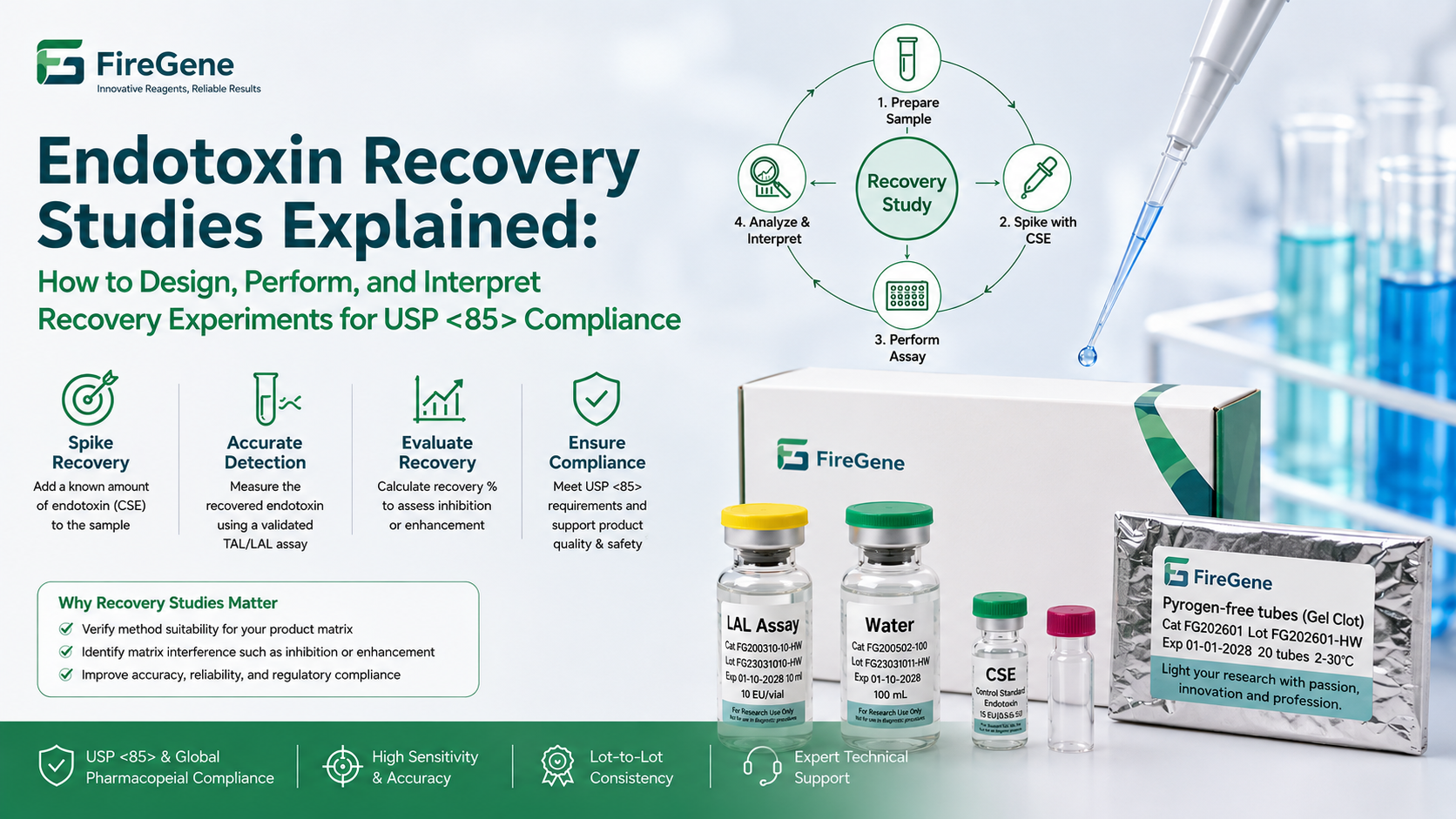
Rather than measuring the naturally occurring endotoxin concentration in a product, the laboratory intentionally adds a known amount of Control Standard Endotoxin (CSE) to the sample. The assay then measures how much of that endotoxin can be recovered.
If the analytical method accurately detects the added endotoxin, the recovery result demonstrates that the product matrix is compatible with the assay.
Conversely, poor recovery suggests that components within the formulation may be interfering with endotoxin detection.
Recovery studies therefore answer one fundamental question:
Can this analytical method accurately measure endotoxin in this specific pharmaceutical product?
This seemingly simple question forms the foundation of reliable bacterial endotoxin testing.
Why Recovery Studies Are Required Under USP <85>
USP <85> recognizes that no single analytical method performs identically across every pharmaceutical formulation.
Injectable drugs may contain proteins, lipids, surfactants, preservatives, salts, buffers, polymers, stabilizers, sugars, or other excipients capable of affecting the TAL/LAL reaction.
Without demonstrating acceptable recovery, laboratories cannot know whether the reported endotoxin concentration truly reflects the sample or whether the formulation has altered assay performance.
Recovery studies therefore support several important objectives:
- Demonstrate analytical accuracy.
- Verify method suitability.
- Detect inhibition or enhancement.
- Support method validation.
- Provide confidence in routine batch release testing.
- Meet global regulatory expectations.
Rather than being viewed as a regulatory formality, recovery studies should be considered an essential component of pharmaceutical quality risk management.
Understanding Spike Recovery
The core principle of every recovery study is spike recovery.
A known concentration of Control Standard Endotoxin (CSE) is intentionally added—or "spiked"—into the product sample before analysis.
The laboratory then compares the measured endotoxin concentration with the amount originally added.
If the measured value closely matches the known spike concentration within the pharmacopeial acceptance criteria, the analytical method is considered capable of accurately detecting endotoxin in that product matrix.
Spike recovery experiments are valuable because they evaluate the analytical system under conditions that closely resemble routine product testing. Instead of assessing reagent performance alone, they measure how the assay behaves in the presence of the actual pharmaceutical formulation.
For this reason, spike recovery is widely regarded as one of the most effective tools for identifying analytical interference before routine testing begins.
Recovery Studies vs. Positive Product Controls (PPC)
One common source of confusion is the relationship between recovery studies and Positive Product Controls (PPCs).
Although both involve adding a known quantity of endotoxin to a product sample, they serve slightly different purposes.
Recovery studies are generally performed during method development, validation, or significant process changes to demonstrate that the analytical procedure is suitable for the product.
Positive Product Controls, on the other hand, are incorporated into routine endotoxin testing to verify that each individual assay continues to perform correctly in the presence of the product matrix.
In other words:
- Recovery studies establish method suitability.
- PPCs verify ongoing assay performance.
Both are essential components of a comprehensive bacterial endotoxin testing program and together provide confidence that reported results accurately reflect product quality.
FireGene Endotoxin Testing
Ready to run your endotoxin assay?
FireGene offers a complete endotoxin testing toolkit — from TAL reagents and CSE standards to pyrogen-free consumables and LAL reagent water. All products are aligned with USP <85>, EP 2.6.14, and JP 4.01.


