
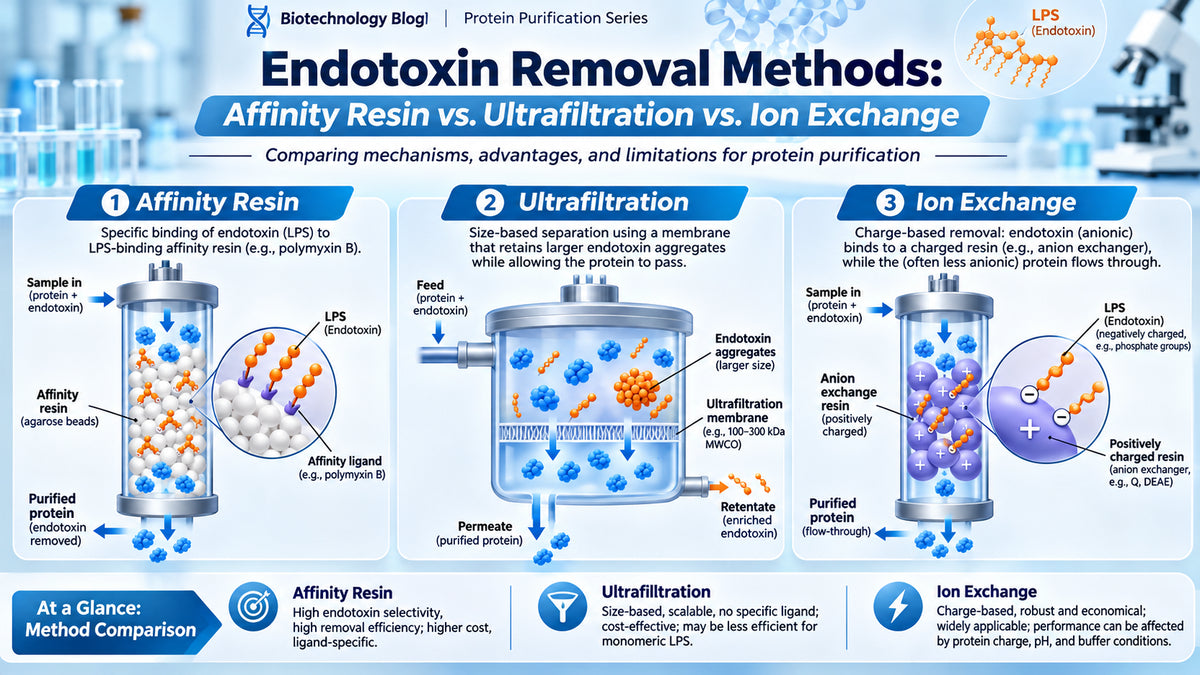
Endotoxin contamination presents a significant challenge in recombinant protein purification, antibody research, and biopharmaceutical process development. Bacterial endotoxins, primarily lipopolysaccharides (LPS) from Gram-negative bacteria, can remain in biological preparations despite conventional purification. Several endotoxin removal methods are available, including affinity adsorption, ultrafiltration, and ion exchange chromatography. Each technique uses a different separation mechanism and offers distinct advantages and limitations. Affinity resins capture endotoxins through immobilized binding ligands, ultrafiltration separates components according to membrane retention characteristics, and ion exchange chromatography exploits differences in molecular charge. This article compares their operating principles, protein compatibility, endotoxin clearance, and practical applications to help researchers select appropriate purification strategies.
1. Introduction
Endotoxin removal is an important consideration in biological sample preparation, particularly for recombinant proteins expressed in Escherichia coli and other Gram-negative bacterial systems.
Bacterial endotoxins are primarily lipopolysaccharides (LPS) located in the outer membrane of Gram-negative bacteria.
During bacterial cell disruption and protein extraction, LPS molecules can enter the protein preparation and remain present throughout downstream processing.
Even proteins that appear highly purified by SDS-PAGE or chromatography may contain residual endotoxin.
These contaminants can interfere with cell-based assays, activate immune signaling pathways, and compromise experimental reproducibility.
Consequently, researchers often incorporate additional endotoxin removal steps into protein purification workflows.
Three widely discussed methods are:
Affinity-based endotoxin removal resin
Ultrafiltration and diafiltration
Ion exchange chromatography
Although these techniques can contribute to endotoxin control, they differ substantially in selectivity, operating requirements, and compatibility with target proteins.
Understanding these differences is essential for choosing an appropriate purification method.
2. Why Is Endotoxin Difficult to Remove?
2.1 Amphiphilic Structure of LPS
Lipopolysaccharides contain both hydrophobic and hydrophilic regions.
A typical LPS molecule includes lipid A, a core oligosaccharide, and, in many structures, an O-antigen polysaccharide.
Lipid A contributes strongly to the molecule's hydrophobic properties and biological activity.
The phosphate-containing regions contribute to its negative charge under many aqueous conditions.
These characteristics allow LPS to interact with different chromatographic materials and biological molecules.
2.2 Endotoxin Aggregation
In aqueous solutions, endotoxin molecules may assemble into micelles, vesicles, or other aggregates.
Their apparent size and physical behavior can therefore vary with solution composition.
This complicates membrane-based separation because endotoxin is not present exclusively as individual molecules of a fixed molecular size.
2.3 Protein–Endotoxin Interactions
Some proteins associate strongly with endotoxins through electrostatic and hydrophobic interactions.
These associations can cause LPS to remain with the target protein during conventional purification.
As a result, a technique that efficiently removes free endotoxin may perform less effectively when endotoxin is tightly associated with a protein.
The physical and chemical properties of the target biomolecule must therefore be considered during method selection.
3. Method 1: Affinity-Based Endotoxin Removal Resin
Affinity adsorption uses immobilized ligands that interact with bacterial endotoxins.
This approach is particularly relevant when the objective is to capture LPS while recovering compatible target proteins in the liquid phase.
3.1 How Affinity Resin Works
An endotoxin removal resin typically consists of a solid support matrix carrying immobilized endotoxin-binding ligands.
Common ligand chemistries include modified Polymyxin B and polycationic polymers such as poly(ε-lysine).
Polymyxin B can bind to the lipid A region of LPS through a combination of electrostatic and hydrophobic interactions.
When an endotoxin-contaminated protein solution contacts the resin, accessible LPS molecules can interact with the immobilized ligands.
Under suitable conditions, endotoxins remain associated with the resin while the target protein is recovered.
The general process can be summarized as:
Contaminated Protein Solution → Affinity Resin → LPS Adsorption → Endotoxin-Reduced Protein
3.2 Advantages of Affinity Resin
Affinity-based endotoxin removal offers several potential advantages.
Selective adsorption: Immobilized ligands provide interactions directed toward LPS rather than relying exclusively on molecular size or charge.
Compatibility with protein purification: Suitable resins can be introduced as a polishing step after recombinant protein or antibody purification.
Flexible processing formats: Depending on the product, resins may support packed-column or other validated processing configurations.
Potential for substantial endotoxin reduction: High-capacity affinity materials can remove substantial amounts of accessible endotoxin under optimized conditions.
3.3 Limitations of Affinity Resin
Affinity adsorption is not universally effective for every protein preparation.
Certain proteins may bind nonspecifically to the resin, reducing protein recovery.
Strong protein–endotoxin associations may limit the accessibility of LPS to immobilized ligands.
The practical binding capacity also depends on the sample matrix, buffer composition, and contact time.
In addition, immobilized ligand leaching and resin reuse must be considered when relevant to the application.
Therefore, endotoxin clearance and target protein recovery should be verified experimentally.
3.4 Applications
Affinity resin is often considered for:
Recombinant protein polishing
Antibody and Fc-fusion protein research
Preparation of endotoxin-controlled biological reagents
Endotoxin-sensitive cell culture research
Laboratory-scale purification optimization
For example, FireGene High-Efficiency Endotoxin Removal Purification Resin uses modified Polymyxin B immobilized on an agarose support to capture endotoxins from compatible biological preparations.
4. Method 2: Ultrafiltration and Diafiltration
Ultrafiltration is a membrane-based separation technique that relies primarily on the retention characteristics of molecules and particles.
It is commonly used for protein concentration and buffer exchange.
4.1 How Ultrafiltration Works
Ultrafiltration membranes are characterized by a nominal molecular weight cutoff (MWCO).
During processing, molecules and particles may be retained or pass through the membrane depending on their hydrodynamic size, shape, interactions with the membrane, and operating conditions.
Because LPS can form relatively large aggregates in aqueous solutions, some endotoxin populations may be retained by suitable membranes.
In selected applications, separation is possible when the target biomolecule passes through the membrane while endotoxin aggregates are retained.
However, the molecular weight cutoff does not provide an absolute boundary between endotoxin and protein fractions.
4.2 Advantages of Ultrafiltration
No affinity ligand required: Ultrafiltration does not rely on immobilized endotoxin-binding molecules.
Integration with existing workflows: Many laboratories already use ultrafiltration devices for concentration and buffer exchange.
Process scalability: Membrane systems are available in laboratory and larger-scale processing formats.
Compatibility with selected samples: Physical separation may be useful when the target molecule and endotoxin aggregates have sufficiently different retention behavior.
4.3 Limitations of Ultrafiltration
Ultrafiltration is not a universally effective method for removing endotoxin from protein preparations.
Large recombinant proteins may be retained together with endotoxin aggregates.
Protein-bound endotoxin may also remain in the retained fraction.
In addition, membrane adsorption, concentration polarization, and fouling can affect sample recovery.
Diafiltration can remove permeable impurities, but repeated buffer exchange does not guarantee endotoxin reduction when LPS is retained with the target protein.
For these reasons, ultrafiltration is often more reliable for concentration and buffer exchange than as a standalone endotoxin removal method.
4.4 Applications
Ultrafiltration may be evaluated for:
Protein concentration
Buffer exchange
Processing selected small biomolecules
Separation of endotoxin aggregates from compatible permeable products
Supporting multistep purification workflows
Its suitability for endotoxin removal should be demonstrated using experimental clearance data.
5. Method 3: Ion Exchange Chromatography
Ion exchange chromatography separates molecules according to differences in electrostatic interactions with charged stationary phases.
This method is widely used for protein purification and can also contribute to endotoxin clearance.
5.1 How Ion Exchange Works
Ion exchange resins contain charged functional groups that interact with oppositely charged molecules.
Two major categories are used in protein purification:
Anion exchange chromatography (AEX): Positively charged stationary-phase groups bind negatively charged species.
Cation exchange chromatography (CEX): Negatively charged stationary-phase groups bind positively charged species.
Because LPS contains negatively charged phosphate groups, it can bind strongly to anion exchange materials under suitable conditions.
A purification process may therefore be designed in which endotoxin binds to the resin while the desired protein passes through.
Alternatively, a target protein may bind and elute separately from endotoxin.
5.2 Advantages of Ion Exchange
Established purification technology: Ion exchange is widely used in laboratory and bioprocess purification workflows.
Scalability: Suitable chromatography systems can be adapted to larger processing volumes.
Potential integration: Endotoxin removal may occur during an existing purification step without requiring a separate affinity resin.
Process flexibility: Buffer pH, ionic strength, and resin chemistry can be adjusted to influence separation behavior.
5.3 Limitations of Ion Exchange
The effectiveness of ion exchange depends strongly on the charge characteristics of the target protein.
Proteins that bind to the same resin as endotoxin may be difficult to separate.
Changes in pH or salt concentration can affect both endotoxin and protein retention.
Some operating conditions may reduce protein stability or recovery.
Consequently, ion exchange chromatography requires product-specific development and cannot be assumed to eliminate endotoxin in every purification process.
5.4 Applications
Ion exchange chromatography is commonly investigated for:
Recombinant protein purification
Antibody and biologics process development
Endotoxin clearance during chromatographic polishing
Protein charge-variant separation
Integrated downstream purification workflows
Anion exchange is frequently evaluated when endotoxin adsorption can be achieved without unacceptable target protein loss.
6. Affinity Resin vs. Ultrafiltration vs. Ion Exchange: Key Differences
The following comparison highlights the major characteristics of these endotoxin removal technologies.
|
Parameter |
Affinity Resin |
Ultrafiltration |
Ion Exchange |
|
Separation principle |
Ligand-mediated LPS adsorption |
Membrane retention and permeation |
Electrostatic interactions |
|
Main driving factor |
Endotoxin–ligand affinity |
Hydrodynamic size and membrane properties |
Molecular charge |
|
Endotoxin selectivity |
Potentially high, ligand-dependent |
Limited, size-dependent |
Condition-dependent |
|
Protein recovery |
Depends on nonspecific adsorption |
Depends on membrane retention and adsorption |
Depends on protein charge and elution |
|
Buffer sensitivity |
pH, salt, additives |
Membrane and sample compatibility |
Strongly affected by pH and salt |
|
Typical role |
Dedicated endotoxin removal or polishing |
Concentration, buffer exchange, selected separations |
Purification and endotoxin clearance |
|
Main limitation |
Protein loss or inaccessible LPS |
Co-retention of protein and LPS |
Competing protein and endotoxin binding |
|
Scalability |
Product- and process-dependent |
Often scalable |
Well-established scalability |
Important: The relative performance of these methods cannot be ranked universally. Endotoxin clearance must be demonstrated for the target product and processing conditions.
7. How to Choose the Right Endotoxin Removal Method
Selecting a suitable method requires an understanding of both endotoxin behavior and target protein characteristics.
7.1 Consider the Target Protein
Evaluate the protein's molecular weight, isoelectric point, hydrophobicity, stability, and tendency to aggregate.
For proteins that are difficult to separate from LPS using charge-based chromatography, affinity resin may provide an alternative strategy.
If a protein is small enough to permeate a suitable membrane while endotoxin aggregates are retained, ultrafiltration may be worth investigating.
7.2 Evaluate Initial Endotoxin Levels
Measure the starting endotoxin concentration using a suitable bacterial endotoxins test.
High initial endotoxin burdens may require substantial adsorption capacity or multiple purification operations.
Resin and membrane selection should be based on actual sample characteristics rather than nominal specifications alone.
7.3 Assess Protein Recovery
Endotoxin removal should not compromise the intended biological function of the target protein.
Measure total protein recovery and evaluate activity or structural integrity when required.
A method offering high endotoxin clearance but substantial protein loss may be unsuitable for valuable recombinant protein preparations.
7.4 Consider Operational Requirements
Laboratories should consider processing time, equipment availability, consumable requirements, and process reproducibility.
Affinity resin may provide a convenient dedicated polishing approach for compatible samples.
Ion exchange may be preferred when it can be integrated into an established chromatography workflow.
Ultrafiltration may remain useful as a supporting concentration or buffer-exchange step.
8. Can Endotoxin Removal Methods Be Combined?
In challenging preparations, a combination of techniques may achieve better overall results than a single purification operation.
For example, recombinant protein purification may include:
Primary Protein Purification → Ion Exchange Chromatography → Affinity Endotoxin Removal → Final Buffer Exchange → Endotoxin Testing
This sequence is illustrative rather than a universal protocol.
Ion exchange can reduce endotoxin through charge-based separation, while affinity resin may capture residual accessible LPS.
A subsequent buffer-exchange step may be useful for adjusting the final protein formulation.
However, adding purification steps can also increase processing time and protein loss.
Each operation should therefore provide a measurable benefit.
9. How to Evaluate Endotoxin Removal Efficiency
Regardless of the selected purification method, endotoxin reduction must be verified analytically.
9.1 Endotoxin Removal Calculation
The percentage of total endotoxin removed can be calculated as:
Endotoxin Removal (%) = [(Initial Total Endotoxin − Final Total Endotoxin) / Initial Total Endotoxin] × 100
For example, reducing the total endotoxin burden from 10,000 EU to 100 EU corresponds to 99% removal.
When purification changes sample volume, use total endotoxin amounts rather than concentrations alone.
9.2 Protein Recovery Calculation
Protein recovery can be calculated using:
Protein Recovery (%) = (Recovered Protein Mass / Initial Protein Mass) × 100
Both endotoxin clearance and protein recovery should be evaluated.
9.3 Endotoxin Detection Methods
Common analytical options include LAL gel-clot, kinetic chromogenic, kinetic turbidimetric, and suitable recombinant Factor C methods.
Because proteins and buffer components may interfere with endotoxin measurements, appropriate positive product controls and inhibition/enhancement assessments are essential.
A low reported endotoxin concentration does not automatically confirm effective clearance if the test method has not demonstrated suitability for the sample matrix.
10. Frequently Asked Questions
Q1. Which endotoxin removal method is most effective for recombinant proteins?
There is no universally superior method. Affinity adsorption can offer targeted endotoxin capture, ion exchange may provide effective clearance through charge-based separation, and ultrafiltration may be useful for selected samples. Performance must be evaluated for the individual protein.
Q2. Can ultrafiltration completely remove endotoxins?
Ultrafiltration cannot be assumed to remove all endotoxins. Protein-associated endotoxin and LPS aggregates may be retained with the target protein, depending on membrane characteristics and sample composition.
Q3. Is ion exchange chromatography suitable for endotoxin removal?
Yes, under suitable conditions. Anion exchange chromatography can bind negatively charged endotoxin molecules, but separation depends on the target protein's charge properties and the selected buffer conditions.
Q4. Why might affinity resin cause protein loss?
Some proteins interact nonspecifically with the resin matrix or immobilized ligand. Protein recovery may also be affected by buffer compatibility, aggregation, and handling losses.
Q5. Can affinity resin be used after Ni-NTA protein purification?
Yes, for compatible proteins. Ni-NTA chromatography does not specifically guarantee endotoxin removal, so affinity endotoxin removal resin may be evaluated as an additional polishing operation.
11. Conclusion
Affinity resin, ultrafiltration, and ion exchange chromatography provide different approaches to endotoxin control in biological preparations.
Affinity resins capture endotoxins through immobilized binding ligands, offering a dedicated adsorption-based strategy for compatible protein solutions.
Ultrafiltration separates components according to membrane retention behavior and can support selected separation, concentration, and buffer-exchange operations. However, its effectiveness for removing endotoxin from protein solutions is often limited by co-retention and protein–endotoxin associations.
Ion exchange chromatography exploits electrostatic interactions and can provide effective endotoxin clearance when the charge characteristics of endotoxin and the target protein allow suitable separation.
Ultimately, method selection should be based on endotoxin clearance, protein recovery, sample compatibility, operational requirements, and analytical verification.
For researchers seeking a dedicated affinity-based approach, FireGene High-Efficiency Endotoxin Removal Purification Resin utilizes modified Polymyxin B immobilized on agarose microspheres to support endotoxin reduction in compatible biological preparations.


