
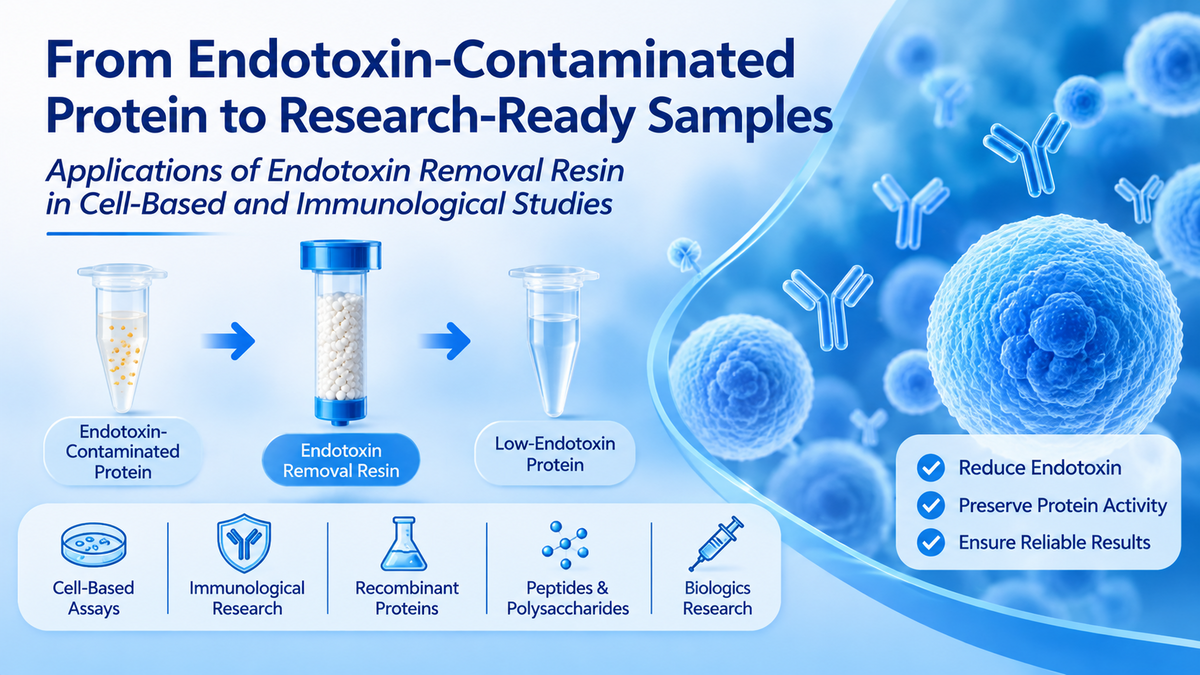
Introduction: When Endotoxin Contamination Becomes an Experimental Problem
A recombinant protein may appear pure after purification, show the expected molecular weight on an SDS-PAGE gel, and meet its concentration target. Yet when it is introduced into a cell-based assay, the results may be unexpectedly inconsistent.
One possible reason is residual endotoxin.
Endotoxins, also known as lipopolysaccharides (LPS), are components of the outer membrane of Gram-negative bacteria. They can enter protein preparations during bacterial expression, cell harvesting, and lysate preparation. If they are not adequately removed, residual LPS may influence cellular responses independently of the target protein.
This is particularly important in experiments involving immune cells, inflammatory signaling, cytokine production, and other endotoxin-sensitive biological systems.
For researchers working with recombinant proteins, the challenge is not simply to achieve high protein purity. It is to prepare samples with an endotoxin level appropriate for their intended experimental application while maintaining target-protein recovery and biological activity.
This is where an endotoxin removal resin can become an important part of the purification workflow.
FireGene's High-Efficiency Endotoxin Removal Purification Resin is designed for endotoxin removal from compatible protein-based preparations, including recombinant proteins, antibodies, peptides, and polysaccharides.
This article explores why endotoxin control matters in cell-based research, where resin treatment can add value, how to evaluate the treatment process, and how TAL/LAL testing can help verify the final sample.
I. Why Endotoxin Contamination Matters in Cell-Based Research
Endotoxin contamination is more than a product-purity issue. It can directly affect experimental interpretation.
LPS is recognized by innate immune recognition systems, including the TLR4 signaling pathway. Depending on the cell type and experimental conditions, endotoxin exposure can trigger inflammatory signaling and alter the expression or release of immune mediators.
As a result, a contaminated protein preparation may produce biological responses that are not entirely attributable to the target molecule.
1. Interference With Immune-Cell Activation Studies
Macrophages, monocytes, and other immune cells are commonly used to investigate inflammatory responses and immune regulation.
Residual endotoxin in a recombinant protein preparation may activate these cells and increase inflammatory readouts.
For example, researchers studying the effect of a recombinant cytokine on macrophage behavior may observe changes in cytokine release. If the preparation also contains LPS, it can become difficult to determine whether the observed response comes from the target protein, endotoxin contamination, or a combination of both.
Reducing residual endotoxin can help control this experimental variable.
2. Unwanted Effects in Cell Proliferation and Viability Assays
Cell-based experiments often rely on controlled conditions to evaluate how a protein affects cell viability, proliferation, differentiation, or signaling.
Endotoxin contamination may introduce an additional biological stimulus, potentially affecting cell growth or viability depending on the cell model and exposure conditions.
This can increase experimental variability and complicate comparisons between treatment groups.
3. Misinterpretation of Cytokine and Inflammatory Readouts
Cytokine measurements are widely used in immunology and inflammation research.
However, residual LPS can independently influence cytokine expression and secretion. When the target protein is also involved in immune signaling, distinguishing its activity from endotoxin-induced responses becomes particularly important.
For this reason, endotoxin testing should be considered when preparing proteins for sensitive immune-response experiments.
4. Reproducibility Across Experimental Batches
A recombinant protein preparation may be produced in multiple batches. Differences in bacterial culture conditions, cell disruption, purification, and handling can result in different endotoxin burdens.
If endotoxin is not measured, batch-to-batch differences may contribute to inconsistent cell-based results.
Combining endotoxin removal when necessary with quantitative TAL/LAL testing can provide better control over this source of variation.
II. Which Protein Preparations May Benefit From Endotoxin Removal?
Not every protein preparation requires the same level of endotoxin control. The appropriate strategy depends on the expression system, purification process, target molecule, and intended application.
The following research areas are examples where additional endotoxin removal may be worth evaluating.
1. Recombinant Cytokines and Chemokines
Cytokines and chemokines regulate immune-cell communication, inflammation, and cell signaling.
Because many cytokine studies involve sensitive cellular responses, residual endotoxin may complicate the interpretation of experimental results.
For compatible recombinant cytokine preparations, endotoxin removal resin can be evaluated as an additional purification step when testing identifies an unacceptable endotoxin burden.
After treatment, researchers should measure endotoxin levels and assess protein recovery. Where appropriate, biological activity should also be compared before and after treatment.
2. Recombinant Growth Factors
Growth factors are commonly used in cell culture, stem-cell research, tissue engineering, and cell differentiation studies.
Residual endotoxin may influence cellular responses and introduce unwanted variability into growth or differentiation experiments.
An additional endotoxin removal step may be considered when the protein preparation is intended for sensitive cell-based applications.
The treatment conditions should be selected to preserve the growth factor's solubility, stability, and biological function.
3. Recombinant Enzymes
Recombinant enzymes are widely used in biochemical studies and functional assays.
Depending on the experimental system, residual endotoxin may interfere with downstream biological measurements or cell-based applications.
Resin treatment can be evaluated when endotoxin contamination is identified, but enzyme activity should be measured after treatment to determine whether the purification process affects the target molecule.
4. Antibodies and Fc-Fusion Proteins
Antibodies and Fc-fusion proteins are frequently used in immune-cell assays, receptor-binding studies, and functional research.
Protein A/G chromatography is commonly used for antibody capture, but it does not automatically establish that the final preparation is endotoxin-free.
For compatible antibody preparations, FireGene endotoxin removal resin may be evaluated as a polishing step after affinity purification.
Researchers should assess antibody recovery, aggregation, binding activity, and endotoxin reduction to determine whether the treatment is suitable.
5. Peptides and Polysaccharides
Peptides and polysaccharides are also listed among the intended sample categories for FireGene's resin.
Their molecular properties can vary considerably, so treatment conditions should be optimized for each sample rather than transferred directly from a protein workflow.
Solubility, charge, viscosity, and nonspecific adsorption should be considered during process development.
III. A Practical Workflow: From Protein Purification to Endotoxin Verification
A reliable endotoxin-control strategy should include both sample treatment and analytical verification.
Resin treatment alone cannot demonstrate that a sample meets its intended endotoxin requirement.
The following workflow provides a practical starting point for compatible protein preparations.
Step 1: Identify the Endotoxin Burden
Before treatment, measure the initial endotoxin concentration using a suitable TAL/LAL assay.
Record the following information:
-
Initial endotoxin concentration
-
Protein concentration
-
Sample volume
-
Buffer composition
-
Sample pH
-
Intended downstream application
This baseline helps researchers determine whether additional endotoxin removal is necessary and provides a reference for evaluating treatment performance.
Step 2: Select a Suitable Treatment Stage
For many recombinant protein workflows, resin treatment can be evaluated after the primary purification steps.
For example:
Bacterial expression → Cell disruption → Clarification → Affinity purification → Endotoxin removal → Final buffer exchange → Endotoxin verification
This is an illustrative workflow rather than a mandatory sequence. The appropriate treatment position depends on the target molecule and the existing purification process.
Step 3: Prepare and Equilibrate the Resin
FireGene's resin is supplied in 20% ethanol and requires regeneration before first use.
Follow the current product instructions for resin preparation, regeneration, and equilibration. Use endotoxin-controlled water, buffers, containers, and consumables to minimize the risk of introducing new contamination.
The product FAQ also confirms that HEPES buffer can be used.
Step 4: Load the Compatible Sample
After equilibration, load the sample under conditions established during process optimization.
FireGene suggests that when the endotoxin content is unknown, a resin-to-sample volume ratio of 1:1 or 1:2 may be used as an initial experimental starting point.
This ratio is not a universal requirement. The appropriate resin volume should be evaluated based on the measured endotoxin burden, sample volume, and resin binding capacity.
Step 5: Collect and Evaluate the Treated Sample
Follow the recommended procedure for the selected resin format and collect the appropriate product fraction.
Assess the treated sample for:
-
Endotoxin concentration
-
Total protein recovery
-
Protein integrity
-
Solubility and aggregation
-
Biological activity, where relevant
The final sample should be evaluated using predefined acceptance criteria appropriate for the downstream application.
Step 6: Verify Endotoxin Reduction With TAL/LAL Testing
Measure endotoxin concentration after treatment using a suitable assay.
Comparing pre-treatment and post-treatment results provides a quantitative basis for evaluating the purification process.
For additional information, explore the FireGene Endotoxin Testing and QC product collection.
IV. How FireGene Endotoxin Removal Resin Supports Protein Purification
FireGene's High-Efficiency Endotoxin Removal Purification Resin uses modified Polymyxin B immobilized on 4% agarose microspheres.
Polymyxin B has an affinity for bacterial lipopolysaccharides. Immobilizing the modified ligand on an agarose matrix provides a solid-phase adsorption approach for reducing endotoxin in compatible protein-based samples.
The product is designed for applications involving:
-
Recombinant protein purification
-
Antibody and Fc-fusion protein purification
-
Peptide preparation
-
Polysaccharide sample preparation
-
Compatible vaccine antigen and biologics research preparations
Product Specifications
Product: High-Efficiency Endotoxin Removal Purification Resin
SKU: FG-YS20518
Matrix: 4% agarose microspheres
Ligand: Modified Polymyxin B
Bead size: 45–165 μm
Listed binding capacity: Greater than 2,000,000 EU/mL matrix
Operating pH range: 5–10
Maximum pressure: 0.1 MPa (1 bar)
Storage condition: 2–8°C
Shelf life: 2 years
Storage solution: 20% ethanol
The listed resin volume refers to the actual gel matrix volume, not the combined volume of gel and storage solution.
According to FireGene's product information, endotoxin levels can be reduced to as low as 0.1 EU/mL under suitable conditions. The product FAQ reports up to 99% endotoxin removal and up to 90% protein recovery.
These figures are manufacturer-reported performance results, not guaranteed outcomes for every sample. Actual results depend on the initial endotoxin concentration, target molecule, sample matrix, buffer composition, resin loading, and treatment conditions.
Explore the product:
FireGene High-Efficiency Endotoxin Removal Purification Resin
V. Optimizing Resin Treatment for Better Endotoxin Reduction and Protein Recovery
An effective endotoxin removal process must balance two objectives:
-
Reduce endotoxin contamination.
-
Preserve the target molecule.
A treatment that produces a low endotoxin concentration but causes substantial protein loss may not be suitable for valuable or limited-quantity samples.
The following parameters should be evaluated during process development.
1. Sample pH
The product lists an operating pH range of 5–10.
When endotoxin removal efficiency is lower than expected, FireGene's product FAQ recommends investigating sample pH and suggests pH 7–8 as a troubleshooting starting point.
However, this range should not be interpreted as universally optimal.
The target protein's stability, solubility, and aggregation behavior should always be considered before changing pH.
2. Salt Concentration
Nonspecific adsorption may contribute to low protein recovery.
FireGene's product FAQ recommends evaluating increased NaCl concentration in both the sample and equilibration buffer when recovery is low.
The optimal salt concentration depends on the target molecule and should be established experimentally.
3. Resin-to-Sample Ratio
The amount of resin required depends on the initial endotoxin burden and the volume of sample being treated.
When endotoxin content is unknown, a 1:1 or 1:2 resin-to-sample volume ratio can be used as an initial experimental starting point according to FireGene's guidance.
For routine processes, measure endotoxin before treatment whenever possible and optimize resin loading based on the actual sample.
4. Contact Time and Flow Rate
In column-based purification, sufficient contact time between the sample and resin is important.
FireGene's product FAQ provides a specific example: for a 40 mL resin bed, a maximum flow rate of 4 mL/min is recommended to maintain a contact time greater than 10 minutes under the described setup.
This example should not be automatically applied to other column dimensions or sample configurations.
The maximum listed operating pressure is 0.1 MPa (1 bar).
5. Glycerol and Other Buffer Components
Buffer composition may influence viscosity, protein recovery, and resin performance.
Although the product FAQ lists tolerance to several reagents, including DMSO, ethanol, glycerol, urea, and imidazole, specific guidance should be followed for each component.
In particular, FireGene recommends using no more than 5% glycerol because higher concentrations may increase viscosity and negatively affect sample recovery.
VI. How to Evaluate Endotoxin Removal Performance
A complete evaluation should include both endotoxin reduction and target-protein recovery.
1. Calculate Endotoxin Reduction
Use the following formula:
Endotoxin Reduction (%) = [(C0 − C1) / C0] × 100
Where:
-
C0 = Initial endotoxin concentration (EU/mL)
-
C1 = Post-treatment endotoxin concentration (EU/mL)
For example:
Initial endotoxin concentration: 40 EU/mL
Post-treatment endotoxin concentration: 4 EU/mL
Calculation:
[(40 − 4) / 40] × 100 = 90%
The measured endotoxin concentration has decreased by 90%.
This calculation compares concentrations. If sample volume changes during processing, it does not independently represent the change in total endotoxin amount.
2. Calculate Protein Recovery
Protein recovery should be evaluated alongside endotoxin reduction.
Protein Recovery (%) = (Recovered Protein Amount / Initial Protein Amount) × 100
For example:
Initial protein amount: 100 mg
Recovered protein amount: 85 mg
(85 / 100) × 100 = 85%
When sample volume changes, calculate the total protein amount using:
Protein Amount (mg) = Protein Concentration (mg/mL) × Sample Volume (mL)
This helps avoid confusing protein concentration with total protein recovery.
3. Confirm Assay Suitability
Protein samples and buffer components may inhibit or enhance the response of a TAL/LAL assay.
Therefore, a low post-treatment result should not automatically be interpreted as successful endotoxin removal.
Depending on the assay and applicable method requirements, researchers should consider:
-
Positive product control recovery
-
Sample dilution studies
-
Inhibition and enhancement evaluation
-
Appropriate assay controls
-
The method's quantification limits
If a result is below the assay's quantification limit, it should not automatically be treated as zero.
VII. Choosing a TAL/LAL Assay to Verify Treated Protein Samples
After resin treatment, the endotoxin level should be measured using an assay appropriate for the sample matrix and required sensitivity.
1. Kinetic Chromogenic Endotoxin Testing
The kinetic chromogenic method monitors color development over time and uses a calibration relationship to determine endotoxin concentration.
It can be useful for quantitative comparison of samples before and after resin treatment when the method is suitable for the matrix.
Explore the FireGene Kinetic Chromogenic Endotoxin Test Kit.
2. Gel-Clot Endotoxin Testing
The gel-clot method provides a qualitative or semi-quantitative endotoxin assessment based on clot formation at a defined sensitivity.
It may be appropriate for limit-based testing when the selected reagent sensitivity and sample dilution are suitable.
Explore the FireGene Gel-Clot Endotoxin Test Kit.
The choice between methods should depend on the testing objective, required sensitivity, sample matrix, and applicable method requirements.
VIII. Common Mistakes When Removing Endotoxin From Protein Samples
Even when the appropriate resin is selected, process-related issues can affect results.
Mistake 1: Assuming High Protein Purity Means Low Endotoxin
SDS-PAGE, chromatography, and protein concentration measurements do not establish endotoxin concentration.
Use a suitable TAL/LAL assay to evaluate endotoxin independently.
Mistake 2: Skipping the Initial Endotoxin Test
Without a baseline measurement, it is difficult to determine whether treatment is necessary or quantify the reduction achieved.
Measure the initial endotoxin concentration whenever the assay and sample matrix allow reliable testing.
Mistake 3: Ignoring Protein Recovery
Endotoxin reduction should not be evaluated in isolation.
Measure total protein recovery and, where relevant, verify structural integrity and biological activity.
Mistake 4: Reusing Resin Across Different Samples
FireGene's product FAQ advises against using previously used resin to process different samples.
Use fresh resin for separate sample preparations according to the product instructions to reduce cross-contamination risk.
Mistake 5: Overlooking Recontamination
Endotoxin can be introduced through water, buffers, containers, and sample-handling materials.
Use endotoxin-controlled consumables and appropriate preparation procedures throughout the workflow.
Mistake 6: Applying the Same Conditions to Every Protein
Different proteins have different pH stability, charge, solubility, and aggregation characteristics.
A process optimized for one recombinant protein should not automatically be transferred to another.
IX. Important Application Limitations
FireGene's resin is intended for compatible protein-based preparations, including proteins, peptides, antibodies, and polysaccharides.
It should not be assumed to be suitable for every biological sample.
Importantly, FireGene's product FAQ explicitly states that the resin cannot remove endotoxin from nucleic acid samples such as plasmids or DNA. Researchers should therefore not use this resin for plasmid or DNA endotoxin removal based on the broader application wording elsewhere on the product page.
For clinical manufacturing, therapeutic product release, or regulated applications, additional process validation and applicable regulatory requirements may apply. Research-use resin treatment alone does not establish clinical or manufacturing suitability.
Conclusion: Better Endotoxin Control Starts With Better Sample Preparation
Endotoxin contamination can complicate cell-based assays, immune-response studies, and other sensitive biological experiments.
For researchers working with recombinant proteins, antibodies, peptides, and other compatible biological preparations, an additional endotoxin removal step may help reduce residual LPS and improve control over sample quality.
FireGene's High-Efficiency Endotoxin Removal Purification Resin uses modified Polymyxin B immobilized on 4% agarose microspheres to support endotoxin reduction in suitable protein-based samples.
A reliable workflow should combine:
-
Initial endotoxin measurement
-
Appropriate resin treatment
-
Optimization of pH, salt concentration, loading, and contact time
-
Post-treatment TAL/LAL testing
-
Protein recovery and functional assessment
Ultimately, the goal is not simply to obtain a lower endotoxin reading. It is to prepare a sample with an appropriate endotoxin level while maintaining the quality and biological function of the target molecule.
Explore FireGene Endotoxin Removal and Testing Solutions
For research use only. Actual endotoxin removal and protein recovery depend on sample characteristics and optimized process conditions.
FireGene Endotoxin Testing
Ready to run your endotoxin assay?
FireGene offers a complete endotoxin testing toolkit — from TAL reagents and CSE standards to pyrogen-free consumables and LAL reagent water. All products are aligned with USP <85>, EP 2.6.14, and JP 4.01.


