
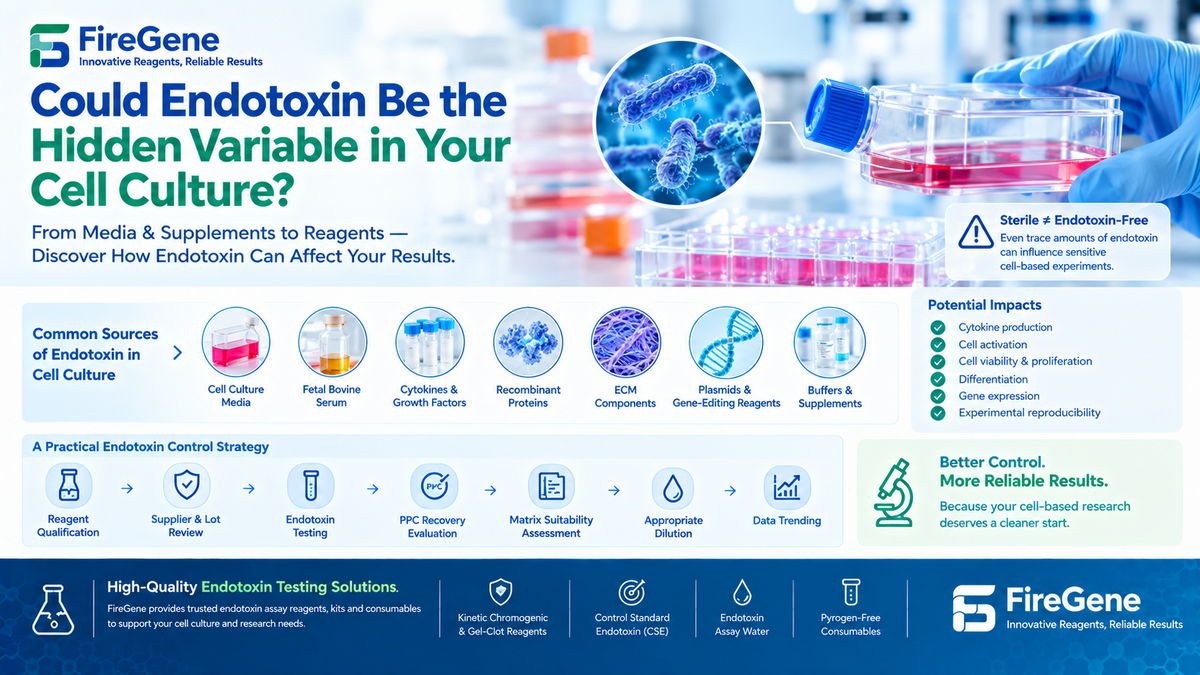
Introduction: The Hidden Variable in Cell Culture Experiments
Cell culture experiments are often designed around carefully controlled variables.
Researchers monitor:
- Cell density
- Passage number
- Culture medium
- Growth factors
- Cytokines
- Temperature
- CO₂
- Incubation time
- Cell viability
- Experimental treatment
But there is another variable that can be overlooked:
endotoxin contamination.
Even when a cell culture medium appears clear, sterile, and chemically correct, it may contain trace amounts of bacterial endotoxin.
This can become especially important when working with:
- Primary cells
- Stem cells
- Immune cells
- Macrophages
- T cells
- Dendritic cells
- Embryonic stem cells
- Induced pluripotent stem cells
- Organoids
- Cell-based assays
- Gene-editing experiments
- Recombinant protein expression
- Preclinical cell therapy research
Endotoxins are lipopolysaccharide components associated with the outer membrane of Gram-negative bacteria. Unlike viable bacteria, endotoxin can remain biologically active even after microorganisms have been removed or destroyed.
For sensitive cell-based systems, even relatively low levels of endotoxin may become an experimental variable.
The result can be confusing.
A researcher may observe:
- Unexpected cytokine production
- Altered cell morphology
- Reduced viability
- Changes in proliferation
- Unexpected activation markers
- Inconsistent differentiation
- Increased experimental variability
- Poor reproducibility between reagent lots
The immediate assumption may be that the biological treatment caused the change.
But sometimes the problem begins with the culture environment.
This is why endotoxin testing for cell culture media and supplements deserves more attention in modern cell-based research.
1. Why Endotoxin Matters in Cell-Based Research
Endotoxin is not simply another form of microbial contamination.
Its biological activity can influence cellular responses even when no viable bacteria are detected.
This distinction is particularly important when researchers are studying immune signaling or cellular responses.
For example, endotoxin exposure can activate pathways associated with innate immune responses and inflammatory signaling.
That means endotoxin contamination can potentially become a confounding variable.
Imagine a researcher testing a new compound for its ability to stimulate cytokine production.
The experimental design includes:
Control cells → Treatment → Cytokine measurement
But if the treatment reagent or culture supplement contains endotoxin, the actual system may be:
Control cells + background endotoxin → Treatment + endotoxin
The resulting biological response may therefore represent a combination of the intended treatment and an unintended endotoxin stimulus.
This can make experimental interpretation significantly more difficult.
2. Which Cell Culture Materials Can Contain Endotoxin?
Endotoxin can potentially enter a cell culture workflow through many different materials.
Common sources include:
Cell culture media
Basal media are often used at relatively large volumes.
If endotoxin is present, even a low concentration can be introduced repeatedly across experiments.
Fetal bovine serum
Serum is a complex biological material and may vary between suppliers and lots.
For sensitive applications, researchers may therefore pay particular attention to supplier endotoxin specifications and lot qualification.
Cytokines
Many immune-cell and stem-cell workflows require cytokines or other signaling proteins.
Because these reagents are often used at low concentrations, endotoxin contamination can be especially problematic when the biological endpoint itself involves immune signaling.
Growth factors
Growth factors used for stem-cell culture, organoids, differentiation, and tissue engineering may also require careful quality control.
Recombinant proteins
Protein expression and purification workflows can introduce endotoxin during bacterial expression, purification, or handling.
Extracellular matrix components
Matrigel-like materials, collagen preparations, laminin, and other extracellular matrix components may become important variables in sensitive cell culture experiments.
Transfection reagents
Gene-delivery workflows may involve multiple reagents and buffers, creating additional opportunities for endotoxin introduction.
Cell culture supplements
Albumin, amino acids, hormones, antibiotics, and other additives can all become potential contributors depending on their source and manufacturing process.
The important point is not that every one of these materials necessarily contains problematic endotoxin.
The point is that critical biological reagents should be evaluated according to the risk of the specific experiment.
3. Why “Sterile” Does Not Automatically Mean “Low Endotoxin”
One of the most common misunderstandings in cell culture is treating sterility and endotoxin control as the same thing.
They are not.
Sterility testing is concerned with viable microorganisms under defined test conditions.
Endotoxin testing addresses biologically active bacterial endotoxins.
Therefore:
Sterile ≠ endotoxin-free
A material can meet a sterility requirement and still require endotoxin control.
This distinction becomes particularly important for cell-based research because endotoxin can remain biologically relevant even when viable bacterial contamination is absent.
For pharmaceutical applications, FDA's March 2026 guidance specifically discusses pyrogen and endotoxin testing and references USP <85>, USP <161>, and AAMI ST72, including gel-clot, photometric, and kinetic approaches.
For researchers, the practical lesson is simple:
Do not use sterility status alone as evidence that a reagent is suitable for endotoxin-sensitive experiments.
4. Cell Type Determines How Important Endotoxin Control May Be
Not every cell type responds to endotoxin in exactly the same way.
This means endotoxin risk should be evaluated in the context of the biological model.
Immune Cells
Immune cells can be particularly sensitive because endotoxin itself can stimulate innate immune signaling.
Macrophages, monocytes, dendritic cells, and related systems are therefore obvious examples where endotoxin contamination may complicate experimental interpretation.
Primary Cells
Primary cells can have greater biological variability than immortalized cell lines.
When baseline variability is already high, an uncontrolled reagent variable can make results even harder to interpret.
Stem Cells
Stem-cell experiments often depend on tightly controlled signaling environments.
Small changes in culture conditions can affect:
- Self-renewal
- Differentiation
- Viability
- Marker expression
- Growth kinetics
Endotoxin should therefore be considered when unexpected biological changes occur after changing media, supplements, or reagent lots.
Organoids
Organoid systems introduce additional complexity because multiple cell types may interact within a three-dimensional environment.
Changes in growth factors, matrix components, or media can alter organoid development.
Endotoxin contamination can become another variable that needs to be controlled.
Gene-Editing Experiments
CRISPR and other gene-editing workflows frequently use plasmids, recombinant proteins, transfection reagents, cell culture supplements, and delivery systems.
A recent FireGene article discusses why endotoxin testing can be important before gene-editing experiments, particularly when biological reagents and delivery materials may introduce contamination.
5. Why Endotoxin Can Affect Experimental Reproducibility
One of the biggest problems with endotoxin contamination is not always an obvious failed experiment.
Sometimes the effect is much more subtle.
For example:
Experiment A
Media Lot 1 → low endotoxin background → expected cellular response
Experiment B
Media Lot 2 → higher endotoxin background → altered cellular response
Both experiments may appear to follow the same protocol.
Yet the biological results may differ.
This can create the impression that:
- The treatment is unstable
- The cell line is changing
- The assay is poorly reproducible
- The differentiation protocol is inconsistent
- The researcher made a pipetting error
The actual variable may be a reagent lot.
This is why endotoxin control can be viewed as part of experimental reproducibility, not simply contamination control.
6. Common Signs That Endotoxin May Be a Confounding Variable
Endotoxin contamination does not always produce one obvious signature.
However, researchers may want to investigate endotoxin when they observe unexpected:
- Cytokine release
- Inflammatory gene expression
- Cell activation
- Morphological changes
- Cell-growth differences
- Viability changes
- Differentiation variability
- Lot-to-lot differences
- Control-group responses
- Background signals
A particularly important clue is a change that appears after switching to a new reagent lot.
For example:
Old serum lot → consistent results
New serum lot → unexpected activation
This does not prove endotoxin contamination.
But it provides a reason to investigate reagent quality, including endotoxin status.
7. Which Materials Should Be Prioritized for Endotoxin Testing?
It is usually unnecessary to test every component with identical frequency.
A risk-based strategy is more practical.
Consider prioritizing materials according to:
Biological sensitivity
Is the cell model highly responsive to inflammatory stimuli?
Material volume
How much of the reagent enters the culture?
Contact frequency
Is the reagent used in every experiment or only occasionally?
Supplier variability
Does the material exhibit significant lot-to-lot variation?
Manufacturing origin
Was the reagent produced using bacterial expression systems or other processes associated with increased endotoxin risk?
Experimental endpoint
Does the experiment measure:
- Cytokines?
- Immune activation?
- Inflammation?
- Cell signaling?
- Gene expression?
- Differentiation?
The more directly endotoxin could affect the endpoint, the more important appropriate endotoxin control becomes.
8. How Endotoxin Testing Can Be Applied to Cell Culture Reagents
The exact testing strategy depends on the material and application.
Potential approaches include:
- Incoming reagent qualification
- Supplier CoA review
- Lot-release verification
- Periodic endotoxin testing
- Investigation testing
- Method suitability testing
- Comparative lot testing
The objective is not necessarily to test every bottle before every experiment.
Instead, laboratories can establish a rational strategy for identifying which materials represent the greatest risk.
For laboratories performing quantitative analysis, kinetic chromogenic endotoxin testing can provide numerical results that may be useful for comparing reagent lots.
FireGene's Kinetic Chromogenic Endotoxin Test Kit provides a quantitative assay format with a 0.005–10 EU/mL detection range and 405 nm microplate-reader detection.
For simpler screening applications, a Gel-Clot TAL/LAL Reagent approach may also be appropriate depending on the sample and validated procedure.
The appropriate method should always be determined according to the specific sample matrix and intended application.
9. Matrix Interference Can Make Cell Culture Reagents Difficult to Test
Testing a culture medium is not always as simple as testing water.
Culture media can contain:
- Salts
- Amino acids
- Sugars
- Proteins
- Vitamins
- Growth factors
- Buffers
- Surfactants
- Other complex components
These ingredients may influence endotoxin assay performance.
Potential effects include:
Inhibition
The sample suppresses the assay response.
Enhancement
The sample increases the apparent assay response.
Optical interference
For photometric methods, sample characteristics may affect optical measurements.
Endotoxin masking
Certain matrix components may alter the availability of endotoxin for detection.
This is why laboratories should not assume that an endotoxin method validated for water will automatically work for every cell culture reagent.
Method suitability is important.
FireGene's detailed guide on endotoxin method suitability testing explains how inhibition, enhancement, PPC recovery, dilution, and matrix effects can influence assay performance.
10. Why Positive Product Control Matters
One of the most useful tools for evaluating matrix effects is the Positive Product Control, or PPC.
The concept is straightforward.
A known amount of endotoxin is added to the sample matrix.
The sample is then tested using the selected endotoxin assay.
The laboratory evaluates how much of the added endotoxin can be recovered.
Conceptually:
Known endotoxin + cell culture reagent → Endotoxin assay → Recovery
If recovery is acceptable under the applicable procedure, the result supports the suitability of the test conditions.
If recovery is poor, the laboratory may need to investigate:
- Dilution
- pH
- Matrix composition
- Sample preparation
- Reagent compatibility
- Potential inhibition
FireGene's Control Standard Endotoxin (CSE) can be used for applications including endotoxin standards, recovery studies, and positive controls.
11. Choosing the Right Dilution
Dilution is often one of the most practical ways to reduce matrix interference.
However, more dilution is not automatically better.
The laboratory needs to balance:
Matrix reduction
against
Analytical sensitivity
For example, excessive dilution may reduce matrix interference but also reduce the endotoxin concentration to a level that is difficult to quantify.
Therefore, the dilution strategy should consider:
- Endotoxin limit
- Assay sensitivity
- Expected sample concentration
- Maximum Valid Dilution
- PPC recovery
- Quantitative range
FireGene's guide to endotoxin sample preparation discusses dilution, interference, recovery, and MVD considerations in greater detail.
12. Cell Culture Media Lot Qualification
For laboratories performing long-term cell-based research, reagent-lot qualification can be a powerful strategy.
A practical workflow might look like this:
Step 1 — Identify critical reagents
Examples:
- Basal media
- Serum
- Cytokines
- Growth factors
- Albumin
- Extracellular matrix components
Step 2 — Review supplier information
Evaluate:
- Endotoxin specification
- Certificate of Analysis
- Lot number
- Manufacturing information
- Storage conditions
Step 3 — Compare critical lots
When appropriate, compare the new lot with the existing qualified lot.
Step 4 — Evaluate biological performance
Run a predefined qualification experiment.
Step 5 — Investigate unexpected differences
If biological performance changes, review potential variables including endotoxin.
This approach can prevent a new reagent lot from becoming an uncontrolled variable in an ongoing study.
13. Endotoxin Testing Before Gene Editing
Gene-editing experiments deserve special attention because they often combine several biological reagents.
A typical workflow may include:
Cells → Culture Medium → Transfection → Nucleic Acid / Protein → Editing → Recovery → Analysis
Potential endotoxin sources can include:
- Plasmid preparations
- Recombinant proteins
- Culture media
- Serum
- Cytokines
- Transfection components
- Buffers
- Purification reagents
For example, endotoxin contamination in a plasmid preparation may affect downstream cell experiments even when the DNA concentration and purity ratios appear acceptable.
This is particularly relevant when the experimental endpoint includes immune activation or cellular stress.
Consequently, endotoxin testing can become a useful quality-control checkpoint for research-grade nucleic acid and protein preparations.
14. Endotoxin Control in Stem Cell and Organoid Research
Stem-cell and organoid research increasingly depends on highly reproducible culture environments.
A typical organoid system may contain:
- Stem or progenitor cells
- Growth factors
- Small molecules
- Extracellular matrix
- Specialized media
- Supplements
- Cytokines
Each additional component creates another potential variable.
This does not mean every component must automatically undergo routine endotoxin testing.
Instead, laboratories should identify which components are most likely to influence the biological endpoint.
For example, if a new growth-factor lot produces unexpected differentiation behavior, researchers may evaluate:
- Concentration
- Activity
- Storage
- Lot-to-lot variability
- Protein integrity
- Endotoxin level
This creates a more complete investigation strategy.
15. Endotoxin Testing for Recombinant Proteins
Recombinant protein production is another important application.
Many recombinant proteins are produced using bacterial expression systems.
Because Gram-negative bacteria naturally contain LPS, downstream purification needs to address endotoxin contamination.
After purification, researchers may therefore perform endotoxin testing before using the protein in:
- Cell culture
- Animal studies
- Immunological assays
- Receptor studies
- Cytokine experiments
- Functional assays
In this context, endotoxin testing serves a different purpose from final pharmaceutical batch release.
The goal may be to establish whether the protein preparation is sufficiently controlled for a particular research application.
When endotoxin is high, laboratories may also consider an appropriate endotoxin-removal strategy followed by re-testing.
FireGene has previously described integrated workflows combining endotoxin detection with purification-based endotoxin removal.
16. Endotoxin Testing Should Not Replace Good Manufacturing and Laboratory Practice
Testing is only one part of endotoxin control.
Laboratories should also control:
- Water quality
- Equipment cleanliness
- Storage
- Reagent handling
- Sampling
- Consumables
- Supplier qualification
- Lot management
Using a sensitive endotoxin assay does not compensate for poor contamination control.
For example, if a laboratory repeatedly experiences unexpected endotoxin results, simply purchasing a more sensitive assay may not solve the problem.
The source could instead be:
- Contaminated water
- Sample containers
- Pipette tips
- Reagent preparation
- Storage
- Equipment
- Raw materials
A strong endotoxin strategy therefore combines prevention + detection + investigation.
17. Why Pyrogen-Free Consumables Matter
At low endotoxin concentrations, even small background contributions can become important.
Potentially relevant consumables include:
- Tubes
- Vials
- Pipette tips
- Microplates
- Sample containers
- Dilution vessels
For sensitive workflows, laboratories should use appropriately qualified consumables rather than assuming that ordinary laboratory plastics are suitable for endotoxin testing.
FireGene offers Pyrogen-Free Vials designed for applications where controlled endotoxin background is important.
The principle is straightforward:
The container used to measure endotoxin should not become the source of the endotoxin signal.
18. Building a Practical Endotoxin-Control Workflow for Cell Culture
A simple risk-based workflow can be structured as follows:
Stage 1: Identify critical materials
Determine which culture components could influence the experimental endpoint.
↓
Stage 2: Review supplier information
Check endotoxin specifications and lot information.
↓
Stage 3: Qualify critical lots
Compare new lots with previously accepted materials where appropriate.
↓
Stage 4: Test when justified
Use an appropriate endotoxin assay based on the sample and intended application.
↓
Stage 5: Evaluate matrix effects
Establish appropriate sample preparation, dilution, and PPC recovery.
↓
Stage 6: Monitor biological performance
Track cell viability, morphology, growth, differentiation, or functional response.
↓
Stage 7: Investigate unexpected changes
If results change, evaluate endotoxin alongside other potential causes.
↓
Stage 8: Trend results
Maintain historical data for critical reagents and applications.
This workflow can help laboratories avoid treating endotoxin as an isolated QC measurement.
19. Endotoxin Testing Can Improve Experimental Reproducibility
One of the most important reasons to control endotoxin in cell culture is reproducibility.
Modern biological research increasingly depends on results that can be reproduced across:
- Laboratories
- Researchers
- Cell lines
- Reagent lots
- Experimental campaigns
- Instruments
- Research sites
An uncontrolled endotoxin variable can make this difficult.
Consider a simple example:
Researcher A
Media Lot A
→ low endotoxin background
→ expected cell response
Researcher B
Media Lot B
→ higher endotoxin background
→ altered cell response
If the endotoxin status is not considered, the two laboratories may conclude that their protocols are different.
In reality, the reagent environment may be contributing to the discrepancy.
This is particularly important for translational research, where experimental systems eventually move from exploratory research toward more controlled development workflows.
20. A Practical Checklist for Endotoxin Testing of Cell Culture Materials
Before starting a sensitive cell-based experiment, researchers can ask:
Reagent qualification
- Does the supplier provide an endotoxin specification?
- Is the reagent lot documented?
- Has the lot been previously qualified?
Experimental sensitivity
- Are the cells sensitive to inflammatory stimuli?
- Does the experiment measure immune activation?
- Is cytokine release an important endpoint?
- Is differentiation being evaluated?
Testing strategy
- Which materials represent the highest endotoxin risk?
- Is testing quantitative or qualitative?
- Is the selected method suitable for the matrix?
- Has PPC recovery been evaluated?
Sample preparation
- Is the dilution appropriate?
- Is the water endotoxin-controlled?
- Are pyrogen-free consumables being used?
- Are samples handled consistently?
Data interpretation
- Are results compared with historical lots?
- Are biological changes correlated with reagent changes?
- Are endotoxin results trended?
These questions can help transform endotoxin testing from a reactive troubleshooting step into a proactive quality-control practice.
21. Endotoxin Testing Is Becoming More Important as Cell-Based Research Becomes More Complex
Cell-based research is moving rapidly toward more sophisticated systems.
These include:
- iPSC-derived cells
- Organoids
- 3D culture
- CAR-T research
- Gene editing
- Cell-based screening
- Single-cell analysis
- Spatial biology
- Regenerative medicine
As these systems become more sensitive and complex, controlling experimental variables becomes increasingly important.
Endotoxin should therefore be considered alongside other important sources of experimental variability.
It is not necessarily the explanation for every unexpected result.
But it is a variable that can be difficult to see—and easy to overlook.
Conclusion
Endotoxin testing for cell culture media and supplements is not simply a pharmaceutical QC requirement.
For sensitive biological research, it can also be an important tool for controlling experimental variability.
Culture media, serum, cytokines, growth factors, recombinant proteins, extracellular matrix components, and other supplements can all become potential sources of endotoxin depending on their origin and application.
The most effective strategy is not to test everything indiscriminately.
Instead, laboratories should identify critical materials, evaluate biological sensitivity, review supplier information, qualify important reagent lots, establish appropriate endotoxin testing where justified, and investigate unexpected biological changes systematically.
A reliable workflow combines:
Supplier qualification
→ Critical reagent identification
→ Endotoxin control
→ Method suitability
→ Appropriate testing
→ Biological performance monitoring
→ Data trending
For laboratories developing sensitive cell-based assays, FireGene provides endotoxin testing solutions including [Kinetic Chromogenic Endotoxin Test Kits], [Gel-Clot TAL/LAL Reagents], [Control Standard Endotoxin], [Endotoxin Assay Water], and [Pyrogen-Free Vials].
Ultimately, the goal is simple:
Control the variables you can control—so that the biological response you measure is the response you actually intended to study.
Frequently Asked Questions
Can endotoxin in cell culture media affect cells?
Yes. Depending on the cell type and endotoxin level, contamination can influence cellular signaling, immune activation, viability, or other biological responses.
Does sterile cell culture media mean it is endotoxin-free?
No. Sterility and endotoxin control address different types of contamination.
Which cell types are particularly sensitive to endotoxin?
Immune-related cells such as macrophages, monocytes, and dendritic cells may be particularly relevant because endotoxin can activate innate immune pathways. Other cell types may also be affected depending on the experimental system.
Should all cell culture media be tested for endotoxin?
Not necessarily. Testing strategy should be based on the sensitivity of the application, material risk, supplier information, experimental endpoint, and intended use.
Can serum contain endotoxin?
Yes. Serum is a complex biological material, and endotoxin specifications and lot qualification can be important for sensitive applications.
Why is PPC important when testing cell culture media?
PPC helps determine whether the culture-medium matrix interferes with endotoxin detection and whether the selected analytical conditions can recover a known endotoxin spike.
Can endotoxin affect CRISPR experiments?
Potentially. Endotoxin contamination in plasmids, recombinant proteins, culture media, or other reagents can introduce an unintended biological variable into gene-editing experiments.
Is endotoxin testing useful for recombinant proteins?
Yes. Recombinant proteins produced using bacterial expression systems may require endotoxin evaluation before use in sensitive cell-based or preclinical experiments.
What should I do if a new reagent lot changes cell behavior?
Do not assume endotoxin is the only cause. Review concentration, storage, biological activity, lot-to-lot variability, handling, and other relevant factors. Endotoxin testing can be one part of the investigation.
FireGene Endotoxin Testing
Ready to run your endotoxin assay?
FireGene offers a complete endotoxin testing toolkit — from TAL reagents and CSE standards to pyrogen-free consumables and LAL reagent water. All products are aligned with USP <85>, EP 2.6.14, and JP 4.01.


