
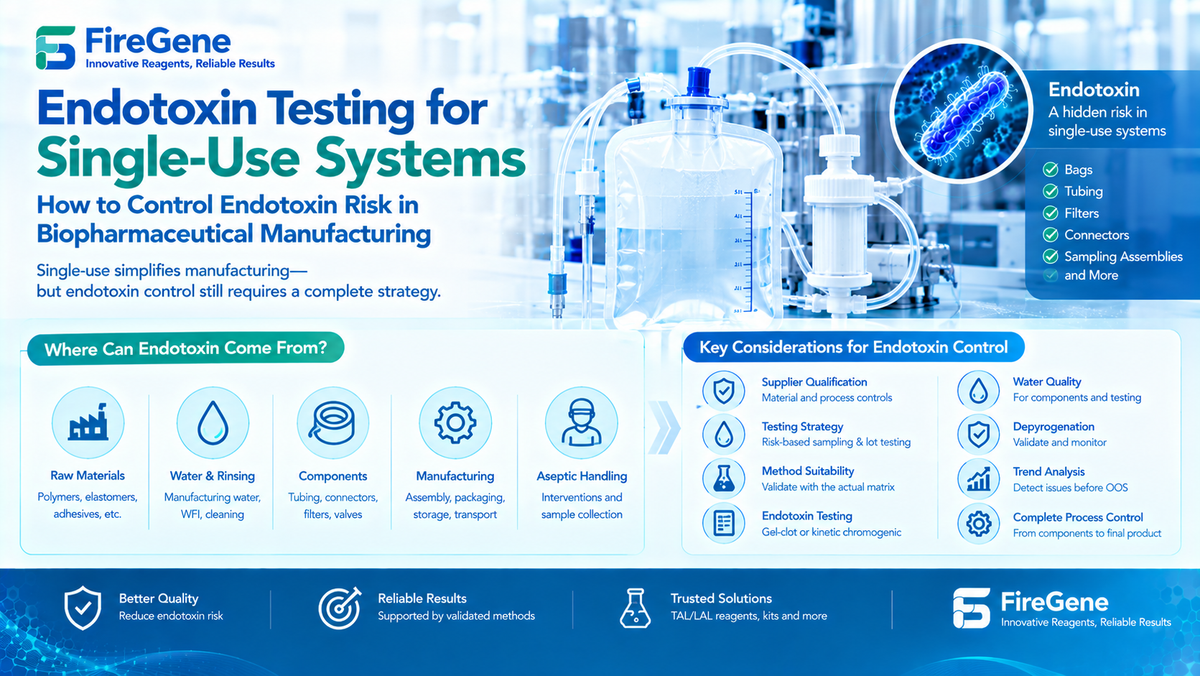
Introduction: Why Single-Use Systems Need an Endotoxin Strategy
Single-use systems (SUS) have become an important part of modern biopharmaceutical manufacturing.
Single-use bags, tubing assemblies, connectors, filters, sampling devices, mixing systems, and other disposable components can reduce cleaning requirements, shorten changeover time, and simplify manufacturing operations.
But eliminating cleaning and sterilization of reusable equipment does not eliminate contamination risk.
Instead, part of the contamination-control responsibility shifts upstream to:
-
Component manufacturing
-
Supplier qualification
-
Material handling
-
Washing and rinsing
-
Sterilization
-
Packaging
-
Storage
-
Transportation
-
Assembly
-
Incoming quality control
-
Pre-use preparation
Endotoxin is particularly important because a component can be sterile while still carrying bacterial endotoxin.
FDA inspection guidance specifically identifies tubing and other plastic devices as potential endotoxin sources when washing or rinsing introduces contamination. It also emphasizes that endotoxin is difficult to remove once present and that preventing contamination of components and finished products is preferable to relying on removal later.
This creates an important principle for single-use manufacturing:
A sterile single-use system is not automatically an endotoxin-controlled single-use system.
For biopharmaceutical manufacturers, endotoxin testing therefore needs to be considered alongside supplier qualification, material specifications, sterilization, storage, assembly, and process monitoring.
1. What Is a Single-Use System?
A single-use system is a disposable or predominantly disposable process assembly designed for one manufacturing campaign or use.
Depending on the process, it may include:
-
Single-use bags
-
Tubing
-
Sterile connectors
-
Aseptic connectors
-
Sampling assemblies
-
Filters
-
Filter housings
-
Mixing components
-
Disposable manifolds
-
Transfer assemblies
-
Sensors
-
Filling assemblies
-
Bioreactor bags
-
Media preparation bags
-
Buffer bags
-
Hold bags
In cell and gene therapy, vaccine manufacturing, recombinant protein production, monoclonal antibody manufacturing, and other biologics workflows, these components may come into direct or indirect contact with process materials.
The exact risk depends on the application.
A tubing segment used upstream may have a different risk profile from a component that directly contacts a final drug product.
A single-use bag used to prepare a buffer may have different requirements from a bag used for a final formulation.
Therefore, endotoxin control should be risk-based and application-specific.
2. Where Can Endotoxin Come From in a Single-Use System?
A common misconception is that because a single-use assembly is manufactured in a controlled environment and supplied sterile, endotoxin risk is automatically low.
The manufacturing and supply chain can introduce several potential sources.
Raw Materials
Polymer films, tubing materials, elastomers, adhesives, connectors, membranes, and other components may be exposed to microbial contamination during manufacturing.
If Gram-negative bacteria proliferate or leave residues during processing, endotoxin can become associated with the material.
Manufacturing Water
Water used during component processing, washing, or rinsing is another potential source.
FDA has specifically identified water involved in washing components such as filter media and rinsing tubing or plastic devices as a potential pathway for endotoxin contamination.
Assembly
A single-use system may contain dozens or even hundreds of components.
Every additional connection, surface, and manufacturing step creates another point that needs to be controlled.
Packaging and Storage
Even when a component has passed its initial quality testing, its condition during packaging, transportation, and storage remains relevant.
Damage to packaging, inappropriate storage conditions, or poor handling can undermine the intended contamination-control strategy.
Pre-Use Preparation
Some single-use components may require flushing, wetting, priming, or other preparation steps before use.
If the preparation process uses water or solutions that are not appropriately controlled, the manufacturing process may introduce endotoxin immediately before production.
3. Sterility and Endotoxin Are Two Different Quality Attributes
This distinction is critical.
A sterilization process is designed to control viable microorganisms.
Endotoxin is a component of the outer membrane of Gram-negative bacteria and can remain even after the organisms have been killed.
FDA guidance explicitly notes that sterilizing-grade filters and moist heat sterilization have not been shown to be effective methods for removing endotoxin.
This explains why the following statement is not sufficient:
“The single-use assembly is sterile, therefore it is endotoxin-free.”
The correct quality question is broader:
Has the single-use component been appropriately qualified for both its intended microbiological status and its endotoxin requirements?
This is particularly important when the system contacts:
-
Injectable drug products
-
Cell therapy products
-
Gene therapy products
-
Parenteral formulations
-
Biological intermediates
-
Final formulation solutions
4. Supplier Qualification Is the First Layer of Endotoxin Control
For single-use systems, the supplier can become an extension of the manufacturer's contamination-control strategy.
Supplier qualification should therefore go beyond checking whether the product is labeled “sterile.”
Depending on the component and intended application, manufacturers may evaluate:
-
Material specifications
-
Manufacturing location
-
Manufacturing process
-
Bioburden controls
-
Sterilization method
-
Endotoxin specifications
-
Endotoxin testing methodology
-
Certificate of Analysis
-
Packaging configuration
-
Storage conditions
-
Transportation controls
-
Change-control procedures
-
Historical quality performance
A supplier's endotoxin specification should also be interpreted in the context of the manufacturer's own process and product requirements.
For example, a component that is acceptable for an upstream buffer-transfer application may not automatically be suitable for direct contact with a final injectable formulation.
5. Why Lot-to-Lot Endotoxin Testing Matters
Single-use components are often purchased repeatedly from qualified suppliers.
Once a supplier has been qualified, it can be tempting to assume that every future lot will perform identically.
That assumption can create a blind spot.
Manufacturing processes can change.
Raw materials can change.
Subcontractors can change.
Sterilization cycles can change.
Packaging configurations can change.
Therefore, a risk-based program may include some combination of:
-
Supplier qualification
-
Incoming inspection
-
Certificate review
-
Periodic verification
-
Lot-based endotoxin testing
-
Change notification
-
Supplier performance trending
The appropriate frequency depends on the component, supplier history, intended use, and risk assessment.
EU GMP Annex 1 emphasizes quality risk management and states that raw materials and packaging materials should be adequately controlled and tested so that their bioburden and endotoxin/pyrogen levels are suitable for use.
6. Single-Use Bags Can Present a Unique Endotoxin Challenge
Large single-use bags can have substantial internal surface areas.
This becomes important because endotoxin contamination is not necessarily associated with one visible defect.
Potential risk factors include:
-
Film manufacturing
-
Sealing
-
Tubing attachment
-
Port assembly
-
Connector installation
-
Storage
-
Bag handling
-
Pre-use rinsing
-
Sampling
A bag may therefore require an endotoxin-control strategy that considers both the bag material and the complete assembly.
For example, testing a piece of film may not fully represent the endotoxin risk of a finished assembly containing:
-
Film
-
Tubing
-
Connectors
-
Filters
-
Sampling ports
-
Welded joints
This is why representative sampling is important.
7. Tubing and Connectors Should Not Be Overlooked
Tubing is often treated as a relatively simple component.
In reality, a single-use flow path can contain multiple tubing segments, connectors, branches, valves, and sampling points.
The more complex the assembly becomes, the more important it is to understand how the supplier controls contamination throughout manufacturing.
FDA's technical guidance specifically identifies tubing and other plastic devices as potential sources of endotoxin when washing and rinsing processes are not adequately controlled.
For high-risk applications, manufacturers should consider questions such as:
-
What material is the tubing made from?
-
How is it manufactured?
-
Is it washed or rinsed?
-
What water is used?
-
Is the final assembly tested?
-
Is endotoxin testing performed on representative lots?
-
How are tubing assemblies packaged?
-
How long can they be stored?
-
What happens after the package is opened?
These questions become particularly important when tubing directly contacts the product.
8. Filters Can Be an Unexpected Endotoxin Risk
Filters are frequently associated with microbial control.
However, a filter that helps remove microorganisms should not automatically be considered an endotoxin-removal step.
FDA guidance notes that sterilizing-grade filtration does not provide an established means of removing endotoxin.
This distinction is critical.
A process might look like:
Bioburden control → filtration → sterile product
while the actual endotoxin pathway is:
Endotoxin already present → filtration → endotoxin remains
In other words:
Removing bacteria is not equivalent to removing the endotoxin they may have produced.
This is why endotoxin control should occur upstream of the final filtration step whenever possible.
9. Water Quality Can Determine the Endotoxin Status of Single-Use Components
Water is one of the recurring connections between single-use systems and endotoxin contamination.
It may be used during:
-
Component manufacturing
-
Washing
-
Rinsing
-
Equipment preparation
-
Assembly
-
Laboratory testing
-
Sample dilution
A component can therefore begin with an acceptable endotoxin level and become contaminated during a poorly controlled rinse or preparation step.
This is not only a manufacturing concern.
It is also an analytical concern.
If endotoxin-free water is not used appropriately during sample preparation, the laboratory itself can introduce endotoxin into the test system.
FireGene's Endotoxin Assay Water can be incorporated into appropriate endotoxin testing workflows for reagent reconstitution, dilution, and control preparation.
For additional background, see FireGene's Endotoxin Assay Water Guide.
10. How Should Single-Use Components Be Sampled for Endotoxin Testing?
Sampling is one of the most difficult parts of a single-use endotoxin program.
A manufacturer may have thousands of individual components, but testing every component may not be practical.
The goal should therefore be to design a representative, risk-based sampling strategy.
Factors to consider include:
Component Type
A product-contact bag may have a different risk than a non-product-contact protective component.
Surface Area
Large surface areas may represent different contamination exposure than small components.
Product Contact
Direct-contact components generally deserve greater attention than components that never contact the process stream.
Manufacturing Process
Components involving extensive washing, assembly, or processing may warrant additional supplier controls.
Supplier History
Historical endotoxin results, deviations, changes, and complaints can influence testing frequency.
Intended Use
A component used for a final injectable product may require a different control strategy than one used during an early upstream operation.
11. Testing the Component vs. Testing the Extract
For many single-use materials, the analytical question is not simply:
“How much endotoxin is in this piece of plastic?”
Instead, the laboratory may need to determine how much endotoxin can be recovered from the material under a defined extraction or rinsing procedure.
This introduces additional variables:
-
Extraction volume
-
Extraction solution
-
Contact time
-
Temperature
-
Agitation
-
Surface area
-
Material characteristics
-
Recovery efficiency
The analytical method therefore needs to be suitable for the sample preparation approach.
This is one reason endotoxin testing for single-use components should not be treated as a simple extension of routine aqueous sample testing.
12. Method Suitability Is Essential
Single-use materials can introduce matrix effects into endotoxin testing.
Extracts may contain:
-
Polymer-related substances
-
Surfactants
-
Residual processing chemicals
-
Additives
-
Extractables
-
Leachables
-
High or low ionic strength solutions
These substances may interfere with endotoxin detection.
Depending on the assay and matrix, interference may result in:
-
Inhibition
-
Enhancement
-
Poor spike recovery
-
Nonlinear results
-
Unexpected variability
Therefore, laboratories should demonstrate that the selected endotoxin testing method is suitable for the actual sample preparation and matrix.
FireGene's Endotoxin Recovery Studies Guide provides a practical framework for understanding spike recovery and matrix suitability.
For broader method validation considerations, see How to Validate an Endotoxin Test Method.
13. Gel-Clot vs. Kinetic Chromogenic Testing for Single-Use Components
The choice of endotoxin assay should reflect the purpose of testing.
Gel-Clot Testing
Gel-clot testing can provide a straightforward qualitative endpoint.
It may be suitable when the testing objective is relatively simple and a pass/fail result is sufficient.
FireGene's Gel-Clot Endotoxin Test Kit provides a TAL-based gel-clot workflow with multiple sensitivity options.
Kinetic Chromogenic Testing
Kinetic chromogenic testing provides quantitative results and can be useful when manufacturers want more detailed analytical information.
Potential advantages include:
-
Quantitative results
-
Standard curve analysis
-
Broad analytical range
-
Higher-throughput plate-based workflows
-
Easier trend analysis
-
Greater visibility into changes between lots
FireGene's Kinetic Chromogenic Endotoxin Test Kit is designed for quantitative endotoxin testing with 405 nm detection.
FDA's March 2026 Pyrogen and Endotoxins Testing guidance describes gel-clot, photometric, and kinetic approaches within the current framework for bacterial endotoxin testing.
The key is not to choose a method simply because it is more quantitative.
The method should be fit for purpose and demonstrated to work with the actual sample matrix and preparation procedure.
14. What About Recombinant Endotoxin Testing Methods?
The endotoxin testing landscape is also evolving.
USP <86> provides additional techniques using non-animal-derived recombinant reagents, including recombinant Factor C and recombinant cascade reagent approaches. FDA's recognized standards database identifies USP <86> as a recognized consensus standard for medical-device applications, while the March 2026 FDA guidance discusses the broader bacterial endotoxin testing framework.
For manufacturers using single-use components, the key issue remains method suitability.
Whether a laboratory uses conventional lysate-based methods or an appropriate recombinant method, it still needs to demonstrate that the method performs adequately with the sample type being tested.
Technology selection should therefore follow the analytical requirement rather than the other way around.
15. Common Endotoxin Testing Mistakes with Single-Use Systems
Mistake 1: Assuming “sterile” means “endotoxin-free”
Sterility and endotoxin are different quality attributes.
Mistake 2: Testing only the raw material
The finished assembly may contain additional components and manufacturing steps that introduce risk.
Mistake 3: Ignoring supplier changes
A change in raw material, manufacturing location, washing process, sterilization process, or subcontractor may affect endotoxin performance.
Mistake 4: Assuming filtration removes endotoxin
Sterilizing-grade filtration is not a substitute for endotoxin control.
Mistake 5: Using non-qualified water for extraction or dilution
Water can become a direct source of analytical contamination.
Mistake 6: Testing without demonstrating recovery
A result is difficult to interpret if the laboratory has not demonstrated that the method can recover endotoxin from the sample matrix.
Mistake 7: Treating a failed lot as only a laboratory problem
An unexpected endotoxin result may originate from:
-
Supplier manufacturing
-
Washing or rinsing
-
Water
-
Assembly
-
Packaging
-
Storage
-
Sampling
-
Extraction
-
Analytical interference
A complete investigation should evaluate the entire chain.
16. A Practical Endotoxin Control Workflow for Single-Use Systems
A robust program can be organized into seven stages.
Stage 1: Define the Intended Use
Determine whether the single-use component contacts:
-
Raw materials
-
Buffers
-
Media
-
Process intermediates
-
Bulk drug substance
-
Final drug product
Stage 2: Map the Supplier Manufacturing Process
Understand where microbial and endotoxin contamination could occur.
Stage 3: Establish Component Specifications
Define appropriate endotoxin expectations based on the intended use and downstream process.
Stage 4: Qualify the Supplier
Review manufacturing controls, test methods, CoAs, change control, and historical quality performance.
Stage 5: Establish a Sampling Strategy
Determine which components and lots require routine, periodic, or qualification testing.
Stage 6: Demonstrate Analytical Suitability
Confirm that the endotoxin assay and extraction procedure provide reliable recovery.
Stage 7: Trend Results
Track results over time to identify:
-
Supplier drift
-
Lot-to-lot variability
-
Increasing endotoxin levels
-
Recurring contamination
-
Process changes
-
Emerging quality risks
This converts endotoxin testing from a simple incoming inspection into a process-monitoring tool.
17. From Supplier Qualification to Process Control
The strongest single-use endotoxin programs connect supplier quality with manufacturing quality.
A practical control chain looks like this:
Supplier Qualification
↓
Material & Component Specifications
↓
Manufacturing & Washing Controls
↓
Sterilization / Endotoxin Controls
↓
Packaging & Storage
↓
Incoming Inspection
↓
Representative Endotoxin Testing
↓
Method Suitability
↓
Process Use
↓
Trend Analysis
This approach is consistent with the risk-based contamination-control philosophy of EU GMP Annex 1, which requires sterile manufacturing processes and systems to be designed and controlled to prevent microbial, particulate, and endotoxin/pyrogen contamination.
18. Why Endotoxin Prevention Is Better Than Endotoxin Removal
Once endotoxin has entered a biopharmaceutical process, removing it can become difficult.
FDA guidance makes this point clearly: it is preferable to keep components and finished products relatively endotoxin-free rather than attempting to remove endotoxin after contamination has occurred.
For single-use systems, prevention can therefore be more practical than downstream remediation.
That means controlling:
-
Supplier manufacturing
-
Water quality
-
Component washing
-
Assembly
-
Packaging
-
Storage
-
Transportation
-
Sampling
-
Incoming testing
before the component reaches the production process.
This preventive approach becomes especially important for products where there is no practical downstream endotoxin-removal step.
19. Building a Risk-Based Single-Use Endotoxin Program
Not every single-use component requires the same level of testing.
A risk-based strategy can classify components according to factors such as:
High Risk
Direct contact with final injectable product or critical intermediates.
Moderate Risk
Direct contact with process solutions that later enter critical downstream steps.
Lower Risk
Indirect-contact or non-product-contact components with limited potential to affect product quality.
The exact classification should be established by the manufacturer's own quality risk management process.
The important principle is:
Testing frequency should follow risk—not simply component count.
A manufacturer may have hundreds of single-use components but only a subset may represent meaningful endotoxin risk.
20. The Future of Endotoxin Control in Single-Use Manufacturing
As biopharmaceutical manufacturing becomes more modular and disposable, single-use technology is likely to remain an important part of production.
That creates a corresponding need for more sophisticated contamination-control strategies.
Future endotoxin programs are likely to place greater emphasis on:
-
Supplier transparency
-
Digital lot traceability
-
Risk-based sampling
-
Quantitative endotoxin data
-
Process trending
-
Automated testing
-
Method suitability
-
Alternative endotoxin detection technologies
-
Integrated contamination-control strategies
The objective is not simply to test more components.
It is to obtain better information about where endotoxin risk originates and whether the process remains under control.
Conclusion: Single-Use Does Not Mean Single-Risk
Single-use systems can simplify biopharmaceutical manufacturing, but they do not eliminate endotoxin risk.
Bags, tubing, filters, connectors, sampling assemblies, and other disposable components can all become relevant to an endotoxin-control strategy.
The most effective approach combines:
-
Supplier qualification
-
Component specifications
-
Water-quality control
-
Manufacturing-process assessment
-
Sterility and endotoxin controls
-
Representative sampling
-
Method suitability
-
Appropriate TAL/LAL or other validated endotoxin testing methods
-
Lot-to-lot monitoring
-
Data trending
Most importantly, endotoxin should be controlled before it enters the manufacturing process, rather than treated solely as a final-product testing problem.
For laboratories developing or strengthening their endotoxin workflows, FireGene offers TAL/LAL endotoxin assay reagents and kits for research and quality-control applications.
Reliable endotoxin control begins long before the final sample reaches the QC laboratory.
In a single-use manufacturing environment, every bag, tube, filter, connector, and rinse can be part of the endotoxin story.
FireGene Endotoxin Testing
Ready to run your endotoxin assay?
FireGene offers a complete endotoxin testing toolkit — from TAL reagents and CSE standards to pyrogen-free consumables and LAL reagent water. All products are aligned with USP <85>, EP 2.6.14, and JP 4.01.


