
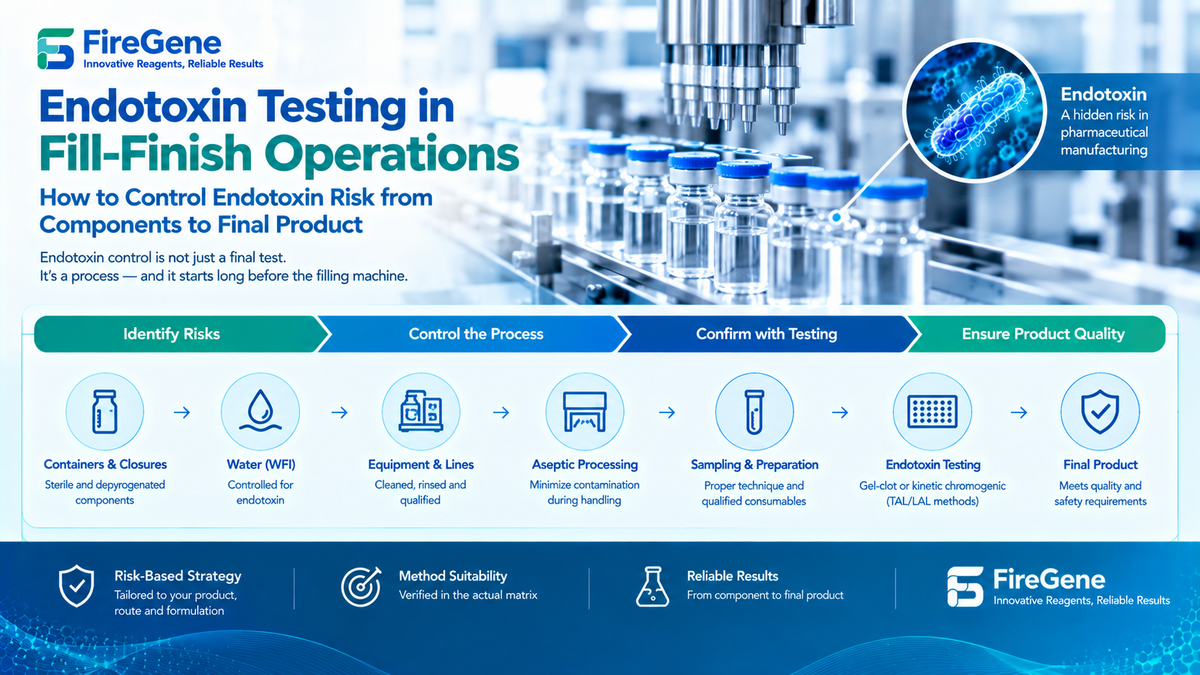
Introduction: Why Fill-Finish Is a Critical Endotoxin Control Point
In pharmaceutical manufacturing, endotoxin control does not end when the active ingredient or bulk formulation has passed quality control.
The fill-finish operation introduces another series of potential contamination pathways.
During filling and final packaging, a product may come into contact with:
- Sterile or depyrogenated containers
- Rubber stoppers and other closures
- Filling needles and tubing
- Product-contact equipment
- Transfer lines
- Single-use assemblies
- Filters and filter housings
- Water used for preparation or rinsing
- Personnel and aseptic interventions
- Temporary holding vessels
- Primary packaging components
For sterile parenteral products, controlling microbial contamination alone is not enough. Endotoxin and other pyrogenic contamination must also be controlled because sterilization and depyrogenation are not interchangeable processes.
FDA guidance on aseptic processing states that containers and closures for parenteral drug products should be rendered both sterile and nonpyrogenic, and that depyrogenation processes should be appropriately validated.
The practical implication is important:
A sterile filling process can still have an endotoxin problem.
This is why endotoxin testing should be considered as part of an integrated fill-finish control strategy rather than simply a final-product laboratory test.
What Makes Fill-Finish Different from Earlier Manufacturing Stages?
Before filling, a pharmaceutical product may have already passed several endotoxin controls.
Raw materials may have been qualified.
Water may have been monitored.
Process intermediates may have been tested.
Purification steps may have reduced endotoxin levels.
However, the final filling operation can introduce new risks.
Consider a simple workflow:
Bulk formulation → transfer → sterile filtration → filling → stoppering → capping → final container
Every transition creates an opportunity for contamination or loss of control.
The risk is especially important for products that cannot undergo a later process capable of removing endotoxin.
FDA inspection guidance has emphasized that endotoxin is difficult to remove once it is present and that preventing contamination of components and finished products is preferable to attempting removal later.
This makes fill-finish a particularly important point for preventive endotoxin control.
1. Where Can Endotoxin Enter During Fill-Finish?
A useful fill-finish endotoxin assessment begins by mapping every product-contact surface.
Containers
Glass vials, cartridges, syringes, and other primary containers may carry endotoxin contamination if washing, rinsing, storage, or depyrogenation is inadequate.
For parenteral products, FDA recommends that container preparation include appropriate washing and rinsing procedures and that final rinse water meet the appropriate high-purity requirements.
Closures
Rubber stoppers and other closure components can become contaminated before they enter the filling area.
Even when a component is supplied as sterile, sterility does not automatically mean the component is free from endotoxin.
This distinction is fundamental:
Sterilization controls viable microorganisms. Depyrogenation controls pyrogenic contamination such as bacterial endotoxin.
Filling Equipment
Filling needles, tubing, manifolds, pumps, vessels, connectors, and other product-contact components may become endotoxin sources if cleaning, storage, rinsing, or sterilization/depyrogenation processes are inadequate.
FDA has specifically identified washing and rinsing of tubing, plastic devices, and other components as potential pathways for endotoxin contamination.
Water
Water is one of the most important potential sources of endotoxin during pharmaceutical processing.
Water may be involved in:
- Equipment cleaning
- Component washing
- Final rinsing
- Solution preparation
- Buffer preparation
- Product formulation
- Sampling procedures
The use of appropriately controlled water therefore needs to be considered together with the endotoxin testing strategy.
For practical laboratory testing, FireGene's Endotoxin Assay Water can be incorporated into dilution, reconstitution, and control preparation workflows where suitable.
Aseptic Interventions
Every intervention creates an opportunity for contamination.
EU GMP Annex 1 specifically requires precautions to minimize microbial, endotoxin/pyrogenic, and particle contamination throughout aseptic processing until the product is sealed in its final container.
The objective is therefore not simply to test the final vial. It is to design the process so that endotoxin contamination is unlikely to occur in the first place.
2. Sterilization Does Not Mean Depyrogenation
One of the most common misconceptions in pharmaceutical manufacturing is that a validated sterilization process automatically resolves endotoxin risk.
It does not.
Endotoxins are relatively heat-stable bacterial components. A process capable of destroying microorganisms may not provide an equivalent level of endotoxin destruction.
This is why depyrogenation needs its own validation strategy.
USP General Chapter <1228> describes depyrogenation as the validated destruction or removal of pyrogens, with bacterial endotoxins being the most prevalent and quantifiable pyrogen considered in the chapter series. The series addresses depyrogenation of product streams, equipment, containers, and closures.
For heat-stable glass components, dry heat is commonly used.
For certain heat-sensitive materials, physical removal methods such as rinsing may be considered. USP <1228.4> specifically discusses depyrogenation by rinsing for heat-labile equipment, components, ingredients, containers, closures, and some medical devices.
The key QC question is therefore not:
“Was the component sterilized?”
It is:
“Was the component demonstrated to be both microbiologically controlled and adequately controlled for endotoxin?”
3. Depyrogenation Validation Requires More Than a Temperature Setting
A depyrogenation oven or tunnel may have a validated temperature range, but successful depyrogenation depends on the actual process configuration.
FDA's aseptic processing guidance recommends that depyrogenation validation for glass containers include appropriate heat distribution and penetration studies, worst-case process cycles, container characteristics, and loading configurations representative of production.
This matters because endotoxin destruction can vary depending on:
- Container size
- Glass mass
- Surface area
- Loading configuration
- Heat penetration
- Exposure time
- Temperature profile
- Equipment configuration
- Initial endotoxin challenge
A process that works for one vial configuration should not automatically be assumed to perform identically for another.
Endotoxin Challenge Studies
One important approach is to deliberately challenge containers or closures with a known endotoxin level and then measure the remaining endotoxin after processing.
FDA describes this type of challenge study for evaluating depyrogenation and notes that validation data should demonstrate adequate endotoxin reduction.
This turns endotoxin testing from a simple release test into a process-validation tool.
4. The Role of Containers and Closures in Endotoxin Control
The primary container closure system deserves particular attention because it is the final physical barrier between the product and the external environment.
Potential components include:
- Glass vials
- Plastic containers
- Syringes
- Cartridges
- Rubber stoppers
- Plungers
- Caps
- Elastomeric components
- Device constituent parts
The FDA's 2026 draft guidance on Container Closure Systems for Human Drugs and Biological Products highlights the importance of evaluating the quality of container closure systems used for drug and biological products.
For endotoxin control, this means manufacturers should consider not only whether components are supplied as sterile, but also:
- How were they manufactured?
- How were they washed?
- What water was used?
- Were they depyrogenated?
- How was depyrogenation validated?
- How were they stored?
- How were they transferred into the aseptic area?
- How were samples collected?
- What controls demonstrate continued suitability?
The supplier's documentation can be an important part of the qualification process, but the manufacturer's own quality system still needs to establish how components are accepted and controlled for their intended use.
FDA's current CGMP Q&A also notes that sampling of containers or closures that purport to be sterile or depyrogenated should occur under conditions equivalent to the claimed quality of the material to protect sample integrity.
5. Endotoxin Testing Should Follow the Product and Process Risk
There is no single endotoxin testing workflow that fits every pharmaceutical fill-finish process.
The appropriate approach depends on:
- Product type
- Route of administration
- Maximum dose
- Endotoxin limit
- Formulation
- Matrix characteristics
- Container closure system
- Manufacturing process
- Sampling strategy
- Testing method
- Method suitability
For products requiring bacterial endotoxin testing, the analytical method must be capable of detecting endotoxin at the relevant level without unacceptable interference from the product matrix.
FireGene's Endotoxin Assay Sensitivity Guide provides a useful starting point for understanding how assay sensitivity relates to testing strategy.
For more complex products, Endotoxin Testing Sensitivity, LOD, LOQ, and MVD Explained can help connect assay sensitivity with dilution strategy and the maximum valid dilution.
6. Method Suitability Becomes Critical for Final Product Testing
A final drug product is not necessarily an ideal analytical matrix.
Formulations may contain:
- Proteins
- Lipids
- Surfactants
- Polymers
- Preservatives
- Salts
- Buffers
- High concentrations of active ingredients
- Particles or suspensions
These components can interfere with endotoxin detection.
Depending on the assay format, interference may result in:
- Inhibition
- Enhancement
- Poor spike recovery
- Nonlinear standard curves
- Delayed reaction kinetics
- Unexpected variability
This is why simply obtaining a numerical endotoxin result is not enough.
The laboratory needs confidence that the analytical method is actually measuring endotoxin correctly in that specific matrix.
FireGene's Endotoxin Recovery Studies Guide provides additional guidance on recovery experiments and method suitability.
For a broader validation workflow, see How to Validate an Endotoxin Test Method.
7. Choosing Between Gel-Clot and Kinetic Chromogenic Testing
Both qualitative gel-clot and quantitative photometric approaches can have roles in endotoxin testing, but the choice should be based on the analytical and manufacturing requirements.
Gel-Clot Endotoxin Testing
Gel-clot testing is straightforward and provides a qualitative endpoint based on clot formation.
It can be useful when:
- Testing is relatively simple
- A pass/fail endpoint is appropriate
- Laboratory throughput is moderate
- Quantitative kinetic information is not required
FireGene's Gel-Clot Endotoxin Test Kit is designed for this type of endotoxin testing workflow.
Kinetic Chromogenic Testing
Kinetic chromogenic testing provides quantitative results based on the relationship between endotoxin concentration and reaction kinetics.
It can be particularly useful when laboratories need:
- Quantitative measurements
- Standard curve analysis
- Higher throughput
- More detailed trend information
- Better integration with laboratory data workflows
FireGene's Kinetic Chromogenic Endotoxin Test Kit provides a quantitative TAL-based approach with a broad assay range and 405 nm detection.
The choice should not be based simply on which method is “more advanced.”
The better question is:
Which method can demonstrate reliable performance in the actual product matrix and manufacturing workflow?
8. Sampling Strategy: Do Not Treat the Final Vial as the Only Risk Point
Endotoxin sampling should be connected to the process risk assessment.
Depending on the manufacturing operation, relevant control points may include:
- Incoming components
- Purified water or WFI systems
- Product-contact equipment
- Bulk formulation
- Pre-fill product
- Post-filtration material
- Filling components
- Container/closure systems
- Final drug product
This does not mean every item must automatically receive routine endotoxin testing.
Instead, the manufacturer should identify where testing provides meaningful information about process control.
EU GMP Annex 1 takes a risk-based approach to contamination control and requires a Contamination Control Strategy that addresses microbial, endotoxin/pyrogenic, and particulate risks throughout sterile manufacturing.
A well-designed sampling strategy therefore asks:
Where could endotoxin enter, where could it increase, and where can testing provide useful evidence that the process remains under control?
9. Endotoxin Control Should Be Connected to Water-System Monitoring
Water is often the common denominator connecting multiple fill-finish activities.
A single water-quality problem can potentially affect:
- Component washing
- Equipment rinsing
- Buffer preparation
- Formulation
- Cleaning
- Laboratory dilution
- Sample preparation
This makes water monitoring an important upstream control for endotoxin testing.
FireGene's article Why Water System Monitoring Is the Foundation of Reliable Endotoxin Testing discusses this relationship in greater detail.
For laboratory testing itself, using appropriately controlled endotoxin-free water is equally important.
Otherwise, the laboratory may introduce endotoxin during dilution or reagent preparation and mistake the contamination for a product-related result.
10. Common Fill-Finish Endotoxin Testing Mistakes
Several recurring mistakes can weaken an otherwise well-designed QC program.
Mistake 1: Assuming sterilization equals depyrogenation
A sterile component can still contain endotoxin.
Mistake 2: Testing only the final product
Final-product testing is important, but it cannot replace upstream process controls.
Mistake 3: Ignoring container and closure risk
Primary packaging components are part of the product-contact system and require appropriate qualification.
Mistake 4: Using unsuitable rinse water
Water quality can directly affect component and equipment endotoxin status.
Mistake 5: Skipping matrix suitability
A method that works well for water may not work the same way for a protein formulation, lipid formulation, suspension, or other complex product.
Mistake 6: Treating an OOS result as an isolated laboratory problem
An unexpected endotoxin result may originate from:
- Sampling
- Water
- Components
- Equipment
- Cleaning
- Depyrogenation
- Storage
- Handling
- Product matrix interference
- Analytical execution
FireGene's False Positive Endotoxin Results Guide provides a more detailed framework for investigating unexpected endotoxin results.
11. A Practical Fill-Finish Endotoxin Control Workflow
A robust approach can be organized into six stages.
Step 1: Map the Product-Contact Path
Identify every material and surface that can contact the product from bulk formulation through final sealing.
Step 2: Identify Potential Endotoxin Sources
Review water, raw materials, components, equipment, cleaning processes, storage, and aseptic interventions.
Step 3: Define Depyrogenation Controls
Where depyrogenation is required, establish appropriate process parameters and validate performance using representative or worst-case configurations.
Step 4: Establish Analytical Suitability
Confirm that the selected endotoxin testing method performs adequately in the actual sample matrix.
Step 5: Build a Risk-Based Sampling Plan
Determine which stages require routine monitoring, periodic verification, supplier qualification, or process validation support.
Step 6: Trend the Results
A single passing result does not necessarily demonstrate long-term process control.
Trend analysis can reveal:
- Gradual increases
- Process drift
- Component-related changes
- Water-system issues
- Recurring sampling problems
- Emerging contamination risks
FireGene's Endotoxin Testing Trend Analysis Guide discusses how QC laboratories can use endotoxin data proactively rather than waiting for an OOS result.
12. Building a More Preventive Endotoxin Strategy
The most effective endotoxin program is not built around one final test.
It is built around multiple layers of control.
Supplier qualification
↓
Raw material and water control
↓
Component qualification
↓
Cleaning and rinsing
↓
Depyrogenation validation
↓
Aseptic processing
↓
Fill-finish controls
↓
Method suitability
↓
Final product endotoxin testing
↓
Trend analysis and continuous monitoring
This layered approach is consistent with the broader direction of modern sterile manufacturing: endotoxin should be controlled throughout the process rather than treated as a problem that can simply be detected at the end.
FDA's March 2026 Pyrogen and Endotoxins Testing Q&A describes current FDA thinking around USP <85>, USP <161>, and AAMI ST72, including gel-clot, photometric, and kinetic testing approaches and the testing of appropriate components and finished products.
Conclusion: Endotoxin Control Does Not Stop at the Filling Machine
Fill-finish operations represent one of the final opportunities to prevent endotoxin from reaching the patient.
By the time a product reaches the filling line, many upstream controls have already been established. But the process is still exposed to risks associated with containers, closures, water, product-contact equipment, aseptic interventions, storage, and handling.
The key lesson is simple:
Sterility, depyrogenation, and endotoxin testing are related—but they are not the same control.
A strong fill-finish endotoxin strategy should connect:
- Component qualification
- Water quality
- Depyrogenation validation
- Aseptic processing
- Product-contact equipment control
- Sampling strategy
- Method suitability
- Appropriate TAL/LAL reagents
- Final product testing
- Data trending
For laboratories looking to strengthen their endotoxin testing workflow, FireGene provides TAL/LAL endotoxin assay reagents and kits for research and quality-control applications.
Ultimately, reliable endotoxin control is not about adding another test at the end of manufacturing.
It is about designing the entire fill-finish process so that endotoxin has fewer opportunities to enter, persist, or go undetected.
Frequently Asked Questions
Is a sterile vial automatically endotoxin-free?
No. Sterility and endotoxin control address different contamination risks. A component can be sterile while still requiring appropriate control for endotoxin.
Why is depyrogenation important during fill-finish?
Depyrogenation specifically addresses the destruction or removal of pyrogenic contamination such as bacterial endotoxin. USP <1228> and related chapters describe validated approaches for depyrogenation of products, equipment, containers, and closures.
Can endotoxin enter through container closures?
Yes. Containers and closures are potential product-contact components and should be appropriately controlled and qualified for their intended use.
Does WFI eliminate all endotoxin risk?
No. Properly controlled water is an important part of endotoxin prevention, but contamination can still be introduced through components, equipment, handling, storage, or other process steps.
Which endotoxin method should be used for fill-finish products?
There is no universal answer. Gel-clot, kinetic chromogenic, and other appropriate methods may be used depending on the product, intended application, analytical requirements, and demonstrated method suitability.
Should endotoxin be tested only in the final product?
Final-product testing can be an important control, but a comprehensive strategy should also consider upstream sources and process controls. Risk-based sampling and contamination control provide additional assurance.
FireGene Endotoxin Testing
Ready to run your endotoxin assay?
FireGene offers a complete endotoxin testing toolkit — from TAL reagents and CSE standards to pyrogen-free consumables and LAL reagent water. All products are aligned with USP <85>, EP 2.6.14, and JP 4.01.


