
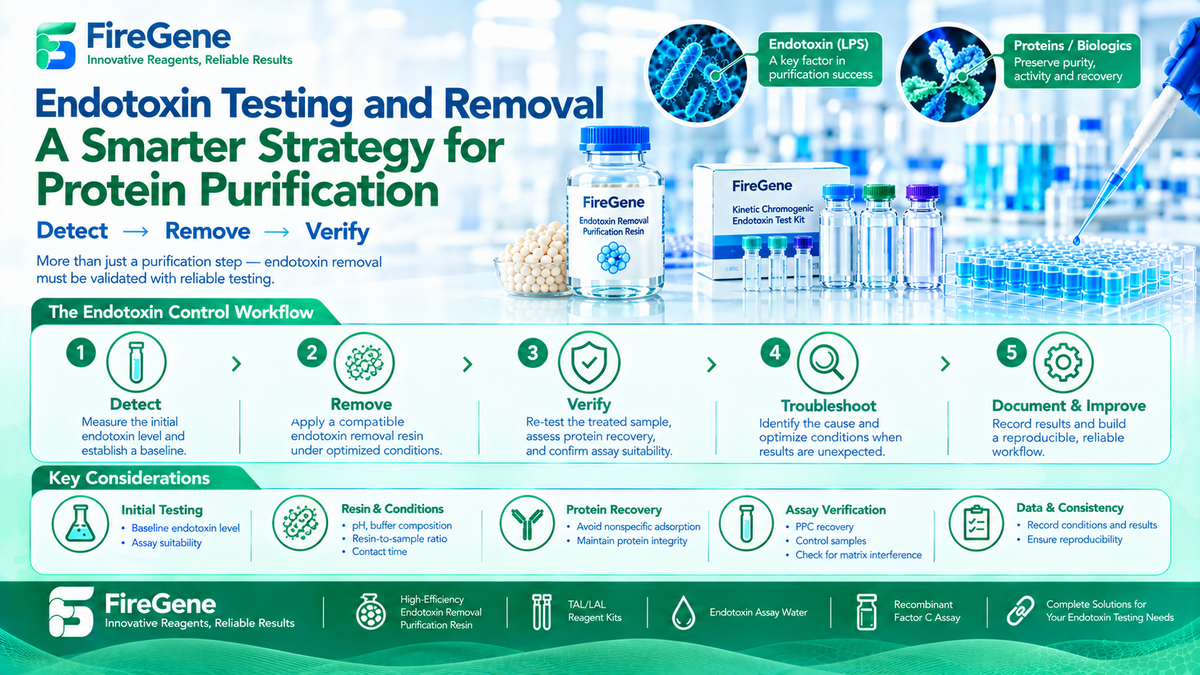
Introduction: Why Endotoxin Testing Is Essential During Protein Purification
Endotoxin contamination remains a persistent challenge in recombinant protein purification, antibody development, vaccine antigen research, and other biological workflows. Endotoxins are lipopolysaccharides (LPS) associated with the outer membrane of Gram-negative bacteria. Even when a protein preparation appears pure by conventional analytical methods, residual endotoxin may still interfere with downstream experiments.
In cell-based studies, endotoxin contamination can trigger inflammatory signaling, alter cell responses, and introduce confounding variables. In animal research, residual endotoxin may affect experimental outcomes and complicate data interpretation. For protein purification teams, the challenge is therefore not simply to produce a sample with high protein purity, but to control endotoxin levels without compromising protein recovery or biological activity.
This is where endotoxin testing and endotoxin removal must work together.
Endotoxin testing establishes the initial contamination level, helps researchers evaluate the effectiveness of a removal process, and confirms whether the treated sample meets its predefined acceptance criteria. An endotoxin removal resin provides a targeted purification step, while post-treatment testing determines whether the process has achieved the intended result.
A practical workflow follows three essential stages:
-
Detect: Measure the initial endotoxin level and establish a baseline.
-
Remove: Apply a compatible endotoxin removal resin under optimized conditions.
-
Verify: Re-test the treated sample, assess protein recovery, and confirm assay suitability.
FireGene supports this workflow with its High-Efficiency Endotoxin Removal Purification Resin and quantitative Kinetic Chromogenic Endotoxin Test Kit.
The key principle is simple: a purification step is not validated by the removal process alone. Its effectiveness must be demonstrated through appropriate analytical testing.
1. Understanding Endotoxin Contamination in Protein Purification
1.1 Where Does Endotoxin Come From?
Endotoxin contamination can enter a protein purification workflow through several routes:
-
Expression systems: Recombinant proteins expressed in Escherichia coli may become contaminated with bacterial endotoxins during cell disruption and downstream processing.
-
Buffers and reagents: Water, buffer components, and other process materials may introduce endotoxin if their quality is not adequately controlled.
-
Purification equipment and consumables: Inadequately controlled contact surfaces, containers, and consumables can contribute to contamination.
-
Sample handling: Cross-contamination during transfer, concentration, storage, or repeated processing may increase the endotoxin burden.
Because endotoxin can remain in a sample after bacterial cells have been removed, standard filtration or sterilization should not be assumed to eliminate endotoxin. Endotoxin control requires a dedicated strategy appropriate to the sample and intended application.
1.2 Why Protein Purity Does Not Guarantee Low Endotoxin
Protein purity and endotoxin content are different quality attributes.
SDS-PAGE, chromatography profiles, and other protein-focused analytical techniques can help characterize the target molecule, but they do not independently establish that a sample has an acceptable endotoxin level.
A sample may show a strong target-protein band and a clean chromatographic profile while still containing biologically significant endotoxin. Conversely, a process that removes endotoxin may also cause target-protein loss, aggregation, or changes in biological activity.
A robust purification workflow should therefore evaluate at least three outcomes:
-
Residual endotoxin concentration
-
Target-protein recovery
-
Target-protein integrity or functional activity, where relevant
This multidimensional assessment is especially important when preparing proteins for sensitive cell-based experiments, animal studies, or other applications in which endotoxin can alter biological responses.
2. How Endotoxin Removal Resin Supports Protein Purification
Endotoxin removal resins provide a dedicated adsorption-based approach for reducing endotoxin contamination in compatible biological samples.
FireGene's High-Efficiency Endotoxin Removal Purification Resin uses modified Polymyxin B immobilized on 4% agarose microspheres. The ligand is designed to interact with endotoxin, helping separate it from compatible target-containing samples.
According to the product specifications, the resin has a listed binding capacity greater than 2,000,000 EU/mL of matrix, a pH operating range of 5–10, and a maximum pressure of 0.1 MPa (1 bar). These are product specifications, not guarantees of performance in every sample matrix.
Actual removal efficiency and protein recovery depend on the sample's endotoxin burden, protein characteristics, buffer composition, pH, contact time, loading conditions, and other process variables.
2.1 Why Use Resin as a Polishing Step?
An endotoxin removal resin can be evaluated as a polishing step after initial protein purification, including after affinity chromatography, where appropriate.
Potential advantages include:
-
Targeted endotoxin reduction in compatible protein preparations
-
Integration into an existing purification workflow
-
Flexible optimization of pH, buffer composition, and loading conditions
-
Quantitative assessment through pre-treatment and post-treatment endotoxin testing
However, resin treatment should not be considered a universal solution for every biomolecule. Each target and matrix requires application-specific evaluation, particularly when protein structure, activity, or recovery is critical.
2.2 Key Application Areas
Recombinant proteins
Recombinant proteins expressed in bacterial systems may require an additional endotoxin reduction step before cell-based assays or animal studies. Resin treatment can be evaluated after the main purification process to reduce residual endotoxin while monitoring target recovery.
Antibodies and Fc-fusion proteins
Antibodies and Fc-fusion proteins may undergo affinity purification before endotoxin polishing. The removal step should be optimized to minimize nonspecific adsorption and preserve antibody integrity, binding activity, and recovery.
Vaccine antigens and biologics research
Vaccine antigen development and other biologics research workflows may require close control of endotoxin contamination. Resin compatibility, assay interference, and post-treatment acceptance criteria should be established for each specific formulation.
Peptides and other compatible biological samples
Some peptides and other biological preparations may also benefit from resin-based endotoxin reduction. Their suitability depends on molecular properties, sample composition, and the interaction between the target and the resin.
The appropriate workflow should be determined by experimental evidence rather than assuming that one set of conditions will work equally well for all sample types.
3. Step One: Measure the Initial Endotoxin Level
Before applying an endotoxin removal resin, determine the sample's initial endotoxin concentration whenever the selected method and sample permit reliable quantification.
This baseline provides a reference for evaluating removal performance and helps inform resin loading and process development.
3.1 Select an Appropriate Endotoxin Assay
TAL/LAL-based methods are commonly used to detect and quantify bacterial endotoxins. Two useful formats are gel-clot and kinetic chromogenic assays.
Gel-clot endotoxin testing
The gel-clot method is useful for qualitative or limit-based assessment. It can help determine whether a sample's endotoxin response is above or below a defined assay sensitivity, provided the method is suitable for the sample.
Explore the FireGene Gel-Clot Endotoxin Test Kit.
Kinetic chromogenic endotoxin testing
The kinetic chromogenic method monitors color development over time and uses the assay calibration relationship to estimate endotoxin concentration. Quantitative results are particularly useful when comparing samples collected before and after resin treatment.
Explore the FireGene Kinetic Chromogenic Endotoxin Test Kit.
The assay should be selected according to the required sensitivity, sample matrix, intended use, and analytical workflow.
3.2 Establish a Reliable Baseline
For a quantitative workflow, record the initial endotoxin concentration as C0, expressed in EU/mL, after accounting for the assay's dilution and calculation requirements.
Document the following information:
-
Initial endotoxin concentration
-
Sample volume and protein concentration
-
Buffer composition and pH
-
Sample dilution and assay conditions
-
Applicable assay acceptance criteria
The initial endotoxin result is only meaningful when the assay can reliably detect endotoxin in the specific sample matrix. A high protein concentration, buffer components, or other formulation ingredients may inhibit or enhance the assay response.
Where necessary, perform method suitability testing before using the result to guide purification decisions.
4. Step Two: Optimize Resin Treatment Conditions
Once the initial endotoxin level has been established, the next step is to evaluate resin treatment under conditions compatible with the target protein.
The goal is not simply to maximize endotoxin binding. It is to achieve an acceptable reduction while preserving protein recovery and function.
4.1 Evaluate pH and Buffer Composition
pH can influence interactions between endotoxin, the resin ligand, and the target protein.
FireGene's product guidance recommends investigating pH adjustment when endotoxin removal efficiency is low, with pH 7–8 suggested as a troubleshooting starting point. This range should not be treated as universally optimal for every protein. The target's stability and solubility must also be considered.
Buffer composition can affect nonspecific adsorption and protein recovery. If target recovery is low, FireGene's product guidance suggests evaluating the NaCl concentration in both the sample and equilibration buffer.
Any change should be assessed experimentally because ionic strength may affect the target protein, endotoxin binding, and downstream assay performance differently.
4.2 Determine an Appropriate Resin-to-Sample Ratio
Resin requirements depend on the endotoxin burden and the characteristics of the sample. FireGene's product guidance suggests that a resin-to-sample volume ratio of 1:1 or 1:2 may serve as an initial experimental starting point when the endotoxin content is unknown.
This is a starting point for process development, not a universal operating requirement. A measured endotoxin concentration, pilot experiments, and recovery data should guide subsequent optimization.
Where a packed column is used, flow rate and contact time also matter. FireGene's guidance specifies that, for a 40 mL resin bed in the described setup, the flow rate should not exceed 4 mL/min to maintain a contact time greater than 10 minutes. Other column geometries, sample properties, and operating conditions may require different settings.
Follow the current product instructions and verify the selected conditions for the intended application.
4.3 Protect Protein Recovery
Endotoxin removal should not come at the expense of the target molecule.
Protein loss may occur through nonspecific adsorption, precipitation, aggregation, or incompatibility with the treatment conditions. To investigate these effects:
-
Measure the protein amount before and after treatment.
-
Evaluate target-protein integrity using an appropriate analytical method.
-
Check biological activity where function is important.
-
Compare buffer conditions and resin loading across pilot experiments.
-
Monitor sample volume changes and dilution introduced during processing.
For a fair comparison, use consistent sample handling and analytical methods before and after treatment.
4.4 Use Appropriate Handling and Storage Practices
Good handling practices are essential to prevent recontamination and preserve resin performance.
Follow the manufacturer's instructions for resin regeneration, equilibration, storage, and use. FireGene specifies storage at 2–8°C in the supplied storage solution and a shelf life of two years under the specified storage conditions.
Use endotoxin-controlled water, buffers, containers, and consumables. Do not reuse resin between different samples, because residual material from a previous run may introduce cross-contamination.
For additional specifications and handling guidance, refer to the official FireGene Endotoxin Removal Purification Resin page.
5. Step Three: Verify Endotoxin Reduction After Treatment
Post-treatment endotoxin testing is an essential part of the workflow. Resin treatment alone does not demonstrate that the final sample meets its intended endotoxin requirement.
Re-test the treated sample using a suitable TAL/LAL assay, and interpret the result together with protein recovery and assay suitability data.
5.1 Calculate Endotoxin Reduction
Use the initial and post-treatment endotoxin concentrations to calculate the percentage reduction.
Formula:
Endotoxin Reduction (%) = [(C0 − C1) / C0] × 100
Where:
-
C0 = endotoxin concentration before treatment (EU/mL)
-
C1 = endotoxin concentration after treatment (EU/mL)
Example:
If the initial endotoxin concentration is 50 EU/mL and the post-treatment concentration is 5 EU/mL:
Endotoxin Reduction (%) = [(50 − 5) / 50] × 100 = 90%
The treatment achieved a 90% reduction in the measured endotoxin concentration under the conditions of this example.
This percentage describes the reduction in concentration. If sample volume changes substantially during treatment, a concentration-based calculation does not by itself represent the change in total endotoxin amount. For a complete mass-balance assessment, consider both concentration and volume.
If the post-treatment result is below the assay's quantification limit, do not automatically treat it as zero. Report and calculate the result according to the method's validated reporting rules.
5.2 Calculate Protein Recovery
Endotoxin reduction is only one measure of process performance. Protein recovery indicates how much of the target protein remains after treatment.
Formula:
Protein Recovery (%) = (Recovered Protein Amount / Initial Protein Amount) × 100
Example:
If the initial sample contains 100 mg of target protein and 80 mg is recovered after resin treatment:
Protein Recovery (%) = (80 mg / 100 mg) × 100 = 80%
The protein recovery is 80%.
When the initial and final samples have different volumes, calculate protein amount using the measured protein concentration and corresponding sample volume:
Protein Amount (mg) = Protein Concentration (mg/mL) × Sample Volume (mL)
Use the same basis for the initial and recovered samples, and account for any sampling losses or intermediate fractions when relevant.
5.3 Interpret Endotoxin Reduction and Protein Recovery Together
The two calculations answer different questions:
-
Endotoxin reduction evaluates how effectively the treatment lowers the measured endotoxin concentration.
-
Protein recovery evaluates how much target protein remains after treatment.
A high endotoxin reduction accompanied by poor protein recovery may indicate that the process needs further optimization. Conversely, high protein recovery with insufficient endotoxin reduction may indicate that the treatment conditions, resin loading, or contact time are inadequate.
The most suitable process is the one that meets predefined endotoxin acceptance criteria while maintaining acceptable protein yield and quality for the intended application.
6. Confirm TAL/LAL Assay Suitability in the Treated Matrix
A post-treatment result is only reliable if the endotoxin assay performs appropriately in the treated sample matrix.
Protein solutions and buffer components may interfere with endotoxin detection. Treatment can also change the matrix by altering pH, salt concentration, or the concentrations of other sample components.
6.1 Check for Inhibition or Enhancement
Inhibition can suppress the assay response and make endotoxin levels appear lower than they actually are. Enhancement can produce an exaggerated response.
A suitable method suitability assessment should follow the requirements of the applicable assay procedure and relevant regulatory or compendial guidance. Depending on the method, this may include positive product control (PPC) recovery, appropriate dilution studies, and confirmation that the sample does not interfere with the assay.
If the sample fails method suitability, investigate dilution, buffer composition, sample preparation, and other matrix-related factors before concluding that the endotoxin removal step was successful.
6.2 Use Quantitative Testing for Process Comparisons
A kinetic chromogenic assay can support quantitative comparison of pre-treatment and post-treatment samples when the concentrations fall within the method's validated working range.
The assay should be run according to its instructions, including the specified temperature, wavelength, timing, calibration, and acceptance criteria. The product's nominal analytical range does not replace validation of the working range for a particular sample matrix.
FireGene's Kinetic Chromogenic Endotoxin Test Kit can be considered for this type of quantitative verification when the method is suitable for the sample.
7. Common Challenges and How to Troubleshoot Them
Challenge 1: Endotoxin Reduction Is Lower Than Expected
Possible causes include unsuitable pH, insufficient contact time, excessive sample loading, or an incompatible buffer composition.
What to evaluate:
-
Confirm the initial endotoxin measurement and assay suitability.
-
Review the sample pH and evaluate the manufacturer's recommended troubleshooting range.
-
Check the resin-to-sample ratio and operating conditions.
-
Compare endotoxin results from controlled pilot runs.
Change one major parameter at a time where practical so that its effect can be interpreted.
Challenge 2: Protein Recovery Is Low
Low recovery may reflect nonspecific adsorption, protein instability, precipitation, or losses during sample transfer.
What to evaluate:
-
Compare protein concentration and total protein amount before and after treatment.
-
Examine sample clarity, aggregation, and target integrity.
-
Investigate the effect of NaCl concentration in the sample and equilibration buffer.
-
Review pH, buffer composition, and contact conditions.
Do not assume that increasing salt or changing pH will always improve recovery; confirm the effect for the specific protein.
Challenge 3: Post-Treatment Endotoxin Results Are Inconsistent
Inconsistent results may arise from assay interference, sample heterogeneity, contamination during handling, or differences in dilution and preparation.
What to evaluate:
-
Confirm that samples are mixed and sampled consistently.
-
Use endotoxin-controlled consumables and reagents.
-
Check calibration, controls, and PPC recovery where applicable.
-
Verify that the assay is being used within its validated working range.
-
Investigate whether the treatment introduces matrix changes that affect detection.
Challenge 4: Endotoxin Levels Increase After Treatment
An unexpected increase may indicate recontamination, cross-contamination, or analytical interference rather than failure of endotoxin binding alone.
What to evaluate:
-
Review the cleanliness and endotoxin status of buffers, containers, and consumables.
-
Confirm that the resin has been prepared and used according to the manufacturer's instructions.
-
Avoid using the same resin for different samples.
-
Repeat the assay with appropriate controls to distinguish a true increase from analytical variability.
8. Build a Practical Endotoxin Testing and Removal Workflow
A consistent workflow connects the analytical results with purification decisions.
Step 1: Characterize the starting sample. Measure initial endotoxin concentration, protein concentration, sample volume, and relevant matrix characteristics.
Step 2: Confirm assay suitability. Establish that the selected TAL/LAL method can provide reliable results in the starting matrix.
Step 3: Select resin treatment conditions. Evaluate pH, buffer composition, resin loading, and contact time in small-scale experiments.
Step 4: Collect and characterize the treated sample. Measure endotoxin concentration and target-protein amount after treatment.
Step 5: Calculate reduction and recovery. Use the formulas above to compare process performance across experimental conditions.
Step 6: Confirm the final result. Verify endotoxin levels against the predefined acceptance criteria and assess protein quality or activity where relevant.
Step 7: Document the optimized procedure. Record the resin lot, sample characteristics, operating conditions, assay results, recovery, and any deviations.
This approach makes endotoxin removal a measurable process rather than an unverified purification step.
9. How FireGene Supports Endotoxin Control
FireGene provides complementary products for endotoxin detection and reduction in research workflows.
-
High-Efficiency Endotoxin Removal Purification Resin: For evaluating resin-based endotoxin reduction in compatible protein and other supported biological sample workflows.
-
Kinetic Chromogenic Endotoxin Test Kit: For quantitative endotoxin measurement when the assay is suitable for the sample matrix.
-
Gel-Clot Endotoxin Test Kit: For gel-clot endotoxin testing according to the kit instructions and intended application.
-
Endotoxin Assay Reagents and Kits: Explore the broader range of endotoxin testing products.
These products can support a detection–removal–verification strategy. The appropriate combination depends on the sample, required analytical sensitivity, intended use, and method suitability requirements.
Product specifications should be distinguished from sample-specific performance. Endotoxin removal percentage, protein recovery, and assay performance should be confirmed experimentally rather than assumed from nominal product specifications.
Conclusion: Verify Endotoxin Removal, Not Just the Purification Step
Successful protein purification requires more than removing visible impurities or achieving a high target-protein purity. Residual endotoxin can affect experimental results, while aggressive removal conditions may compromise protein recovery or function.
An effective strategy combines initial endotoxin testing, carefully optimized resin treatment, and post-treatment verification. Calculating endotoxin reduction and protein recovery provides two complementary measures of performance, while method suitability testing helps ensure that the analytical results are trustworthy.
FireGene's Endotoxin Removal Purification Resin and TAL/LAL testing products can support this integrated workflow when selected and validated for the intended sample.
The most reliable endpoint is not simply a treated sample. It is a sample whose residual endotoxin level, target-protein recovery, and relevant quality attributes have been measured and shown to meet predefined requirements.
Explore FireGene Endotoxin Testing Solutions
For application-specific questions, consult the current product instructions and confirm the suitability of the proposed resin and assay conditions for your sample.
For research use only. Product selection, process conditions, and acceptance criteria should be established for the intended application.
FireGene Endotoxin Testing
Ready to run your endotoxin assay?
FireGene offers a complete endotoxin testing toolkit — from TAL reagents and CSE standards to pyrogen-free consumables and LAL reagent water. All products are aligned with USP <85>, EP 2.6.14, and JP 4.01.


