
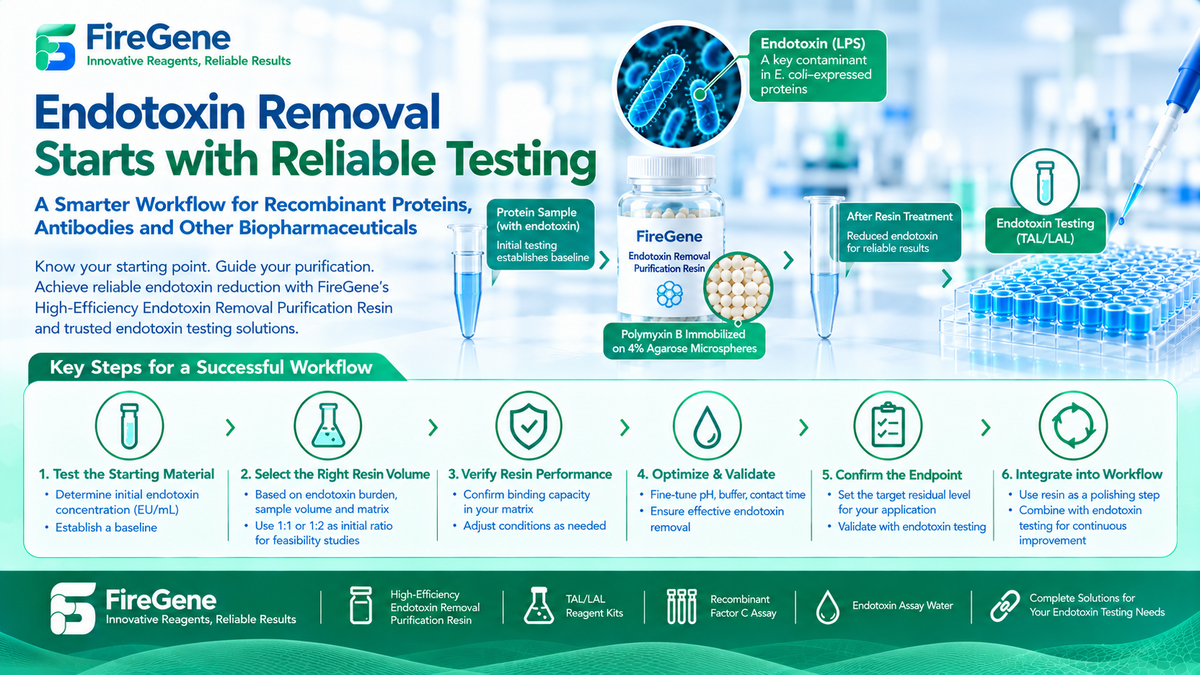
Introduction: Why Endotoxin Removal Must Be Supported by Reliable Testing
Endotoxin contamination remains a persistent challenge in recombinant protein production, antibody development, vaccine research, and other biopharmaceutical workflows. Even when a target molecule has been successfully expressed and purified, residual bacterial endotoxins can interfere with downstream experiments, affect cell responses, and compromise the interpretation of biological data.
The challenge is particularly significant for proteins expressed in Escherichia coli. Endotoxins, primarily lipopolysaccharides (LPS) from the outer membrane of Gram-negative bacteria, can enter the sample during cell disruption and remain associated with the target protein throughout purification.
A conventional purification workflow may remove many host-cell impurities without reducing endotoxin to the level required for a specific research application. Additional endotoxin removal may therefore be necessary.
However, applying an endotoxin removal step is only part of the solution. Researchers also need to determine the initial endotoxin burden, evaluate whether the selected treatment works with the sample matrix, and verify the residual endotoxin concentration afterward.
This is where endotoxin testing and resin-based purification work together.
FireGene's High-Efficiency Endotoxin Removal Purification Resin is designed for endotoxin reduction in protein-based samples, including proteins, peptides, antibodies, and polysaccharides. The resin uses modified Polymyxin B immobilized on 4% agarose microspheres to bind endotoxins during purification.
When integrated with an appropriate TAL/LAL endotoxin testing workflow, resin treatment can become a measurable, optimization-driven process rather than an unverified cleanup step. The key is to connect analytical results with purification decisions at every stage.
1. Why Endotoxin Testing Should Come Before Resin Treatment
Before selecting an endotoxin removal strategy, researchers need to understand the contamination level in the starting material.
Without baseline data, it is difficult to determine how much endotoxin needs to be removed, whether a treatment has been effective, or whether additional processing is justified.
Pretreatment endotoxin testing provides several important benefits.
Establishing the initial endotoxin concentration
A quantitative endotoxin assay can establish the starting concentration in endotoxin units per milliliter (EU/mL). This result provides a baseline for comparing the sample before and after resin treatment.
For example, a research team may discover that two batches of the same recombinant protein have substantially different initial endotoxin concentrations. This difference could reflect variation in bacterial expression, cell disruption, clarification, chromatography, buffer preparation, or handling.
Measuring the initial concentration helps researchers identify whether the problem is primarily associated with upstream contamination or downstream purification.
Supporting resin-volume selection
The appropriate resin volume depends on the endotoxin burden, sample volume, matrix characteristics, and the resin's performance under the selected operating conditions.
FireGene lists a binding capacity of greater than 2,000,000 EU per mL of matrix for its High-Efficiency Endotoxin Removal Purification Resin. This specification provides a useful starting point for process planning, but it should not be interpreted as a guarantee of equivalent removal performance in every sample matrix.
Actual performance can depend on factors such as pH, buffer composition, endotoxin accessibility, contact time, and competing sample components.
When the initial endotoxin concentration is unknown, the manufacturer's product FAQ suggests evaluating an initial resin-to-sample volume ratio of 1:1 or 1:2. These ratios should be treated as starting conditions for feasibility studies, not universal operating requirements.
Explore the FireGene Endotoxin Removal Purification Resin for the product specifications and handling guidance.
Defining the required endpoint
The appropriate residual endotoxin level depends on the intended application, sample characteristics, and relevant acceptance criteria.
A sample intended for a preliminary biochemical experiment may have different requirements from a protein used in a sensitive cell-based assay. Research requirements should also be distinguished from specifications applicable to regulated pharmaceutical products.
Rather than assuming that one numerical target is suitable for every project, researchers should define the required endpoint before beginning resin optimization.
2. Where Endotoxin Removal Resin Fits into Protein Purification
Endotoxin removal resin is most useful when integrated into a broader purification workflow.
For many protein-based samples, the resin can be evaluated as a polishing step after the target molecule has undergone primary purification. This allows the researcher to address residual endotoxin after removing a substantial proportion of other impurities.
Recombinant protein purification
Recombinant proteins expressed in E. coli are a common application for endotoxin reduction.
During bacterial cell disruption, LPS can be released into the lysate. Some endotoxin may remain associated with proteins or protein aggregates, making it difficult to eliminate through standard clarification and purification alone.
Residual endotoxin can complicate experiments involving immune-cell activation, cytokine measurements, receptor signaling, and other biological responses.
A practical workflow may include:
-
Express and harvest the recombinant protein.
-
Perform clarification and primary purification.
-
Measure the initial endotoxin concentration.
-
Evaluate resin treatment under suitable buffer and pH conditions.
-
Recover the target protein and assess its concentration or yield.
-
Measure residual endotoxin using a suitable TAL/LAL assay.
-
Confirm that both endotoxin reduction and target-protein recovery meet project requirements.
This approach provides evidence that the removal step is contributing to sample quality without introducing unacceptable losses of the target molecule.
Antibody and Fc-fusion protein purification
Monoclonal antibodies and Fc-fusion proteins may undergo affinity purification, including Protein A or Protein G chromatography, before additional polishing steps.
Although affinity chromatography can remove many impurities, residual endotoxin may remain in the purified material. A dedicated endotoxin removal step can therefore be evaluated when the downstream application requires lower endotoxin levels.
Important considerations include antibody concentration, buffer compatibility, pH, ionic strength, aggregation risk, and protein recovery.
The objective is not simply to obtain the lowest possible endotoxin reading. It is to reduce endotoxin while preserving the target molecule's relevant characteristics.
For sensitive antibody research, the post-treatment evaluation should therefore consider both endotoxin concentration and product quality.
Vaccine antigen and biologics process development
Recombinant vaccine antigens and other biologically derived materials may require additional endotoxin control during research and process development.
In these applications, the resin can be evaluated as part of a purification strategy designed to reduce endotoxin before subsequent characterization or biological testing.
Researchers should assess whether the treatment affects antigen recovery, structural integrity, aggregation, or other attributes relevant to the intended experiment.
A reduction in endotoxin does not automatically demonstrate that the sample remains suitable for its intended use. Analytical verification should be accompanied by appropriate sample-quality assessments.
3. Choosing an Endotoxin Testing Method for Resin-Treated Samples
A resin-based removal process needs an analytical method that can reliably measure endotoxin in the sample matrix.
Two commonly used TAL/LAL assay formats are gel-clot and kinetic chromogenic testing. The most appropriate choice depends on the testing objective, required quantitative information, available equipment, and method suitability.
Gel-clot endotoxin testing
The gel-clot method is based on the formation of a gel in response to endotoxin under the specified assay conditions.
It is useful for qualitative or limit-based assessments when the method and acceptance criteria are appropriate for the intended purpose.
For resin-treatment studies, gel-clot testing may help evaluate whether a sample meets a defined endotoxin limit. However, because the method generally provides an endpoint rather than a continuous quantitative concentration, it may not provide enough information for detailed comparisons across multiple resin-treatment conditions.
When the objective is to compare the magnitude of endotoxin reduction, a quantitative assay may be more informative.
Learn more about the FireGene Gel-Clot Endotoxin Test Kit.
Kinetic chromogenic endotoxin testing
Kinetic chromogenic testing measures the rate of color development generated by the endotoxin-responsive enzymatic reaction. The kinetic response is compared with an appropriate standard curve to determine the endotoxin concentration.
This format can be particularly useful for resin optimization because researchers may need to compare pretreatment and post-treatment results across different conditions.
A quantitative workflow can help answer questions such as:
-
How much endotoxin was present before treatment?
-
How much remains after resin treatment?
-
Does changing the resin-to-sample ratio improve the result?
-
Does adjusting pH or buffer composition affect removal?
-
Is the measured reduction consistent across replicate experiments?
FireGene's Kinetic Chromogenic Endotoxin Test Kit is designed for quantitative endotoxin measurement using a compatible microplate reader. The product information lists a 405 nm measurement wavelength and a 0.005–10 EU/mL range.
The actual reportable range for a particular sample depends on the assay configuration, sample dilution, and validated or verified method conditions. Samples outside the usable range may require appropriate dilution or further method evaluation.
Important: The product is designated for research use only. It should not be represented as an FDA-approved method for pharmaceutical batch release.
4. A Practical Detect–Remove–Verify Workflow
A reliable endotoxin-control strategy connects analytical measurement with purification decisions. The following workflow can help researchers organize resin-based removal studies.
Step 1: Characterize the sample before treatment
Record the sample identity, concentration, volume, buffer composition, pH, and relevant processing history.
Measure the initial endotoxin concentration using a suitable TAL/LAL assay, provided the method is suitable for the sample matrix.
If the measured result is outside the assay's usable range, adjust the analytical procedure as appropriate and document the dilution or other method changes.
Step 2: Evaluate resin compatibility
Before processing the entire sample, consider a small-scale feasibility study.
The FireGene resin uses modified Polymyxin B immobilized on 4% agarose microspheres. The manufacturer lists an operating pH range of 5–10 and recommends adjusting pH to approximately 7–8 when low removal efficiency may be associated with unsuitable pH conditions.
This does not mean that pH 7–8 is automatically optimal for every protein. Buffer selection and pH must remain compatible with the target molecule.
The manufacturer's FAQ also notes that HEPES can be used and that certain other solution components are tolerated under specified conditions. Compatibility should be confirmed for the actual sample formulation rather than inferred from a single ingredient.
The resin requires regeneration before its first use according to the product guidance. Use appropriate endotoxin-controlled water, buffers, and consumables throughout preparation.
Step 3: Optimize resin-to-sample ratio and contact conditions
The amount of resin and the contact conditions can influence both endotoxin removal and target-molecule recovery.
If the initial endotoxin burden is unknown, the manufacturer's suggested 1:1 or 1:2 resin-to-sample volume ratios can provide starting points for a feasibility study.
Researchers can then compare selected conditions using consistent analytical methods. When evaluating different ratios, keep other variables as consistent as possible so that observed differences can be interpreted more confidently.
For column operation, contact time and flow rate are also important. FireGene's product FAQ states that, for a 40 mL resin bed in the described setup, a flow rate not exceeding 4 mL/min is recommended to maintain a contact time greater than 10 minutes. This is a specific example rather than a universal flow-rate specification for every column geometry or sample.
Step 4: Recover the sample and assess yield
After treatment, collect the appropriate product fraction according to the resin format and the manufacturer's instructions.
Measure the target-protein concentration or another suitable indicator of sample recovery. If the recovered material has low yield, investigate possible nonspecific adsorption and other process-related losses.
FireGene's product FAQ identifies nonspecific sample adsorption as one possible explanation for low recovery and suggests evaluating salt concentration in the sample and equilibration buffer where compatible with the target molecule.
Any adjustment should be evaluated for its effect on protein solubility, stability, aggregation, and downstream use.
Step 5: Measure residual endotoxin
Retest the treated sample using a suitable TAL/LAL method.
Use the same analytical approach for pretreatment and post-treatment samples whenever possible, and account for any dilution factors when calculating concentrations.
The comparison should be based on valid results, not simply on a lower instrument signal. Matrix effects can change the assay response, making method suitability essential to interpreting the apparent reduction.
Step 6: Document and repeat where necessary
Record the initial and final endotoxin concentrations, resin volume, sample volume, pH, buffer composition, contact conditions, protein recovery, and assay controls.
If the final result does not meet the defined endpoint, investigate the likely cause before repeating the treatment. Additional resin or longer contact time may not solve a problem caused by matrix interference, inappropriate buffer conditions, or contamination introduced during sample handling.
This documented workflow helps make resin optimization more reproducible and easier to troubleshoot.
5. Why Method Suitability Matters After Endotoxin Removal
One of the most important considerations in post-treatment testing is that a lower assay result does not always mean endotoxin has been removed successfully.
Proteins, peptides, buffer components, and other sample constituents can affect the performance of a TAL/LAL assay. Some matrices may inhibit the reaction, while others may enhance the measured response.
A treatment can also change the sample matrix. For example, adjusting pH or buffer composition during resin processing may alter how the sample behaves in the subsequent endotoxin assay.
Consequently, pretreatment and post-treatment results should be interpreted alongside appropriate controls and method-suitability evidence.
Use positive product controls where appropriate
A positive product control (PPC) helps evaluate whether the sample matrix interferes with the endotoxin assay.
In a suitable quantitative method, a known amount of endotoxin is added to a sample aliquot. The measured recovery is then assessed against the acceptance criteria applicable to the method.
If recovery is outside the acceptable range, the result may not provide a reliable estimate of the sample's endotoxin concentration.
Researchers may need to evaluate sample dilution, preparation conditions, or other compatible method adjustments before drawing conclusions about resin performance.
Avoid confusing analytical interference with successful removal
Consider a sample that produces a lower endotoxin result after resin treatment but also shows poor PPC recovery. The low result may reflect assay inhibition rather than genuine endotoxin reduction.
Without investigating that interference, a laboratory could mistakenly conclude that the resin performed better than it actually did.
A sound verification strategy therefore considers three questions:
-
Is the post-treatment endotoxin result within the required range?
-
Does the assay perform acceptably in the treated sample matrix?
-
Has sufficient target material been recovered for the intended application?
All three questions matter when interpreting the outcome of a resin-treatment study.
6. Calculating Endotoxin Reduction and Protein Recovery
Two useful metrics for evaluating resin performance are endotoxin reduction and target-protein recovery.
Endotoxin reduction
When valid pretreatment and post-treatment concentrations are available, the percentage reduction can be calculated as:
Endotoxin reduction (%) = [(C₀ − C₁) / C₀] × 100
Here, C₀ represents the initial endotoxin concentration and C₁ represents the post-treatment concentration, expressed in the same units and measured using an appropriate method.
For example, if a sample decreases from 10 EU/mL to 1 EU/mL, the calculated reduction is 90%.
This calculation describes the reduction in concentration. If the sample volume changes substantially during processing, concentration reduction alone may not represent the total endotoxin mass removed; volume should also be considered when a mass-balance assessment is needed.
Protein recovery
Protein recovery can be calculated as:
Protein recovery (%) = (Recovered target-protein amount / Initial target-protein amount) × 100
The target-protein amount should be calculated using the relevant concentration and volume measurements.
For example, a treatment may reduce endotoxin substantially but also cause significant protein loss. Whether that outcome is acceptable depends on the application and the project requirements.
A useful optimization study evaluates endotoxin reduction and protein recovery together instead of selecting a treatment solely on the basis of the lowest endotoxin result.
FireGene's product information reports that endotoxin removal can reach up to 99% and protein recovery can reach up to 90% under suitable conditions. These are manufacturer-reported performance figures, not guaranteed outcomes for every sample, protein, or process.
7. Common Troubleshooting Scenarios
Low endotoxin removal efficiency
Potential causes include unsuitable pH, insufficient resin capacity for the sample's endotoxin burden, inadequate contact time, or matrix conditions that limit endotoxin binding.
Review the initial endotoxin result, pH, resin volume, buffer composition, and operating conditions before changing multiple variables simultaneously.
Low protein recovery
Possible causes include nonspecific adsorption, aggregation, or incompatibility between the treatment conditions and the target protein.
Assess the protein before and after treatment, and evaluate compatible buffer adjustments where appropriate. Increasing salt concentration may be worth investigating for some samples, but it should not be applied automatically.
Unexpectedly high post-treatment endotoxin results
Possible explanations include inadequate removal, endotoxin introduced during sample handling, contaminated water or consumables, or analytical variability.
Review sample preparation, resin handling, blanks, controls, and assay suitability. Reusing resin across different samples can introduce contamination risks; FireGene advises against using previously used resin to remove endotoxin from different samples.
Inconsistent results between replicates
Inconsistent results may arise from uneven sample mixing, variation in treatment conditions, low-level contamination, or analytical variability.
Standardize sample preparation, document the resin-treatment procedure, use appropriate replicates, and verify that the assay controls meet the applicable acceptance criteria.
8. Applications Beyond a Single Purification Step
Resin-based endotoxin removal can support multiple stages of biological research when the target material and process conditions are suitable.
Recombinant protein research: Reduce endotoxin after primary purification before sensitive biochemical or cell-based studies.
Antibody and Fc-fusion development: Evaluate a polishing step after affinity chromatography when residual endotoxin remains a concern.
Vaccine antigen research: Investigate endotoxin reduction while monitoring antigen recovery and relevant quality attributes.
Peptide and polysaccharide research: Assess resin compatibility and treatment performance for the specific material and intended application.
Cell-based research: Combine appropriate endotoxin removal with post-treatment testing to reduce the risk that endotoxin-related effects will confound experimental interpretation.
These applications require sample-specific evaluation. No resin should be assumed to work equally well with every biological material or formulation.
One additional point is important: although some general product-page application wording refers to nucleic acids, FireGene's product FAQ explicitly states that this resin cannot remove endotoxin from nucleic acid samples such as plasmids or DNA. Therefore, researchers should not assume that the resin is suitable for plasmid or DNA decontamination; confirm applicability with the manufacturer before considering such a workflow.
9. Building a More Reliable Endotoxin-Control Strategy with FireGene
A practical endotoxin-control workflow combines three complementary activities:
Detect: Establish the initial endotoxin concentration with a suitable TAL/LAL assay.
Remove: Evaluate FireGene's High-Efficiency Endotoxin Removal Purification Resin under conditions compatible with the sample.
Verify: Retest the treated material, evaluate method suitability, and assess target-molecule recovery.
For quantitative comparisons, the FireGene Kinetic Chromogenic Endotoxin Test Kit can support before-and-after measurement when the assay is suitable for the sample. The Gel-Clot Endotoxin Test Kit offers another testing format for applications where gel-clot testing is appropriate.
Reliable testing also depends on controlling contamination during sample preparation. Endotoxin-controlled water, appropriate consumables, clean handling practices, and suitable assay controls help reduce the risk of introducing contamination or misinterpreting analytical results.
For broader reagent options, visit the FireGene Endotoxin Assay Reagents and Kits collection.
Conclusion: Measure, Remove, and Verify
Endotoxin removal should not be treated as an isolated purification step. In protein and biologics research, the most useful strategy combines pretreatment measurement, carefully selected resin conditions, post-treatment verification, and an assessment of target-molecule recovery.
FireGene's High-Efficiency Endotoxin Removal Purification Resin provides an option for evaluating endotoxin reduction in protein-based samples, including recombinant proteins, antibodies, peptides, and other suitable biological materials. When paired with a suitable TAL/LAL assay, it supports a more evidence-based approach to evaluating removal performance.
The central principle is straightforward: measure the starting point, optimize the treatment, and verify the result.
That approach helps researchers distinguish genuine endotoxin reduction from analytical interference, understand potential sample losses, and build more reproducible purification workflows.
Looking to optimize your endotoxin-control workflow?
Explore FireGene's High-Efficiency Endotoxin Removal Purification Resin and Kinetic Chromogenic Endotoxin Test Kit to learn more about resin-based endotoxin reduction and quantitative TAL/LAL testing for research applications.
FireGene — Innovative Reagents, Reliable Results.
FireGene Endotoxin Testing
Ready to run your endotoxin assay?
FireGene offers a complete endotoxin testing toolkit — from TAL reagents and CSE standards to pyrogen-free consumables and LAL reagent water. All products are aligned with USP <85>, EP 2.6.14, and JP 4.01.


