
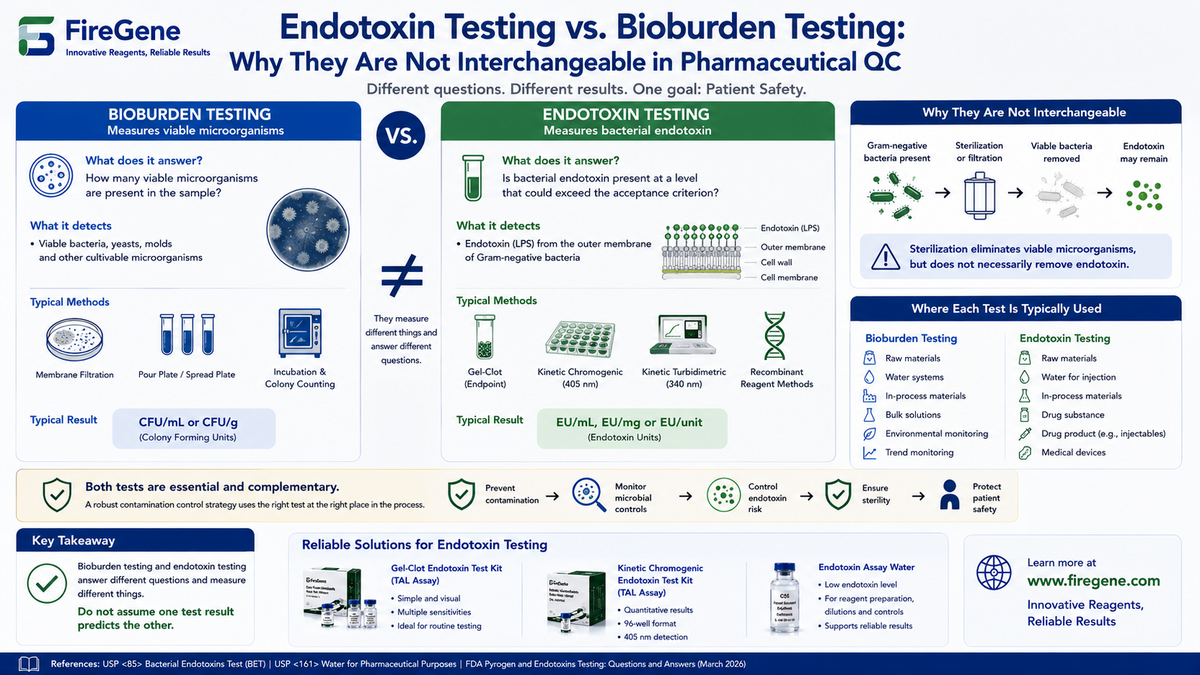
Introduction: Endotoxin Testing and Bioburden Testing Are Not the Same
In pharmaceutical manufacturing, bioburden testing and endotoxin testing are sometimes discussed together because both are associated with microbiological contamination.
But they answer fundamentally different questions.
Bioburden testing asks:
How many viable microorganisms are present?
Endotoxin testing asks:
Is biologically active bacterial endotoxin present at a level that could exceed the applicable acceptance criterion?
These are not interchangeable measurements.
A product can have a low or even undetectable viable microbial count and still contain endotoxin.
Conversely, a product can have detectable viable microorganisms without necessarily exceeding its endotoxin specification.
This distinction is especially important in pharmaceutical manufacturing because endotoxins are associated primarily with the outer membrane of Gram-negative bacteria and can remain after the organisms themselves have been removed or destroyed.
FDA explicitly notes that reducing microbial levels through sterilization does not necessarily produce a corresponding reduction in endotoxin levels.
That means a robust pharmaceutical contamination-control strategy may need to consider bioburden, endotoxin, sterility, and process controls as complementary—not interchangeable—elements.
What Is Bioburden Testing?
Bioburden testing is used to determine the number of viable microorganisms present in a sample under defined test conditions.
Depending on the product and applicable procedure, microorganisms may include:
- Bacteria
- Yeasts
- Molds
- Other cultivable microorganisms
The result is commonly expressed as a microbial count such as:
CFU/mL
or:
CFU/g
where CFU means colony-forming units.
Bioburden testing can therefore provide information about the viable microbial population associated with:
- Raw materials
- Process intermediates
- Bulk solutions
- Drug substances
- Manufacturing systems
- Water systems
- Components
- Finished products, where applicable
The purpose is generally to understand and control the microbial load within a manufacturing or testing process.
FDA's pharmaceutical inspection guidance describes bioburden testing as an important microbiological control activity for appropriate raw materials, in-process materials, and drug substances.
What Is Endotoxin Testing?
Bacterial Endotoxin Testing (BET) is designed to detect or quantify bacterial endotoxins.
Endotoxins are lipopolysaccharide-containing components associated with the outer membrane of Gram-negative bacteria.
Unlike a conventional microbial count, an endotoxin test does not primarily ask whether viable bacteria are present.
Instead, it evaluates the endotoxin burden in the tested material.
Common endotoxin testing approaches include:
- Gel-Clot
- Kinetic Chromogenic
- Kinetic Turbidimetric
- Other applicable photometric or recombinant-reagent methods
FDA's March 2026 guidance describes the fundamental principles of gel-clot, photometric, and kinetic endotoxin test methods and provides current recommendations related to endotoxin and pyrogen testing.
For laboratories using traditional TAL/LAL Reagent-based methods, FireGene provides both Gel-Clot and Kinetic Chromogenic endotoxin testing solutions.
The Fundamental Difference: Organisms vs. Endotoxin
The easiest way to understand the difference is to focus on what each test actually measures.
Bioburden Testing
Measures:
Viable microorganisms
Endotoxin Testing
Measures:
Endotoxin activity or concentration
This distinction has major implications.
Imagine a manufacturing solution containing Gram-negative bacteria.
Before sterilization:
Viable bacteria → present
Endotoxin → potentially present
After an effective sterilization step:
Viable bacteria → dramatically reduced or eliminated
But:
Endotoxin → may remain
This is because sterilization designed to eliminate viable microorganisms does not necessarily eliminate endotoxin.
FDA specifically warns that sterilizing or microbiological filtration can reduce microorganisms without producing a corresponding reduction in endotoxin.
Therefore:
A low bioburden result cannot automatically be interpreted as evidence of low endotoxin.
Why Sterilization Does Not Automatically Solve the Endotoxin Problem
This is one of the most important concepts in pharmaceutical microbiological control.
Sterilization and endotoxin control are different challenges.
A sterilization process is generally designed to control or eliminate viable microorganisms.
Endotoxin control, however, requires controlling:
Generation → Introduction → Accumulation → Removal → Detection
This is particularly important when Gram-negative bacteria have been present in:
- Water systems
- Manufacturing equipment
- Raw materials
- Process solutions
- Storage vessels
- Manufacturing environments
If microorganisms multiply before a sterilization step, they may contribute to endotoxin accumulation.
Later destruction of the microorganisms does not necessarily eliminate the endotoxin that has already been introduced.
This is why FDA inspection guidance emphasizes that high microbial levels before sterilization can be relevant to endotoxin risk even when subsequent sterilization reduces viable microorganisms.
Can a Product Pass Bioburden Testing but Fail Endotoxin Testing?
Yes.
This is one of the most important reasons the two tests should not be treated as interchangeable.
Consider a simplified example.
A manufacturing solution contains a population of Gram-negative bacteria.
The microorganisms produce or release endotoxin.
The solution is subsequently subjected to a sterilization process.
After sterilization:
Viable microorganisms: Low or undetectable
But:
Residual endotoxin: Still detectable
The product could therefore produce:
Bioburden: Pass
while:
Endotoxin: Fail
This is not necessarily a contradiction.
The two tests are measuring different properties.
Can a Product Have Detectable Bioburden but Pass Endotoxin Testing?
Potentially, yes.
The presence of viable microorganisms does not automatically mean that endotoxin concentration exceeds the applicable endotoxin acceptance criterion.
For example, microbial contamination could involve organisms that contribute relatively little endotoxin compared with a heavily contaminated Gram-negative system.
However, any unexpected microbial contamination should be investigated according to the applicable quality system.
The important point is:
Bioburden results and endotoxin results should be interpreted independently and then considered together as part of the broader contamination-control strategy.
Endotoxin Testing vs. Bioburden Testing: Different Questions
A useful way to frame the difference is:
Bioburden Testing
“How much viable microbial contamination is present?”
Endotoxin Testing
“How much bacterial endotoxin is present?”
Sterility Testing
“Does the tested sample meet the defined sterility requirement under the specified test conditions?”
These tests may support the same overall quality objective, but they are not substitutes for one another.
Why Endotoxin Testing Is Especially Important for Injectable Products
Endotoxin control becomes particularly important when a product is administered parenterally.
Products such as:
- Injectable drugs
- Vaccines
- Biologics
- Monoclonal antibodies
- Drug substances intended for parenteral use
- Certain medical devices
- Cell and gene therapy-related products
may require endotoxin control according to their applicable regulatory and product-specific requirements.
The concern is not simply whether microorganisms are alive.
It is whether the product contains an unacceptable amount of endotoxin that could contribute to a pyrogenic response.
FDA's current 2026 guidance covers endotoxin and pyrogen testing considerations for drugs, biological products, and devices and references USP <85>, USP <161>, and AAMI ST72.
Why Endotoxin Control Should Start Before Finished Product Testing
Another common misconception is that endotoxin control is primarily a finished-product QC activity.
In reality, endotoxin risk can originate much earlier.
Potential sources include:
- Raw materials
- Excipients
- Process water
- Buffers
- Manufacturing equipment
- Containers
- Process intermediates
- Environmental contamination
- Poorly controlled microbial growth
This is why a modern endotoxin-control strategy should consider the complete manufacturing lifecycle.
FireGene recently discussed this topic in Endotoxin Testing for Raw Materials and Excipients: How to Control Endotoxin Risk Before Manufacturing.
The principle is straightforward:
Preventing endotoxin introduction is generally more effective than relying entirely on downstream removal and finished-product testing.
The Relationship Between Bioburden and Endotoxin Risk
Although the two tests are different, bioburden data can still provide useful information about endotoxin risk.
Why?
Because bacterial growth can contribute to endotoxin generation.
A simplified relationship can be represented as:
Microbial Growth
↓
Greater Gram-Negative Bacterial Burden
↓
Potential Endotoxin Generation
↓
Potential Endotoxin Accumulation
This does not mean:
Higher bioburden = automatically higher endotoxin
The relationship is more complicated.
Factors such as:
- Microbial species
- Growth conditions
- Time
- Temperature
- Water quality
- Process conditions
- Bacterial death or lysis
- Removal efficiency
can all influence endotoxin risk.
Therefore, bioburden data should be considered a risk indicator, not a replacement for direct endotoxin testing.
Why Water Systems Are Critical for Both Tests
Water is one of the most important shared risk areas.
Water systems can support microbial growth if poorly controlled.
This creates two related but distinct concerns:
Bioburden Risk
Microorganisms may proliferate in the water system.
Endotoxin Risk
Gram-negative microorganisms can contribute to endotoxin accumulation.
FDA specifically highlights the importance of water-system control in relation to microorganisms and endotoxin risk.
This is why pharmaceutical water systems should be managed through appropriate:
- Microbiological monitoring
- Endotoxin monitoring
- System design
- Sanitization
- Maintenance
- Sampling
- Trending
For laboratory endotoxin testing itself, the water used for reagent preparation, dilution, and controls must also be appropriately controlled.
FireGene's Endotoxin Assay Water is designed for applications such as CSE reconstitution, standard dilution, sample preparation, and negative controls.
Bioburden Reduction Does Not Equal Endotoxin Reduction
This deserves special emphasis.
Suppose a process contains:
100,000 viable microorganisms
A sterilization or filtration step reduces the viable count to:
0 CFU
It would be tempting to assume that endotoxin has also been reduced to zero.
But that conclusion is not scientifically justified.
The microorganisms may have been removed or killed while endotoxin remains.
Therefore:
Bioburden reduction ≠ endotoxin reduction
This is particularly important when evaluating:
- Sterilizing filtration
- Heat treatment
- Aseptic processing
- Terminal sterilization
- Manufacturing process changes
The process must be evaluated for both microbial control and endotoxin control where applicable.
Why Sterility Testing Also Cannot Replace Endotoxin Testing
Sterility testing addresses another different question.
A sterility test is intended to determine whether viable microorganisms are detected under the specified test conditions.
It does not directly quantify endotoxin.
Therefore:
Sterility testing ≠ Bioburden testing
and:
Sterility testing ≠ Endotoxin testing
A product can meet a sterility requirement while still requiring separate endotoxin evaluation.
FDA's current cGMP-related materials recognize the need for appropriate testing of products represented as sterile and/or pyrogen-free, including consideration of microbial contamination and pyrogens or bacterial endotoxins.
How Endotoxin Testing Fits Into a Pharmaceutical QC Strategy
A strong microbiological quality-control strategy can be viewed as several connected layers.
Layer 1: Prevention
Control:
- Raw materials
- Water
- Equipment
- Environment
- Personnel
- Manufacturing process
Layer 2: Microbial Monitoring
Monitor:
- Bioburden
- Environmental microorganisms
- Water-system microbiology
Layer 3: Endotoxin Control
Monitor:
- Raw material endotoxin
- Process endotoxin
- Water endotoxin
- Product endotoxin
where appropriate.
Layer 4: Sterility Assurance
Apply appropriate sterility assurance strategies and testing.
Layer 5: Finished Product Release
Confirm that the final product meets applicable specifications.
This layered strategy is much stronger than relying on a single test at the end of manufacturing.
When Should Pharmaceutical Manufacturers Perform Endotoxin Testing?
The exact testing strategy depends on the product, manufacturing process, regulatory filing, and validated procedures.
Potential testing points may include:
Raw Materials
High-risk materials may require endotoxin assessment before entering production.
Process Water
Water systems may require endotoxin monitoring according to their intended use and applicable requirements.
In-Process Materials
Testing may be appropriate where endotoxin risk can increase or where process control needs to be demonstrated.
Drug Substance
Endotoxin specifications may apply to drug substances intended for certain applications.
Drug Product
Finished product endotoxin testing may be required before release.
FDA inspection materials describe endotoxin testing of bulk protein drug substance and appropriate testing of in-process or raw materials as part of microbiological quality control.
How Sample Preparation Affects Endotoxin Testing
Even when the manufacturing process is well controlled, the analytical method itself can encounter challenges.
Pharmaceutical products may contain:
- Proteins
- Salts
- Surfactants
- Lipids
- Buffers
- Excipients
- Preservatives
These components can interfere with endotoxin assays.
Potential outcomes include:
Inhibition
or:
Enhancement
Therefore, laboratories should not assume that a method suitable for one product will automatically be suitable for another.
FireGene's Endotoxin Testing Sample Preparation Guide covers sample dilution, interference, recovery, and other considerations relevant to reliable endotoxin testing.
Why Positive Product Controls Matter
A Positive Product Control (PPC) can help determine whether the product matrix interferes with endotoxin detection under the selected test conditions.
Conceptually:
Known endotoxin spike
Product sample
↓
Measure recovery
If the expected recovery criteria are met under the applicable procedure, the result supports the suitability of the test conditions.
If recovery is outside the applicable criteria, the laboratory may need to investigate:
- Matrix interference
- Sample dilution
- Reagent performance
- Sample preparation
- Pipetting
- Product formulation
This is one of the reasons why a passing standard curve alone does not prove that the product matrix is suitable for endotoxin testing.
FireGene's recent Endotoxin Method Validation Guide provides additional discussion of method suitability and product-specific interference.
Choosing an Endotoxin Testing Method
Once the need for endotoxin testing has been established, laboratories need to select an appropriate analytical approach.
Common options include:
Gel-Clot Endotoxin Testing
Gel-Clot testing provides a straightforward endpoint based on gel formation.
It can be useful for:
- Routine testing
- Qualitative or limit-based applications
- Laboratories seeking a simple workflow
- Applications compatible with the selected reagent sensitivity
FireGene's Gel-Clot Endotoxin Test Kit is available with multiple sensitivities to support different testing requirements.
Kinetic Chromogenic Endotoxin Testing
Kinetic Chromogenic testing provides quantitative measurements based on color development over time.
It can be particularly useful when laboratories need:
- Quantitative endotoxin results
- Higher throughput
- Plate-based testing
- Numerical trending
- Automated data acquisition
FireGene's Kinetic Chromogenic Endotoxin Test Kit uses a 96-well format and 405 nm absorbance detection.
For a more detailed explanation, see The Ultimate Guide to Kinetic Chromogenic Endotoxin Assays.
Endotoxin Testing and Bioburden Testing During Process Investigations
When an unexpected microbiological event occurs, both types of data can become valuable.
Consider a hypothetical manufacturing deviation:
Step 1: Water-system microbial count increases.
Step 2: Bioburden increases in an in-process sample.
Step 3: The process continues.
Step 4: Finished-product endotoxin result increases.
In this situation, the bioburden data may help identify when the microbial-control problem began.
The endotoxin data may help determine whether the event resulted in an unacceptable endotoxin burden.
Neither dataset necessarily provides the complete answer by itself.
Together, however, they can help investigators reconstruct the event.
Why Trending Is More Valuable Than Looking Only at Pass/Fail
A laboratory may record every endotoxin test as:
PASS
PASS
PASS
PASS
But the actual endotoxin values may be gradually increasing.
For example:
0.02 EU/mL
→ 0.04 EU/mL
→ 0.07 EU/mL
→ 0.11 EU/mL
Even if all results remain below the specification, the trend may deserve investigation.
The same principle can apply to bioburden.
A gradual increase in:
CFU
may indicate deteriorating process control before a specification failure occurs.
This is why modern QC programs increasingly emphasize data trending rather than simple pass/fail classification.
FireGene has also discussed the broader shift toward data-driven endotoxin QC in Kinetic Chromogenic Endotoxin Testing in 2026: From Routine BET to Quantitative, Automated, and Data-Driven QC.
A Practical Decision Framework
When deciding whether an endotoxin test or bioburden test is needed, ask:
Question 1
Are we trying to measure viable microorganisms?
If yes:
Bioburden testing may be appropriate.
Question 2
Are we trying to determine whether endotoxin levels meet a product-specific limit?
If yes:
Endotoxin testing is required.
Question 3
Are we evaluating whether a product is sterile?
If yes:
Sterility assurance and applicable sterility testing should be considered.
Question 4
Are we investigating a contamination event?
If yes:
Consider multiple datasets:
Bioburden + endotoxin + environmental monitoring + water data + process records
Question 5
Could the process have killed microorganisms without removing endotoxin?
If yes:
Do not use a low bioburden result as evidence that endotoxin risk has disappeared.
7 Common Misconceptions About Bioburden and Endotoxin Testing
Misconception 1: “No bacteria means no endotoxin.”
Not necessarily.
Endotoxin can remain after viable microorganisms have been eliminated.
Misconception 2: “Sterilization eliminates endotoxin.”
Not necessarily.
Sterilization and depyrogenation are different process objectives.
Misconception 3: “A low bioburden means the product is low in endotoxin.”
Not necessarily.
Bioburden measures viable microorganisms, not endotoxin concentration.
Misconception 4: “Endotoxin testing can replace bioburden testing.”
No.
They measure different contamination characteristics.
Misconception 5: “Sterility testing makes endotoxin testing unnecessary.”
No.
Sterility and endotoxin are different quality attributes.
Misconception 6: “A failed endotoxin result automatically means microbial contamination occurred in the final product.”
Not necessarily.
Endotoxin may have been introduced earlier in the manufacturing process or through materials, water, equipment, or other sources.
Misconception 7: “A passing endotoxin test proves the manufacturing process is microbiologically controlled.”
Not by itself.
A finished-product endotoxin result is only one component of a broader contamination-control strategy.
How to Build a More Effective Endotoxin Control Strategy
A strong pharmaceutical endotoxin strategy should include several interconnected elements.
1. Control Raw Materials
Evaluate high-risk materials and establish appropriate specifications.
2. Control Water
Monitor and maintain water systems according to their intended use.
3. Control Bioburden
Prevent excessive microbial growth before it becomes an endotoxin-control problem.
4. Control Manufacturing Equipment
Use appropriate cleaning, sanitization, and maintenance procedures.
5. Control Process Hold Times
Longer microbial exposure can increase contamination risk.
6. Monitor Endotoxin
Apply endotoxin testing where appropriate to materials, process streams, water, drug substances, and finished products.
7. Validate Method Suitability
Demonstrate that the selected endotoxin method performs appropriately with the actual product matrix.
8. Trend the Data
Look for changes before they become specification failures.
9. Investigate Deviations Systematically
Use microbiological and endotoxin data together rather than relying on a single test result.
2026 Perspective: Endotoxin Testing Is Becoming More Integrated With Process Control
The role of endotoxin testing is changing.
Historically, many laboratories viewed bacterial endotoxin testing primarily as a finished-product release test.
Today, endotoxin control is increasingly considered within the broader manufacturing lifecycle.
This shift is particularly relevant as pharmaceutical manufacturing becomes more complex.
Modern products may include:
- Monoclonal antibodies
- Recombinant proteins
- Cell therapies
- Gene therapies
- mRNA therapeutics
- Lipid nanoparticle formulations
- Complex injectable formulations
At the same time, regulatory expectations continue to evolve.
FDA's March 2026 revised guidance updates its current thinking on pyrogen and endotoxin testing and explicitly covers gel-clot, photometric, and kinetic methods.
FDA has also highlighted the broader regulatory pathway for recombinant endotoxin testing methods, noting that sponsors should verify that the selected method is suitable for its intended purpose.
This means the future of endotoxin testing is not simply about detecting endotoxin more sensitively.
It is about building a risk-based, product-specific, and scientifically justified contamination-control strategy.
Endotoxin Testing vs. Bioburden Testing: Quick Summary
The simplest way to remember the difference is:
Bioburden testing = viable microorganisms
Endotoxin testing = bacterial endotoxin
Sterility testing = defined sterility assessment
They can support the same overall product-quality objective, but none should automatically be substituted for another.
A strong pharmaceutical QC program asks:
What contamination risk are we trying to measure?
Then selects the appropriate test.
Frequently Asked Questions
Is bioburden testing the same as endotoxin testing?
No. Bioburden testing measures viable microorganisms, while endotoxin testing detects or quantifies bacterial endotoxin.
Can a product pass bioburden testing and fail endotoxin testing?
Yes. Viable microorganisms can be absent or greatly reduced while residual endotoxin remains.
Does sterilization remove endotoxin?
Not necessarily. Processes that eliminate viable microorganisms do not automatically eliminate endotoxin.
Does endotoxin testing replace sterility testing?
No. Endotoxin testing and sterility testing evaluate different quality attributes.
Does low bioburden mean low endotoxin?
No. Bioburden can provide useful contamination information, but it does not directly measure endotoxin.
Why is endotoxin testing important for injectable drugs?
Because endotoxin exposure can cause pyrogenic responses, and applicable regulatory frameworks establish endotoxin acceptance criteria for relevant products.
Should raw materials be tested for endotoxin?
Depending on the material, manufacturing process, product, and applicable quality system, endotoxin testing may be an important part of raw-material and process control.
What is the best endotoxin testing method?
There is no single method that is universally best. Gel-Clot, Kinetic Chromogenic, and other applicable methods should be evaluated based on the product, endotoxin limit, matrix, sensitivity, throughput, and demonstrated method suitability.
Why can endotoxin levels increase even when bioburden is controlled?
Endotoxin may have accumulated before microbial reduction occurred, or it may have entered through water, raw materials, equipment, or other sources.
How can pharmaceutical manufacturers reduce endotoxin risk?
The most effective strategy combines contamination prevention, water and raw-material control, bioburden monitoring, appropriate process controls, endotoxin testing, method suitability, and data trending.
Conclusion: Endotoxin Testing and Bioburden Testing Work Together—But They Do Different Jobs
The biggest takeaway is simple:
Bioburden testing tells you about viable microorganisms. Endotoxin testing tells you about endotoxin.
Neither result should be used as a substitute for the other.
A low microbial count does not guarantee low endotoxin.
Sterilization does not automatically guarantee endotoxin removal.
A passing sterility result does not automatically demonstrate compliance with an endotoxin specification.
For pharmaceutical manufacturers, the strongest approach is therefore to integrate:
Raw Material Control
↓
Water-System Control
↓
Bioburden Monitoring
↓
Process Control
↓
Endotoxin Testing
↓
Sterility Assurance
↓
Finished Product Release
This layered approach provides a much more complete picture of microbiological and endotoxin risk than relying on any single test.
As pharmaceutical products become more complex and endotoxin testing continues to evolve, laboratories should think beyond simple PASS/FAIL results and focus on understanding the relationship between microbial contamination, endotoxin generation, process control, analytical suitability, and patient safety.
Ultimately, reliable endotoxin control begins long before the endotoxin test is placed on the laboratory bench.
FireGene Endotoxin Testing
Ready to run your endotoxin assay?
FireGene offers a complete endotoxin testing toolkit — from TAL reagents and CSE standards to pyrogen-free consumables and LAL reagent water. All products are aligned with USP <85>, EP 2.6.14, and JP 4.01.


