
Introduction
Accurate endotoxin testing is essential for the quality and safety of pharmaceutical products, biological products, medical devices, and other materials that may come into contact with the human body. Among the most important parameters in an endotoxin assay are assay sensitivity, limit of detection (LOD), limit of quantitation (LOQ), and maximum valid dilution (MVD).
These terms are closely related, but they do not describe exactly the same thing.
For example, an LAL reagent may have a labeled sensitivity of 0.03 EU/mL, 0.06 EU/mL, 0.125 EU/mL, 0.25 EU/mL, or 0.5 EU/mL. A lower numerical value generally indicates a higher assay sensitivity. However, selecting the most sensitive reagent is not automatically the best solution for every sample.
The appropriate endotoxin assay should be selected based on the endotoxin limit, sample characteristics, dilution requirements, interference, and intended quantitative range.
This article explains the differences among these key parameters and provides a practical example showing how assay sensitivity can affect MVD.
1. What Is Sensitivity in Endotoxin Testing?
In endotoxin testing, sensitivity describes the lowest endotoxin concentration that an assay is designed to detect under defined test conditions.
For gel-clot LAL assays, sensitivity is commonly represented by λ (lambda) and expressed in EU/mL.
For example:
0.03 EU/mL
0.06 EU/mL
0.125 EU/mL
0.25 EU/mL
0.5 EU/mL
The lower the λ value, the greater the nominal sensitivity of the assay.
Therefore:
0.03 EU/mL > 0.06 EU/mL > 0.125 EU/mL > 0.25 EU/mL > 0.5 EU/mL
in terms of analytical sensitivity.
A reagent with a sensitivity of 0.03 EU/mL is designed to detect endotoxin at a lower concentration than a reagent with a sensitivity of 0.5 EU/mL.
However, assay sensitivity should not be interpreted as a guarantee that every sample containing endotoxin below the stated value will produce a reliable quantitative result. Actual assay performance also depends on the test method, sample matrix, controls, and validation conditions.
2. Why Does Endotoxin Assay Sensitivity Matter?
Different products can have very different endotoxin acceptance limits.
If a product has a relatively high endotoxin limit, a lower-sensitivity assay may be sufficient.
In contrast, products with stringent endotoxin requirements may require a more sensitive assay.
Sensitivity also affects how much a sample can be diluted before testing.
This is particularly important when a sample contains substances that interfere with the endotoxin assay.
For example, a pharmaceutical formulation may require dilution because of:
Extreme pH
High salt concentration
Proteins
Surfactants
Preservatives
Active pharmaceutical ingredients
Chelating agents
Other matrix components
A more sensitive assay may allow a greater dilution factor while still maintaining the ability to evaluate the sample against its endotoxin limit.
This is where Maximum Valid Dilution (MVD) becomes important.
3. Sensitivity vs. LOD: Are They the Same?
Sensitivity and limit of detection (LOD) should not automatically be treated as interchangeable terms.
Sensitivity
Sensitivity is an assay characteristic. In a gel-clot LAL method, λ commonly represents the labeled assay sensitivity.
For example:
λ = 0.06 EU/mL
means the assay is designed with a stated sensitivity of 0.06 EU/mL.
Limit of Detection
LOD generally refers to the lowest concentration of an analyte that can be reliably distinguished from background or noise under specified analytical conditions.
The exact way LOD is established depends on the analytical method.
Therefore, it is important not to assume:
LAL sensitivity = LOD
in every type of endotoxin assay.
For kinetic assays, performance characteristics may instead be described using parameters such as the lowest point of the validated quantitative range, assay linearity, precision, and other validation characteristics.
4. Sensitivity vs. LOQ
Another commonly confused parameter is the Limit of Quantitation (LOQ).
The key difference is:
Detection asks whether endotoxin can be detected, while quantitation asks whether its concentration can be reliably measured.
A method may be capable of detecting a very low endotoxin concentration but may not be able to quantify that concentration with acceptable precision and accuracy.
Therefore:
LOD < LOQ
is a common conceptual relationship, although the actual numerical values and validation criteria depend on the analytical method.
For quantitative endotoxin assays, researchers should evaluate the validated quantitative range rather than simply assuming that the lowest detectable concentration is automatically a reliable quantitative result.
5. What Is Maximum Valid Dilution (MVD)?
Maximum Valid Dilution (MVD) is an important concept in endotoxin testing.
MVD represents the maximum dilution of a sample that can be used while still allowing the endotoxin limit to be evaluated using the selected assay sensitivity.
A commonly used calculation is:
MVD = Endotoxin Limit ÷ λ
where:
MVD = Maximum Valid Dilution
Endotoxin Limit = allowable endotoxin concentration for the product
λ = assay sensitivity
For example, if:
Endotoxin Limit = 0.5 EU/mL
and:
λ = 0.05 EU/mL
then:
MVD = 0.5 ÷ 0.05 = 10
The calculated MVD is therefore 10-fold.
This means that, based on these parameters, a dilution greater than 1:10 would not be appropriate for evaluating the endotoxin limit using that assay sensitivity.
The exact application of MVD should always follow the applicable pharmacopoeial requirements and the validated test procedure.
6. Practical Example: Comparing Five Endotoxin Assay Sensitivities
Consider a hypothetical pharmaceutical sample with an endotoxin limit of 0.5 EU/mL.
Suppose five LAL reagents are available with the following nominal sensitivities:
0.03 EU/mL
0.06 EU/mL
0.125 EU/mL
0.25 EU/mL
0.5 EU/mL
Using:
MVD = Endotoxin Limit ÷ λ
we can compare their theoretical MVD values.
|
Assay Sensitivity (λ) |
Endotoxin Limit |
Calculated MVD |
Relative Sensitivity |
|
0.03 EU/mL |
0.5 EU/mL |
16.67 |
Highest |
|
0.06 EU/mL |
0.5 EU/mL |
8.33 |
High |
|
0.125 EU/mL |
0.5 EU/mL |
4 |
Moderate |
|
0.25 EU/mL |
0.5 EU/mL |
2 |
Lower |
|
0.5 EU/mL |
0.5 EU/mL |
1 |
Lowest |
This example clearly demonstrates the relationship between assay sensitivity and MVD.
As assay sensitivity increases, the numerical value of λ decreases, allowing a larger theoretical MVD when the endotoxin limit remains constant.
7. What Does This Mean in Practice?
Suppose the pharmaceutical sample produces assay interference when tested at a low dilution.
The laboratory may need to dilute the sample to reduce the effect of the interfering matrix.
Consider the five assays above.
0.5 EU/mL sensitivity
MVD:
0.5 ÷ 0.5 = 1
The sample cannot theoretically be diluted beyond 1-fold for evaluation against the specified endotoxin limit.
This provides very little dilution flexibility.
0.25 EU/mL sensitivity
MVD:
0.5 ÷ 0.25 = 2
The theoretical MVD is 2-fold.
This provides somewhat more dilution flexibility.
0.125 EU/mL sensitivity
MVD:
0.5 ÷ 0.125 = 4
The theoretical MVD increases to 4-fold.
0.06 EU/mL sensitivity
MVD:
0.5 ÷ 0.06 ≈ 8.33
The assay provides considerably greater theoretical dilution flexibility.
0.03 EU/mL sensitivity
MVD:
0.5 ÷ 0.03 ≈ 16.67
Among these five options, the 0.03 EU/mL assay provides the greatest theoretical MVD.
8. Does Higher Sensitivity Always Mean Better?
Not necessarily.
A common misconception is:
The lower the endotoxin sensitivity, the better the assay.
In practice, assay selection is more complicated.
A highly sensitive assay can be advantageous when a low endotoxin concentration needs to be detected or when sample dilution is necessary.
However, higher sensitivity does not automatically eliminate:
Sample inhibition
Enhancement
β-glucan interference
pH effects
Matrix effects
Recovery problems
Pipetting errors
Standard curve problems
Poor assay precision
For example, if a sample strongly inhibits the LAL reaction, simply selecting a more sensitive reagent may not completely solve the problem.
The laboratory may instead need to optimize:
Sample dilution
Buffer conditions
pH
Sample preparation
Pretreatment
Assay method
Controls
Therefore, assay suitability must be demonstrated experimentally.
9. Why PPC Is Important
For quantitative LAL testing, the Positive Product Control (PPC) is an important part of evaluating potential sample interference.
The PPC introduces a known amount of endotoxin into the sample matrix.
The laboratory can then evaluate whether the added endotoxin is recovered within the method's acceptance criteria.
If the recovery is acceptable, the sample is generally considered to be suitable for the test conditions with respect to the evaluated interference.
If recovery is outside the applicable acceptance range, the sample matrix may be interfering with the assay.
Possible approaches may include:
Increasing sample dilution
Adjusting sample preparation
Changing assay conditions
Using an appropriate pretreatment
Selecting another validated assay approach
The important point is that high analytical sensitivity does not replace interference testing.
10. Choosing Between 0.03, 0.06, 0.125, 0.25, and 0.5 EU/mL
The appropriate sensitivity depends on the product and analytical requirements.
|
Sensitivity |
Potential Advantage |
Consideration |
|
0.03 EU/mL |
Very high sensitivity; greatest theoretical MVD among the five |
May not be necessary for products with higher endotoxin limits |
|
0.06 EU/mL |
High sensitivity with substantial dilution flexibility |
Requires appropriate validation |
|
0.125 EU/mL |
Balanced sensitivity for some applications |
Lower MVD than 0.03 or 0.06 EU/mL |
|
0.25 EU/mL |
Suitable when a higher sensitivity is not required |
Limited dilution flexibility |
|
0.5 EU/mL |
Useful when the endotoxin limit and test design permit |
Provides the least theoretical dilution flexibility |
Therefore, the selection should not simply be based on choosing the smallest λ value.
Instead, laboratories should consider:
Endotoxin Limit → Required MVD → Sample Interference → Assay Range → Validation
This workflow provides a more scientifically appropriate basis for assay selection.
11. Sensitivity Is Only One Part of Endotoxin Test Performance
A reliable endotoxin test involves more than sensitivity.
Depending on the method, laboratories may need to evaluate:
Standard Curve
For kinetic chromogenic and kinetic turbidimetric assays, the standard curve establishes the relationship between endotoxin concentration and the measured response.
Controls
Appropriate negative and positive controls help verify that the assay is functioning correctly.
PPC / Spike Recovery
These controls help evaluate whether the sample matrix interferes with endotoxin detection.
Dilution
Sample dilution can help reduce matrix interference, provided the dilution remains within the applicable MVD.
Reagent Performance
The actual performance of the LAL or recombinant reagent should be consistent with its intended use and validated test procedure.
Method Validation
Accuracy, precision, specificity, range, and other relevant characteristics should be evaluated according to the applicable analytical framework.
12. Key Takeaways
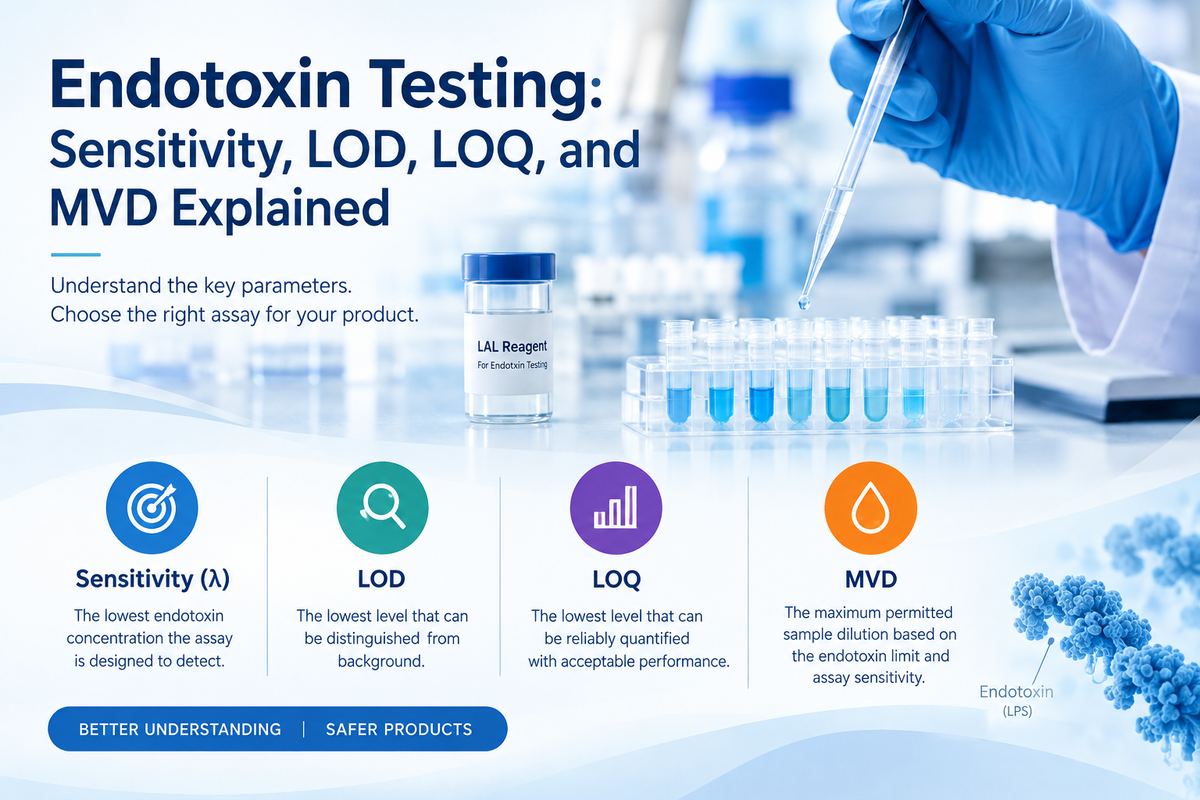
The concepts of Sensitivity, LOD, LOQ, and MVD are closely connected but should not be used interchangeably.
Sensitivity (λ) describes the stated sensitivity of an endotoxin assay, particularly in the context of gel-clot LAL testing.
LOD describes the lowest level that can be distinguished from background under defined analytical conditions.
LOQ concerns the lowest level that can be reliably quantified with acceptable analytical performance.
MVD describes the maximum permitted sample dilution based on the endotoxin limit and assay sensitivity.
Using an endotoxin limit of 0.5 EU/mL, the theoretical MVD values for the five example sensitivities are:
0.03 EU/mL → MVD 16.67
0.06 EU/mL → MVD 8.33
0.125 EU/mL → MVD 4
0.25 EU/mL → MVD 2
0.5 EU/mL → MVD 1
This demonstrates why assay sensitivity can be particularly important when sample dilution is required.
However, higher sensitivity does not automatically mean better accuracy or better assay suitability. Sample matrix effects, inhibition or enhancement, PPC recovery, assay range, controls, and method validation must also be considered.
Ultimately, the goal of endotoxin assay selection is not simply to choose the most sensitive reagent. The goal is to select a validated, fit-for-purpose method that can reliably evaluate the sample against its applicable endotoxin limit.


