
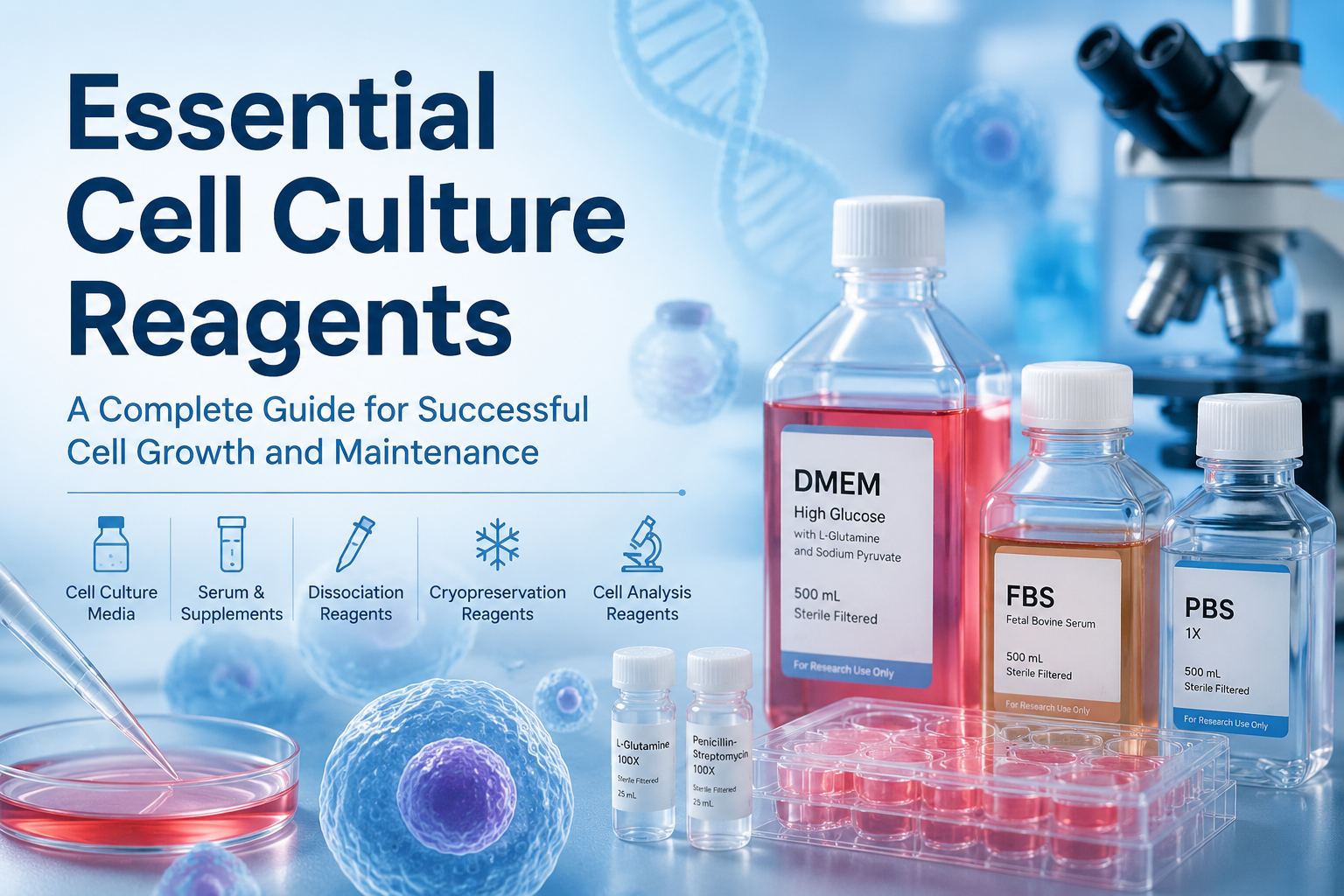
Introduction
Cell culture is one of the most important techniques in modern life science research, supporting advances in cancer biology, immunology, stem cell research, drug discovery, vaccine development, and biotechnology. The success of any cell culture experiment depends not only on proper laboratory techniques but also on the quality and selection of cell culture reagents.
Cell culture reagents provide cells with essential nutrients, maintain physiological conditions, support cell attachment and proliferation, and enable researchers to perform downstream applications such as flow cytometry, molecular analysis, and functional assays.
This article introduces the major types of cell culture reagents, their applications, and their importance in maintaining healthy and reproducible cell cultures.
What Are Cell Culture Reagents?
Cell culture reagents are specialized biological and chemical substances used to grow, maintain, manipulate, and analyze cells under controlled laboratory conditions.
Unlike cells growing naturally inside an organism, cultured cells require an artificial environment that provides:
· Nutrients and energy sources
· Growth factors and hormones
· pH and osmotic balance
· Protection from contamination
· Conditions suitable for cell attachment and proliferation
High-quality cell culture reagents are critical for achieving consistent experimental results and improving research reproducibility.
1. Cell Culture Media
Cell culture media are the foundation of in vitro cell growth. They contain essential nutrients, salts, amino acids, vitamins, glucose, and buffering components required for cell survival.
Different cell types require different media formulations.
Common Cell Culture Media Include:
DMEM (Dulbecco’s Modified Eagle Medium)
DMEM is one of the most widely used cell culture media for mammalian cells.
Applications:
· HEK293 cells
· HeLa cells
· Fibroblasts
· Cancer cell lines
DMEM provides high glucose levels and essential nutrients to support rapid cell proliferation.
RPMI-1640 Medium
RPMI-1640 is commonly used for immune and blood-related cell culture.
Applications:
· Lymphocytes
· Hybridoma cells
· Leukemia cell lines
· Immune cell activation studies
MEM and α-MEM
MEM and α-MEM are widely used for:
· Primary cell culture
· Stem cell research
· Fibroblast culture
α-MEM contains additional nutrients and is frequently used for specialized cell growth applications.
DMEM/F12 Medium
DMEM/F12 combines DMEM and Ham’s F12 formulations.
It is commonly used for:
· Stem cell culture
· Neural cell research
· Organoid culture
2. Fetal Bovine Serum (FBS) and Cell Culture Supplements
Serum supplements provide essential biological components that are not present in basal media.
Fetal Bovine Serum (FBS)
FBS is the most commonly used supplement in mammalian cell culture.
It contains:
· Growth factors
· Hormones
· Attachment proteins
· Nutrients
· Transport proteins
Functions of FBS include:
· Promoting cell proliferation
· Improving cell attachment
· Supporting cell survival
Because serum quality directly affects experimental outcomes, researchers often select FBS based on:
· Endotoxin level
· Sterility
· Lot-to-lot consistency
· Growth performance
Common Cell Culture Supplements
L-Glutamine
L-glutamine is an important energy source for cultured cells.
Functions:
· Supports protein synthesis
· Provides nitrogen metabolism
· Promotes cell growth
Sodium Pyruvate
Sodium pyruvate provides additional energy and helps reduce oxidative stress.
Non-Essential Amino Acids (NEAA)
NEAA supplements improve cell growth by providing additional amino acid sources.
HEPES Buffer
HEPES maintains stable pH conditions, especially during handling outside the CO₂ incubator.
3. Cell Dissociation and Detachment Reagents
Many adherent cells require detachment from culture vessels during passaging.
Trypsin-EDTA
Trypsin-EDTA is the most commonly used cell dissociation reagent.
It works by:
· Breaking protein interactions between cells and surfaces
· Allowing cell harvesting
· Supporting routine cell passage
Common concentrations include:
· 0.05% Trypsin-EDTA
· 0.25% Trypsin-EDTA
Accutase and TrypLE
These enzyme-based alternatives provide gentler cell dissociation.
Applications:
· Stem cells
· Sensitive primary cells
· Long-term culture systems
Collagenase and Dispase
Used for tissue digestion and primary cell isolation.
Applications:
· Tissue-derived cells
· Organoid preparation
· Primary culture establishment
4. Cell Culture Buffers
Buffers maintain proper physiological conditions during cell handling.
PBS (Phosphate Buffered Saline)
PBS is widely used for:
· Cell washing
· Antibody staining
· Sample preparation
DPBS and HBSS
These balanced salt solutions help maintain cell integrity during:
· Cell washing
· Flow cytometry preparation
· Short-term cell storage
5. Antibiotics and Antimicrobial Reagents
Microbial contamination is one of the biggest challenges in cell culture laboratories.
Common antimicrobial reagents include:
Penicillin-Streptomycin (Pen/Strep)
The most widely used antibiotic combination.
Provides protection against:
· Gram-positive bacteria
· Gram-negative bacteria
Amphotericin B
Used for fungal contamination prevention.
Gentamicin
Provides broad antibacterial activity.
Although antibiotics can reduce contamination risk, proper aseptic technique remains essential because antibiotics cannot replace good laboratory practices.
6. Cell Cryopreservation Reagents
Cryopreservation allows researchers to store cells for long-term use while maintaining viability.
DMSO (Dimethyl Sulfoxide)
DMSO is the most commonly used cryoprotective agent.
Functions:
· Prevents ice crystal formation
· Protects cellular structures during freezing
Commercial Cell Freezing Media
Modern freezing solutions provide optimized formulations for:
· Stem cells
· Primary cells
· Immortalized cell lines
They improve:
· Recovery rate
· Post-thaw viability
· Long-term stability
7. Cell Stimulation Reagents
Cell stimulation reagents are used to activate cellular pathways and study biological responses.
Common stimulators include:
Immune Cell Activators
· LPS
· PMA
· Ionomycin
· Concanavalin A (ConA)
· PHA
Applications:
· Cytokine analysis
· Immune response studies
· T-cell activation research
Growth Factors and Cytokines
Examples:
· EGF
· FGF
· VEGF
· IL-2
· IL-6
· TNF-α
Used in:
· Stem cell differentiation
· Immune cell expansion
· Signal pathway studies
8. Cell Culture Reagents for Cell Analysis
After cell growth and treatment, researchers often analyze cellular functions.
Common analysis reagents include:
Cell Viability Reagents
Examples:
· Trypan Blue
· MTT assay reagents
· CCK-8 assay kits
Used for:
· Cell proliferation analysis
· Cytotoxicity studies
Apoptosis Detection Reagents
Common markers:
· Annexin V
· Propidium Iodide (PI)
· Caspase assay reagents
Applications:
· Drug screening
· Cancer research
· Cell death studies
Cell Cycle Analysis Reagents
Common reagents:
· PI staining kits
· BrdU detection reagents
· EdU proliferation kits
How to Choose High-Quality Cell Culture Reagents?
When selecting cell culture reagents, researchers should consider:
1. Cell Type Compatibility
Different cells require different media and supplements.
2. Quality Control
Important factors include:
· Sterility testing
· Endotoxin testing
· Performance validation
3. Application Requirements
Research involving:
· Stem cells
· Primary cells
· Immune cells
· Drug discovery
may require specialized formulations.
Conclusion
Cell culture reagents are essential tools that enable researchers to maintain healthy cells and conduct reliable biological experiments. From basal media and serum supplements to dissociation enzymes, cryopreservation solutions, and cell analysis reagents, each component plays a critical role in supporting cell growth and experimental success.
Selecting high-quality cell culture reagents helps improve reproducibility, reduce experimental variation, and accelerate discoveries in biomedical research, biotechnology, and pharmaceutical development.
For laboratories involved in cell biology, cancer research, immunology, and drug development, reliable cell culture reagents remain the foundation of successful scientific innovation.


