
Introduction
In protein analysis, SDS-PAGE (sodium dodecyl sulfate-polyacrylamide gel electrophoresis) is one of the most widely used techniques for separating proteins according to their molecular weight. A key component of successful SDS-PAGE experiments is the Tris-Glycine-SDS electrophoresis buffer, also known as the running buffer.
This buffer provides the appropriate ionic environment for protein migration through polyacrylamide gels. It maintains stable pH conditions, supports electrical conductivity, and allows efficient separation of denatured proteins.
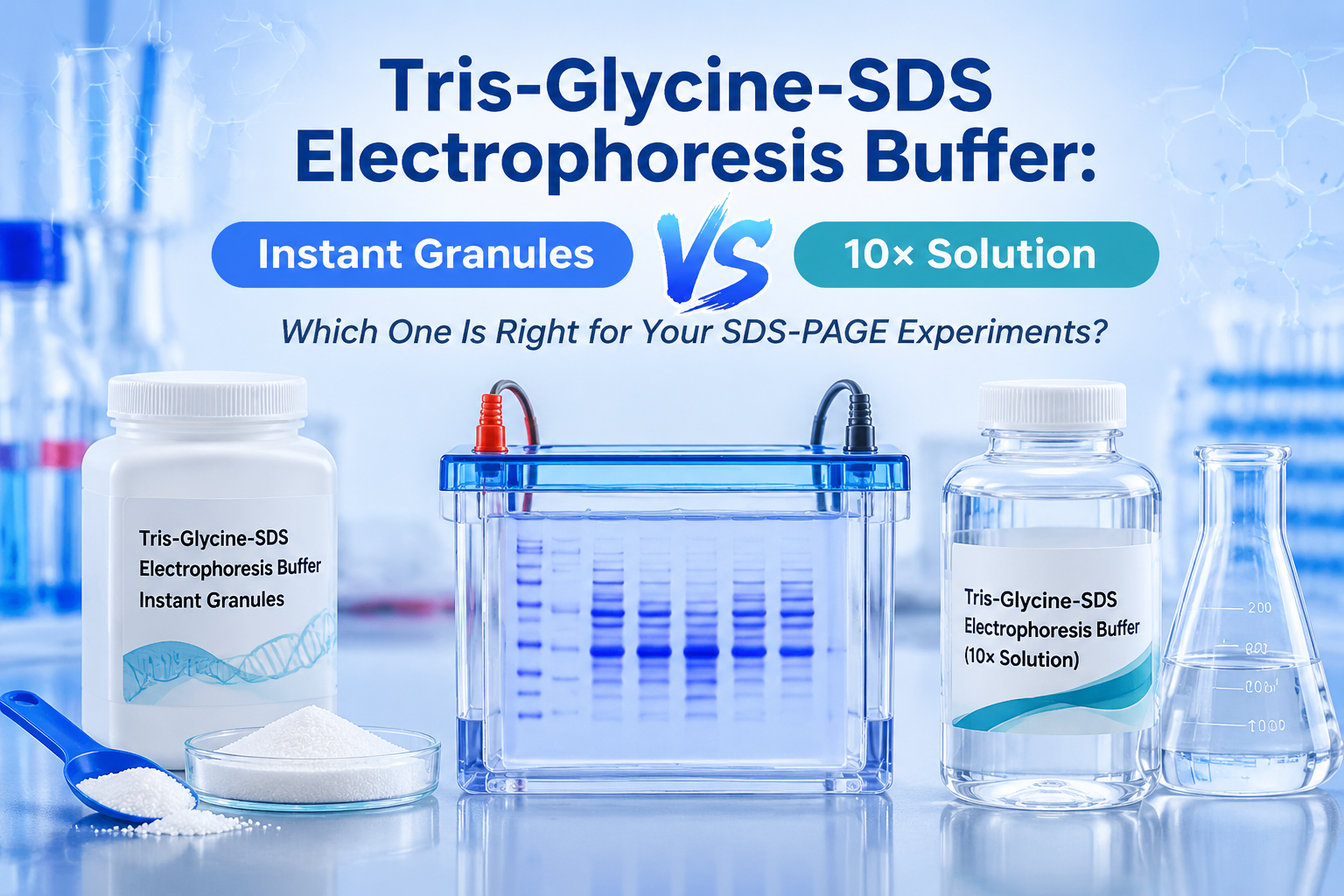
Today, Tris-Glycine-SDS electrophoresis buffer is commonly available in two forms:
· Tris-Glycine-SDS Electrophoresis Buffer Instant Granules
· Tris-Glycine-SDS Electrophoresis Buffer (10× Solution)
Although both products are designed for the same applications, including SDS-PAGE and Western blotting, they differ in formulation, preparation method, storage, and laboratory convenience. Understanding these differences can help researchers choose the most suitable format for their workflows.
What Is Tris-Glycine-SDS Electrophoresis Buffer?
Tris-Glycine-SDS electrophoresis buffer is a classic running buffer used in the Laemmli SDS-PAGE system. It contains three major components:
Tris
Tris (tris(hydroxymethyl)aminomethane) maintains the alkaline pH required for protein electrophoresis. It helps stabilize the electrical environment during gel running and ensures consistent protein migration.
Glycine
Glycine functions as the leading ion in the discontinuous electrophoresis system. Its movement through the gel contributes to the stacking and resolving processes that create sharp protein bands.
SDS
Sodium dodecyl sulfate (SDS) is an anionic detergent that denatures proteins and gives them a uniform negative charge. This allows proteins to separate mainly based on molecular weight rather than their native charge or structure.
A typical 1× Tris-Glycine-SDS running buffer contains:
· 25 mM Tris
· 192 mM Glycine
· 0.1% SDS
This formulation is widely used for:
· SDS-PAGE protein separation
· Western blot sample analysis
· Protein expression studies
· Molecular weight determination
· Immunoblotting experiments
What Is Tris-Glycine-SDS Electrophoresis Buffer (10× Solution)?
Tris-Glycine-SDS Electrophoresis Buffer (10×) is a concentrated liquid formulation designed for dilution before use.
Researchers typically prepare the working buffer by diluting the concentrate:
10× buffer : distilled water = 1 : 9
After dilution, the solution becomes a standard 1× electrophoresis buffer suitable for routine SDS-PAGE experiments.
Advantages of 10× Solution
1. Ready-to-Dilute Convenience
The biggest advantage of a 10× solution is speed. Researchers do not need to weigh individual chemicals such as Tris, glycine, and SDS. Simply dilute the concentrate with water to prepare the working solution.
2. Reduced Preparation Errors
Manual preparation of electrophoresis buffer requires accurate measurement of multiple components. A concentrated solution minimizes variation between batches and improves experimental consistency.
3. Ideal for Routine Laboratory Use
For laboratories performing frequent Western blot or SDS-PAGE experiments, a 10× solution provides a convenient workflow:
· Dilute
· Mix
· Use immediately
This saves preparation time and improves laboratory efficiency.
What Are Tris-Glycine-SDS Electrophoresis Buffer Instant Granules?
Instant granules are a dry, pre-mixed formulation containing the required components of Tris-Glycine-SDS electrophoresis buffer.
Instead of handling multiple reagents separately, researchers simply dissolve the granules in the recommended volume of water to prepare the electrophoresis buffer.
Advantages of Instant Granules
1. Excellent Storage Stability
Compared with liquid solutions, dry granules generally have better stability during storage. They are less affected by temperature fluctuations and do not require handling large volumes of liquid.
2. Easy Transportation
Because instant granules are lightweight and compact, they are convenient for:
· Laboratory supply storage
· International shipping
· Long-term inventory management
3. Accurate Pre-Mixed Formulation
Each package contains precisely measured components, reducing the possibility of incorrect weighing or formulation mistakes.
4. Suitable for High-Throughput Research
For laboratories that consume large amounts of electrophoresis buffer, instant granules provide a practical solution for preparing fresh buffer whenever needed.
Key Differences Between Instant Granules and 10× Solution
|
Feature |
Instant Granules |
10× Solution |
|
Physical form |
Dry granules |
Liquid concentrate |
|
Preparation |
Dissolve in water |
Dilute with water |
|
Storage |
More stable, compact |
Requires liquid storage |
|
Transportation |
Easier and lower cost |
More challenging |
|
Laboratory convenience |
Excellent for bulk preparation |
Excellent for rapid use |
|
Risk of preparation error |
Very low |
Very low |
|
Application |
SDS-PAGE, Western blot |
SDS-PAGE, Western blot |
Do They Provide the Same Experimental Performance?
Yes. When prepared at the same final concentration, both formats provide comparable electrophoresis performance.
Whether researchers use instant granules or a 10× liquid solution, the final working buffer contains the same essential components:
· Tris for pH control
· Glycine for ion migration
· SDS for protein denaturation and charge uniformity
Therefore, both products can achieve reliable protein separation in:
· Polyacrylamide gel electrophoresis
· Western blot workflows
· Protein characterization studies
The choice mainly depends on laboratory requirements, storage conditions, and workflow preferences.
How to Choose the Right Tris-Glycine-SDS Electrophoresis Buffer?
Choose 10× Solution If:
· Your laboratory performs SDS-PAGE frequently
· You need immediate preparation
· You prefer liquid reagents
· You want a simple dilution workflow
The 10× solution is especially suitable for daily laboratory operations where speed and convenience are priorities.
Choose Instant Granules If:
· You require long-term storage
· You need to reduce shipping costs
· You prepare large volumes of buffer
· You want a compact laboratory reagent format
Instant granules are a practical choice for research institutions, biotechnology companies, and laboratories managing large reagent inventories.
Conclusion
Both Tris-Glycine-SDS Electrophoresis Buffer Instant Granules and Tris-Glycine-SDS Electrophoresis Buffer (10× Solution) are reliable solutions for SDS-PAGE and Western blot applications. They provide the same fundamental electrophoresis chemistry while offering different advantages in storage, preparation, and convenience.
The 10× solution is ideal for researchers who prioritize rapid preparation and daily usability, while instant granules offer excellent stability, portability, and flexibility for long-term laboratory management.
Choosing the right format depends on your experimental frequency, storage requirements, and workflow preferences. Regardless of the format, a high-quality Tris-Glycine-SDS electrophoresis buffer remains essential for obtaining clear protein bands and reproducible results in modern molecular biology research.


