
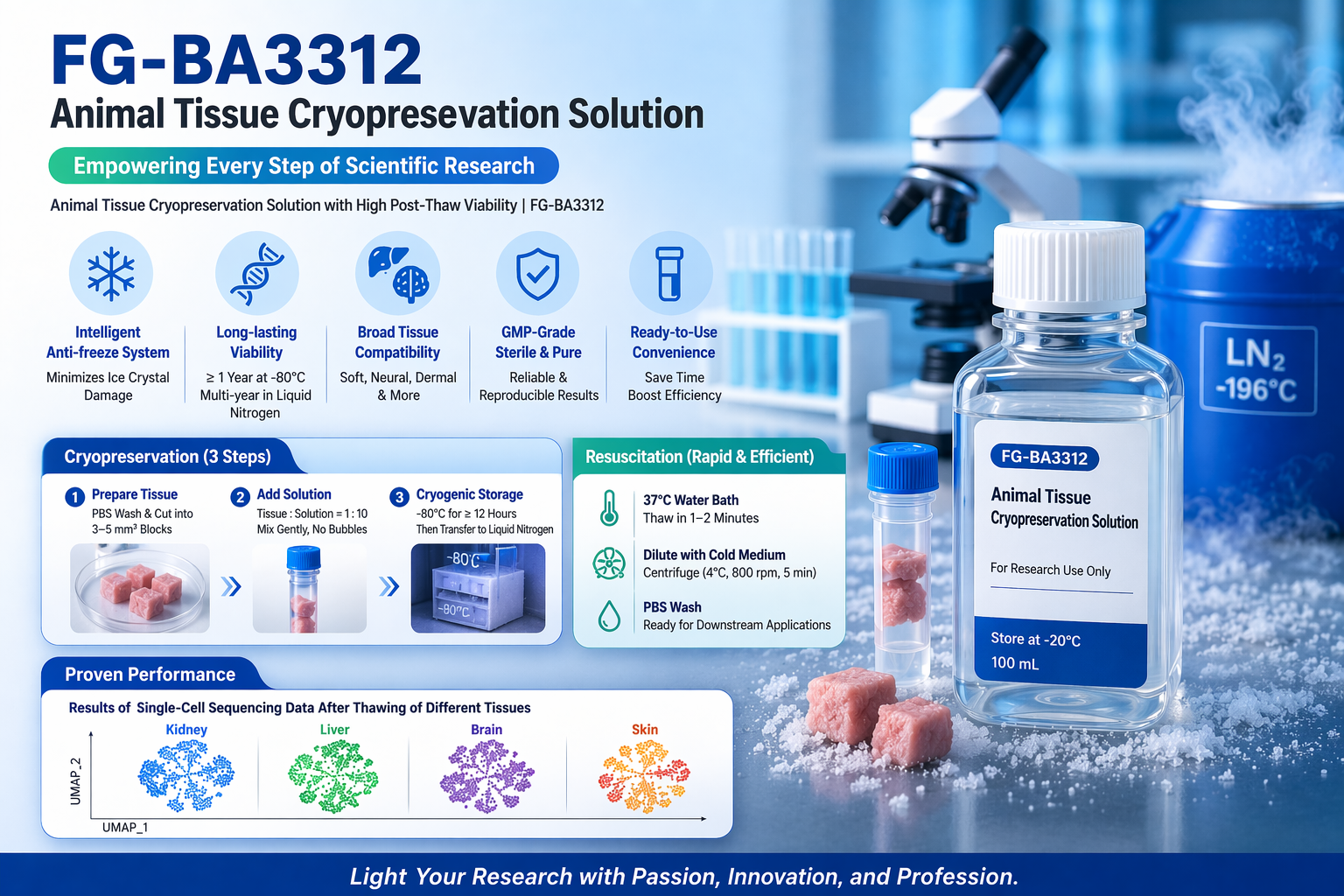
On the path of scientific exploration, the preservation and utilization of animal tissue samples serve as the critical link connecting experimental design with research outcomes. A fresh, intact tissue sample provides a solid foundation for the accuracy of experimental data, while the choice of cryopreservation reagent directly determines whether the intrinsic value of that sample is successfully retained.
Addressing common research pain points—such as the susceptibility of ex vivo tissues to degradation, poor viability upon thawing, and a lack of adaptability across diverse experimental scenarios—Firegene has dedicated itself to deep specialization within the field of research reagents. We proudly introduce FG-BA3312 Animal Tissue Cryopreservation Solution: leveraging groundbreaking new technologies, this solution delivers a cryopreservation strategy precisely tailored to meet the demands of scientific research. It ensures that every precious sample remains "fresh" and viable for the long term, thereby injecting powerful momentum into scientific innovation.
I. Key Upgrades: Redefining the Cryopreservation Experience
(I) Intelligent Anti-freeze System: Minimizing Ice Crystal Damage.
Innovatively employing a temperature-controlled anti-freeze formula, this system automatically adjusts its protective mechanisms based on the cryopreservation temperature. It effectively inhibits the formation and growth of ice crystals during the freezing process, thereby preventing ice-induced damage to tissue and cellular structures. Compared to traditional cryopreservation solutions, it significantly reduces the rate of cell lysis, ensuring that cryopreserved tissues retain their structural integrity and guaranteeing higher viability upon recovery.
(II) Long-lasting Viability-Locking Technology: Extending Storage Duration.
Infused with long-acting viability-locking components, this solution deeply preserves the activity of tissue cells while delaying apoptosis and tissue degradation. It allows for stable storage for at least one year at -80°C, and for several years in liquid nitrogen environments. Upon recovery, tissue viability remains at a high level, effectively eliminating concerns regarding the long-term storage of samples.
(III) Broad-Spectrum Compatibility: Suitable for Diverse Tissue Types.
Tailored to the specific characteristics of various mammalian tissues, the optimized formula offers exceptional compatibility. Whether dealing with soft visceral tissues, sensitive and fragile neural tissues, or dense dermal tissues, it ensures highly efficient cryopreservation across the board. There is no need to switch reagents based on tissue type; a single bottle serves all scenarios, significantly enhancing experimental convenience.
(IV) Sterility and Purity: Ensuring Experimental Integrity.
The manufacturing process strictly adheres to GMP standards, undergoing multiple rounds of sterile filtration and impurity testing. This guarantees that the cryopreservation solution is free from contamination by bacteria, fungi, mycoplasma, and other pathogens, as well as interference from exogenous impurities. With high batch-to-batch consistency in purity, it is suitable for direct use in research experiments requiring stringent sample purity, thereby contributing to the accuracy and reliability of experimental data.
(V) User-Friendly Design: Lowering Experimental Barriers.
Featuring a "ready-to-use" design, the solution eliminates the need for complex preparation procedures; simply thaw after removal from storage, and it is ready for immediate use, saving valuable time for laboratory personnel. Cryopreservation operations require no specialized equipment and can be performed under standard laboratory conditions, allowing both research novices and seasoned investigators to quickly master the process and boost experimental efficiency.
II. Practical Tutorial | Easily Master Cryopreservation and Resuscitation Techniques
(I) Cryopreservation Procedure (Completed in 3 Steps)
Sample Processing: Immediately after collecting fresh ex vivo tissue, place it into pre-chilled, sterile PBS buffer and rapidly transport it to the laboratory. Using sterile instruments, remove surface impurities, fascia, and blood vessels from the tissue; rinse twice with PBS, blot the surface dry, and cut the tissue into 3–5 mm³ blocks, ensuring uniform size.
Reagent Addition: Retrieve the BA3312 cryopreservation solution from the -20°C freezer and place it in a 4°C refrigerator to thaw (approximately 20–30 minutes); once thawed, gently invert the container to mix. Place the processed tissue blocks into a sterile cryovial, then add the cryopreservation solution at a tissue-to-solution volume ratio of 1:10. Gently shake the cryovial to ensure the tissue blocks are completely submerged and that no air bubbles remain.
Cryogenic Storage: Clearly label the cryovial with the tissue type, collection date, and cryopreservation date. Place the vial into a gradient freezing box and store it in a -80°C freezer for at least 12 hours; subsequently, it may be transferred to liquid nitrogen for long-term storage as needed.
(II) Resuscitation Procedure (Efficient and Rapid)
Thawing Preparation: Pre-chill 1640 culture medium to 4°C in advance. Prepare a 37°C constant-temperature water bath and ensure all necessary sterile operating conditions are established.
Rapid Thawing: Remove the cryovial from the -80°C freezer or liquid nitrogen storage and immediately place it into the 37°C constant-temperature water bath. Gently shake the vial to ensure the cryopreservation solution thaws completely within 1–2 minutes, thereby avoiding potential cell damage caused by prolonged thawing.
Post-Thawing Processing: Transfer the thawed tissue suspension into a sterile centrifuge tube. Add three times the volume of pre-chilled 1640 culture medium and mix gently. Centrifuge at low temperature (4°C) at 800 rpm for 5 minutes, then discard the supernatant. Rinse once with PBS; the tissue is then ready for use in subsequent experimental procedures.
III. Presentation of Actual Test Data


Results of single-cell sequencing data after thawing of different tissues
Firegene Animal Tissue Cryopreservation Solution (Cat. No.: FG-BA3312) provides robust support for researchers' work, distinguished by its user-friendly operation, superior performance, and exceptional cost-effectiveness. Whether the goal is to enhance experimental efficiency or ensure experimental quality, it serves as a trusted scientific partner—guaranteeing the reliability of subsequent experimental results!
FireGene, light your research with passion, innovation, and profession.
FireGene Single-Cell Sample Prep
Looking for validated dissociation kits?
FireGene's tissue dissociation kits are optimized for specific organ types — brain, tumor, liver, GI, reproductive, and more. Validated for 10x Genomics Chromium and BD Rhapsody workflows.


