
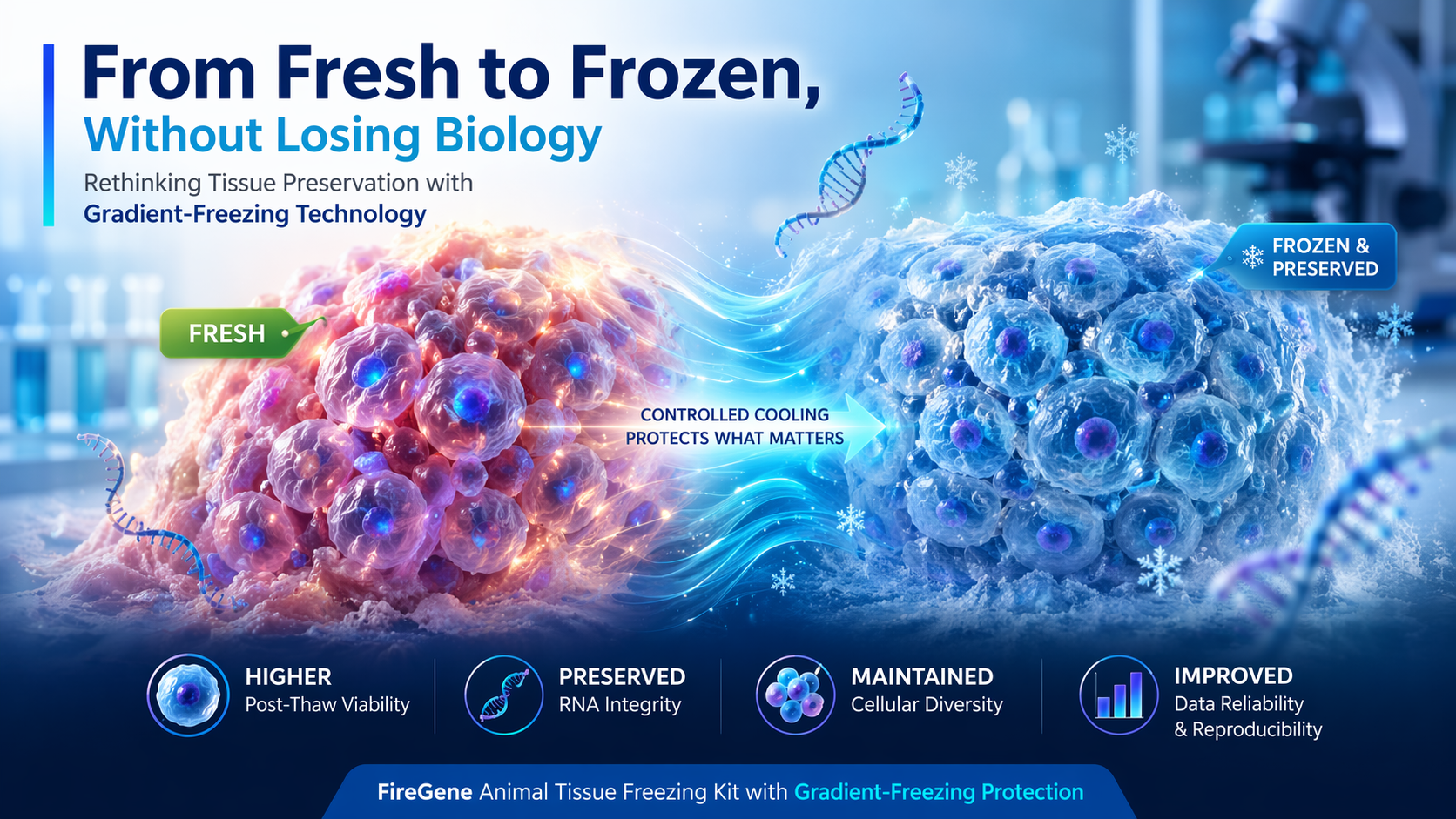
1. Introduction: The Hidden Challenge of Tissue Preservation
In recent years, advances in single-cell technologies and precision biology have transformed how researchers explore complex biological systems. From uncovering cellular heterogeneity to identifying novel therapeutic targets, high-resolution analysis now depends heavily on the quality of starting materials. However, one critical step is often underestimated: tissue preservation.
Preserving animal tissues is not as simple as freezing samples and storing them for later use. During conventional freezing processes, cells are exposed to rapid temperature changes and osmotic stress, leading to ice crystal formation, membrane damage, and loss of viability. As a result, the biological integrity of the tissue can be compromised long before downstream analysis begins. This becomes especially problematic in applications such as single-cell RNA sequencing, where even subtle changes in cell state or composition can introduce significant bias.
Traditional freezing methods, while convenient, were not designed with modern research demands in mind. They often fail to maintain the delicate balance required to preserve both cell structure and molecular fidelity. Consequently, researchers may face inconsistent results, reduced data quality, and the need for repeated experiments—costing both time and resources.
As the expectations for data accuracy and reproducibility continue to rise, there is a growing need for more advanced preservation strategies. Solutions that go beyond simple freezing—offering controlled protection and improved recovery—are becoming essential for ensuring that what is analyzed truly reflects the original biological state.
2. Why Conventional Freezing Methods Fall Short
Despite being widely used, conventional tissue freezing methods were developed for basic preservation rather than the demands of modern high-resolution analysis. Techniques such as snap freezing in liquid nitrogen or simple DMSO-based cryopreservation are often applied as standard practice, yet they introduce significant limitations that can compromise downstream results.
 One of the primary challenges is ice crystal formation. During rapid freezing, intracellular water solidifies unevenly, creating sharp crystals that disrupt cell membranes and damage intracellular structures. This mechanical injury reduces cell viability and alters the natural state of the tissue. In parallel, cells experience osmotic stress, as water shifts in and out of the cell during freezing and thawing, further destabilizing cellular integrity.
Another overlooked issue is the loss of cellular diversity. Sensitive cell populations may not survive the freezing process, leading to selective loss and distortion of the original tissue composition. For applications like single-cell sequencing, this can result in incomplete or misleading datasets. Additionally, RNA degradation may occur, directly affecting gene expression analysis and reducing data reliability.
Ultimately, these limitations translate into practical challenges: lower recovery rates, inconsistent experimental outcomes, and reduced reproducibility. As research increasingly depends on precise, high-quality data, it becomes clear that traditional freezing approaches are no longer sufficient to meet the evolving standards of life science workflows.
3. Gradient-Freezing Protection: A Smarter Approach
To overcome the limitations of traditional methods, a more refined strategy is required—one that actively protects tissues throughout the freezing process rather than simply preserving them at low temperatures. This is where gradient-freezing protection offers a meaningful advancement.
Instead of exposing tissues to abrupt temperature drops, gradient-based freezing introduces a controlled transition that allows cells to gradually adapt to changing conditions. Combined with an optimized cryoprotectant environment, this approach helps balance osmotic pressure and significantly reduces the risk of intracellular ice formation. The result is a gentler, more physiological preservation process that minimizes structural and molecular damage.
By maintaining membrane integrity and reducing stress responses, gradient-freezing protection supports higher post-thaw cell viability and better preservation of tissue architecture. Equally important, it helps retain RNA integrity and true gene expression profiles, which are essential for downstream applications such as single-cell sequencing and spatial analysis.
Rather than acting as a simple storage solution, this approach serves as a bridge between fresh tissue and reliable data generation. It ensures that the biological information captured after thawing more accurately reflects the original in vivo state, reducing experimental bias and improving reproducibility.
In an era where data precision is critical, adopting smarter preservation strategies like gradient-freezing protection is not just beneficial—it is becoming essential.
4. Designed for Modern Research Workflows
As life science research continues to evolve toward higher resolution and larger scale data generation, tissue preservation solutions must keep pace with increasingly complex experimental demands. The FireGene Animal Tissue Freezing Kit with Gradient-Freezing Protection is designed specifically to integrate into modern biomedical workflows, particularly those centered on single-cell and multi-omics technologies.
One of its key strengths lies in its broad tissue compatibility. Whether working with brain, liver, lung, kidney, skin, or tumor samples, researchers can apply a consistent preservation strategy without the need for extensive protocol optimization. This standardization is especially valuable in multi-site studies or high-throughput research environments, where reproducibility is critical.
The kit is also highly suited for a range of downstream applications, including single-cell RNA sequencing, tissue biobanking, organoid research, and histological analysis. By preserving both cellular viability and molecular integrity, it helps ensure that downstream datasets remain robust and biologically meaningful.
From a workflow perspective, the system is designed to be ready-to-use and time-efficient, reducing the need for in-house formulation or trial-and-error optimization. This not only simplifies experimental setup but also helps minimize variability between users and laboratories.
In essence, the kit is more than just a preservation tool—it is a workflow enabler. By improving consistency and reducing technical barriers, it allows researchers to focus more on data interpretation and discovery, rather than troubleshooting sample quality issues.
5. Conclusion: Freeze with Confidence, Recover with Accuracy
In modern biological research, the value of an experiment is often determined long before sequencing or analysis begins. It starts at the very first step—how well the original tissue is preserved. When preservation fails, even the most advanced downstream technologies cannot fully recover lost biological information.
The FireGene Animal Tissue Freezing Kit with Gradient-Freezing Protection addresses this fundamental challenge by shifting tissue preservation from a passive storage step to an active protection strategy. Instead of simply slowing down biological decay, it helps maintain cellular integrity, molecular stability, and tissue composition throughout the freezing process.
By reducing ice crystal damage and minimizing osmotic stress, the system supports higher post-thaw viability and more reliable recovery of diverse cell populations. More importantly, it helps preserve the biological “truth” of the sample, ensuring that gene expression profiles and cellular states remain as close as possible to their native in vivo conditions.
For researchers working in single-cell sequencing, tissue biobanking, or translational studies, this translates into greater data consistency, improved reproducibility, and reduced experimental waste. Fewer failed samples mean more efficient workflows and more confident scientific conclusions.
Ultimately, advanced preservation is no longer a secondary consideration—it is a foundational requirement for high-quality biological insight. With gradient-freezing protection, researchers can move from uncertainty to confidence, ensuring that what is analyzed in the lab truly reflects the biology of life itself.
FireGene, light your research with passion, innovation, and profession.
FireGene Single-Cell Sample Prep
Looking for validated dissociation kits?
FireGene's tissue dissociation kits are optimized for specific organ types — brain, tumor, liver, GI, reproductive, and more. Validated for 10x Genomics Chromium and BD Rhapsody workflows.


