
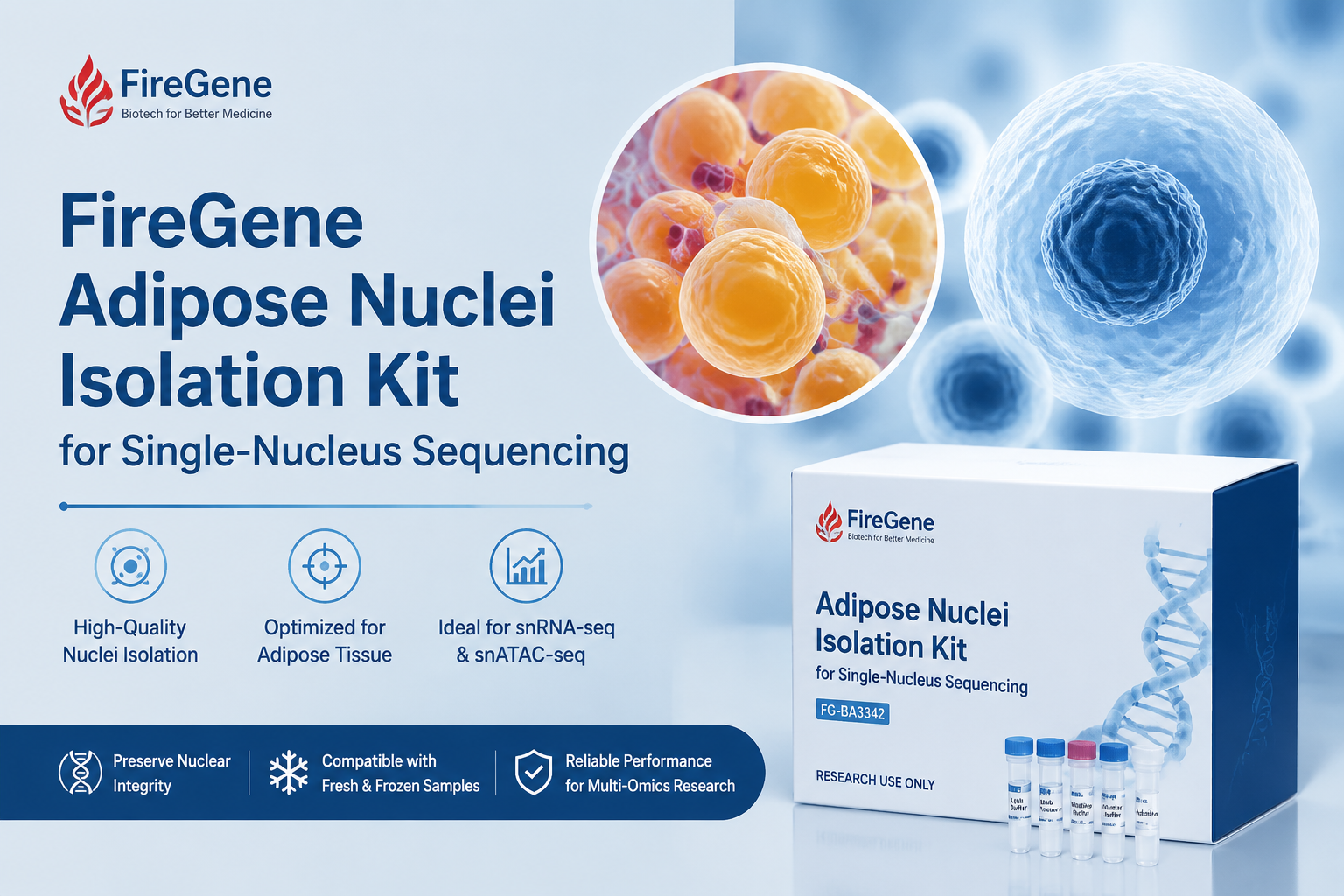
Single-nucleus sequencing has become a powerful technology for studying complex tissues at cellular resolution. However, adipose tissue remains one of the most challenging sample types due to its high lipid content, fragile adipocytes, and complex extracellular environment. The FireGene Adipose Nuclei Isolation Kit for Single-Nucleus Sequencing provides an optimized workflow for isolating intact, high-quality nuclei from adipose tissue, enabling reliable downstream applications such as single-nucleus RNA sequencing (snRNA-seq) and single-nucleus ATAC sequencing (snATAC-seq). This article introduces the challenges of adipose tissue analysis, the advantages of nuclei isolation, and how FireGene technology supports advanced single-cell research.
FireGene Adipose Nuclei Isolation Kit for Single-Nucleus Sequencing: Advancing Adipose Tissue Research
Adipose tissue is no longer considered only an energy storage organ. Modern research has revealed that adipose tissue functions as a highly dynamic endocrine and metabolic organ involved in energy regulation, immune responses, inflammation, and disease progression. Understanding the cellular composition and molecular mechanisms of adipose tissue is essential for studying obesity, diabetes, metabolic disorders, aging, and regenerative medicine.
With the rapid development of single-cell technologies, researchers can now analyze individual cell populations and identify previously unknown cellular states. However, traditional single-cell RNA sequencing approaches often face limitations when applied to adipose tissue. The unique biological characteristics of adipose samples make efficient cell isolation difficult.
The FireGene Adipose Nuclei Isolation Kit for Single-Nucleus Sequencing is designed to overcome these challenges by providing an optimized method for obtaining high-quality nuclei from adipose tissue. By enabling reliable single-nucleus preparation, this kit supports comprehensive transcriptomic and epigenomic analysis of complex adipose tissues.
Why Is Adipose Tissue Difficult for Single-Cell Analysis?
Adipose tissue contains a mixture of different cell types, including:
· Mature adipocytes
· Preadipocytes
· Fibroblasts
· Endothelial cells
· Immune cells
· Mesenchymal stromal cells
Among these populations, mature adipocytes present a significant technical challenge.
1. High Lipid Content
Mature adipocytes contain large lipid droplets that occupy most of the cellular volume. These lipid structures:
· Reduce tissue dissociation efficiency
· Increase sample debris
· Affect cell recovery
· Interfere with microfluidic-based sequencing platforms
During conventional enzymatic digestion, adipocytes are often fragile and difficult to maintain as intact cells.
2. Fragile Cell Structure
Adipocytes are highly sensitive to mechanical stress and enzymatic treatment. Excessive digestion can lead to:
· Cell membrane damage
· Reduced cell viability
· Loss of biological information
· Altered gene expression profiles
3. Complex Extracellular Matrix
Adipose tissue contains extracellular matrix components such as:
· Collagen
· Elastin
· Proteoglycans
These structures provide tissue support but create barriers during cell isolation.
Because of these limitations, researchers increasingly use single-nucleus sequencing approaches as an alternative strategy.
What Is Single-Nucleus Sequencing?
Single-nucleus sequencing analyzes the genetic information contained within individual nuclei rather than whole cells.
The basic workflow includes:
Tissue Sample
↓
Nuclei Isolation
↓
Nuclei Quality Assessment
↓
Library Preparation
↓
Sequencing and Bioinformatics Analysis
Unlike traditional single-cell sequencing, single-nucleus sequencing offers several advantages:
· Compatible with difficult tissues
· Suitable for frozen samples
· Reduced dissociation-induced stress
· Improved analysis of fragile cell populations
For adipose tissue research, nuclei isolation provides access to valuable molecular information while avoiding many challenges associated with intact cell recovery.
FireGene Adipose Nuclei Isolation Kit: Optimized for Adipose Tissue Samples
The FireGene Adipose Nuclei Isolation Kit is specifically developed for researchers performing single-nucleus sequencing experiments with lipid-rich adipose tissues.
The kit provides an optimized workflow that enables efficient nuclei release while maintaining nuclear integrity.
Key advantages include:
1. Efficient Nuclei Recovery from Lipid-Rich Tissue
Adipose tissue requires specialized processing methods because of its high fat content. The FireGene workflow is optimized to:
· Break down tissue structures effectively
· Release intact nuclei
· Reduce lipid contamination
· Improve sample cleanliness
High-quality nuclei preparation is critical for obtaining reliable sequencing data.
2. Preservation of Nuclear Integrity
The quality of isolated nuclei directly influences downstream sequencing performance.
The FireGene kit helps maintain:
· Intact nuclear membranes
· Suitable nuclear morphology
· Stable genomic and transcriptomic information
Well-preserved nuclei contribute to improved library construction and sequencing accuracy.
3. Compatibility with Multiple Single-Nucleus Applications
The isolated nuclei can support various molecular analysis platforms, including:
Single-Nucleus RNA Sequencing (snRNA-seq)
snRNA-seq enables researchers to study:
· Cell-type identification
· Gene expression patterns
· Cellular heterogeneity
· Disease-associated transcriptional changes
In adipose research, snRNA-seq can reveal differences between:
· Healthy and diseased adipocytes
· Immune cell populations
· Stromal cell states
· Metabolic cell programs
Single-Nucleus ATAC Sequencing (snATAC-seq)
snATAC-seq focuses on chromatin accessibility and regulatory mechanisms.
Applications include:
· Identifying active regulatory regions
· Studying transcription factor activity
· Understanding epigenetic regulation
· Mapping cell-state transitions
Together, snRNA-seq and snATAC-seq provide deeper insights into adipose biology.
Applications of Adipose Single-Nucleus Sequencing Research
Obesity and Metabolic Disease Research
Obesity involves complex interactions between adipocytes, immune cells, and metabolic pathways.
Single-nucleus sequencing helps researchers investigate:
· Adipocyte diversity
· Inflammatory responses
· Insulin resistance mechanisms
· Metabolic remodeling
Diabetes Research
Adipose tissue plays an important role in glucose metabolism.
Researchers can use single-nucleus analysis to study:
· Insulin signaling pathways
· Adipocyte dysfunction
· Immune infiltration
· Disease progression mechanisms
Aging Research
Aging causes significant changes in adipose tissue composition and function.
Single-nucleus sequencing enables investigation of:
· Cellular aging signatures
· Senescence-related pathways
· Tissue remodeling
· Age-associated gene regulation
Regenerative Medicine
Adipose-derived stromal cells are widely studied in regenerative medicine.
Nuclei-based analysis helps characterize:
· Stem cell populations
· Differentiation states
· Regenerative potential 
Advantages of FireGene Adipose Nuclei Isolation Technology
Compared with traditional cell isolation methods, the FireGene approach provides several important benefits:
|
Challenge |
FireGene Solution |
|
Lipid-rich adipose tissue |
Optimized nuclei extraction workflow |
|
Fragile adipocytes |
Reduced dependence on intact cell recovery |
|
Difficult cell dissociation |
Direct nuclei-based analysis |
|
Frozen sample limitations |
Compatible with challenging samples |
|
Complex tissue composition |
Enables detailed cellular profiling |
By focusing on nuclei quality, researchers can obtain more consistent results from challenging adipose samples.
Improving Single-Nucleus Sequencing Results: Key Considerations
High-quality sequencing starts with high-quality nuclei preparation.
Important factors include:
Sample Handling
Rapid and appropriate tissue processing helps maintain molecular integrity.
Nuclei Quality Control
Researchers should evaluate:
· Nuclear concentration
· Nuclear integrity
· Debris levels
· Aggregation status
Optimized Downstream Workflow
A clean nuclei suspension improves:
· Library preparation efficiency
· Sequencing performance
· Data quality
The FireGene Adipose Nuclei Isolation Kit provides a standardized solution for these critical preparation steps.
Future Perspectives of Adipose Single-Nucleus Research
As single-cell and multiomics technologies continue to advance, adipose tissue research is entering a new era.
Future studies will increasingly combine:
· Single-nucleus RNA sequencing
· Single-nucleus ATAC sequencing
· Spatial transcriptomics
· Proteomics
· Metabolomics
These integrated approaches will provide deeper understanding of how adipose tissue regulates metabolism, immunity, and disease.
Reliable nuclei isolation technology will remain a key foundation for successful single-nucleus sequencing projects.
Conclusion
Adipose tissue presents unique challenges for single-cell research because of its lipid-rich structure, fragile adipocytes, and complex cellular environment. Traditional cell isolation methods may compromise cell recovery and molecular quality.
The FireGene Adipose Nuclei Isolation Kit for Single-Nucleus Sequencing provides an efficient and reliable solution for preparing high-quality nuclei from adipose samples. By supporting applications such as snRNA-seq and snATAC-seq, this technology enables researchers to explore adipose tissue biology with greater accuracy and resolution.
From metabolic disease research to regenerative medicine, FireGene adipose nuclei isolation technology helps accelerate discoveries in modern single-cell and multiomics research.


