
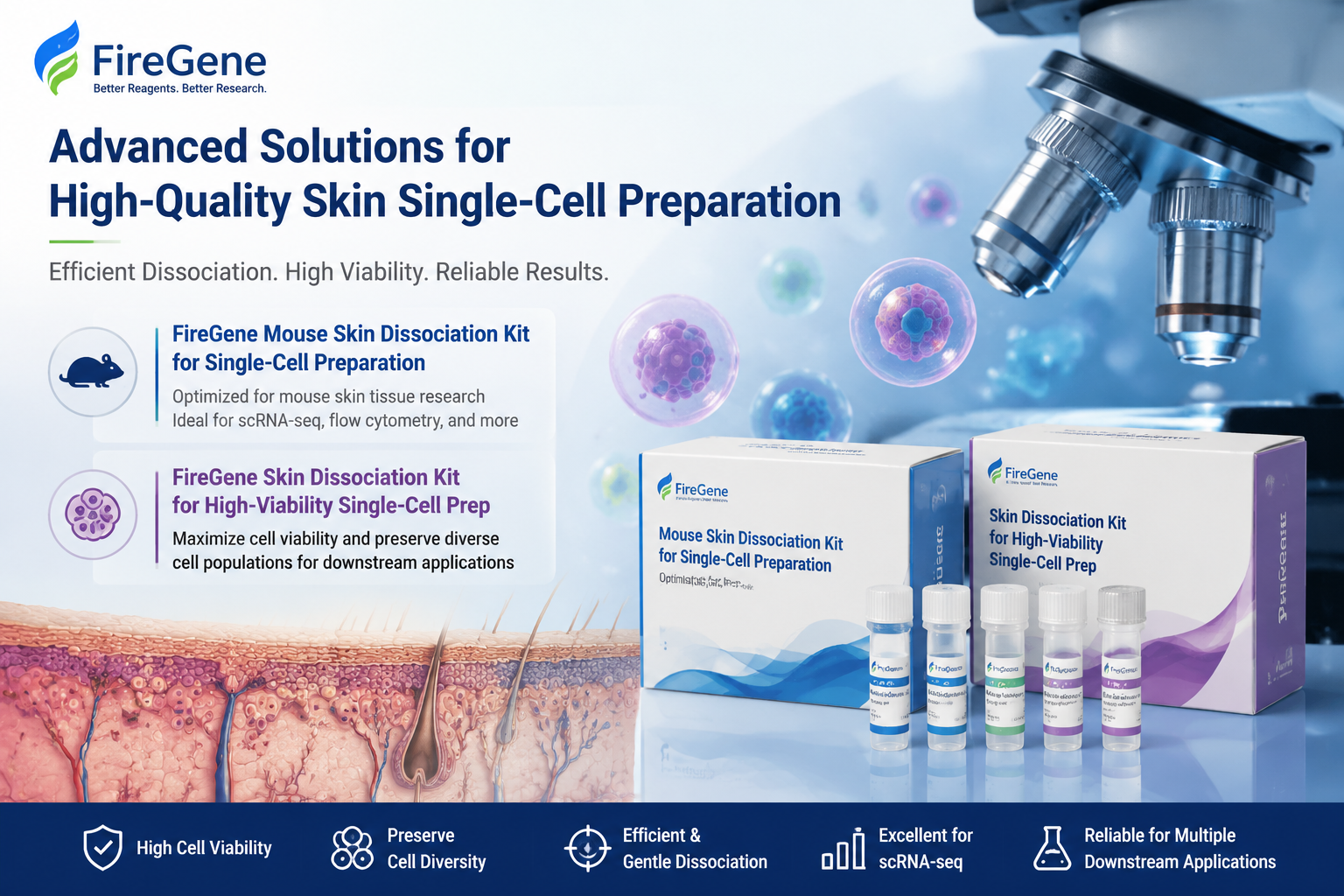
Single-cell analysis has transformed modern biomedical research by enabling researchers to investigate cellular heterogeneity, molecular signatures, and biological mechanisms at unprecedented resolution. However, obtaining high-quality single-cell suspensions from skin tissue remains challenging due to its complex extracellular matrix structure and diverse cell populations. FireGene Mouse Skin Dissociation Kit for Single-Cell Preparation and FireGene Skin Dissociation Kit for High-Viability Single-Cell Prep provide optimized solutions for efficient tissue dissociation while maintaining high cell viability and cellular integrity. These advanced skin dissociation kits support single-cell RNA sequencing (scRNA-seq), flow cytometry, cell sorting, and primary cell research.
Introduction: The Growing Importance of Skin Single-Cell Research
Skin is the largest organ in the mammalian body and plays essential roles in barrier protection, immune regulation, wound healing, aging, and tissue regeneration. With the rapid development of single-cell technologies, researchers can now analyze individual skin cell populations and understand complex biological processes at the cellular level.
Single-cell RNA sequencing (scRNA-seq), flow cytometry, and advanced cell profiling technologies require high-quality single-cell suspensions as the starting material. However, skin tissue presents unique challenges because it contains multiple layers and highly organized structures, including:
· Epidermis
· Dermis
· Hair follicles
· Fibrous extracellular matrix
· Immune cell compartments
· Vascular structures
The dense extracellular matrix and strong cell-to-cell connections make skin one of the more difficult tissues for single-cell preparation. Traditional mechanical dissociation methods may result in:
· Low cell recovery
· Reduced cell viability
· Damaged cell membranes
· Loss of sensitive cell populations
· Poor downstream sequencing quality
To overcome these challenges, optimized enzymatic tissue dissociation solutions are essential.
Why Is Skin Tissue Dissociation Challenging?
Unlike simple tissues, skin contains a complex combination of structural proteins and specialized cell types. Collagen, elastin, and other extracellular matrix components create a protective environment that maintains tissue strength but makes cell isolation difficult.
During tissue dissociation, researchers need to balance two important goals:
1. Efficiently break down tissue structures
2. Preserve living cells and their biological characteristics
Over-digestion can damage surface markers, reduce RNA quality, and affect cell functionality. Under-digestion may lead to incomplete dissociation and excessive cell aggregates.
An ideal skin dissociation solution should provide:
· Efficient tissue breakdown
· High single-cell recovery
· Excellent cell viability
· Preservation of native cell populations
· Compatibility with downstream applications
FireGene Skin Dissociation Kits are designed to address these requirements.
FireGene Mouse Skin Dissociation Kit for Single-Cell Preparation
The FireGene Mouse Skin Dissociation Kit for Single-Cell Preparation is specifically developed for mouse skin tissue research. It provides an optimized workflow for generating high-quality single-cell suspensions from mouse skin samples.
Mouse skin is widely used in biomedical studies, including:
· Skin regeneration research
· Wound healing models
· Immune response studies
· Dermatological disease models
· Aging research
· Hair follicle biology
The kit is optimized to release major mouse skin cell populations while maintaining sample quality.
Important cell populations obtained from mouse skin include:
Keratinocytes
Keratinocytes represent the major cell population in the epidermis and are essential for studying:
· Skin barrier formation
· Epidermal differentiation
· Tissue repair mechanisms
Fibroblasts
Dermal fibroblasts produce extracellular matrix components and are important for:
· Collagen remodeling
· Wound healing
· Skin aging studies
Immune Cells
Skin contains diverse immune populations, including macrophages, dendritic cells, and lymphocytes. Preserving these populations is critical for immune profiling studies.
Hair Follicle-Associated Cells
Hair follicle cells provide valuable information for:
· Hair growth research
· Stem cell biology
· Regenerative medicine
By providing efficient dissociation while preserving cell populations, the FireGene Mouse Skin Dissociation Kit is suitable for researchers performing single-cell sequencing and functional analysis.
FireGene Skin Dissociation Kit for High-Viability Single-Cell Prep
The FireGene Skin Dissociation Kit for High-Viability Single-Cell Prep is designed for researchers who require highly viable single-cell suspensions from skin tissues.
Compared with conventional tissue dissociation approaches, maintaining cell viability is especially important for applications involving:
· Live cell sorting
· Flow cytometry
· Primary cell culture
· Functional assays
· Single-cell sequencing
The kit focuses on protecting sensitive cell populations during the dissociation process.
Key Advantages
1. High Cell Viability
High-quality single-cell preparation depends not only on cell numbers but also on cell health. Viable cells provide more reliable biological information for downstream experiments.
The kit helps maintain:
· Intact cell membranes
· Better cellular morphology
· Improved sample quality
2. Preservation of Cellular Diversity
Skin contains multiple specialized cell types with different sensitivities to enzymatic treatment.
An optimized dissociation system helps preserve:
· Epidermal cells
· Stromal cells
· Immune populations
· Rare cell subsets
Maintaining cellular diversity is particularly important for single-cell transcriptomic analysis.
3. Compatibility with Advanced Research Applications
The FireGene Skin Dissociation Kit supports multiple downstream applications, including:
Single-Cell RNA Sequencing (scRNA-seq)
High-quality single-cell suspensions are the foundation of accurate transcriptomic profiling. Better cell viability and reduced cell stress contribute to improved sequencing results.
Flow Cytometry
Preserving cell surface markers enables reliable identification and quantification of different skin cell populations.
Cell Sorting
Viable single-cell preparation allows researchers to isolate specific populations for further functional studies.
Primary Cell Culture
Healthy isolated cells provide better opportunities for establishing primary skin cell models.
Applications of FireGene Skin Dissociation Kits
FireGene Skin Dissociation Kits can support a wide range of biomedical research areas.

Skin Regeneration Research
Researchers study how different skin cell populations contribute to tissue repair and regeneration. Single-cell analysis helps identify regenerative pathways and cellular interactions.
Wound Healing Studies
Skin injury involves coordinated responses from keratinocytes, fibroblasts, immune cells, and vascular cells. High-quality cell preparation enables detailed investigation of these processes.
Aging Research
Skin aging involves changes in extracellular matrix production, immune regulation, and cellular senescence. Single-cell technologies provide insights into age-related cellular changes.
Immunology Research
Skin is an important immune organ. Preserving immune cell populations allows researchers to investigate inflammatory responses and immune regulation.
Dermatology and Disease Models
Single-cell profiling helps researchers understand mechanisms involved in:
· Inflammatory skin disorders
· Fibrotic diseases
· Barrier dysfunction
· Skin tumors
Choosing the Right FireGene Skin Dissociation Kit
The choice between the two products depends on research objectives.
Choose FireGene Mouse Skin Dissociation Kit for Single-Cell Preparation when:
· Working with mouse skin models
· Performing mouse skin scRNA-seq studies
· Studying mouse skin biology
· Investigating wound healing or regeneration models
Choose FireGene Skin Dissociation Kit for High-Viability Single-Cell Prep when:
· Maximum cell viability is required
· Working with sensitive skin cell populations
· Performing flow cytometry or cell sorting
· Conducting functional cellular assays
Both products provide researchers with reliable solutions for preparing high-quality single-cell suspensions from challenging skin tissues.
Conclusion
High-quality single-cell preparation is the foundation of successful skin biology research. Because skin tissue contains complex extracellular structures and diverse cell populations, optimized dissociation methods are essential for obtaining accurate and reproducible results.
The FireGene Mouse Skin Dissociation Kit for Single-Cell Preparation provides a specialized solution for mouse skin research, while the FireGene Skin Dissociation Kit for High-Viability Single-Cell Prep offers a versatile approach for maintaining cell viability and preserving cellular diversity.
By combining efficient tissue dissociation with improved single-cell quality, FireGene Skin Dissociation Kits help researchers unlock deeper insights into skin regeneration, immunology, aging, and disease mechanisms through advanced single-cell technologies.


