
In biomedical research, the quality of animal tissue samples can determine the reliability of downstream experimental results. Whether researchers are preparing samples for frozen sectioning, histological observation, immunofluorescence staining, molecular analysis, or long-term sample banking, tissue preservation is a critical step. Poor freezing procedures can introduce ice crystal damage, tissue cracking, morphology distortion, biomolecule degradation, and inconsistent sectioning performance. These issues may compromise experimental accuracy and reduce confidence in research findings.
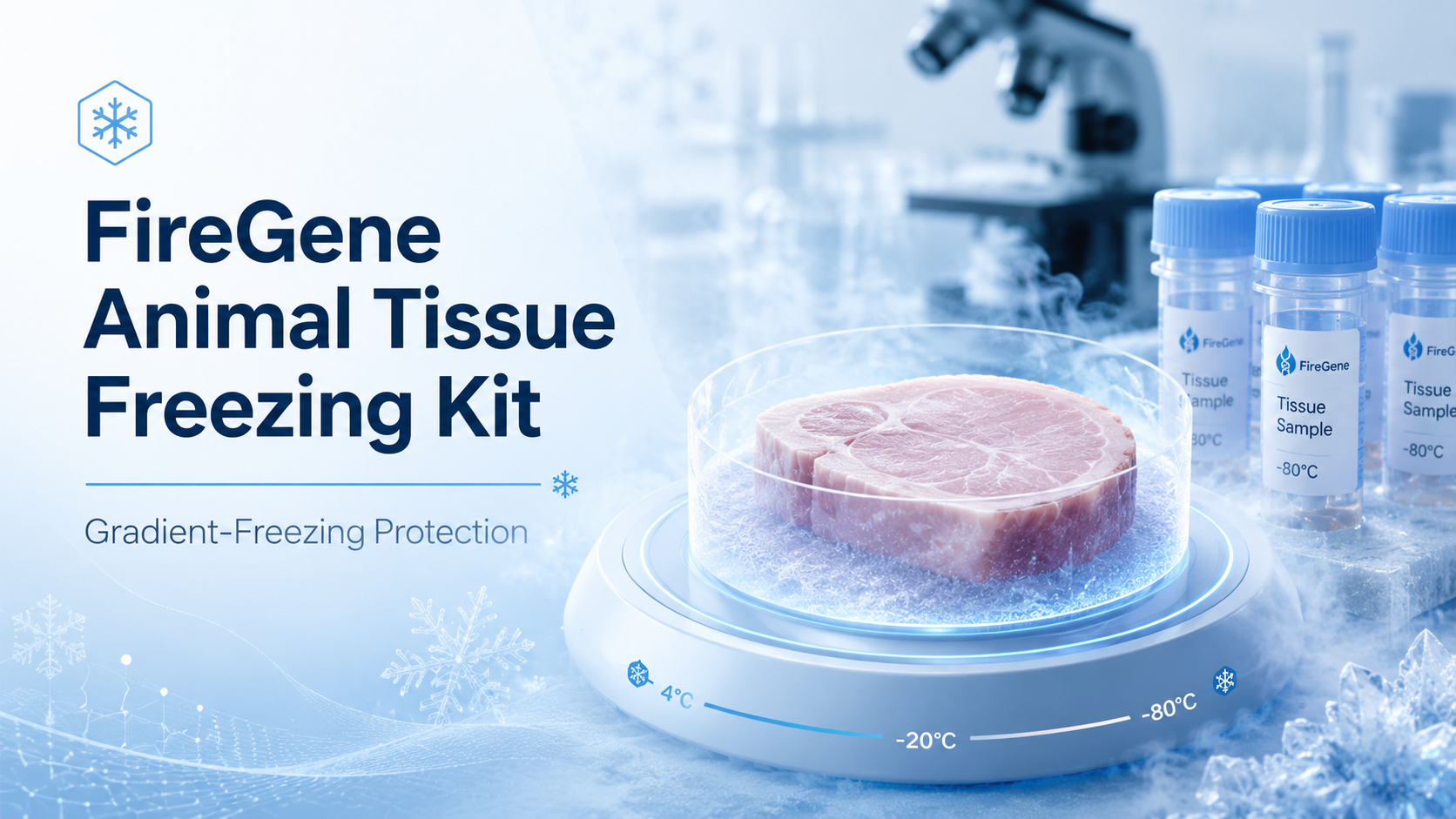
The FireGene Animal Tissue Freezing Kit - Gradient-Freezing Protection is designed to support high-quality freezing and preservation of animal tissue samples. By using a gradient-freezing protection strategy, the kit helps reduce freeze-induced damage and maintain tissue integrity during low-temperature processing. It provides researchers with a convenient and reproducible solution for tissue cryoprotection, especially when sample morphology and downstream analytical performance are important.
Why Tissue Freezing Quality Matters
Animal tissues are complex biological materials composed of cells, extracellular matrix, blood vessels, connective structures, proteins, lipids, nucleic acids, and water. During freezing, water inside and around the tissue can form ice crystals. If freezing is too rapid, uneven, or poorly controlled, these ice crystals may disrupt cellular membranes and tissue architecture. If freezing is too slow without proper protection, dehydration and solute concentration effects may also damage the sample.
These freezing artifacts can appear as tissue tearing, holes, cracks, distorted morphology, poor cellular definition, and uneven staining results. In frozen sectioning, damaged tissue may become brittle, difficult to cut, or prone to fragmentation. In molecular biology applications, poor sample handling can affect RNA, DNA, or protein quality. For these reasons, an optimized freezing process is essential for maintaining sample reliability.
The FireGene Animal Tissue Freezing Kit is developed to address these common challenges by providing gradient-freezing protection for animal tissue samples before low-temperature storage or cryosectioning.
What Is Gradient-Freezing Protection?
Gradient-freezing protection refers to a preservation approach that helps tissues transition more smoothly during temperature reduction. Instead of exposing tissue samples to sudden freezing stress without protection, a gradient-based protective system is intended to reduce the impact of abrupt temperature change and minimize damage caused by ice crystal formation.
This protection is especially valuable for animal tissues that are structurally delicate or difficult to process. Soft tissues, tumor tissues, organs, and disease model samples may respond differently to freezing conditions. A protective freezing kit can help standardize sample preparation and improve consistency across experiments.
The FireGene Animal Tissue Freezing Kit provides a practical workflow for laboratories that need improved tissue freezing outcomes without relying on complicated freezing instruments or highly specialized procedures.
Designed for Animal Tissue Cryoprotection
The FireGene Animal Tissue Freezing Kit is suitable for a wide range of animal-derived tissue samples. It can be used in research involving experimental animal models, disease model tissues, organ samples, tumor samples, soft tissues, and other biological specimens requiring frozen preservation.
Researchers often need to freeze tissue samples quickly after collection to preserve biological information. However, direct freezing in simple buffer systems or unsupported freezing media may not provide adequate protection. FireGene’s gradient-freezing protection system helps maintain tissue morphology and reduce freezing artifacts, making it suitable for routine sample preparation in biomedical laboratories.
This kit is particularly useful when researchers need preserved tissue samples for applications such as frozen sectioning, histology, immunohistochemistry, immunofluorescence, nucleic acid analysis, protein research, and sample storage.
Supporting Frozen Sectioning Workflows
Frozen sectioning is a widely used technique in biomedical research because it allows rapid tissue analysis without the longer processing time required for paraffin embedding. However, frozen section quality depends strongly on sample freezing conditions.
Poorly frozen tissues may produce incomplete sections, curling, cracking, uneven thickness, or structural damage under the cryostat blade. These issues can interfere with microscopic observation and make image interpretation difficult. For immunostaining applications, tissue damage may also affect antigen distribution and staining clarity.
By supporting tissue cryoprotection before freezing, the FireGene Animal Tissue Freezing Kit helps improve sample handling and sectioning performance. Better-preserved tissues are easier to process and more likely to generate clear, intact frozen sections for downstream analysis.
Reducing Ice Crystal Formation and Freezing Artifacts
One of the main goals of tissue freezing protection is to reduce the formation and impact of damaging ice crystals. Ice crystals can physically disrupt cellular and extracellular structures, resulting in visible artifacts during microscopy. In severe cases, ice damage can create gaps, tissue collapse, or loss of structural detail.
The FireGene Animal Tissue Freezing Kit helps protect tissue samples during the freezing process by supporting a more controlled transition into low-temperature conditions. This helps reduce mechanical stress and improve tissue preservation quality.
For researchers working with valuable or limited samples, reducing freezing artifacts is especially important. Experimental animal tissues may represent specific disease models, treatment groups, developmental stages, or rare experimental conditions. Protecting these samples from freezing damage helps preserve their research value.
Applications in Histology and Pathology Research
Histological analysis requires well-preserved tissue architecture. Researchers need to observe cellular organization, tissue layers, lesion areas, inflammatory infiltration, tumor boundaries, vascular structures, and other morphological features. Freezing damage can obscure these details and introduce misleading artifacts.
The FireGene Animal Tissue Freezing Kit can be used to prepare animal tissues for frozen histological workflows. By helping maintain structural integrity, the kit supports clearer morphology and more reliable microscopic evaluation.
In pathology-related research, tissue quality is particularly important. Studies involving tumor models, inflammation models, metabolic disease models, neurological disease models, or organ injury models often depend on accurate tissue observation. A reliable tissue freezing kit helps researchers preserve samples in a condition suitable for meaningful analysis.
Applications in Immunostaining
Immunohistochemistry and immunofluorescence are commonly used to detect proteins, biomarkers, cell markers, signaling molecules, and structural components in tissue samples. These methods require tissue sections that retain both morphology and antigen accessibility.
Freezing damage can affect staining quality by disrupting tissue organization, damaging cellular structures, or creating uneven penetration of staining reagents. Poorly preserved samples may show weak signals, high background, uneven fluorescence, or difficult-to-interpret staining patterns.
The FireGene Animal Tissue Freezing Kit helps prepare tissue samples for immunostaining by reducing freeze-related structural damage. This makes it a useful tool for research laboratories performing marker localization, cell-type identification, disease model characterization, or treatment-response studies.
Compatibility with Molecular Biology Research
Beyond morphology-based applications, frozen tissue samples are often used for molecular analysis. Researchers may extract RNA, DNA, or proteins from preserved animal tissues for gene expression studies, sequencing, PCR, western blotting, proteomics, or other biochemical assays.
Although molecular workflows require specific downstream extraction methods, sample preservation remains a key upstream factor. Poor tissue handling can contribute to biomolecule degradation or inconsistent results between samples. A protective freezing workflow helps maintain sample quality before molecular processing.
The FireGene Animal Tissue Freezing Kit is therefore suitable for laboratories that need to preserve animal tissue samples for both structural and molecular research applications.
Advantages of a Ready-to-Use Tissue Freezing Kit
A major benefit of using a dedicated freezing kit is workflow consistency. Traditional tissue freezing methods may vary between operators, laboratories, sample types, and experimental conditions. Differences in freezing medium, timing, temperature exposure, and sample handling can affect results.

The FireGene Animal Tissue Freezing Kit provides a convenient solution for routine tissue cryoprotection. It helps simplify tissue preparation and supports reproducible freezing outcomes. For laboratories managing multiple samples or large experimental groups, this can improve efficiency and reduce variability.
The kit is especially helpful for researchers who need a practical alternative to complex gradient-freezing equipment. By using a ready-to-use protection system, laboratories can improve tissue freezing quality while maintaining a streamlined workflow.
Suitable Sample Types
The FireGene Animal Tissue Freezing Kit can be used for a variety of animal tissue samples, including organ tissues, soft tissues, tumor tissues, experimental disease model tissues, and research specimens collected from laboratory animals. It is suitable for samples that require preservation before frozen sectioning, staining, microscopy, or molecular analysis.
Because different tissues have different water content, density, lipid composition, and structural properties, freezing performance may vary. Using a dedicated cryoprotection kit helps improve the reliability of preservation across different tissue types and research applications.
Improving Research Reproducibility
Reproducibility is a core requirement in modern biomedical research. Sample preparation is one of the most important but sometimes underestimated sources of experimental variation. If tissue samples are frozen inconsistently, downstream results may vary even when the analytical method is well controlled.
The FireGene Animal Tissue Freezing Kit supports standardized tissue freezing preparation. By reducing freezing artifacts and improving preservation consistency, it helps researchers obtain more reliable results from histology, immunostaining, frozen sectioning, and molecular workflows.
For laboratories working with animal models, this consistency can be valuable in comparing control and treatment groups, different disease stages, or multiple biological replicates.
Conclusion
The FireGene Animal Tissue Freezing Kit - Gradient-Freezing Protection is a practical solution for researchers who need reliable animal tissue preservation. By helping reduce ice crystal damage, tissue cracking, morphology distortion, and freezing artifacts, the kit supports high-quality sample preparation for frozen sectioning, histological analysis, immunostaining, molecular biology, and biomedical sample storage.
With its gradient-freezing protection strategy, FireGene provides laboratories with a convenient and reproducible approach to tissue cryoprotection. For research teams handling valuable animal tissue samples, this kit helps preserve sample integrity and improve confidence in downstream experimental results.
FireGene, light your research with passion, innovation, and profession.
FireGene Single-Cell Sample Prep
Looking for validated dissociation kits?
FireGene's tissue dissociation kits are optimized for specific organ types — brain, tumor, liver, GI, reproductive, and more. Validated for 10x Genomics Chromium and BD Rhapsody workflows.


