
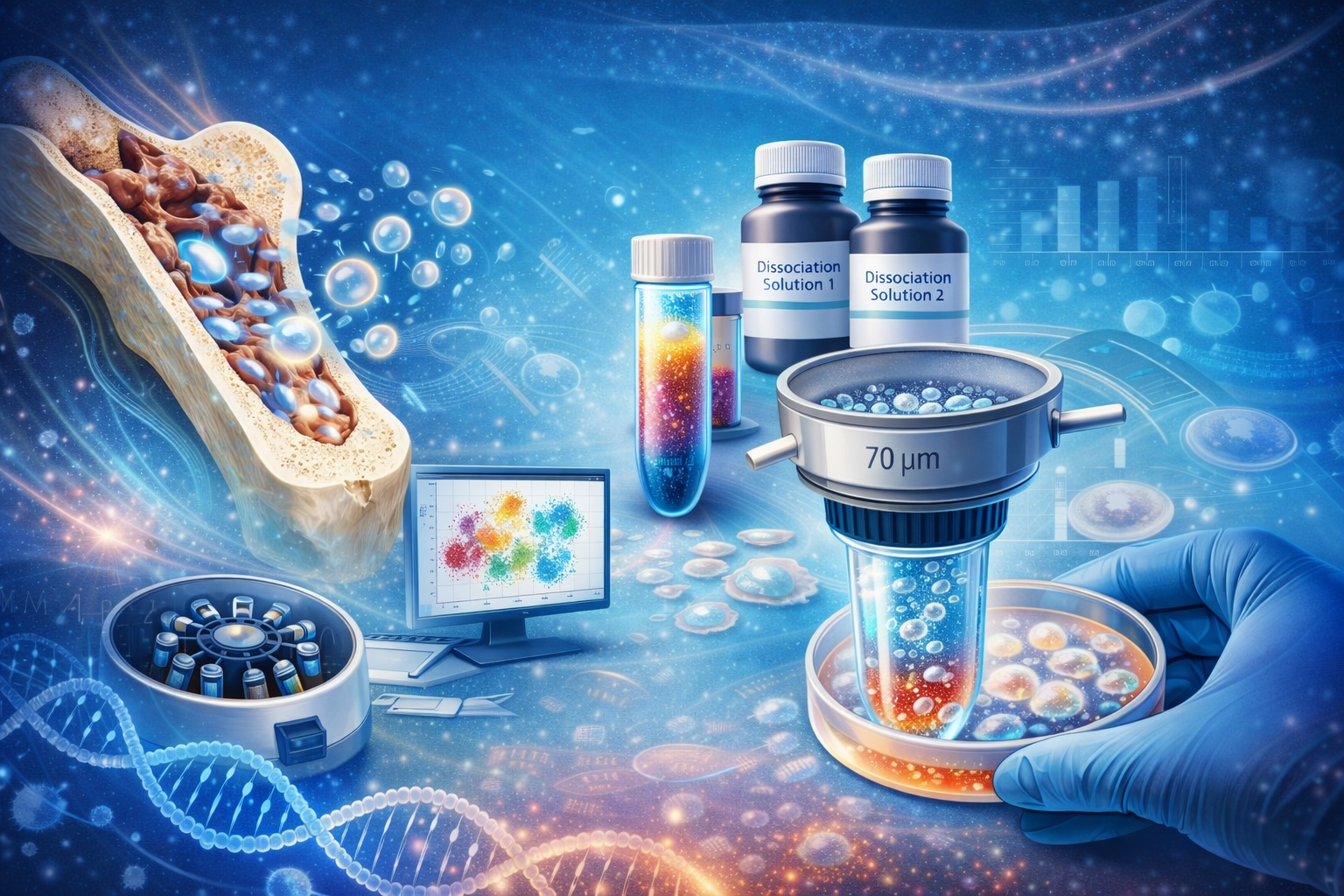
In the field of bone tissue engineering and regenerative medicine research, how to efficiently and non-destructively isolate highly active cells from bone tissue has always been a core challenge for researchers. Traditional bone tissue dissociation methods suffer from drawbacks such as complex operation, low cell yield, and significant loss of viability, severely hindering the research and clinical translation of bone regeneration mechanisms. Firegene's latest bone tissue dissociation kit (FG-BA3308), with its unique "mild enzymatic digestion-gradient filtration" dual technology, completely solves this industry problem, providing a standardized solution for bone tissue research.
I. Innovative Technology: Solving the Problem of Bone Tissue Separation at its Root
Through continuous technological innovation, the Firegene R&D team has developed a bone tissue dissociation system with independent intellectual property rights. Its core advantages are reflected in the following three aspects:
1. Two-step enzymatic digestion for efficient dissociation
The kit adopts an optimized dual-enzyme stepwise digestion strategy. The first step gently softens the calcified extracellular matrix, while the second step precisely releases embedded cells. This approach is suitable for hard bone, cartilage, and joint tissues, effectively addressing common challenges such as difficult bone tissue dissociation and cell entrapment within the dense matrix.
2. Gentle yet efficient, ensuring high-quality single cells
The enzyme formulation is carefully optimized to provide mild yet effective digestion without damaging cell membranes. The resulting single-cell suspensions from both mouse and human bone tissues exhibit high cell viability, low cell aggregation rates, and uniform morphology. These high-quality cell suspensions are fully compatible with major single-cell sequencing platforms such as 10x Genomics, ensuring reliable and reproducible downstream sequencing results.
3. Easy operation with broad applicability
The kit includes a complete and standardized SOP, with clear procedures and easy-to-follow steps. Only standard laboratory equipment is required, making it accessible even for researchers with limited experience. The dissociation process is efficient, controllable, and highly reproducible, supporting batch processing and making it suitable for a wide range of bone tissues from humans, mice, and other mammalian species.
II. Wide range of applications: Driving breakthroughs in multiple fields of bone regeneration research
Bone regeneration mechanism research
The kit enables efficient isolation of key seed cells, including bone marrow mesenchymal stem cells (BMSCs) and periosteal stem cells (PSCs). These cells can be used to investigate osteogenic differentiation, mineralization capacity, and regulatory signaling pathways, supporting in-depth studies of bone regeneration mechanisms.
Bone disease model construction
In disease models such as osteoporosis, bone tumors, and inflammatory bone disorders, the system allows efficient isolation of cells from affected tissues. The obtained cells can be used for in vitro functional assays, molecular profiling, and disease mechanism studies.
Drug screening platforms
By providing a high-quality and standardized bone cell suspension, the kit supports the establishment of reliable in vitro bone cell culture models. These models can be used for screening anti-osteoporosis drugs, evaluating bone regeneration materials, and testing osteogenic stimulators.
Clinical translational research
The technology provides a standardized solution for obtaining high-quality seed cells for bone tissue engineering scaffolds. It also supports preclinical studies in stem cell therapy and regenerative medicine, facilitating the translation of bone regeneration research toward clinical applications.
III. Standardized Experimental Procedure: Facilitating Precise Single-Cell Research of Bone Tissue
1. Reagent Preparation and Tissue Pretreatment
Prepare a 5 mL centrifuge tube and add Bone Tissue Dissociation Solution 1 and RPMI-1640 medium according to the specified ratio, then mix thoroughly. Wash the bone tissue with PBS to remove residual blood and impurities. Finely mince the tissue using sterile scissors or a scalpel, transfer the minced tissue into the prepared solution, and mix well.
2. Short-Term Mild Digestion
Place the tissue suspension in a 37 °C water bath or hybridization oven for 20 minutes.
If using a water bath, gently mix the suspension every 3–5 minutes.
If using a hybridization oven, set the rotation speed to 20–30 rpm.
After digestion, centrifuge at 300 × g for 5 minutes at 4 °C, discard the supernatant, and resuspend the pellet in RPMI-1640 medium. Wash once, centrifuge again under the same conditions, and discard the supernatant.
Note: This short digestion step primarily serves to soften the extracellular matrix. Avoid excessive digestion or harsh handling that may damage cells.
3. Long-Term Complete Digestion
Add RPMI-1640 medium and Bone Tissue Dissociation Solution 2 to the pellet and mix thoroughly. Incubate at 37 °C for 6–14 hours (overnight digestion is acceptable). During this period, periodically monitor the digestion progress and determine the optimal termination time based on cell count and viability.
4. Filtration and Cell Collection
After complete tissue dissociation and release of intact single cells, filter the suspension through a 70 μm cell strainer. Rinse the tube walls repeatedly with culture medium and pass the rinse through the strainer again to maximize cell recovery. Collect approximately 12 mL of filtrate.
5. Centrifugation, Washing, and Final Resuspension
Centrifuge the collected filtrate at 300 × g for 5 minutes at 4 °C and discard the supernatant. Wash the cell pellet twice with PBS containing 5% FBS. Finally, resuspend the cells to the desired concentration, perform cell counting and quality control, and proceed with downstream experiments as soon as possible.
Note: Maintaining low-temperature conditions during centrifugation helps reduce cell damage. Thorough washing effectively removes residual enzymes and debris, ensuring stability and reliability for downstream analyses.
IV. Actual Data Measurement
Data performance of bone tissue after dissection in some projects

Human-bone tissue 1 Human-bone tissue 2

Mouse-bone tissue 1 Mouse-bone tissue 2

In some projects, single-cell sequencing clustering performance after bone tissue dissociation was measured.
The FG-BA3308 Bone Tissue Dissociation Kit, with its customized design, simple operation, and stable results, solves the challenges of bone tissue sample preparation. Firegene, adhering to the philosophy of "technology creates value and serves human health," is deeply committed to the research and development of biological reagents, using professional products to safeguard scientific research.
FireGene, light your research with passion, innovation, and profession.


