
Abstract: Effective single-cell research depends on high-quality, viable cell suspensions. Dead cells and debris can compromise scRNA-seq, flow cytometry, and primary cell culture by introducing background noise, false signals, and reduced viability. The FireGene Dead Cell Debris & Impurities Removal Kit provides a simple, efficient solution using density gradient centrifugation to separate viable cells from contaminants. Compatible with multiple tissue types, including brain and tumor samples, this kit preserves cell surface markers, improves nucleated cell recovery, and enhances downstream data quality. By integrating this cleanup step, researchers can achieve more reliable, reproducible results while minimizing experimental variability and costs.
Keywords: Single-Cell Research | Cell Preparation | Dead Cell Removal | Debris Removal Kit | scRNA-seq Sample Prep | Flow Cytometry Research Reagents | Research Supplier
Introduction: Why Sample Purity Matters in Single-Cell Research
In modern life science research, single-cell technologies such as single-cell RNA sequencing (scRNA-seq) have transformed our ability to study cellular heterogeneity with unprecedented resolution. However, the accuracy and reliability of these techniques depend heavily on one critical factor: the quality of the starting sample. Among all quality parameters, sample purity—particularly the removal of dead cells and debris—plays a decisive role in determining downstream success.
During tissue dissociation, mechanical and enzymatic processes inevitably generate a mixture of viable cells, apoptotic cells, and fragmented debris. If not properly removed, these contaminants can significantly compromise experimental outcomes. Dead cells, for example, tend to release ambient RNA into the suspension, leading to elevated background noise and reduced signal specificity in sequencing data. Similarly, cellular debris can interfere with microfluidic systems, such as those used by 10x Genomics, increasing the risk of clogging and lowering capture efficiency.
Poor sample purity can also affect flow cytometry analysis by introducing false signals and complicating gating strategies. In cell culture applications, residual dead cells may negatively impact the growth and viability of healthy populations. Altogether, these issues can lead to misleading biological interpretations and costly experimental failures.
As single-cell workflows become more sophisticated, the need for clean, high-quality cell suspensions has never been more critical. Implementing an effective debris and dead cell removal step is no longer optional—it is an essential part of sample preparation. This is where optimized solutions, such as dedicated cleanup kits, play a key role in ensuring consistent and reproducible results across a wide range of applications.
Common Problems Caused by Dead Cells and Debris
The presence of dead cells and cellular debris in a sample is one of the most common yet underestimated challenges in single-cell experiments. Even a small proportion of these contaminants can introduce significant artifacts, ultimately compromising data quality and interpretation.
One of the most critical issues arises from ambient RNA contamination. When cells undergo apoptosis or necrosis, their membranes lose integrity, releasing intracellular RNA into the surrounding solution. In platforms such as those developed by 10x Genomics, this free-floating RNA can be captured alongside intact cells, resulting in background noise and false gene expression signals. This phenomenon reduces the sensitivity of detecting true biological differences and can distort clustering analysis.
Another major problem is cell aggregation and instrument clogging. Debris and sticky dead cells tend to form clumps, which can block microfluidic channels or interfere with droplet formation during single-cell encapsulation. This not only decreases cell capture efficiency but may also lead to uneven data output or complete run failure.
In flow cytometry and cell sorting applications, debris can generate non-specific signals, making it more difficult to accurately distinguish between cell populations. This complicates gating strategies and increases the likelihood of including unwanted events in the final dataset.
Additionally, high levels of dead cells can negatively impact cell viability and recovery in downstream applications such as primary cell culture. Toxic byproducts released from dying cells may harm healthy cells, reducing their functional integrity.
Overall, failing to remove dead cells and debris can lead to unreliable results, wasted resources, and repeated experiments—making effective sample cleanup a crucial step in any single-cell workflow.
How the FireGene Dead Cell Debris & Impurities Removal Kit Works
To address the challenges associated with dead cells and debris, the FireGene Dead Cell Debris & Impurities Removal Kit utilizes a density gradient centrifugation approach to efficiently purify cell suspensions. This method separates components based on their physical properties—primarily density and structural integrity—allowing for the selective enrichment of viable cells without the need for labeling or specialized equipment.
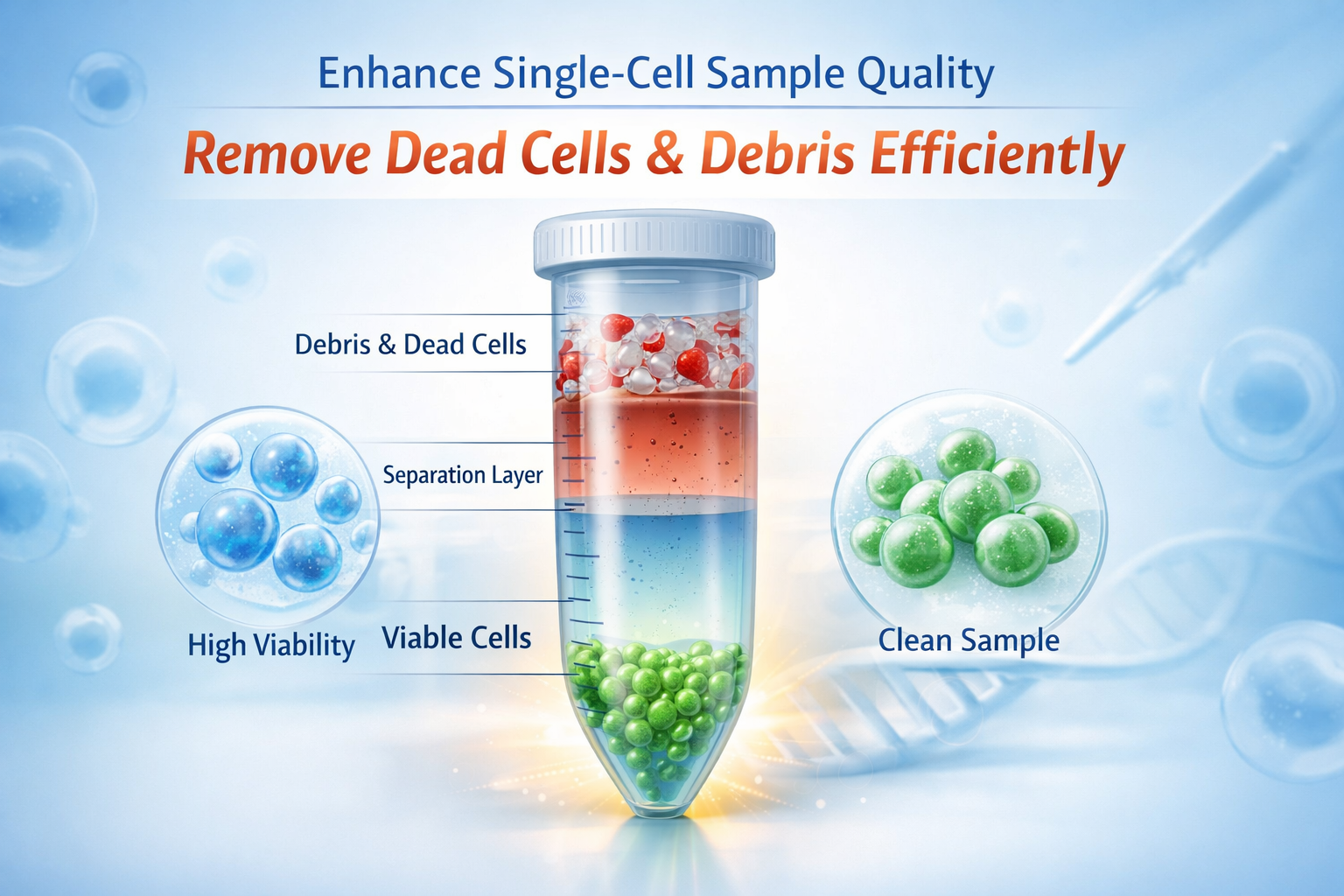
In a typical workflow, the processed cell suspension is gently layered with the proprietary separation reagent and subjected to centrifugation. During this step, components within the sample distribute into distinct layers. Intact, viable cells—being denser and structurally complete—migrate to the lower phase or form a pellet, while lighter materials such as dead cells, membrane fragments, and debris remain in the upper layer. This clear separation enables easy collection of a cleaner, high-quality cell fraction.
One of the key advantages of this approach is its non-invasive nature. Unlike magnetic bead-based systems or antibody-dependent methods, density-based separation does not rely on surface marker binding. This ensures that native cell surface proteins remain unaltered, which is particularly important for downstream applications like immunophenotyping and cell sorting.
The protocol is also designed to be fast and user-friendly, typically requiring only a few simple steps: reagent addition, centrifugation, and recovery of purified cells. This streamlined process minimizes hands-on time and reduces the risk of sample loss or variability between operators.
Because it does not depend on specific cell markers, the method is broadly applicable across different tissue types, including complex samples such as brain, tumor, and fibrotic tissues. As a result, it provides a versatile and reliable solution for improving sample quality prior to sensitive downstream analyses.
Key Features and Advantages
The FireGene Dead Cell Debris & Impurities Removal Kit offers several features that make it an essential tool for researchers working with single-cell suspensions. Designed for efficiency and reliability, it directly addresses the common challenges posed by dead cells and debris while preserving the integrity of viable cells.

1. High Recovery of Viable Cells
The kit’s density gradient separation ensures that the majority of live, nucleated cells are retained while unwanted debris and dead cells are efficiently removed. This maximizes the usable cell population for downstream applications, improving experimental reliability.
2. Improved Nucleated Cell Rate
By selectively removing non-viable cells and debris, the kit increases the proportion of nucleated, healthy cells in the final suspension. This is particularly important for sensitive single-cell sequencing platforms, where data quality depends on the integrity of individual cells.
3. Compatibility with Multiple Tissue Types
The FireGene kit is versatile, working effectively with a wide range of tissues, including brain, tumor, and fibrotic samples. Its gentle yet effective separation method minimizes cell damage, making it suitable for delicate primary cells.
4. Fast and Simple Workflow
The protocol is straightforward: add the reagent, centrifuge, and collect purified cells. No specialized equipment, magnetic beads, or antibodies are required, which reduces hands-on time and technical variability between experiments.
5. Preservation of Cell Surface Markers
Since the kit does not rely on antibody labeling or chemical modification, surface proteins on viable cells remain intact. This makes the cleaned cell suspension fully compatible with applications like flow cytometry, FACS, and immunostaining.
6. Enhanced Data Quality
By removing contaminants that could cause background noise, clogging, or false signals, the FireGene kit helps ensure more accurate sequencing, reliable flow cytometry results, and overall better experimental reproducibility.
In summary, this kit provides a fast, gentle, and highly effective solution for enriching viable cells while eliminating dead cells and debris, helping researchers achieve consistent and high-quality single-cell data.
Application Scenarios and Workflow Integration
The FireGene Dead Cell Debris & Impurities Removal Kit is designed to fit seamlessly into a variety of single-cell workflows, improving sample quality and reliability across multiple applications. Its versatility makes it suitable for both research and preclinical settings where high-quality cell suspensions are critical.

1. Single-Cell RNA Sequencing (scRNA-seq) and snRNA-seq
High-quality cell suspensions are essential for accurate transcriptomic profiling. Dead cells and debris can release ambient RNA, leading to background noise and false gene expression signals. By removing these contaminants, the FireGene kit ensures that only viable, intact cells are captured, improving data accuracy and reproducibility.
2. Flow Cytometry and Cell Sorting (FACS)
Debris and dead cells can interfere with gating strategies, produce non-specific signals, and reduce sorting efficiency. Integrating this kit into pre-analysis sample preparation ensures cleaner populations, clearer gating, and higher recovery of target cells.
3. Primary Cell Culture and Expansion
For researchers working with delicate primary cells, residual dead cells can release toxic factors that impair growth and viability. Using the FireGene kit before culture preserves healthy cell populations, promoting better proliferation and functional integrity.
4. Spatial Transcriptomics and Imaging-Based Assays
Accurate spatial mapping and imaging assays require uniform, debris-free suspensions. By enriching viable cells and removing aggregates, this kit enhances both imaging quality and downstream analysis.
Workflow Integration:
A typical workflow might look like this:
Tissue dissociation → Filtration → FireGene Debris Removal → Cell counting → Downstream analysis (scRNA-seq, flow cytometry, culture)
This simple integration step is compatible with most tissue types, including brain, tumor, and fibrotic tissues, and requires minimal hands-on time. By incorporating the FireGene kit at the critical cleanup stage, researchers can significantly improve the quality and reliability of their single-cell experiments.
Conclusion
High-quality single-cell analysis begins with clean, viable cell suspensions, and the removal of dead cells and debris is a critical step in ensuring accurate and reproducible results. The presence of apoptotic cells, fragmented debris, and aggregates can compromise sequencing accuracy, create background noise, interfere with flow cytometry gating, and negatively impact primary cell cultures. Without proper cleanup, these issues can lead to misleading biological interpretations and repeated experiments, increasing both time and cost.
The FireGene Dead Cell Debris & Impurities Removal Kit addresses these challenges with a simple, efficient, and versatile solution. Using a gentle density gradient centrifugation method, it effectively separates viable cells from contaminants while preserving cell surface markers and structural integrity. Its compatibility with multiple tissue types, including delicate brain and tumor samples, makes it suitable for a wide range of applications, from scRNA-seq and snRNA-seq to flow cytometry, FACS, primary cell culture, and spatial transcriptomics.
By integrating this kit into the workflow, researchers can maximize recovery of healthy, nucleated cells, reduce experimental variability, and improve downstream data quality. Ultimately, FireGene provides a reliable, cost-effective, and user-friendly approach to sample cleanup, enabling scientists to focus on generating meaningful insights from their single-cell studies with confidence.
FireGene, light your research with passion, innovation, and profession.


