
It’s 2:00 AM in the lab, and the only thing staring back is a screen full of chaotic flow cytometry plots. Single-cell sequencing capture rates are far below expectations, and the median gene counts are frustratingly low. Have you ever found yourself stuck in this cycle? Despite carefully controlling your sample sources and refining every step of your protocol, the interference from dead cells and debris remains unavoidable. These “invisible killers,” hidden within your cell suspensions, quietly compromise your data quality and gradually wear down your scientific enthusiasm, becoming a persistent obstacle in your research journey.

The Experimental Nightmare: Who Is the Culprit?
Many researchers invest vast amounts of time and capital into single-cell sequencing, only to see their efforts crumble at the very final stage. Unseen "junk" is sabotaging your experiments across four critical dimensions:
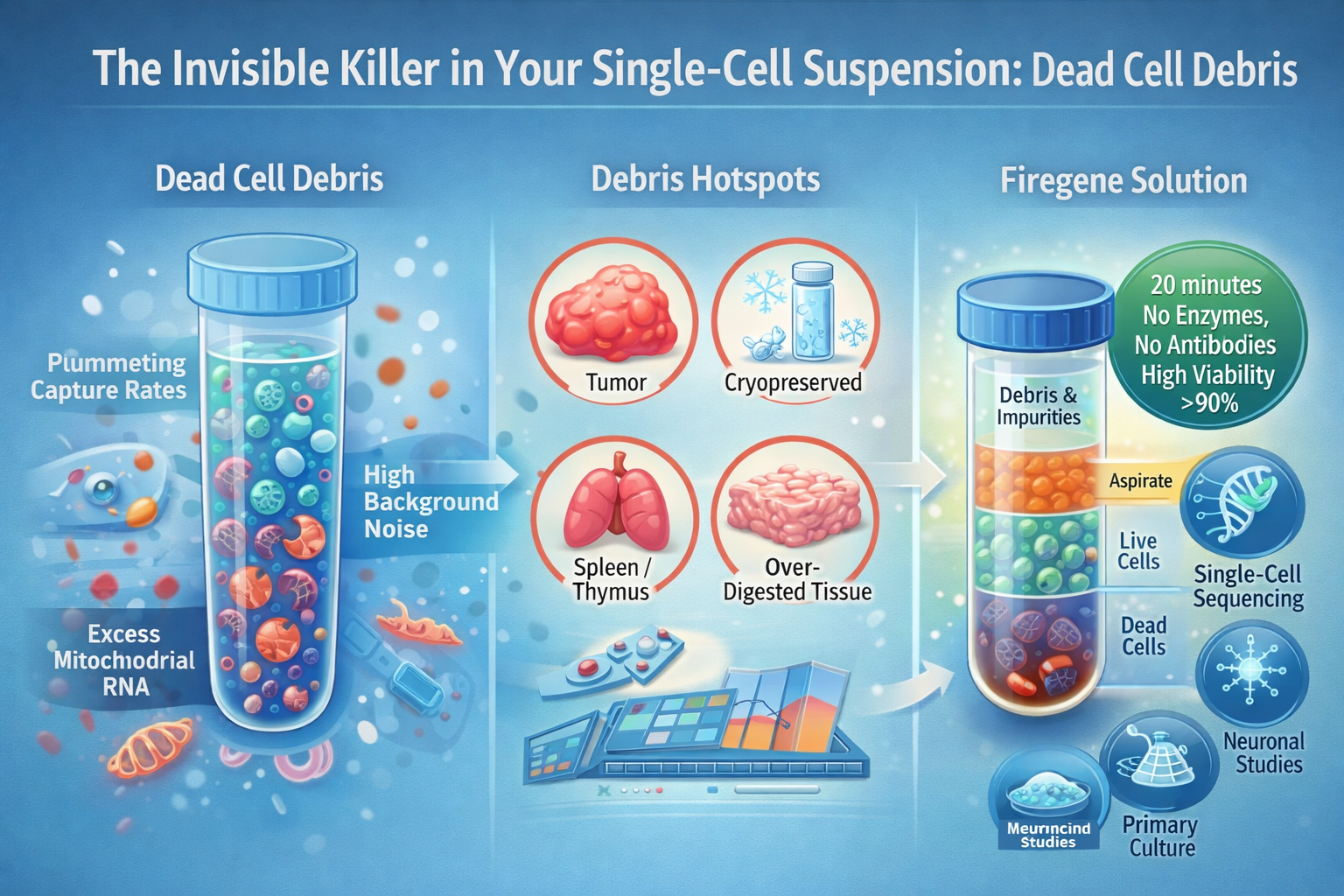
Plummeting Capture Rates: Dead cell debris—often similar in size to intact cells—aggressively clogs the capture wells of microfluidic chips, leaving precious live cells "homeless."
Soaring Background Noise: Free-floating RNA and DNA released from this debris flood the system, generating extremely high background noise that drowns out genuine cellular transcriptional signals.
Exploding Mitochondrial Gene Levels: Debris from apoptotic or necrotic cells frequently harbors massive quantities of mitochondrial genes; this leads to an anomalously high proportion of mitochondrial sequences in the data, severely compromising downstream analysis.
Ultimate Library Construction Failure: As these issues compound, the inevitable outcome is a low-quality sequencing library and unusable data—rendering tens of thousands of dollars in reagents and weeks of painstaking labor completely down the drain.
Why Are High-Risk Samples Consistently "Hotspots" for Contamination?
The issue of dead cell debris is not uniformly distributed. The following categories of samples can be considered true "hotspots":
Tumor Tissues: Characterized by high heterogeneity and significant variability in cellular state, these samples are highly prone to generating large quantities of dead cells during the dissociation process.
Cryopreserved Samples: Whether consisting of cells or tissues, the freeze-thaw cycle inflicts damage upon cell membranes, resulting in a significant increase in the rate of dead cells.
Immune Organs (e.g., Spleen, Thymus): These organs contain inherently fragile cells and harbor a high abundance of cell types that are highly susceptible to apoptosis.
Over-Dissociated Tissues: Excessive enzymatic digestion times or the application of overly aggressive mechanical forces can drastically increase the generation of cellular debris.
If you are currently working with these "challenging" sample types, the extent of debris contamination may very well exceed your expectations.
A Breakthrough Solution Emerges: Firegene’s Innovative Approach
The Firegene Dead Cell Debris Removal Kit was designed specifically to address this critical pain point. At its core lies a unique "density gradient flotation" method.
"One Spin, Four Layers": Intact dead cells settle at the very bottom layer, intact live cells are enriched in the middle layer, while the vast majority of cellular debris and minute impurities remain suspended in the uppermost layer. You simply need to aspirate the live cells from the middle layer to obtain a cell suspension of exceptionally high purity.
The entire process takes only about 20 minutes, requires no specialized equipment, and is remarkably simple to execute. More importantly, the entire workflow is antibody-free, enzyme-free, and requires no vigorous pipetting; this maximizes the preservation of the cells' natural state and viability, making it particularly well-suited for delicate primary cells, neurons, and other precious sample types.

Let the Data Speak: The Transformation from "Waste Fluid" to "Premium Sample"
No matter how sound the theory, nothing is as intuitive as the data.
Consider this real-world comparison: Before processing, the nucleated cell rate in the cell suspension stood at a mere 46%, with fragments and impurities predominating.
After processing with this kit, the nucleated cell rate surged to over 93%, while fragments and impurities were significantly reduced.
This substantial improvement in data quality directly determines the depth of subsequent analysis and the caliber of the resulting research publication.

Before Processing After Processing

Cell Diameter Distribution of Single-Cell Suspensions Before and After Treatment with a Dead Cell Debris Removal Kit
In the journey of single-cell sequencing—an exploration into the microscopic world of life—we constantly seek out the most advanced instrumentation and the most sophisticated algorithms. Yet, sometimes, the most critical breakthroughs originate precisely at the most fundamental stage: a clean, highly viable cell suspension. It serves not only as the starting point for data but also as a testament to scientific rigor. Do not let invisible "junk" hold back your visible brilliance.
FireGene, light your research with passion, innovation, and profession.


