
Introduction
Single-cell technologies have transformed modern biomedical research by enabling scientists to examine gene expression, cellular heterogeneity, and tissue microenvironments at unprecedented resolution. However, the success of downstream applications such as single-cell RNA sequencing (scRNA-seq), flow cytometry, and spatial transcriptomics depends heavily on one critical factor: the quality of the starting single-cell suspension.
Tissue dissociation, especially from complex organs like the digestive tract, often produces large amounts of debris, dead cells, extracellular matrix fragments, and mucus contaminants. These impurities can significantly interfere with cell counting accuracy, reduce sequencing efficiency, and introduce noise into downstream datasets.
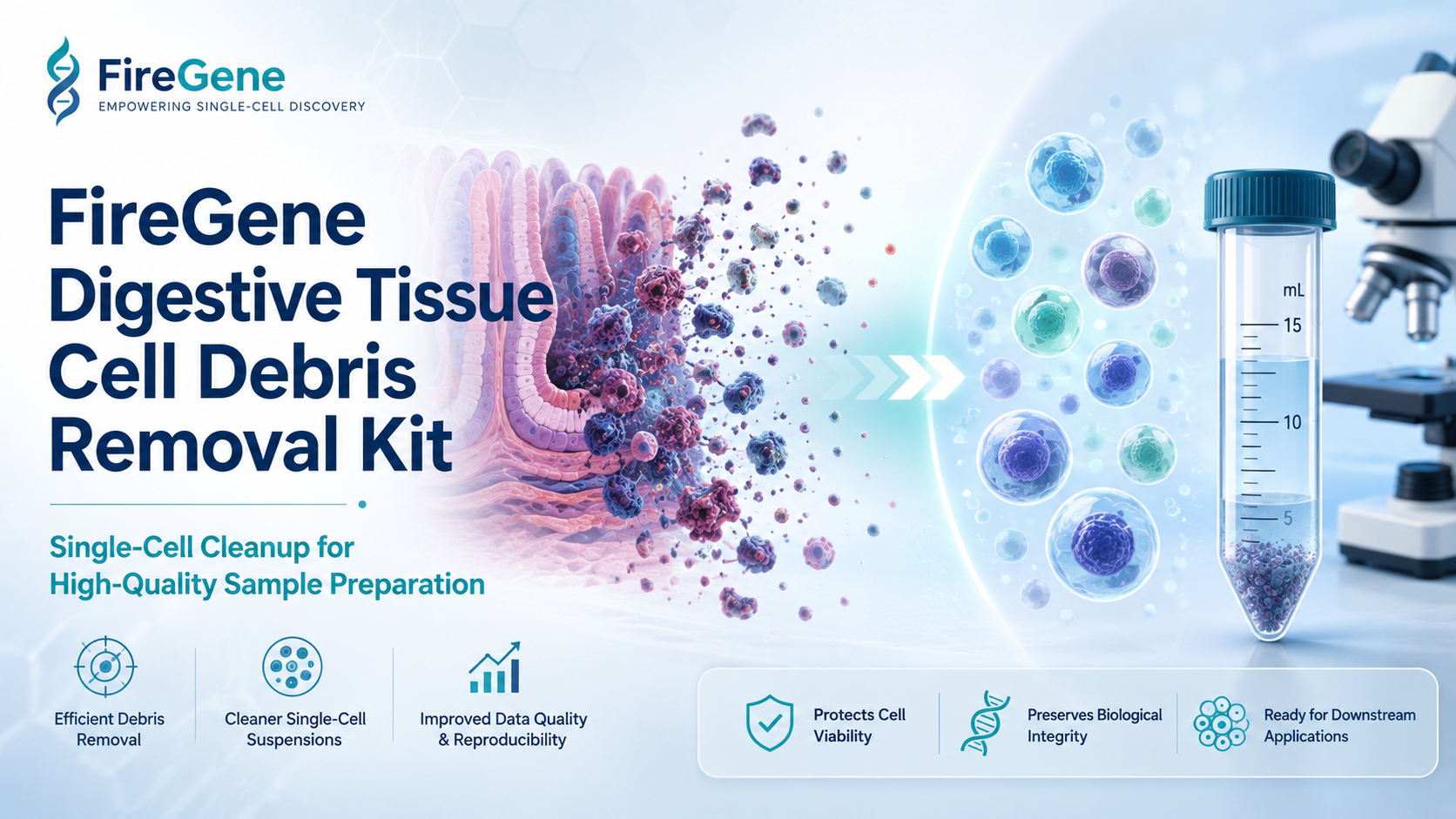
The FireGene Digestive Tissue Cell Debris Removal Kit for Single-Cell Cleanup is designed to address this bottleneck. It provides a streamlined method for purifying dissociated cell suspensions by removing unwanted debris while preserving viable cells, thereby improving the reliability and resolution of single-cell experiments.
Why Debris Removal Is Critical in Single-Cell Workflows
Before understanding the role of the kit, it is important to recognize the challenges associated with tissue dissociation.
Digestive tissues such as the intestine, colon, and stomach are structurally complex. They contain:
· High levels of mucus and secreted proteins
· Dense extracellular matrix structures
· Diverse epithelial and immune cell populations
· Rapidly turning over epithelial layers
During enzymatic or mechanical dissociation, these features lead to:
· High cell death rates
· Fragmentation of tissue into debris particles
· Release of ambient RNA from lysed cells
· Formation of sticky aggregates that trap viable cells
These issues create several downstream problems:
· Reduced cell viability reduces usable input for sequencing
· Clogging of microfluidic devices in platforms like 10x Genomics
· Doublets and multiplets, which distort cell population analysis
· Elevated background RNA contamination, affecting transcriptome accuracy
As single-cell technologies become more sensitive, even minor contamination can significantly skew biological interpretation. Therefore, a robust cleanup step is essential.
Overview of the FireGene Digestive Tissue Cell Debris Removal Kit
The FireGene kit is a specialized reagent system developed to improve the quality of single-cell suspensions derived from digestive tissues. It is typically used after enzymatic digestion and before downstream analytical procedures.
While exact formulation details are proprietary, the system is generally based on a differential separation strategy, allowing viable cells to be separated from debris and apoptotic material through controlled centrifugation and layering techniques.
The primary objective is simple but essential:
Enrich intact, viable single cells while efficiently eliminating debris and non-cellular contaminants.
This ensures that downstream assays operate on a cleaner, more uniform sample population.
Core Principle of Operation
The kit is designed around physical separation principles rather than chemical modification of cells. The workflow typically involves:
1. Preparation of Single-Cell Suspension
Tissue is first mechanically and enzymatically dissociated using standard digestion protocols appropriate for digestive system tissues.
2. Layering with Separation Reagents
The suspension is then processed using a two-phase reagent system. These reagents create a density or sedimentation environment that allows different cellular components to separate based on size, density, and structural integrity.
3. Centrifugation-Based Separation
Upon centrifugation:
· Viable cells settle into a distinct layer
· Debris and dead cell fragments remain separated in other fractions
· Mucus and protein aggregates are excluded from the target cell layer
4. Collection of Purified Cells
The enriched viable cell fraction is carefully collected for downstream applications.
This relatively simple workflow can be completed within a short time frame and integrates easily into existing single-cell pipelines.
Key Applications in Biomedical Research
The FireGene debris removal system is primarily used in high-resolution cellular analysis workflows. Its most common applications include:
1. Single-Cell RNA Sequencing (scRNA-seq)
In droplet-based sequencing platforms, debris can interfere with microfluidic partitioning and increase ambient RNA contamination. Clean suspensions improve:
· Cell capture efficiency
· Transcriptome fidelity
· Cluster resolution in downstream analysis
2. Flow Cytometry and FACS Sorting
Debris and aggregates can mimic cellular signals or block lasers, leading to inaccurate gating. Cleaner samples result in:
· More precise population identification
· Reduced background noise
· Improved sorting purity
3. Primary Cell Culture
Removing toxic debris improves:
· Cell attachment efficiency
· Viability in culture
· Long-term proliferation stability
4. Immunological and Gut Microbiome Studies
Digestive tissues contain high immune cell diversity. Clean samples help preserve:
· Rare immune subsets
· Tissue-resident lymphocytes
· Epithelial-immune interaction signals
Advantages of Using a Dedicated Debris Removal System
The integration of a specialized cleanup kit into single-cell workflows offers several advantages:
Improved Data Quality
By reducing non-cellular contamination, the resulting datasets show:
· Lower background noise
· Improved gene detection sensitivity
· More accurate cell type annotation
Higher Viability Yield
Traditional washing steps often result in cell loss. Optimized separation helps retain a larger fraction of viable cells.
Compatibility with High-Throughput Platforms
Clean suspensions are particularly important for:
· 10x Genomics Chromium systems
· Drop-seq and similar droplet technologies
· Automated cell sorting platforms
Reduced Experimental Variability
Standardized cleanup reduces batch-to-batch variation introduced by inconsistent tissue digestion quality.
Comparison with Conventional Cleanup Methods
Researchers often rely on basic filtration or centrifugation washes. However, these methods have limitations:
|
Method |
Limitation |
|
Filtration (cell strainers) |
Removes large debris only; clogs easily |
|
Simple PBS washes |
Inefficient at removing fine debris |
|
Density gradient centrifugation (generic) |
Time-consuming, requires optimization |
|
FireGene debris removal kit |
Targeted system optimized for digestive tissues |
Compared to conventional methods, the FireGene system is designed specifically for complex, debris-rich tissues, making it more effective in challenging samples.
Practical Considerations and Limitations
While highly useful, the kit should be applied with proper understanding of its constraints:
1. Tissue Specificity
It is optimized for digestive system tissues. Performance may vary in:
· Liver
· Tumor biopsies
· Fibrotic tissues
2. Not a Dissociation Tool
The kit does not perform enzymatic digestion. It must be used after initial tissue breakdown.
3. Handling Sensitivity
As with most centrifugation-based separation systems:
· Speed and timing must be optimized
· Improper handling may lead to cell loss
· Operator consistency influences results
4. Downstream Compatibility
While generally compatible with most platforms, validation is recommended for specialized assays such as spatial transcriptomics or rare cell enrichment workflows.
Role in Modern Single-Cell Research Pipelines
As single-cell technologies continue to evolve, sample preparation has become as important as sequencing depth itself. High-throughput systems generate large datasets, but their accuracy depends on upstream sample integrity.
The FireGene Digestive Tissue Cell Debris Removal Kit fits into a broader trend in life sciences:
· Moving from manual, variable cleanup methods
· Toward standardized, reproducible sample prep modules
· Designed specifically for single-cell omics workflows
In this context, debris removal is no longer a minor preprocessing step—it is a foundational requirement for reliable data interpretation.
Conclusion
The FireGene Digestive Tissue Cell Debris Removal Kit for Single-Cell Cleanup addresses one of the most persistent challenges in single-cell research: contamination from debris-rich tissue dissociation, particularly in digestive system samples.
By enabling efficient separation of viable cells from non-cellular material, the kit improves:
· Data quality in single-cell sequencing
· Accuracy in flow cytometry analysis
· Reproducibility across experimental batches
While it is not a replacement for careful tissue dissociation protocols, it serves as a critical downstream purification step that significantly enhances experimental outcomes.
As single-cell biology continues to expand into more complex tissues and clinical applications, reliable cleanup systems like this will remain essential components of modern experimental workflows.
FireGene, light your research with passion, innovation, and profession.


