
Endotoxin Testing in 2026: How AI Is Improving Endotoxin Risk Assessment, Depyrogenation Validation, and Contamination Control
Introduction
Artificial Intelligence (AI) is rapidly becoming one of the most influential technologies in pharmaceutical manufacturing and quality assurance. While AI has already transformed drug discovery, predictive maintenance, and process optimization, its role in endotoxin testing and contamination control is now attracting significant attention across the pharmaceutical industry.
As biologics, vaccines, cell therapies, gene therapies, and advanced injectable therapeutics continue to grow, manufacturers face increasing pressure to strengthen endotoxin control strategies while maintaining compliance with USP <85>, USP <86>, FDA expectations, and EU GMP Annex 1 requirements.
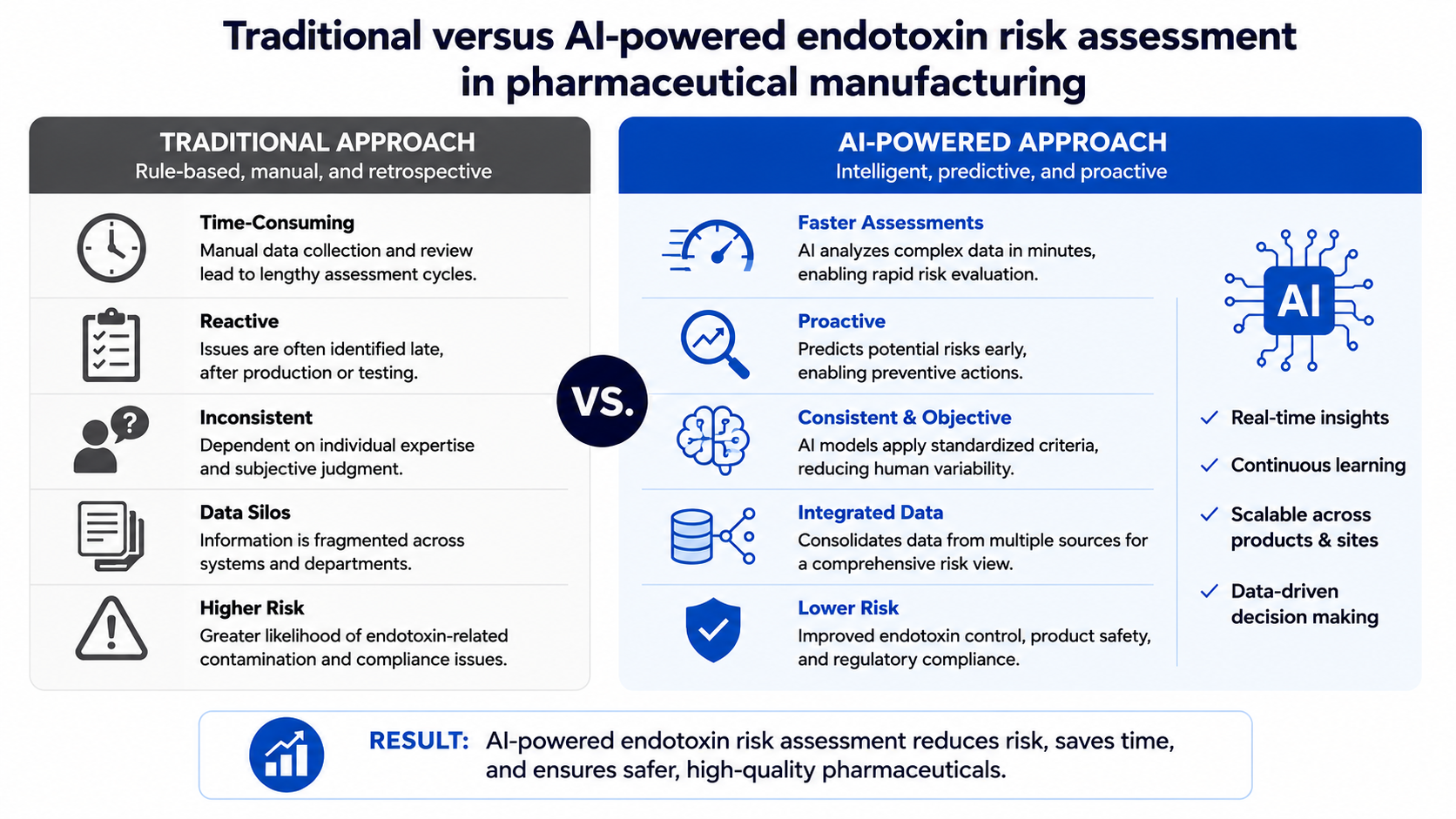
Traditionally, bacterial endotoxin testing programs have relied on validated analytical methods, environmental monitoring, water system control, supplier qualification, and contamination investigations. However, most of these systems are reactive—they identify contamination after it occurs.
AI offers a different approach.
Instead of asking:
"What caused the contamination event?"
AI-enabled quality systems help organizations ask:
"Where is contamination most likely to occur next?"
This shift from reactive quality management to predictive contamination prevention may become one of the most important developments in pharmaceutical quality control over the next decade.
What Is Endotoxin Testing?
Endotoxin testing is a quality control procedure used to detect bacterial endotoxins in pharmaceutical products, biologics, vaccines, medical devices, and injectable therapies.
The purpose of endotoxin testing is to ensure patient safety by identifying endotoxin contamination before product release. Regulatory frameworks such as USP <85> and USP <86> establish validated approaches for bacterial endotoxin testing throughout pharmaceutical manufacturing and quality control.
What Is Endotoxin Contamination?
Endotoxin contamination occurs when lipopolysaccharides (LPS) derived from Gram-negative bacteria are introduced into pharmaceutical products, manufacturing equipment, water systems, raw materials, or production environments.
Because endotoxins remain biologically active even after bacterial cells are destroyed, contamination risks can persist despite sterilization activities.
This is why endotoxin testing remains one of the most critical components of pharmaceutical quality assurance.
What Is Depyrogenation Validation?
Depyrogenation validation is the documented process of demonstrating that a manufacturing process, dry heat tunnel, oven, or depyrogenation system can effectively destroy or remove endotoxins to an acceptable level.
Most pharmaceutical manufacturers use standardized endotoxin challenge materials during depyrogenation validation studies to verify endotoxin reduction performance and demonstrate regulatory compliance.
Why Endotoxin Testing Remains Essential in Modern Pharmaceutical Manufacturing

Despite advances in pharmaceutical manufacturing technologies, bacterial endotoxins remain among the most significant contamination risks.
Even extremely low endotoxin levels can trigger:
-
Fever
-
Inflammatory responses
-
Hypotension
-
Septic shock
-
Organ dysfunction
Because injectable products bypass the body's natural protective barriers, endotoxin contamination can directly impact patient safety.
As a result, endotoxin testing remains a critical quality activity throughout:
-
Drug development
-
Process validation
-
Equipment qualification
-
Depyrogenation validation
-
Manufacturing
-
Batch release testing
-
Regulatory submissions
The Evolution of Endotoxin Testing
Rabbit Pyrogen Test Era
Historically, pyrogen detection relied on the Rabbit Pyrogen Test (RPT).
While effective, the method suffered from limitations in sensitivity, reproducibility, and efficiency.
USP <85> and Traditional BET Methods
The introduction of Bacterial Endotoxins Test (BET) methodologies transformed pharmaceutical quality control.
USP <85> established three primary endotoxin testing approaches:
Gel-Clot Method
-
Simple implementation
-
Low equipment requirements
-
Strong regulatory acceptance
Kinetic Chromogenic Method
-
Quantitative endotoxin testing
-
High sensitivity
-
Suitable for automation
Kinetic Turbidimetric Method
-
Broad dynamic range
-
Quantitative results
-
Widely used in pharmaceutical QC laboratories
These methods typically utilize TAL or LAL reagents and remain the global standard for endotoxin testing.
USP <86> and Recombinant Endotoxin Testing
USP <86> introduced recombinant endotoxin testing technologies, including:
-
Recombinant Factor C (rFC)
-
Recombinant Cascade Reagents (rCR)
These animal-free technologies provide additional testing options while maintaining endotoxin-specific detection capabilities.
AI and the Future of BET, LAL, TAL, and Recombinant Endotoxin Testing
As pharmaceutical manufacturers continue adopting digital quality systems, AI is expected to support a broad range of endotoxin testing technologies.
These include:
-
BET methods
-
TAL assays
-
LAL assays
-
Recombinant Factor C assays
-
USP <86> recombinant platforms
Although AI cannot replace validated analytical methods, it can assist laboratories by:
-
Identifying testing trends
-
Detecting unusual data patterns
-
Supporting investigation prioritization
-
Improving contamination risk assessment
-
Enhancing contamination prevention programs
As recombinant endotoxin testing adoption expands, AI-driven data analysis may become an increasingly valuable component of modern quality systems.
Why Traditional Endotoxin Risk Assessment Has Limitations
Most pharmaceutical organizations currently rely on:
-
FMEA
-
HACCP
-
Root Cause Analysis
-
CAPA Investigations
-
Historical Trending
Although valuable, these approaches are often retrospective rather than predictive.
Traditional assessments generally answer:
"What happened?"
AI aims to answer:
"What is likely to happen next?"
This distinction represents a major advancement in contamination prevention.
How AI Is Transforming Endotoxin Risk Assessment
Artificial Intelligence excels at identifying hidden relationships across large datasets.

In pharmaceutical environments, AI can analyze:
-
Endotoxin testing results
-
Environmental monitoring data
-
Water system performance
-
Supplier quality metrics
-
Equipment maintenance records
-
Manufacturing process parameters
-
Deviation histories
-
CAPA effectiveness trends
Machine learning algorithms can identify contamination risk patterns that may not be visible through traditional analysis.
This enables pharmaceutical manufacturers to proactively address risks before contamination events occur.
Real-World Example: AI-Based Endotoxin Risk Prediction
Consider a pharmaceutical facility operating a Water for Injection (WFI) loop supplying multiple aseptic production suites.
Historically, the facility relied on:
-
Weekly endotoxin testing
-
Environmental monitoring
-
Routine maintenance activities
Although systems remained within specification, several endotoxin excursions occurred over a two-year period.
An AI-based monitoring platform continuously analyzed:
-
Conductivity
-
TOC
-
Temperature
-
Flow velocity
-
Historical endotoxin testing data
-
Maintenance activities
The AI model identified recurring conditions associated with increased endotoxin contamination risk.
Following implementation of preventive actions, the facility reported:
-
Reduced investigations
-
Improved contamination control
-
Enhanced process visibility
-
Better risk assessment accuracy
Importantly, AI enhanced existing endotoxin testing programs rather than replacing them.

AI, USP <85>, and USP <86>: What Validation Teams Need to Know
AI does not change regulatory expectations.
Manufacturers must continue demonstrating compliance with:
-
USP <85>
-
USP <86>
-
FDA guidance
-
EU GMP Annex 1
Validation teams must still perform:
-
Method suitability testing
-
Spike recovery studies
-
Precision assessments
-
Robustness evaluations
-
Comparability studies
AI should be viewed as a complementary quality tool rather than an alternative analytical method.
Why Endotoxin Challenge Vials Remain Critical for Validation
Advanced analytics cannot replace physical validation studies.
High-quality validation data remains essential for:
-
Depyrogenation validation
-
Dry heat tunnel qualification
-
Equipment qualification
-
Endotoxin recovery studies
-
Process verification
Many pharmaceutical manufacturers use Endotoxin Challenge Vials during depyrogenation validation programs to demonstrate effective endotoxin destruction and regulatory compliance.
Why Standardized Validation Materials Improve AI-Driven Quality Systems
Artificial intelligence depends on data quality.
Poor validation data leads to poor predictions.
Organizations seeking reliable Endotoxin Validation Materials often incorporate standardized challenge systems into qualification and validation programs to generate consistent and reproducible datasets.
These datasets support:
-
Statistical analysis
-
Process trending
-
Predictive quality models
-
Regulatory documentation

AI and Cell & Gene Therapy Manufacturing
Cell and gene therapies present unique contamination control challenges.
These products often involve:
-
Small batch sizes
-
Complex biological matrices
-
Short manufacturing timelines
-
Highly sensitive manufacturing conditions
Many advanced therapy manufacturers utilize Endotoxin Recovery Study Materials during qualification activities to verify endotoxin control and method suitability performance.
As advanced therapies continue expanding, AI-assisted contamination prevention strategies are expected to become increasingly important.
Choosing an Endotoxin Testing Supplier in the AI Era
As pharmaceutical quality systems become increasingly data-driven, supplier qualification remains a critical consideration.
A qualified endotoxin testing supplier should provide:
-
Consistent product performance
-
Technical documentation
-
COAs
-
Validation support
-
Global regulatory expertise
Reliable Pharmaceutical Endotoxin Challenge Systems are becoming increasingly important for generating the high-quality validation data required for modern contamination control strategies.
Why Depyrogenation Validation Will Become More Important in 2026 and Beyond
As biologics and advanced therapies continue to grow, regulatory expectations surrounding endotoxin control are becoming more stringent.
Consistent Depyrogenation Validation Standards help manufacturers demonstrate:
-
Process effectiveness
-
Endotoxin reduction performance
-
Equipment qualification
-
Regulatory compliance
For this reason, depyrogenation validation remains one of the most important applications of endotoxin challenge materials.
Future Trends: Endotoxin Testing Through 2030
Several trends are expected to shape the future of endotoxin testing:
Increased AI Adoption
Predictive quality systems will become increasingly common.
Greater USP <86> Adoption
Recombinant endotoxin testing will continue expanding globally.
Advanced Contamination Control Strategies
Manufacturers will increasingly rely on integrated CCS programs.
Growth of Cell & Gene Therapies
Advanced therapeutic products will continue driving demand for sophisticated endotoxin control solutions.
Continued Importance of Validation
Validation, qualification, and endotoxin testing will remain foundational quality requirements regardless of technological advances.
Frequently Asked Questions
What is bacterial endotoxin testing?
Bacterial endotoxin testing is used to detect endotoxins derived from Gram-negative bacteria in pharmaceutical products and medical devices.
Is endotoxin testing required by FDA?
Yes. Endotoxin testing is a regulatory expectation for injectable drugs, biologics, and many medical devices.
What causes endotoxin contamination?
Common sources include water systems, raw materials, biofilms, equipment surfaces, and environmental contamination.
Can AI detect endotoxins directly?
No. AI analyzes quality data and predicts contamination risks but does not directly detect endotoxins.
Can AI replace LAL or TAL testing?
No. AI complements endotoxin testing but cannot replace validated analytical methods.
What is the difference between USP <85> and USP <86>?
USP <85> covers traditional TAL/LAL-based methods, while USP <86> focuses on recombinant endotoxin testing technologies.
What is the difference between pyrogen testing and endotoxin testing?
Pyrogen testing evaluates fever-causing substances broadly, while endotoxin testing specifically detects bacterial endotoxins.
What is endotoxin masking?
Endotoxin masking occurs when formulation components interfere with endotoxin detection.
What is a 3-log endotoxin reduction?
A 3-log reduction represents a 1,000-fold decrease in endotoxin activity.
What is the endotoxin limit?
The endotoxin limit is the maximum allowable endotoxin concentration established for a pharmaceutical product.
Why are Endotoxin Challenge Vials used during validation?
They provide standardized endotoxin loads for depyrogenation validation, recovery studies, and equipment qualification.
How is depyrogenation validation performed?
Manufacturers challenge equipment with known endotoxin loads and demonstrate effective endotoxin reduction.
Does FDA accept AI-based quality systems?
FDA supports innovative technologies provided they meet validation, traceability, and data integrity requirements.
Can AI improve endotoxin risk assessment?
Yes. AI can identify contamination trends, analyze complex datasets, and provide predictive insights that support proactive risk management.
How can manufacturers reduce endotoxin contamination risks?
Through robust endotoxin testing, contamination control strategies, environmental monitoring, supplier qualification, validation studies, and proactive risk assessment programs.
Supporting Future-Ready Endotoxin Testing Programs
As pharmaceutical quality systems evolve, reliable validation materials remain essential for generating accurate, reproducible endotoxin testing data.
FireGene supports pharmaceutical manufacturers, CROs, CDMOs, research institutions, and validation teams with high-quality endotoxin challenge materials designed for:
-
Depyrogenation validation
-
Dry heat tunnel qualification
-
Endotoxin recovery studies
-
Equipment qualification
-
Process verification
Organizations investing today in validated endotoxin testing programs, qualified suppliers, robust contamination control strategies, and high-quality validation materials will be best positioned for the future of pharmaceutical quality control.
Conclusion
Artificial Intelligence is poised to transform pharmaceutical quality systems by enabling predictive contamination prevention, smarter risk assessment, and more proactive decision-making.
However, the future of pharmaceutical quality is not AI versus endotoxin testing.
Instead, it is the integration of AI-driven insights with scientifically validated endotoxin testing programs under USP <85>, USP <86>, FDA expectations, and Annex 1 contamination control frameworks.
Manufacturers that combine advanced analytics, robust validation programs, qualified suppliers, and effective endotoxin control strategies will be best positioned to thrive in the era of predictive pharmaceutical quality.
FireGene Endotoxin Testing
Ready to run your endotoxin assay?
FireGene offers a complete endotoxin testing toolkit — from TAL reagents and CSE standards to pyrogen-free consumables and LAL reagent water. All products are aligned with USP <85>, EP 2.6.14, and JP 4.01.


