
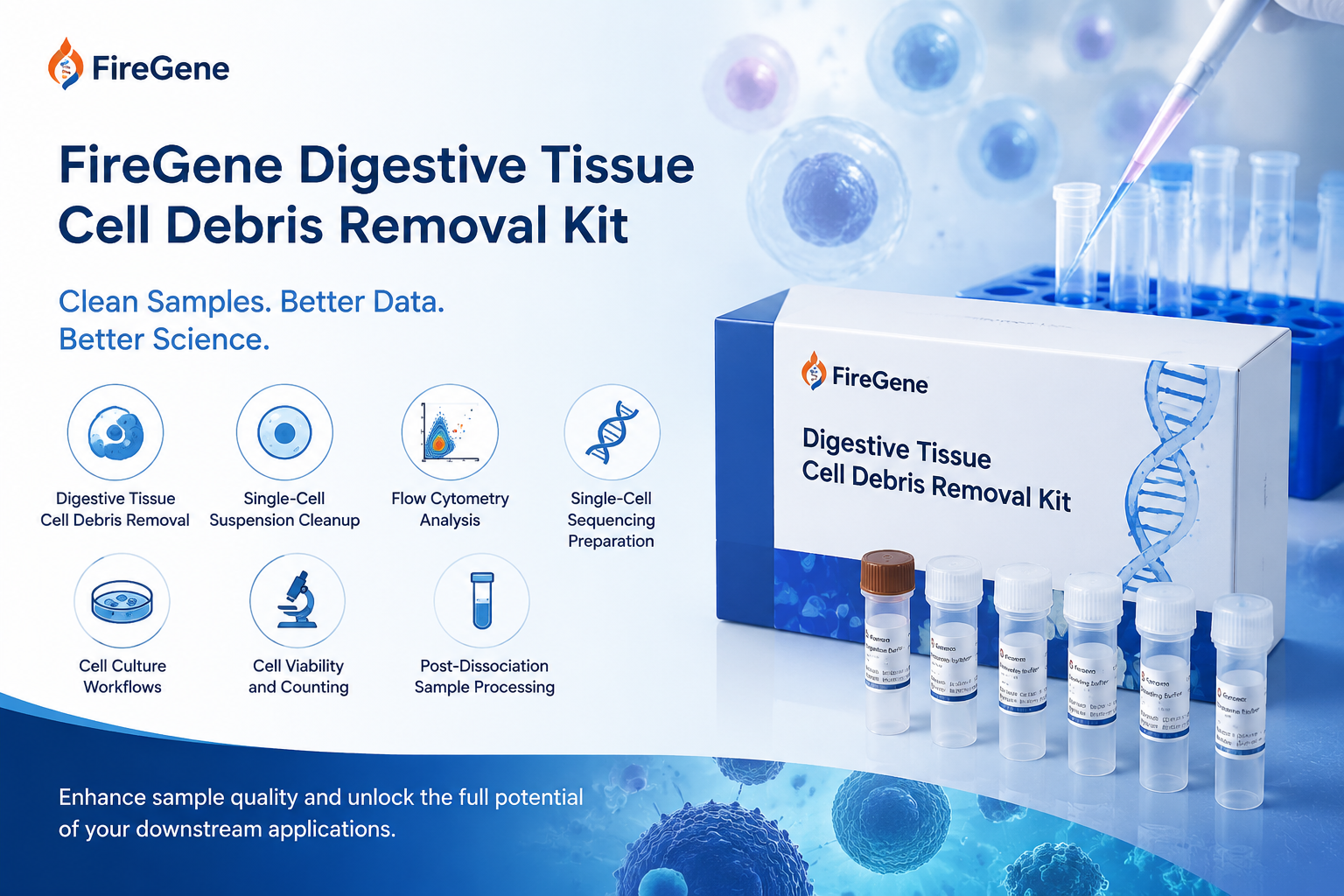
In modern biomedical research, the quality of starting material often determines the success of downstream data. Whether performing flow cytometry, single-cell sequencing, or cell culture experiments, researchers consistently face one major challenge after tissue dissociation: cell debris contamination and sample heterogeneity.
The FireGene Digestive Tissue Cell Debris Removal Kit is designed to address exactly this bottleneck. It provides a streamlined way to clean up post-digestion samples, improving both cell suspension quality and experimental reliability. This article explores its key applications and why it has become an essential step in many laboratory workflows.
Why Cell Debris Removal Matters
Tissue digestion is a necessary first step for most single-cell workflows. However, enzymatic and mechanical dissociation inevitably produces unwanted byproducts, including:
· Cell membrane fragments
· Dead cells and apoptotic bodies
· Extracellular matrix debris
· Aggregated proteins and lipids
If not removed, these contaminants can significantly interfere with downstream experiments by:
· Reducing cell viability readings accuracy
· Blocking microfluidic channels in single-cell platforms
· Increasing background noise in flow cytometry
· Compromising sequencing data quality
· Promoting cell clumping in culture systems
The FireGene Digestive Tissue Cell Debris Removal Kit helps eliminate these issues by generating a cleaner, more uniform single-cell or nuclei suspension.
Application 1: Digestive Tissue Cell Debris Removal
The primary function of the kit is direct debris clearance from enzymatically digested tissues. After dissociation, samples often appear cloudy and contain visible particulates that are not suitable for sensitive downstream applications.
Using the kit allows researchers to:
· Separate intact cells from debris efficiently
· Improve sample clarity and homogeneity
· Reduce variability between preparations
· Enhance reproducibility across experiments
This step is especially important when working with solid tissues such as liver, tumor, brain, or gastrointestinal samples, where digestion produces high levels of residual debris.
Application 2: Single-Cell Suspension Cleanup
High-quality single-cell suspensions are essential for most modern molecular biology techniques. However, achieving true single-cell resolution is difficult without removing debris and aggregates.
The FireGene kit plays a key role in single-cell suspension cleanup by:
· Removing non-cellular contaminants that interfere with counting accuracy
· Reducing cell aggregation that may bias downstream analysis
· Improving uniformity of cell size distribution
· Enhancing recovery of viable, intact cells
Clean suspensions are particularly important for droplet-based single-cell systems, where debris can disrupt encapsulation efficiency and reduce throughput.
Application 3: Flow Cytometry Analysis
Flow cytometry requires highly clean samples to ensure accurate optical detection and gating strategies. Debris and dead cells often create significant background noise, leading to misinterpretation of results.
By incorporating the FireGene debris removal workflow, researchers can:
· Reduce autofluorescent background signals
· Improve gating precision for live cell populations
· Prevent clogging of cytometer fluidics
· Enhance resolution of rare cell populations
This is especially valuable in immunology, oncology, and stem cell research, where precise population profiling is critical.
Application 4: Single-Cell Sequencing Preparation
Single-cell sequencing (scRNA-seq and snRNA-seq) has transformed biological research by enabling gene expression profiling at the individual cell level. However, sequencing quality is extremely sensitive to sample purity.
The kit improves sequencing preparation by:
· Increasing the proportion of intact, viable cells
· Reducing ambient RNA contamination from lysed cells
· Minimizing barcode background noise
· Enhancing cell capture efficiency in microfluidic systems
Cleaner input material directly translates into higher-quality sequencing data, more accurate clustering, and improved biological interpretation.
For researchers working with complex tissues or clinical samples, debris removal is often a critical step to achieve publishable-grade datasets.
Application 5: Cell Culture Workflows
Although often associated with analytical techniques, the FireGene kit also supports cell culture applications.
After tissue dissociation, residual debris can negatively affect primary cell culture by:
· Triggering inflammatory responses in sensitive cell types
· Interfering with cell attachment and spreading
· Promoting contamination-like artifacts
· Reducing overall culture viability
By removing debris before plating, researchers can establish cleaner primary cultures with:
· Improved cell adherence
· More stable growth kinetics
· Reduced early-stage cell stress
· Higher long-term viability
This is particularly useful in primary neuron, hepatocyte, and tumor-derived cultures.
Application 6: Cell Viability and Counting
Accurate cell counting is essential for virtually all experimental workflows, from plating density optimization to sequencing input normalization. However, debris and dead cells often distort automated counting systems.
The FireGene kit improves this step by:
· Eliminating particles that mimic live cell signals
· Reducing false-positive counts in automated counters
· Improving trypan blue or fluorescent viability staining accuracy
· Providing more reliable concentration measurements
As a result, researchers can achieve better experimental consistency and reproducibility across replicates.
Application 7: Post-Dissociation Sample Processing
Beyond specific downstream applications, the kit is broadly useful as a general post-dissociation processing step.
After enzymatic digestion, samples often require stabilization and refinement before being used in any workflow. The kit provides a standardized method to:
· Normalize sample quality across experiments
· Reduce variability introduced by tissue type differences
· Standardize preparation protocols across operators
· Improve overall experimental workflow efficiency
This makes it particularly valuable in high-throughput labs and multi-user core facilities, where consistency is critical.
Conclusion
The FireGene Digestive Tissue Cell Debris Removal Kit serves as a foundational tool in modern single-cell and cell-based workflows. By improving sample purity after tissue digestion, it enhances the performance of a wide range of downstream applications, including:
· Single-cell suspension preparation
· Flow cytometry
· Single-cell sequencing
· Cell culture
· Viability and counting assays
· General post-dissociation processing
In an era where data quality and reproducibility are more important than ever, effective debris removal is no longer optional—it is a critical step in experimental design.
For laboratories aiming to maximize accuracy, efficiency, and reproducibility, integrating a dedicated debris removal step can make a measurable difference in results.
FireGene, light your research with passion, innovation, and profession.


