
Overview
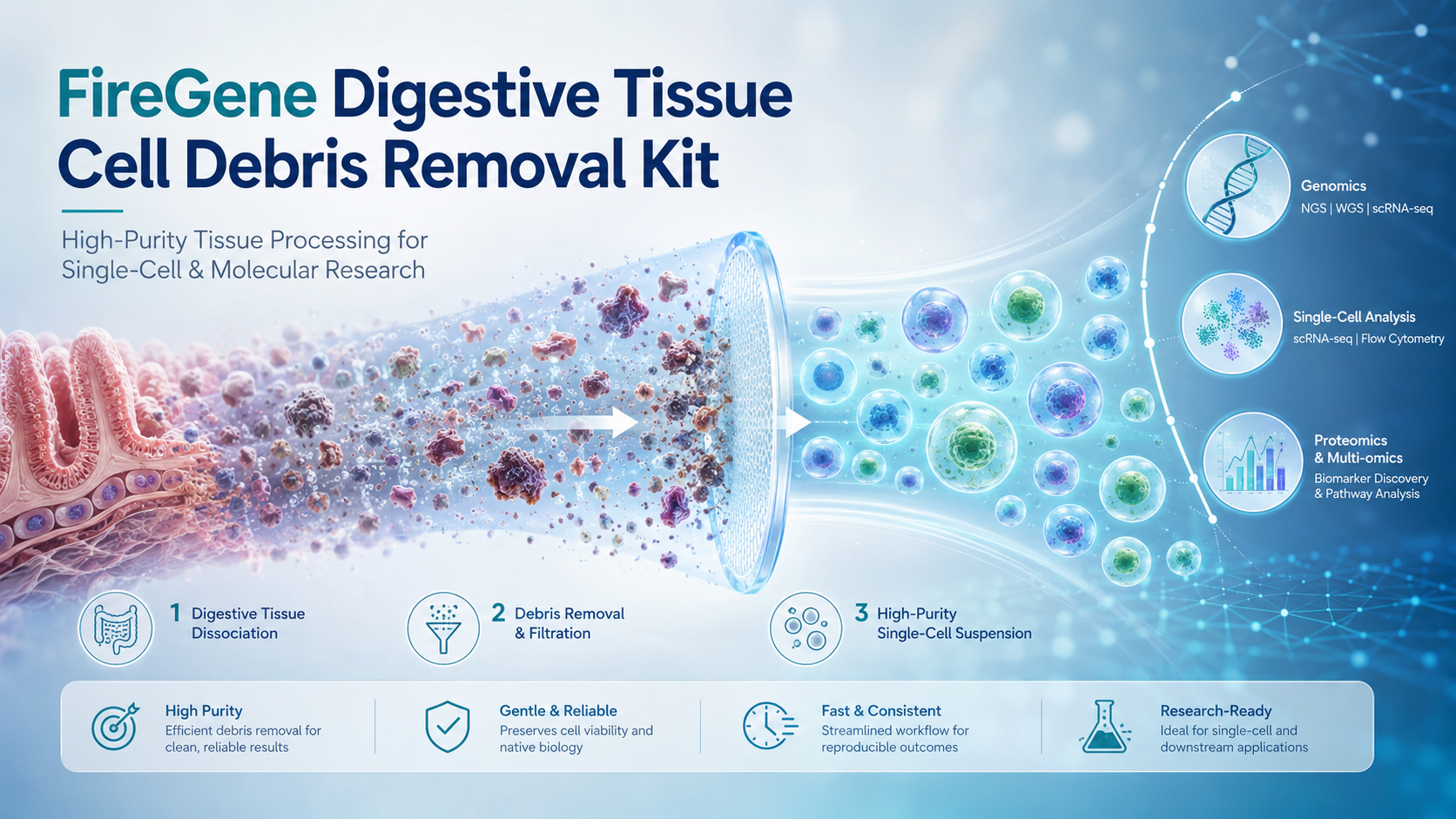
The FireGene Digestive Tissue Cell Debris Removal Kit is a specialized sample preparation solution designed to enhance the quality of cell suspensions derived from complex digestive tissues. It enables researchers to efficiently remove cellular debris, extracellular matrix fragments, and other non-viable material that can compromise downstream molecular and cellular analyses.
Digestive tissues—such as intestinal, gastric, hepatic-adjacent, and mucosal samples—are particularly difficult to process due to their dense structure, enzymatic activity, and heterogeneous cellular composition. Without proper debris removal, these samples often result in poor cell yield, reduced viability, and inconsistent analytical performance.
This kit addresses these challenges by improving sample clarity and enabling more reproducible preparation of high-quality single-cell or bulk cell suspensions suitable for advanced biomedical research.
Challenges in Digestive Tissue Processing
Digestive tissue dissociation is inherently complex. Researchers frequently encounter several issues:
· High levels of cellular debris following enzymatic or mechanical dissociation
· Aggregation of extracellular matrix fragments that interfere with filtration
· Reduced cell viability due to prolonged processing steps
· Inconsistent sample quality between biological replicates
· Technical limitations in downstream single-cell sequencing or flow cytometry
These issues can significantly impact data quality, particularly in high-resolution applications such as single-cell RNA sequencing or immune profiling. The FireGene Digestive Tissue Cell Debris Removal Kit is designed to mitigate these bottlenecks by improving sample cleanliness at an early stage of processing.
Principle of Operation
The kit is engineered to selectively reduce non-cellular and low-integrity components in dissociated tissue suspensions while preserving viable cells. Through optimized separation chemistry and gentle processing conditions, it helps:
· Remove fine particulate debris generated during dissociation
· Reduce viscosity caused by extracellular matrix remnants
· Improve filtration efficiency and reduce clogging in downstream workflows
· Enhance the uniformity of single-cell suspensions
This results in cleaner samples that are more compatible with analytical instrumentation and biological assays.
Key Features and Benefits
· Efficient debris removal: Improves clarity of tissue-derived cell suspensions
· High cell recovery compatibility: Designed to minimize loss of viable cells
· Improved downstream performance: Enhances reliability in sequencing, cytometry, and culture
· Reduced sample variability: Supports reproducible experimental outcomes
· Workflow integration: Compatible with standard enzymatic and mechanical dissociation protocols
· Optimized for complex tissues: Particularly effective for mucus-rich and matrix-dense digestive samples
Workflow Compatibility
The FireGene kit is designed to integrate seamlessly into existing laboratory workflows. It can be used after enzymatic digestion or mechanical dissociation steps and before downstream processing such as:
· Cell counting and viability assessment
· Flow cytometry and fluorescence-activated cell sorting (FACS)
· Single-cell RNA sequencing (scRNA-seq)
· Primary cell culture and organoid establishment
· Protein and nucleic acid extraction
· Spatial and molecular profiling workflows
Its modular design allows researchers to incorporate it without major protocol modifications.
Application Areas
Gastrointestinal Biology
Supports investigation of epithelial turnover, nutrient absorption mechanisms, and gut barrier integrity by producing cleaner epithelial and stromal cell suspensions.
Digestive Disease Research
Enables improved sample quality for studying inflammatory bowel disease, colorectal disorders, gastritis, and other gastrointestinal pathologies.
Mucosal Immunology
Facilitates high-resolution profiling of immune populations within mucosal tissues, improving detection of rare immune subsets and cell-state transitions.
Inflammation Research
Enhances the study of inflammatory signaling pathways by reducing background debris that may interfere with molecular assays.
Cancer and Tumor Microenvironment Studies
Improves dissociation of tumor-adjacent digestive tissues, enabling more accurate characterization of immune infiltration, stromal architecture, and tumor heterogeneity.
Single-Cell Biology
Optimized for single-cell workflows by reducing clogs, improving microfluidic performance, and increasing cell suspension uniformity for sequencing platforms.
Cell Culture Workflows
Provides cleaner primary cell populations for ex vivo expansion, functional assays, and organoid culture systems.
Translational Biomedical Research
Supports clinical and preclinical pipelines requiring consistent tissue processing across large sample sets, improving reproducibility and data comparability.
Why Sample Cleanliness Matters
In modern biomedical research, especially in single-cell and high-throughput molecular applications, sample quality directly determines data fidelity. Debris contamination can:
· Obstruct microfluidic channels in sequencing platforms
· Increase background noise in transcriptomic or proteomic datasets
· Reduce antibody accessibility in flow cytometry
· Impair cell viability during culture initiation
By addressing these issues early in the workflow, the FireGene Digestive Tissue Cell Debris Removal Kit contributes to more reliable experimental outcomes and higher-quality datasets.
FireGene, light your research with passion, innovation, and profession.


