
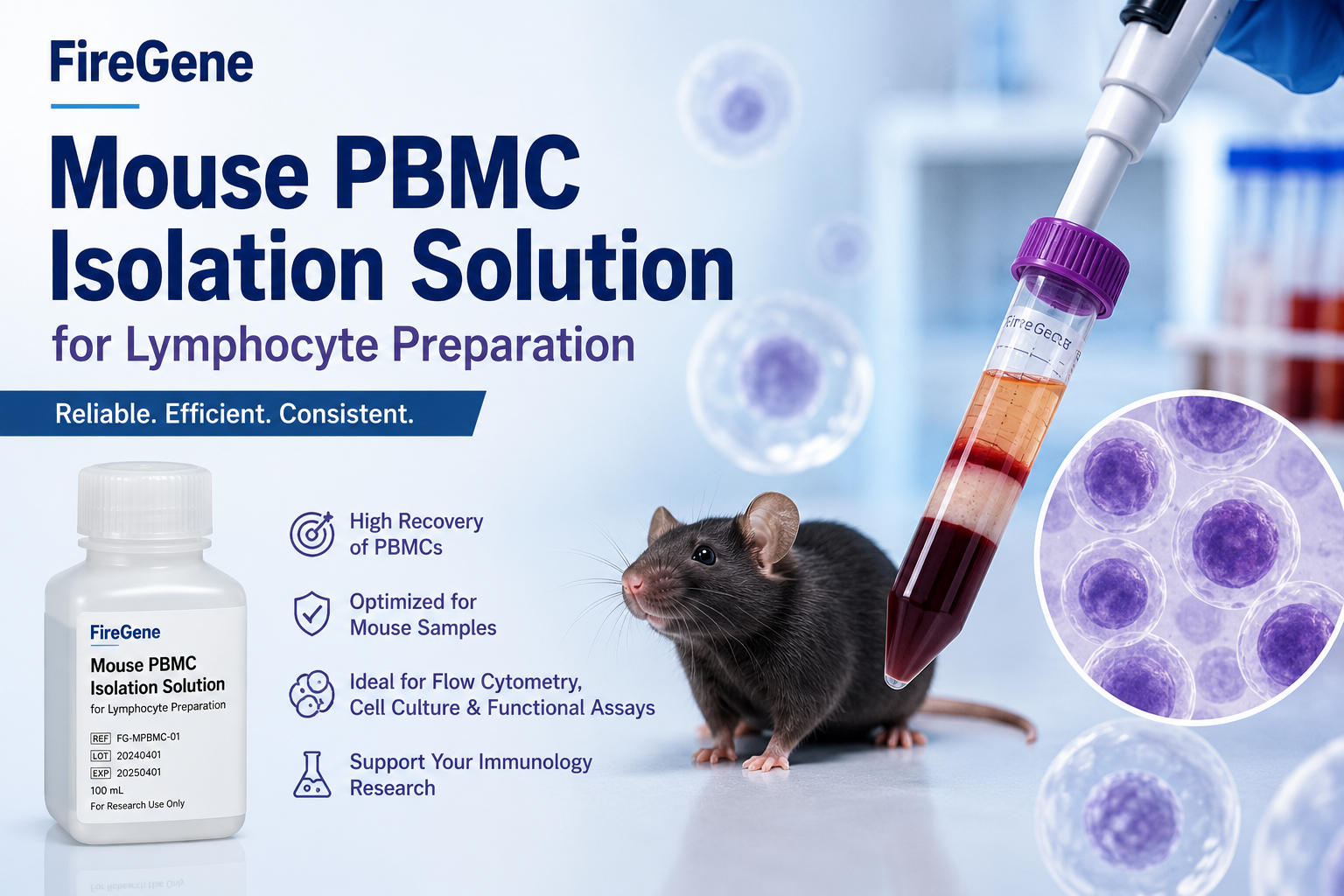
Peripheral blood mononuclear cells, commonly known as PBMCs, are among the most important cell populations used in immunology, inflammation, oncology, infection, metabolic disease, and preclinical drug research. In mouse models, PBMCs provide valuable information about systemic immune responses, disease progression, therapeutic effects, and immune-cell dynamics. Because mice are widely used in biomedical research, efficient preparation of mouse PBMCs is essential for laboratories that need reproducible immune-cell samples for downstream analysis.
FireGene Mouse PBMC Isolation Solution for Lymphocyte Preparation is designed to support the isolation of mouse peripheral blood mononuclear cells, especially lymphocytes and monocytes, from anticoagulated whole blood. By helping researchers separate mononuclear cells from red blood cells, granulocytes, platelets, and other blood components, this solution provides a practical reagent for immune cell preparation in mouse-based studies.
Why Mouse PBMC Isolation Matters
Mouse PBMCs are widely used to evaluate immune status in experimental models. These cells include lymphocytes, such as T cells, B cells, and natural killer cells, as well as monocytes and other mononuclear immune cells. Because PBMCs circulate in peripheral blood, they can reflect systemic immune activity and provide useful information about inflammatory responses, immune regulation, infection, tumor immunity, and treatment-related changes.
In preclinical research, PBMC analysis is often used to study how disease or therapeutic intervention affects immune-cell composition. For example, researchers may examine changes in T-cell subsets after immunotherapy, monitor inflammatory immune responses in autoimmune models, or analyze monocyte activation in metabolic disease models. Reliable PBMC isolation is therefore an important step before flow cytometry, cell culture, transcriptomic analysis, cytokine assays, and functional immune-cell studies.
However, mouse blood samples present unique challenges. Compared with human blood, mouse blood volume is limited, and the number of recoverable immune cells may be relatively small. This makes sample handling and separation performance especially important. A suitable PBMC isolation solution can help improve workflow consistency and support better preparation of viable mononuclear cells for downstream experiments.
Product Overview
FireGene Mouse PBMC Isolation Solution for Lymphocyte Preparation is a laboratory reagent developed for density-based separation of mouse PBMCs. It is intended for use with anticoagulated mouse whole blood and supports the enrichment of peripheral blood lymphocytes and mononuclear cells.
The solution is suitable for research workflows that require preparation of mouse immune cells before analytical or functional testing. By separating mononuclear cells according to density differences, the reagent helps researchers obtain PBMC fractions that can be used in a variety of immunological assays.
This product is especially useful for laboratories working with mouse models of cancer, infection, inflammation, autoimmune disease, vaccine response, metabolic disorders, and therapeutic evaluation. It can be incorporated into routine immune monitoring workflows and experimental studies where peripheral immune-cell analysis is required.
Key Features of FireGene Mouse PBMC Isolation Solution
FireGene Mouse PBMC Isolation Solution offers several advantages for researchers who need consistent lymphocyte preparation from mouse blood samples.
First, it is designed specifically for mouse PBMC preparation. Mouse samples often require careful optimization because of smaller sample volumes and species-specific blood composition. A mouse-focused PBMC isolation solution helps support more consistent preparation compared with general sample-processing approaches.
Second, the solution supports density-based separation. This method is commonly used to separate mononuclear cells from other blood components. After centrifugation, PBMCs can be collected from the appropriate cell layer and processed for downstream applications.
Third, the reagent is suitable for lymphocyte preparation. Since lymphocytes are central to many immunological studies, efficient recovery of these cells is important for accurate immune profiling. T cells, B cells, and NK cells are frequently analyzed in mouse research, especially in studies involving immune activation, immune suppression, vaccination, infection, and cancer immunotherapy.
Fourth, the product can support multiple downstream applications, including flow cytometry, cell culture, molecular analysis, and cell-based assays. This flexibility makes it useful for laboratories with diverse experimental needs.
Applications in Immunology Research
One of the primary applications of Mouse PBMC Isolation Solution is immunology research. PBMCs are frequently analyzed to understand immune-cell composition, activation state, and response to stimulation. Researchers may isolate mouse PBMCs to evaluate T-cell subsets, B-cell populations, monocyte frequencies, NK-cell activity, or immune checkpoint expression.
Flow cytometry is one of the most common downstream applications. After PBMC isolation, cells can be stained with fluorescent antibodies against surface or intracellular markers. This enables researchers to identify specific immune-cell populations and analyze functional markers such as activation, exhaustion, proliferation, or cytokine production.
Mouse PBMCs may also be used for ex vivo stimulation assays. In these experiments, isolated cells are exposed to antigens, mitogens, cytokines, or test compounds to evaluate immune responsiveness. Such studies are useful in vaccine development, infection research, autoimmune disease models, and immunotherapy evaluation.
Applications in Cancer and Immunotherapy Studies
Mouse cancer models play a major role in preclinical oncology research. PBMCs collected from tumor-bearing mice can provide insight into systemic immune changes associated with tumor progression or therapeutic treatment. Researchers may monitor circulating T cells, regulatory T cells, myeloid cells, or immune checkpoint markers to evaluate antitumor immune responses.
In immunotherapy research, PBMC isolation is especially valuable. Treatments such as immune checkpoint inhibitors, cancer vaccines, adoptive cell therapies, and cytokine-based therapies can produce measurable changes in peripheral immune-cell populations. FireGene Mouse PBMC Isolation Solution can support sample preparation for these studies by helping researchers obtain mononuclear cells for immune profiling and functional analysis.
By preparing PBMCs from mouse blood, researchers can complement tissue-based analysis from tumor, spleen, lymph node, or bone marrow samples. Peripheral immune monitoring provides a less tissue-restricted view of immune changes and can help reveal systemic effects of experimental treatments.
Applications in Inflammation and Autoimmune Disease Models
Inflammatory and autoimmune disease models often involve changes in circulating immune cells. Mouse PBMCs can be used to study immune activation, leukocyte migration, cytokine response, and disease-associated immune imbalance. PBMC isolation is therefore useful in models of arthritis, colitis, dermatitis, lupus-like disease, neuroinflammation, and other immune-mediated conditions.
Researchers may use isolated PBMCs to examine inflammatory markers, immune-cell subset distribution, or gene-expression changes. Monocytes and lymphocytes are particularly relevant in inflammation research because they contribute to cytokine production, antigen presentation, tissue infiltration, and immune regulation.
FireGene Mouse PBMC Isolation Solution supports these workflows by enabling preparation of peripheral mononuclear cells from mouse blood for downstream analysis.

Applications in Infection and Vaccine Research
Mouse models are widely used to study bacterial, viral, fungal, and parasitic infections. During infection, PBMC populations can shift significantly as immune cells respond to pathogens. Isolation of mouse PBMCs allows researchers to evaluate immune activation, pathogen-specific lymphocyte responses, antibody-related B-cell activity, and innate immune responses.
In vaccine research, PBMCs are frequently used to assess immune memory and antigen-specific responses. After vaccination, isolated PBMCs may be stimulated with antigen to measure cytokine release, T-cell activation, or proliferation. These studies help researchers understand whether a vaccine candidate induces a meaningful immune response.
FireGene Mouse PBMC Isolation Solution can be used as part of sample preparation workflows for infection biology, vaccine development, and host-pathogen interaction studies.
Downstream Compatibility
After isolation, mouse PBMCs may be used in several downstream applications, including:
· Flow cytometry and immune-cell phenotyping
· Cell culture and ex vivo stimulation
· Cytokine secretion assays
· qPCR and gene-expression analysis
· RNA sequencing or single-cell analysis workflows
· Functional immune-cell assays
· Drug response and toxicity studies
· Immunometabolism research
Because downstream experimental quality depends heavily on sample preparation, consistent PBMC isolation is an important foundation for reliable data. Proper handling, appropriate anticoagulation, controlled centrifugation conditions, and careful cell-layer collection are all important factors in achieving high-quality PBMC preparations.
Research Areas Supported
FireGene Mouse PBMC Isolation Solution is suitable for a broad range of biomedical research fields. These include cancer immunology, infectious disease research, inflammation and immunology, metabolic disease research, cardiovascular inflammation, neurological disease models, vaccine development, immune monitoring, and preclinical drug evaluation.
In metabolic disease research, for example, circulating immune cells are increasingly recognized as important contributors to chronic inflammation, insulin resistance, and obesity-related immune dysfunction. In neurological disease models, PBMC analysis may help researchers study peripheral immune involvement in neuroinflammation. In cardiovascular disease research, PBMCs can be used to examine inflammatory and immune mechanisms associated with vascular injury or atherosclerosis.
This broad applicability makes mouse PBMC isolation an essential technique for many laboratories working with animal models.
Conclusion
FireGene Mouse PBMC Isolation Solution for Lymphocyte Preparation provides a practical reagent for preparing mouse peripheral blood mononuclear cells from anticoagulated whole blood. By supporting density-based separation of lymphocytes and other mononuclear cells, the solution helps researchers obtain immune-cell samples for flow cytometry, cell culture, cytokine assays, gene-expression analysis, and functional studies.
For laboratories studying immunology, cancer, infection, inflammation, vaccine response, metabolic disease, or preclinical therapeutics, reliable PBMC preparation is a critical step. FireGene Mouse PBMC Isolation Solution supports this process by helping streamline lymphocyte preparation from mouse blood samples and enabling downstream immune-cell analysis.
FireGene, light your research with passion, innovation, and profession.
FireGene Single-Cell Sample Prep
Looking for validated dissociation kits?
FireGene's tissue dissociation kits are optimized for specific organ types — brain, tumor, liver, GI, reproductive, and more. Validated for 10x Genomics Chromium and BD Rhapsody workflows.


