
Introduction
High-quality single-cell suspensions are essential for modern biological research, especially in applications such as single-cell RNA sequencing (scRNA-seq), flow cytometry, and primary cell culture. However, tissue dissociation is often a bottleneck due to variability in tissue composition, extracellular matrix density, and cell sensitivity.
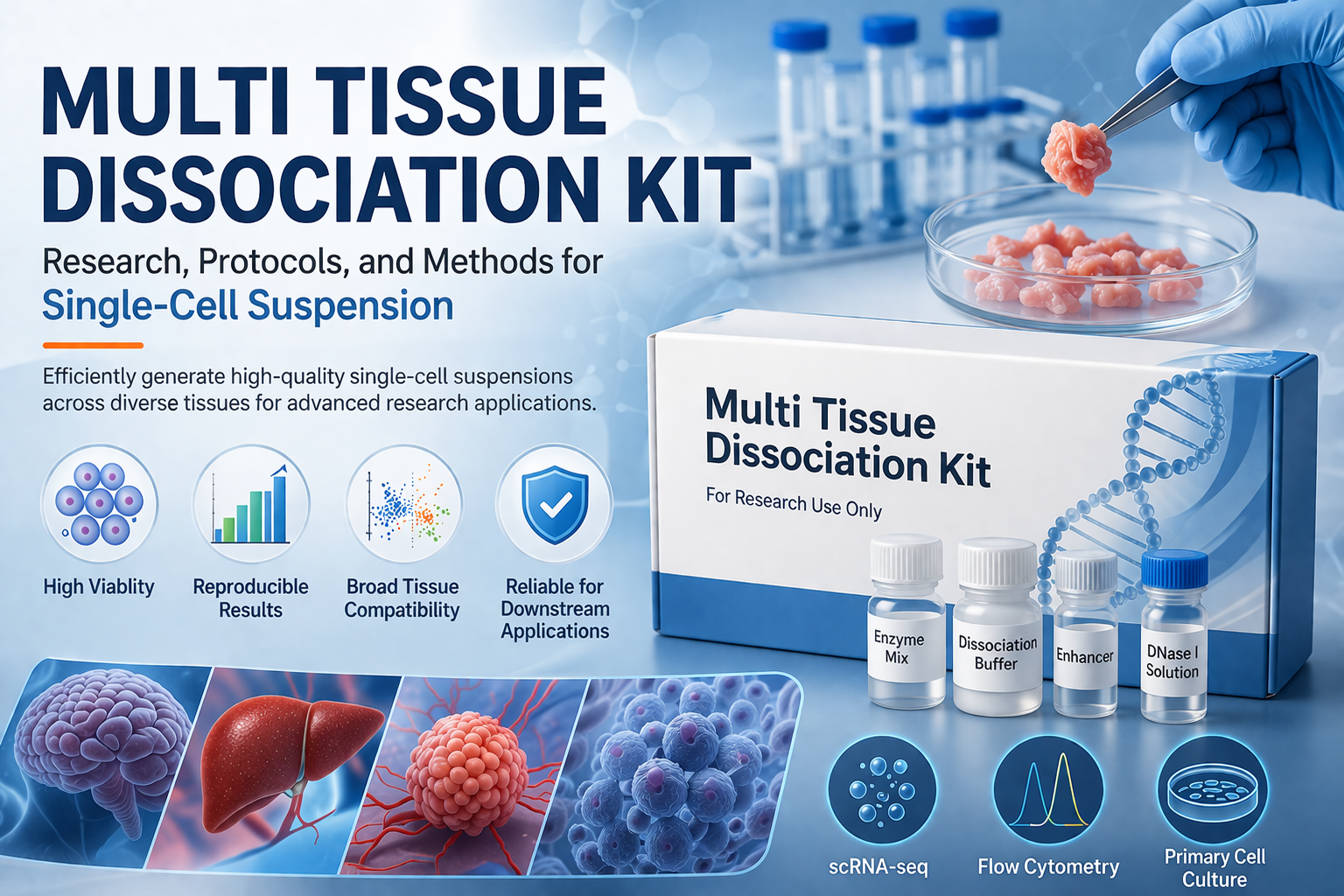
The FireGene Multi Tissue Dissociation Kit is designed to streamline this process by providing a standardized, reproducible workflow that integrates enzymatic digestion with gentle mechanical dissociation. This approach helps researchers obtain viable, high-integrity cells suitable for downstream analysis.
This article focuses on research applications, protocols, and methodological best practices for achieving consistent and high-quality single-cell suspensions.
Research Applications of Multi Tissue Dissociation
The FireGene Multi Tissue Dissociation Kit supports a wide range of research and experimental workflows:

1. Single-Cell RNA Sequencing (scRNA-seq)
Single-cell sequencing requires highly viable and minimally stressed cells. Proper dissociation preserves transcriptomic integrity and reduces artificial gene expression changes.
2. Flow Cytometry and Cell Sorting
Uniform single-cell suspensions improve antibody accessibility, reduce aggregation, and enhance sorting accuracy and reproducibility.
3. Primary Cell Culture
Efficient dissociation increases yield of viable cells that can be expanded in vitro for functional assays, drug screening, and differentiation studies.
4. Tumor Microenvironment Analysis
Complex tissues such as tumors contain heterogeneous populations including immune cells, stromal cells, and cancer cells. Multi tissue dissociation enables detailed profiling of these components.
5. Regenerative Medicine and Stem Cell Research
Maintaining cell viability and phenotype is critical when isolating stem or progenitor cells for expansion or lineage studies.
Core Methodology: Principles of Tissue Dissociation
A successful dissociation workflow relies on balancing three key components:
Enzymatic Digestion
Enzymes such as collagenase and proteases break down extracellular matrix proteins, enabling cells to separate from tissue structure.
Mechanical Disruption
Gentle trituration or agitation assists enzymatic activity and helps release cells without causing excessive damage.
Controlled Conditions
Temperature, incubation time, and mixing conditions must be carefully controlled to prevent over- or under-digestion.
General Protocol Workflow
Below is a standardized research protocol framework for multi tissue dissociation. Specific parameters should be optimized depending on tissue type and experimental requirements.
Step 1: Tissue Collection and Preparation
Collect tissue under sterile conditions
Remove contaminants such as blood or fat
Mince tissue into small fragments (1–2 mm pieces) to increase enzyme accessibility
Step 2: Enzymatic Digestion
Incubate tissue fragments in an enzyme-containing dissociation buffer
Maintain appropriate temperature (commonly 37°C)
Gently mix or rotate to enhance digestion efficiency
Method Note:
Digestion time should be optimized to avoid excessive exposure, which can damage cell membranes and surface markers.
Step 3: Mechanical Dissociation
Pipette or triturate gently to further break down remaining tissue fragments
Use consistent and controlled force to preserve cell integrity
Step 4: Filtration
Pass the suspension through a cell strainer (e.g., 70 µm or 40 µm)
Remove undigested debris and aggregates
Step 5: Washing and Centrifugation
Wash cells using buffer such as PBS or culture medium
Centrifuge at low speed to pellet cells without causing damage
Step 6: Viability Assessment
Evaluate cell viability using trypan blue staining or automated counters
Proceed to downstream applications if viability thresholds are met
Method Optimization Strategies
Different tissues require tailored approaches. Key optimization factors include:
Tissue Characteristics
Soft tissues (e.g., brain, liver): Require mild enzymatic conditions
Dense/fibrous tissues (e.g., skin, muscle): Require stronger or longer digestion
Tumor tissues: Often heterogeneous and may need multi-enzyme strategies
Enzyme Concentration
Higher enzyme concentrations may improve dissociation efficiency but can negatively impact viability if not carefully controlled.
Incubation Time
Under-digestion leads to low yield
Over-digestion leads to reduced viability and altered cell states
Mechanical Handling
Excessive shear forces can damage fragile cells. Gentle pipetting and controlled trituration are recommended.
Temperature Stability
Maintaining consistent temperature ensures optimal enzyme activity and reproducibility across experiments.
Advantages of a Kit-Based Approach
Using a standardized solution from FireGene provides several advantages:
Reproducibility: Consistent results across operators and experiments
Workflow Efficiency: Reduces time spent on reagent preparation and protocol optimization
Broad Applicability: Suitable for multiple tissue types with minimal adjustments
Scalability: Adaptable for both small-scale experiments and larger research projects
Improved Data Quality: Higher viability and reduced stress enhance downstream analytical accuracy
Common Troubleshooting Guide
Low Cell Viability
Possible causes: Over-digestion, harsh mechanical disruption
Solutions: Reduce incubation time, apply gentler pipetting techniques
Low Cell Yield
Possible causes: Incomplete digestion or insufficient enzyme activity
Solutions: Optimize enzyme concentration or extend digestion time
Cell Aggregation
Possible causes: DNA released from lysed cells
Solutions: Include DNase in the dissociation buffer and ensure proper mixing
High Debris Levels
Possible causes: Incomplete filtration or excessive tissue breakdown
Solutions: Improve filtration steps and adjust centrifugation parameters
Best Practices for Research and Method Development
To ensure consistent and high-quality results:
Perform pilot experiments to optimize conditions for each tissue type
Standardize handling procedures across experiments
Document all protocol parameters for reproducibility
Use fresh reagents and proper storage conditions
Validate cell viability, yield, and purity before downstream analysis
Conclusion
The FireGene Multi Tissue Dissociation Kit provides a reliable and efficient solution for generating high-quality single-cell suspensions across diverse tissue types. By combining enzymatic digestion with controlled mechanical dissociation, it supports a wide range of research applications including single-cell sequencing, flow cytometry, and primary cell culture.
Optimizing research protocols, experimental methods, and workflow parameters is critical for achieving high viability, reproducibility, and data integrity. With careful method design and execution, researchers can significantly improve the quality of their single-cell preparations and downstream results.
FireGene, light your research with passion, innovation, and profession.
FireGene Single-Cell Sample Prep
Looking for validated dissociation kits?
FireGene's tissue dissociation kits are optimized for specific organ types — brain, tumor, liver, GI, reproductive, and more. Validated for 10x Genomics Chromium and BD Rhapsody workflows.


