
Attention Researchers!
Struggling with repeated tissue dissociation failures? Low single-cell yields? Poor cell viability?
Over-dissociation leading to cell lysis? Incomplete dissociation causing severe clumping? Reagent toxicity compromising downstream experiments?
FG-BA3303 helps you resolve all these research pain points—once and for all!
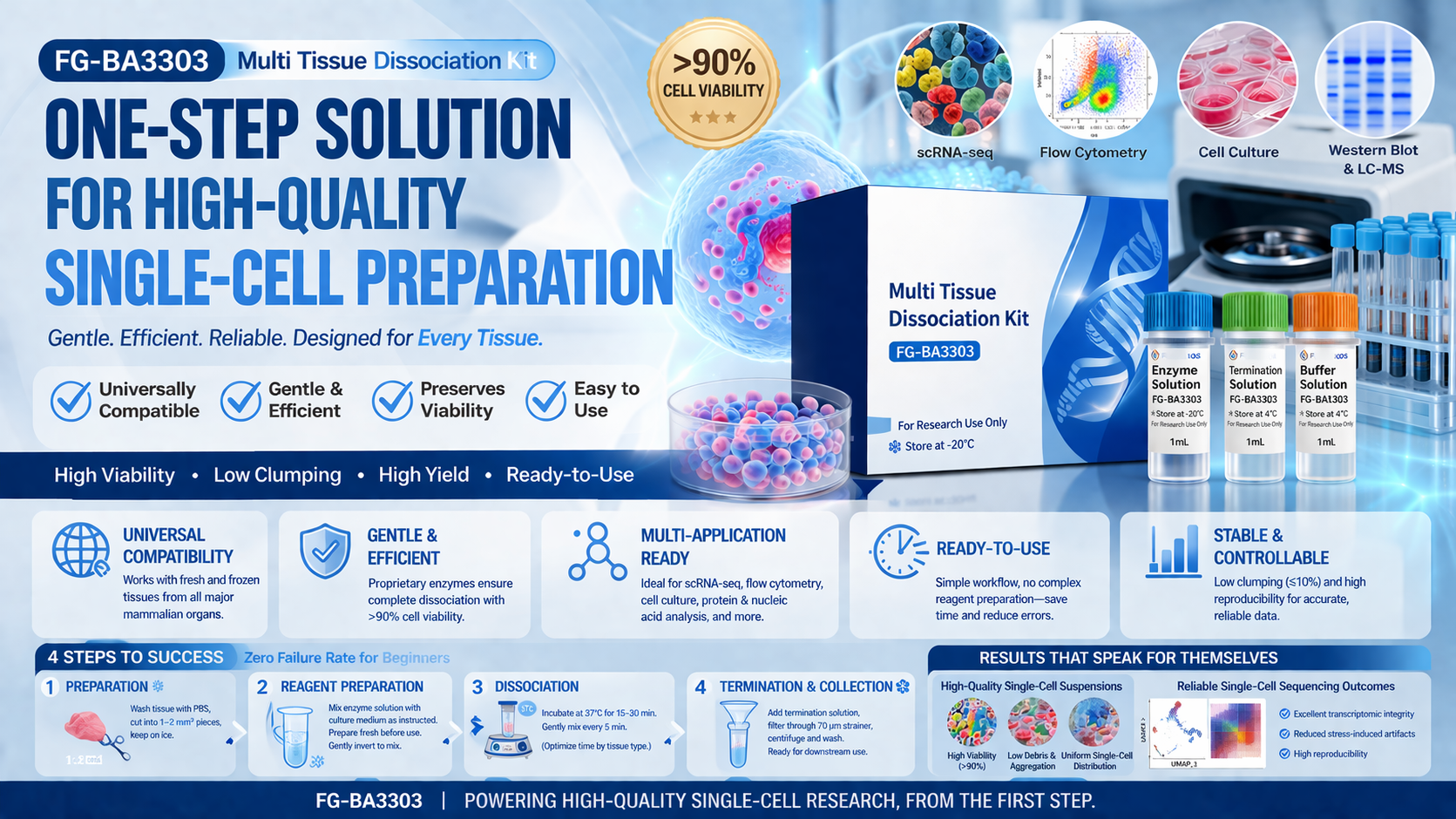
FireGene Multi Tissue Dissociation Kit (Cat. No.: FG-BA3303)
Universally Compatible ✅ Gentle & Efficient ✅ Preserves Viability ✅ Easy to Use ✅
Unlock a new paradigm in mammalian tissue dissociation—making your single-cell experiments more efficient and your data more precise!
I. Five Core Advantages: Say Goodbye to Dissociation Challenges
1. Universal Compatibility: Comprehensive Coverage of All Scenarios
Compatible with all mammalian tissues—including liver, kidney, heart, skin, spleen, intestine, neural tissue, embryonic tissue, and more—this system achieves efficient dissociation for both fresh and cryopreserved-and-thawed samples, requiring no additional reagent changes.
2. Gentle & Efficient: High Viability Retention
The proprietary enzymatic dissociation system is both gentle and controllable; it rapidly disrupts the interstitial matrix to ensure complete dissociation while maximally preserving cellular integrity. Post-dissociation single-cell viability exceeds 90%, and cell yield is improved by over 30% compared to standard kits, effectively eliminating issues associated with either excessive or insufficient dissociation.
3. Multi-Experiment Compatibility
Dissociated cells can be directly utilized for downstream applications such as high-throughput single-cell sequencing, cell culture, flow cytometry analysis, and nucleic acid/protein extraction. The system is fully compatible with a wide range of downstream experimental requirements, including Western blotting and LC-MS.
4. Ready-to-Use: Time-Saving and Effortless
The kit requires no complex reagent preparation; simply add the components according to the specified ratios to begin. This simplifies operational steps, significantly reduces experimental time, and lowers the technical barrier—allowing even novice users to get started quickly—while eliminating the potential for errors associated with manual reagent preparation.
5. Stable & Controllable: Enhanced Data Accuracy
The enzymatic dissociation temperature and duration are strictly controlled yet remain flexible, allowing for tailored adjustments based on specific tissue types. Post-dissociation cell clumping rates remain ≤10%, effectively minimizing experimental errors and ensuring the accuracy and reproducibility of downstream experimental data, thereby facilitating the efficient generation of scientific research outcomes.
II. Practical Guide | 4 Steps to Successful Tissue Dissociation (Zero Failure Rate for Beginners)
1. Preparation: Remove the enzyme solution from the BA3303 kit and allow it to thaw at 4°C (avoid thawing via high heat). Once thawed, mix gently; *do not* shake vigorously. Rinse fresh tissue 2–3 times with PBS to remove blood and impurities, then cut it into uniform small pieces (1–2 mm³). Maintain sterile conditions throughout this process and keep the samples on ice to minimize degradation.
2. Reagent Preparation: Following the ratios specified in the kit instructions, mix the enzyme solution with the culture medium to prepare the working dissociation solution. Mix gently by inverting the tube; prepare the solution immediately before use to prevent prolonged storage from compromising enzymatic activity.
3. Dissociation Procedure: Place the prepared tissue pieces into a sterile centrifuge tube and add an appropriate volume of the dissociation enzyme solution. Incubate at a constant temperature of 37°C for 15–30 minutes. During incubation, gently shake the centrifuge tube once every 5 minutes to ensure the tissue remains in full contact with the reagent. Incubation times may be adjusted based on the specific tissue type and experimental requirements.
4. Termination and Downstream Processing: Upon completion of the incubation, add an equal volume of termination solution (or 1640 culture medium) to halt the enzymatic reaction. Filter the mixture through a 70 μm cell strainer to remove any undissociated tissue fragments. Centrifuge the filtrate to collect the single-cell suspension; after washing the cells 1–2 times, they are ready for use in downstream experiments.
⚠️Note: Maintain sterile conditions throughout the entire procedure. Avoid subjecting the enzyme solution to repeated freeze-thaw cycles. Strictly control the temperature and duration during dissociation to prevent over-dissociation, which can lead to cell lysis. Centrifugation steps should be performed in a low-temperature environment (4°C) to minimize the loss of cell viability; specific centrifugation parameters should be determined based on the requirements of the downstream experiments.
III. Results Presentation
Quality Inspection Results of Single-Cell Suspensions Prepared from Different Tissues Using the Dissociation Kit


 Single-Cell Sequencing Data Results of Different Tissues after Dissociation
The FireGene Multi Tissue Dissociation Kit (Cat. No.: FG-BA3303) provides robust support for researchers' work, distinguished by its user-friendly operation, superior performance, and exceptional value for money. Whether the goal is to boost experimental efficiency or to ensure experimental quality, it serves as a trusted scientific partner—guaranteeing the reliability of subsequent experimental results!
FireGene, light your research with passion, innovation, and profession.
FireGene Single-Cell Sample Prep
Looking for validated dissociation kits?
FireGene's tissue dissociation kits are optimized for specific organ types — brain, tumor, liver, GI, reproductive, and more. Validated for 10x Genomics Chromium and BD Rhapsody workflows.


