
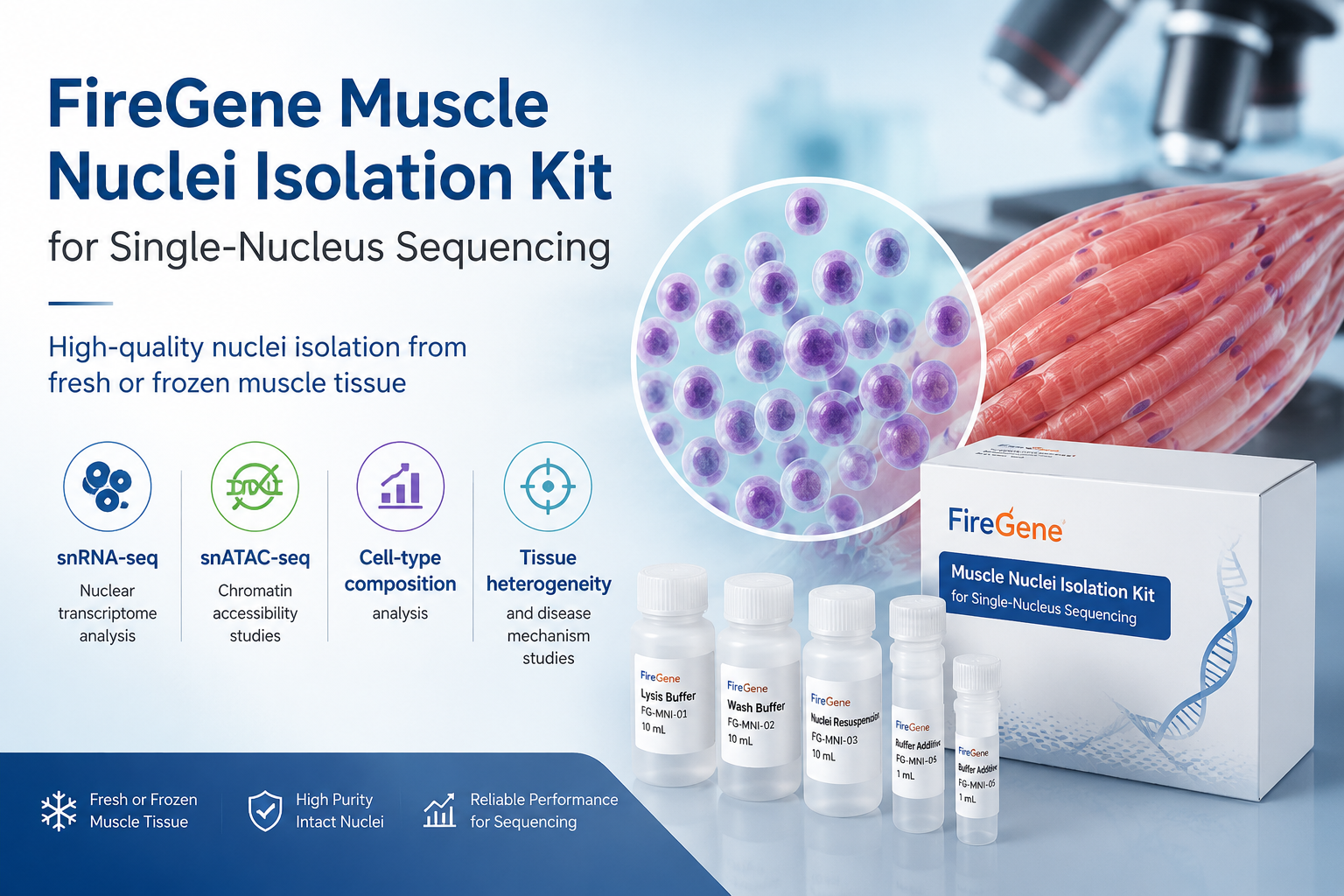
High-Quality Nuclei Isolation for Single-Nucleus Sequencing from Muscle Tissue
Single-nucleus sequencing has become an essential tool for studying complex tissues, especially samples that are difficult to dissociate into intact single cells. Muscle tissue is one of the best examples. Skeletal muscle, cardiac muscle, and other muscle-derived samples contain large, elongated, multinucleated fibers, dense extracellular matrix, and diverse supporting cell populations. These features make conventional single-cell preparation challenging and often lead to biased cell recovery, damaged cells, or incomplete representation of tissue heterogeneity.
The FireGene Muscle Nuclei Isolation Kit for Single-Nucleus Sequencing is designed to prepare clean, intact nuclei suspensions from fresh or frozen muscle tissue. The isolated nuclei can be used in downstream single-nucleus RNA sequencing, single-nucleus ATAC sequencing, nuclear transcriptome analysis, chromatin accessibility profiling, and other sequencing-based applications that require high-quality nuclear material.
For researchers working with muscle development, regeneration, aging, metabolic disease, neuromuscular disorders, cardiac biology, or tissue heterogeneity, reliable nuclei isolation is a critical first step toward meaningful single-nucleus data.
Why Muscle Tissue Requires Specialized Nuclei Isolation
Muscle tissue presents unique technical challenges for sequencing sample preparation. Unlike many soft tissues, muscle is rich in structural proteins, connective tissue, contractile fibers, and extracellular matrix components. In skeletal muscle, individual fibers can be very large and multinucleated, making it difficult to generate a representative single-cell suspension without damaging fragile cell types or losing specific populations.
Single-nucleus sequencing offers an effective alternative. Instead of isolating whole cells, researchers isolate nuclei from the tissue. This approach is particularly valuable for frozen or archived muscle samples, where intact cells may no longer be viable but nuclei remain suitable for molecular analysis.
However, nuclei isolation from muscle still requires careful optimization. Poor extraction can result in debris contamination, nuclear aggregation, damaged nuclei, or low recovery. These issues may affect sequencing quality, increase background RNA, reduce usable reads, or distort downstream cell-type analysis.
The FireGene Muscle Nuclei Isolation Kit provides a streamlined workflow for obtaining nuclei suspensions compatible with advanced single-nucleus sequencing applications.
Key Applications of FireGene Muscle Nuclei Isolation Kit
The nuclei suspensions prepared using the kit are suitable for downstream experiments that require clean and intact nuclear material from muscle tissue.

1. Single-Nucleus RNA Sequencing, or snRNA-seq
Single-nucleus RNA sequencing is widely used to profile gene expression at nuclear resolution. For muscle tissue, snRNA-seq enables researchers to analyze gene expression patterns across myonuclei, satellite cells, fibro-adipogenic progenitors, endothelial cells, immune cells, smooth muscle cells, and other cell populations present in the tissue microenvironment.
Because snRNA-seq can be performed on fresh or frozen samples, it is especially useful for studies involving human biopsies, disease models, archived specimens, and rare tissue collections. By using isolated nuclei rather than whole cells, researchers can reduce dissociation-related bias and better capture cellular diversity in complex muscle samples.
2. Single-Nucleus ATAC Sequencing, or snATAC-seq
Single-nucleus ATAC sequencing is used to study chromatin accessibility at the single-nucleus level. This method helps identify open chromatin regions, regulatory elements, transcription factor activity, and cell-type-specific epigenetic states.
In muscle biology, snATAC-seq can support studies of myogenesis, regeneration, aging, inflammation, fibrosis, metabolic remodeling, and disease-associated regulatory changes. High-quality nuclei isolation is essential for snATAC-seq because damaged nuclei or debris can compromise chromatin accessibility profiles and reduce data quality.
3. Nuclear Transcriptome Analysis
The kit supports nuclear transcriptome analysis, allowing researchers to examine RNA populations present within isolated nuclei. Nuclear transcriptomics can provide valuable information about active transcription, pre-mRNA processing, cell identity, and gene regulation.
For muscle tissue, nuclear transcriptome analysis is useful when whole-cell RNA recovery is limited or when researchers need to study samples that are difficult to dissociate. It can also help uncover molecular signatures associated with muscle development, injury response, regeneration, degeneration, and disease progression.
4. Chromatin Accessibility Studies
Chromatin accessibility is a key indicator of gene regulatory activity. By preparing nuclei suitable for chromatin-based assays, the FireGene kit can support research into enhancer usage, promoter accessibility, lineage-specific gene regulation, and disease-associated epigenetic remodeling.
In muscle research, chromatin accessibility studies can help explain how gene expression programs are controlled during muscle differentiation, hypertrophy, atrophy, repair, and pathological remodeling.
5. Cell-Type Composition Analysis
Muscle tissue is not composed only of muscle fibers. It contains many cell types, including stem/progenitor cells, vascular cells, fibroblasts, adipogenic cells, immune cells, neuronal-associated cells, and connective tissue-associated populations. The relative abundance of these cell types may change during development, exercise, injury, aging, inflammation, and disease.
Single-nucleus sequencing enables cell-type composition analysis by identifying nuclear transcriptional or chromatin signatures associated with specific cell populations. This makes it possible to compare healthy and diseased tissues, treated and untreated samples, or different stages of muscle regeneration.
6. Gene Expression Profiling from Fresh or Frozen Muscle Tissue
One of the major advantages of single-nucleus approaches is compatibility with fresh or frozen muscle tissue. Frozen samples are commonly used in biomedical research, especially when working with clinical specimens, animal models, biobanks, or time-course collections.
The FireGene Muscle Nuclei Isolation Kit helps researchers prepare nuclei from these sample types for gene expression profiling. This expands the usability of precious or difficult-to-obtain muscle samples and supports retrospective molecular analysis.
7. Tissue Heterogeneity and Disease Mechanism Studies
Muscle diseases often involve multiple cell types and molecular pathways. In muscular dystrophy, cachexia, sarcopenia, metabolic disease, inflammatory myopathy, cardiomyopathy, and injury models, changes may occur not only in myofibers but also in immune cells, fibroblasts, vascular cells, and progenitor populations.
By supporting single-nucleus sequencing workflows, the FireGene kit helps researchers explore tissue heterogeneity and disease mechanisms with greater resolution. This can reveal disease-associated cell states, altered regulatory networks, inflammatory signatures, fibrosis-related pathways, and potential therapeutic targets.
Advantages of Single-Nucleus Sequencing for Muscle Research
Single-nucleus sequencing is particularly powerful for muscle biology because it helps overcome several limitations of conventional single-cell sequencing.
First, it enables analysis of frozen tissue, making it suitable for archived and clinical samples. Second, it reduces the need for harsh enzymatic dissociation, which can damage cells or alter gene expression. Third, it improves access to large or fragile cell types that are difficult to recover as intact single cells. Finally, it allows researchers to study both transcriptional and epigenetic features at single-nucleus resolution.
For muscle studies, these advantages can lead to a more accurate view of tissue architecture, cellular diversity, and molecular regulation.
A Reliable Starting Point for Downstream Sequencing Workflows
The success of snRNA-seq and snATAC-seq depends heavily on sample quality. Clean, intact nuclei help improve library preparation, reduce background noise, and support more reliable downstream analysis. In contrast, poor-quality nuclei suspensions may lead to low sequencing efficiency, increased debris, poor clustering, and reduced biological interpretability.
The FireGene Muscle Nuclei Isolation Kit for Single-Nucleus Sequencing is developed to support researchers who need consistent nuclei preparation from muscle tissue. It is suitable for workflows focused on gene expression profiling, chromatin accessibility, cell-type identification, and disease mechanism research.
Conclusion
Muscle tissue is biologically complex and technically challenging, but single-nucleus sequencing provides a powerful way to study its cellular and molecular diversity. The FireGene Muscle Nuclei Isolation Kit for Single-Nucleus Sequencing enables the preparation of clean nuclei suspensions from fresh or frozen muscle tissue for downstream snRNA-seq, snATAC-seq, nuclear transcriptome analysis, chromatin accessibility studies, and tissue heterogeneity research.
By supporting high-quality nuclei isolation, this kit helps researchers investigate muscle development, regeneration, disease mechanisms, and cell-type-specific molecular changes with greater confidence.
FireGene, light your research with passion, innovation, and profession.
FireGene Single-Cell Sample Prep
Looking for validated dissociation kits?
FireGene's tissue dissociation kits are optimized for specific organ types — brain, tumor, liver, GI, reproductive, and more. Validated for 10x Genomics Chromium and BD Rhapsody workflows.


