
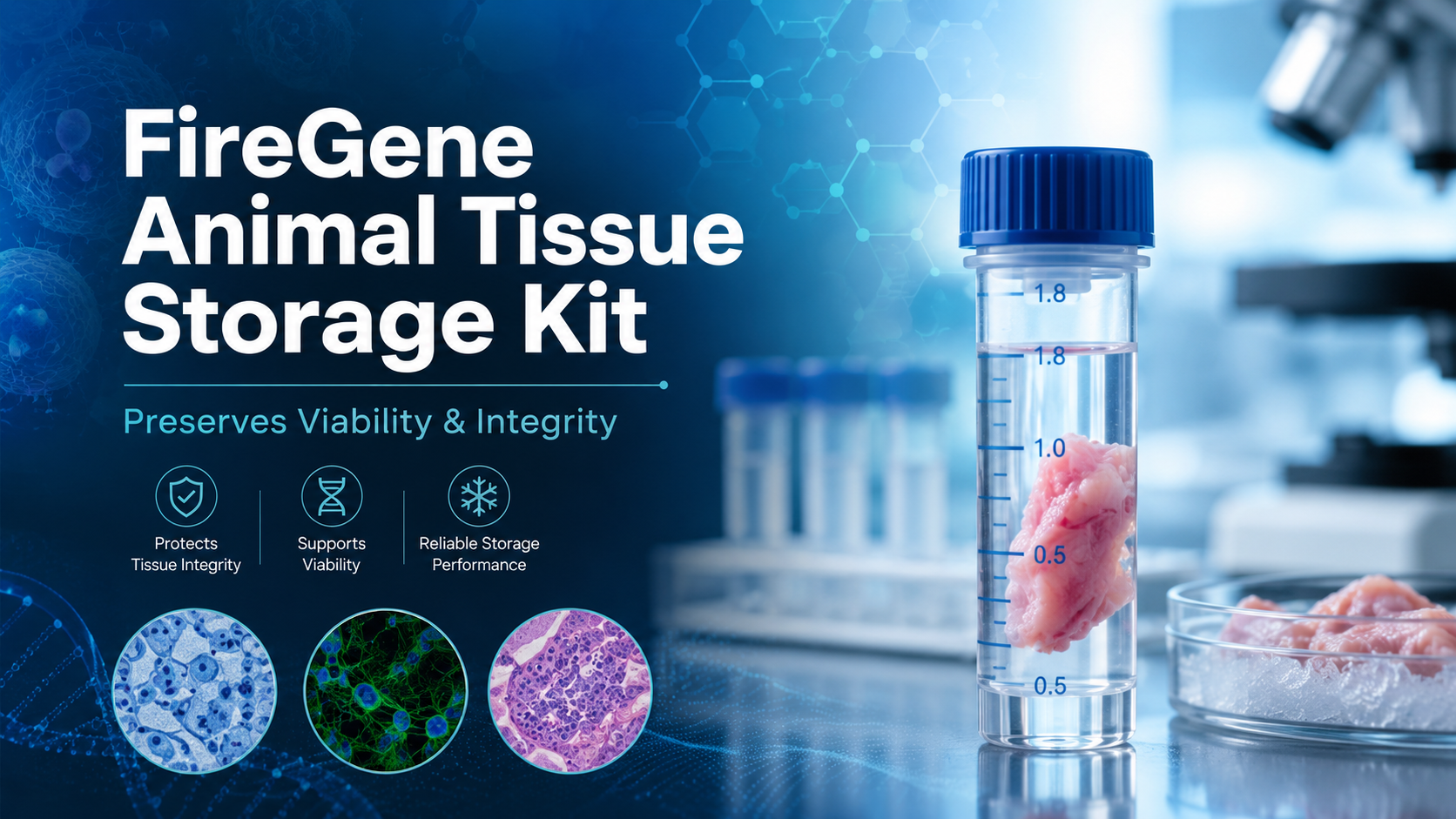
In modern biomedical research, the quality of a tissue sample can determine the quality of the entire experiment. From single-cell sequencing and tissue dissociation to organoid culture, disease modeling, flow cytometry, and molecular analysis, researchers depend on starting materials that remain biologically representative after collection. However, animal tissues are highly sensitive once removed from their native environment. Delays in processing, temperature fluctuations, transport conditions, and improper storage can quickly reduce cell viability, damage tissue structure, alter gene expression, and compromise downstream data.
The FireGene Animal Tissue Storage Kit – Preserves Viability & Integrity is designed to address this critical pre-analytical challenge. As part of the FireGene sample preparation workflow, this kit helps researchers store and transport fresh animal tissue while maintaining the sample’s biological quality before further processing. For laboratories handling animal models, preclinical samples, tumor tissues, organ tissues, or fragile specimens destined for single-cell applications, reliable tissue preservation is not just convenient—it is essential.
Why Animal Tissue Storage Matters in Research
Animal tissue samples often represent valuable experimental material. A single sample may come from a carefully designed animal study, a limited disease model, a time-sensitive pharmacology experiment, or a rare tissue collection. Once harvested, the sample begins to experience environmental stress. Cells can lose viability, tissues may degrade, and the original physiological state may drift over time.
This is especially important for single-cell sequencing sample preparation, where the goal is to capture the cellular composition and transcriptomic state of the original tissue as accurately as possible. Poor tissue storage may increase dead cell percentage, reduce nucleated cell recovery, create debris, distort cell-type representation, and introduce artificial stress-response signatures. Even if sequencing succeeds technically, the biological interpretation may be weakened by poor sample handling.
For researchers working with animal tissues, the time between tissue collection and tissue dissociation is often unavoidable. Samples may need to be transported between facilities, processed in batches, stored temporarily while multiple tissues are collected, or held before specialized equipment becomes available. A dedicated animal tissue storage solution helps bridge this gap by supporting sample viability and integrity during the pre-processing window.
What Is FireGene Animal Tissue Storage Kit?
The FireGene Animal Tissue Storage Kit is a preservation solution developed for fresh animal tissue samples before downstream cell preparation and analysis. Its purpose is to help maintain tissue quality during short-term storage and transport, so researchers can proceed with dissociation, cell isolation, culture, or sequencing with greater confidence.
Unlike general-purpose buffers that may not be optimized for tissue preservation, a dedicated tissue storage kit is designed around the biological needs of ex vivo tissues. The goal is to reduce unnecessary sample loss and help preserve the cellular state before the next step in the workflow. This makes the FireGene Animal Tissue Storage Kit especially useful in workflows where viability, structural integrity, and reproducibility are central performance requirements.
The kit is relevant for research areas such as cancer biology, immunology, neuroscience, developmental biology, metabolic disease, organ-specific disease modeling, drug discovery, and single-cell omics. Whether researchers are working with mouse, rat, or other animal-derived tissues, sample quality must be protected from the moment of collection.
Designed for Single-Cell Sequencing Workflows
Single-cell sequencing has transformed biomedical research by allowing scientists to explore tissue heterogeneity at high resolution. However, single-cell data quality depends heavily on the condition of the starting tissue. Before sequencing can begin, tissues must usually be transported, minced, enzymatically dissociated, filtered, counted, and assessed for viability. If tissue quality is poor at the start, no sequencing platform can fully compensate for that loss.
The FireGene Animal Tissue Storage Kit supports the front end of this workflow. By helping preserve fresh animal tissue before dissociation, it contributes to better sample consistency and more reliable downstream preparation. For single-cell RNA sequencing, this can be especially valuable because damaged or stressed cells may affect transcriptomic profiles. For single-cell immune profiling, preservation of viable immune cells can influence cell recovery and population balance. For tumor microenvironment studies, maintaining tissue integrity may help preserve diverse cell types that are otherwise easily lost during poor handling.
A reliable tissue storage step can also help laboratories coordinate complex single-cell projects. Instead of rushing every sample immediately into dissociation, teams may gain greater flexibility in scheduling, transport, and batch processing.
Key Benefits of FireGene Animal Tissue Storage Kit
1. Helps Preserve Cell Viability
Cell viability is one of the most important indicators of sample quality. Low viability can lead to poor recovery, increased debris, inefficient library preparation, and biased data. The FireGene Animal Tissue Storage Kit is designed to help maintain viable cells within fresh animal tissue before downstream processing.
2. Supports Tissue Integrity
Tissue integrity matters not only for histology or morphology but also for dissociation quality. Over-degraded tissue can produce uneven cell suspensions, excessive clumping, and poor representation of fragile cell types. By supporting structural integrity during storage, the kit helps preserve a more useful starting material for cell preparation workflows.
3. Improves Workflow Flexibility
Animal tissue collection and processing are not always perfectly synchronized. Researchers may need to collect multiple samples, ship tissues to another site, or wait for a core facility slot. A dedicated storage kit helps reduce the pressure of immediate processing and supports more organized experimental workflows.
4. Useful for Multiple Downstream Applications
The kit is suitable for research workflows that depend on high-quality tissue preservation, including single-cell sequencing, tissue dissociation, cell isolation, organoid culture, disease modeling, molecular biology, and preclinical sample preparation.
5. Helps Improve Reproducibility
Reproducibility begins before the assay. If one sample is processed immediately while another is stored under suboptimal conditions, technical variation may be introduced before data collection even begins. Standardized tissue storage can help reduce pre-analytical variability across samples, operators, and time points.
Common Problems Caused by Poor Tissue Storage
Improper animal tissue storage can affect nearly every stage of research. Common issues include decreased cell viability, increased apoptosis or necrosis, RNA degradation, loss of fragile cell populations, higher debris content, reduced cell yield, altered gene expression, and inconsistent experimental results. In single-cell workflows, these issues can become particularly costly because poor input material may lead to failed runs or misleading biological conclusions.
For example, if tissue is stored in a non-optimized solution, cells may experience osmotic stress or nutrient deprivation. If temperature conditions are inconsistent, degradation may accelerate. If tissue pieces are too large or not fully immersed, preservation may be uneven. If samples are stored for too long without a suitable preservation system, the final cell suspension may no longer reflect the original biological state.
Using a purpose-built product such as FireGene Animal Tissue Storage Kit helps researchers build a more controlled and reliable sample handling process.
Recommended Workflow Considerations
For best results, tissue preservation should be planned before sample collection begins. Researchers should prepare the storage solution, label containers clearly, and standardize collection times and sample sizes as much as possible. Freshly collected tissue should be transferred promptly into the storage medium, ensuring that the sample is adequately immersed. Storage conditions should follow the product instructions, and downstream processing should be performed within the recommended preservation window.
It is also important to pair tissue storage with an appropriate dissociation strategy. Different tissues vary in extracellular matrix content, cell fragility, lipid content, vascularization, and enzymatic sensitivity. A well-preserved sample still requires optimized dissociation to produce a high-quality single-cell or primary cell suspension.
Who Should Use FireGene Animal Tissue Storage Kit?
The FireGene Animal Tissue Storage Kit is suitable for research teams that collect and process fresh animal tissue but cannot always proceed immediately to downstream analysis. It is particularly useful for single-cell sequencing laboratories, preclinical research teams, animal model researchers, translational research groups, CROs, core facilities, and academic laboratories working with tissue dissociation or cell-based analysis.
It can also benefit teams handling multiple samples across time points, researchers shipping tissue between collection and analysis sites, and laboratories seeking to reduce variability in sample preparation.
Build Better Data from Better Preserved Samples
High-quality research starts with high-quality samples. In animal tissue studies, the preservation step between collection and processing can strongly influence downstream success. The FireGene Animal Tissue Storage Kit – Preserves Viability & Integrity provides a practical solution for maintaining fresh animal tissue quality before dissociation, culture, sequencing, or other analytical workflows.
By helping preserve cell viability and tissue integrity, this kit supports more reliable sample preparation, improved workflow flexibility, and stronger confidence in downstream results. For researchers working in single-cell sequencing, disease modeling, drug discovery, and animal tissue analysis, FireGene Animal Tissue Storage Kit offers a dependable way to protect valuable samples from collection to processing.
FireGene, light your research with passion, innovation, and profession.
FireGene Single-Cell Sample Prep
Looking for validated dissociation kits?
FireGene's tissue dissociation kits are optimized for specific organ types — brain, tumor, liver, GI, reproductive, and more. Validated for 10x Genomics Chromium and BD Rhapsody workflows.


