
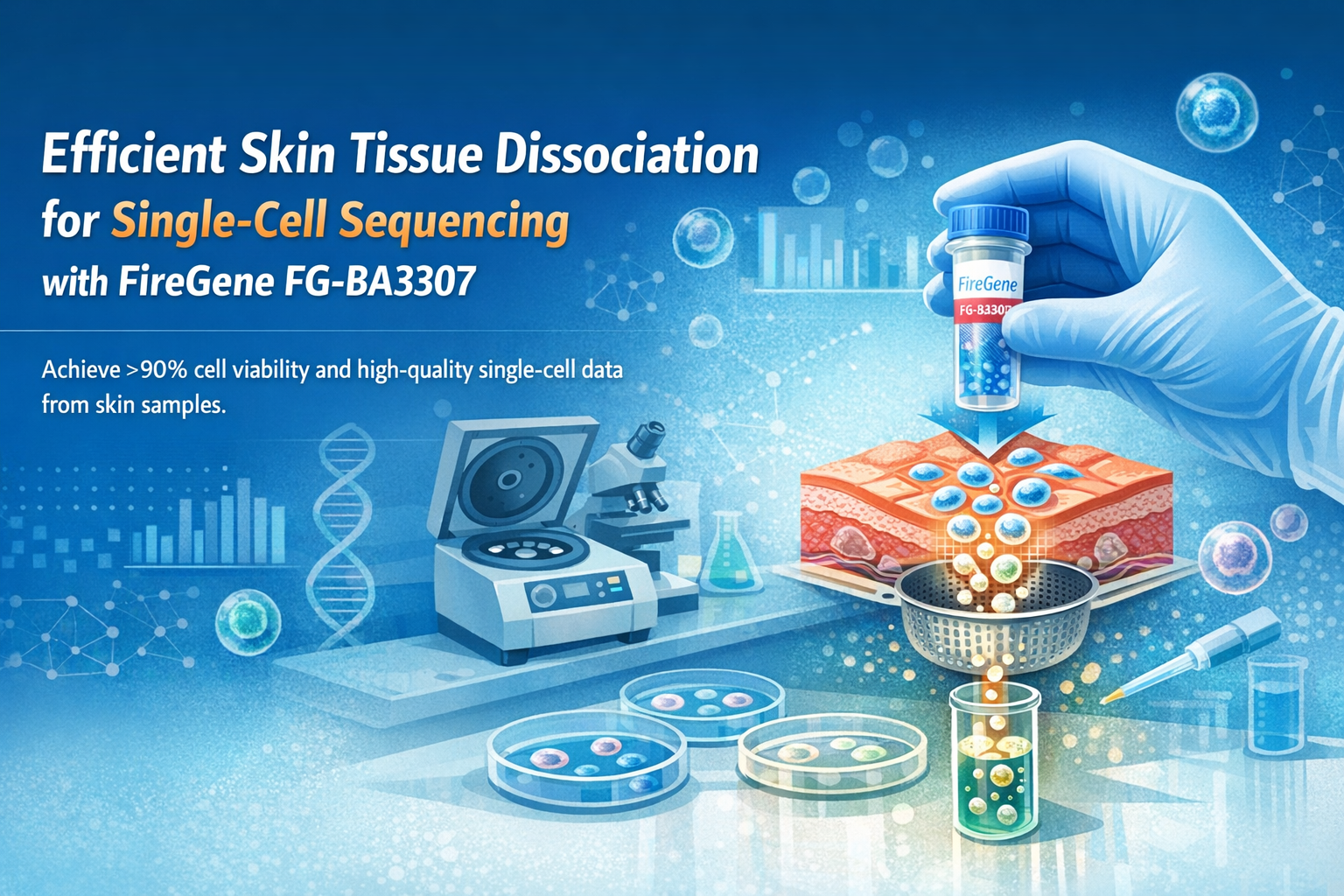
In the complex realm of single-cell sequencing experiments involving skin, researchers frequently encounter numerous challenges. Significant variations in skin thickness and cellular composition across different sampling sites render skin dissociation a formidable task, thereby severely impeding the progress of downstream experiments such as single-cell sequencing. To overcome these hurdles, FireGene has meticulously developed the FireGene Skin Dissociation Kit (Cat. No.: FG-BA3307), offering an efficient and reliable solution for the preparation of single-cell suspensions from skin tissue.
Product Introduction
Simple and Convenient Operation: Compared to other complex methods for skin tissue dissociation, this kit eliminates the need for tedious steps or specialized dissociation instruments. Researchers need only follow the clear and concise instructions to effortlessly achieve skin tissue dissociation and rapidly prepare high-quality single-cell suspensions. Even those with no prior experience in skin tissue dissociation experiments can quickly master the workflow, significantly boosting experimental efficiency and minimizing the risk of errors or failures caused by procedural complexity.
Stable and Reliable Performance: Extensively validated and optimized through numerous experiments, this kit consistently delivers stable dissociation results across diverse experimental environments and sample conditions. Skin tissue samples collected from various anatomical sites can all be successfully processed using this kit to yield optimal dissociation outcomes, providing researchers with a reliable experimental tool that enhances the reproducibility and comparability of their results.
High Cell Viability and Low Fragmentation Rate: Cells obtained after dissociation with this kit exhibit exceptionally high viability, frequently exceeding 90%. Such highly viable cells retain their physiological characteristics and functions more effectively, serving as premium cellular material for downstream applications such as single-cell sequencing, cell sorting, and cell culture. Furthermore, the kit ensures low rates of cell fragmentation and aggregation, thereby significantly minimizing interference from debris and cell clumps to ensure the accuracy and reliability of experimental data. All other relevant parameters also meet the rigorous requirements of high-throughput single-cell sequencing studies, providing a robust foundation for advanced single-cell research.
Usage Instructions
Sample Preparation: Obtain fresh skin tissue samples, ensuring as much as possible that the samples remain intact and viable. Place the samples in an appropriate preservation solution and transport them rapidly to the laboratory for subsequent processing.
Tissue Processing: Remove the skin tissue from the preservation solution and rinse it several times with sterile PBS buffer to remove surface impurities and blood residues. Subsequently, mince the tissue into small pieces to facilitate more thorough enzymatic digestion in the following step.
Enzymatic Digestion: Following the proportions specified in the kit's instruction manual, add an appropriate volume of enzyme solution to the minced skin tissue and mix gently. Incubate the mixture at a suitable temperature (typically 37°C) under agitation to carry out the digestion reaction; the digestion time should be adjusted based on the specific characteristics of the tissue and prior experience. During the digestion process, periodically observe the state of the tissue to ensure that digestion is complete but not excessive.
Digestion Termination and Cell Collection: Once it is observed that the majority of the tissue fragments have been digested and the solution has become noticeably turbid, add an appropriate volume of termination solution to halt the digestion reaction. Subsequently, filter the digested mixture through a mesh strainer to remove any incompletely digested tissue fragments, thereby collecting the single-cell suspension contained in the filtrate.
Cell Washing and Counting: Centrifuge the collected single-cell suspension to remove the supernatant. Resuspend the cells in PBS buffer or a suitable cell culture medium, and repeat the centrifugation and washing process 2–3 times to eliminate residual enzymes and impurities. If erythrocytes (red blood cells) are present in the resulting cell suspension, decide whether to perform an additional step to remove them as needed (Catalog No.: FG-BA3311). Finally, use a cell counter or a hemocytometer to count the washed cells; simultaneously, assess cell viability and aggregation rates to evaluate the overall quality of the single-cell suspension.
Data Presentation
The empirical results obtained using this kit are remarkable. The cell suspension generated following dissociation with this kit is of exceptional quality, fully meeting the requirements for downstream applications such as single-cell transcriptome sequencing.
At present, we have completed a large number of single-cell sequencing projects using samples treated with this dissociation kit.
Data Performance of Skin Tissue After Dissociation in Some Actual Projects


 Single-Cell Sequencing Data Results of Skin Tissue After Dissociation in Some Actual Projects
With its exceptional performance and user-friendly protocol, the FireGene Skin Dissociation Kit provides robust support for research applications such as single-cell sequencing of skin, serving as an invaluable tool for researchers in the field of skin tissue studies.
FireGene, light your research with passion, innovation, and profession.
FireGene Single-Cell Sample Prep
Looking for validated dissociation kits?
FireGene's tissue dissociation kits are optimized for specific organ types — brain, tumor, liver, GI, reproductive, and more. Validated for 10x Genomics Chromium and BD Rhapsody workflows.


