
Introduction
Single-cell and single-nucleus sequencing have revolutionized modern biology by enabling researchers to examine cellular diversity and gene expression with unprecedented resolution. Unlike traditional bulk analysis, which averages signals across millions of cells, single-cell technologies reveal subtle variations among individual cells, uncover rare cell populations, and track dynamic cellular responses. This level of detail is particularly crucial in complex tissues, such as the brain, heart, liver, or tumors, where cellular heterogeneity drives both normal function and disease progression.
However, obtaining high-quality single-cell or single-nucleus suspensions remains a significant challenge. Many tissues are difficult to dissociate due to their structural complexity, large or irregularly shaped cells, or high lipid content. Conventional enzymatic digestion often damages fragile cells or triggers stress responses that alter gene expression, while frozen or archived tissues pose additional obstacles for sample preparation. These limitations can compromise sequencing quality, reduce detectable genes, and hinder accurate downstream analysis.
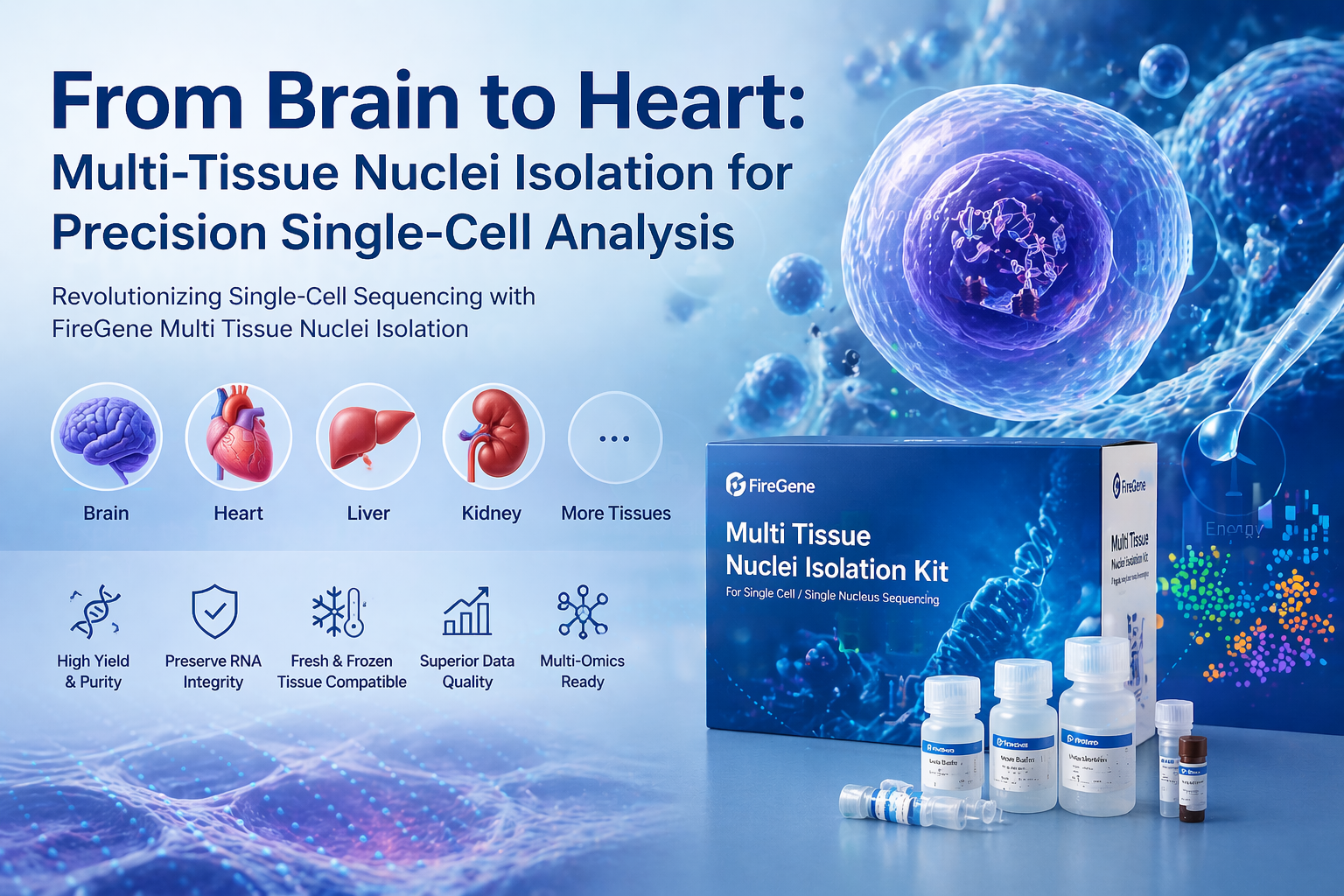
The FireGene Multi Tissue Nuclei Isolation Kit addresses these challenges by providing a reliable method to isolate intact nuclei from a wide range of tissue types, whether fresh or frozen. By focusing on nuclei rather than whole cells, the kit minimizes cellular stress and preserves transcriptional information, making it suitable for diverse research applications. Its streamlined workflow ensures high yield and purity, enabling scientists to generate reproducible, high-quality data for single-cell and single-nucleus studies.
With the ability to overcome common preparation bottlenecks, this kit empowers researchers to explore cellular landscapes across multiple tissues, supporting discoveries in basic biology, disease mechanisms, and translational medicine.
Versatility Across Tissue Types
One of the key advantages of the FireGene Multi Tissue Nuclei Isolation Kit is its broad applicability across diverse tissue types. Many tissues present unique challenges for single-cell or single-nucleus preparation. For example, brain tissue is highly lipid-rich and delicate, making enzymatic dissociation prone to cell damage, while heart tissue contains large, structurally complex cells that are difficult to process without affecting RNA integrity. Liver and kidney tissues often contain dense extracellular matrices, further complicating conventional dissociation methods.
The kit is specifically designed to overcome these obstacles by isolating nuclei instead of whole cells. This approach allows researchers to bypass the mechanical and enzymatic stresses that can alter cellular profiles. Whether working with fresh tissue, frozen samples, or archived specimens, the kit delivers consistently high-quality nuclei suitable for downstream single-nucleus sequencing.
Its streamlined protocol is optimized for multiple mammalian tissues, ensuring efficient nuclei extraction while maintaining RNA integrity and nuclear morphology. This versatility makes it a powerful tool for studies that require cross-tissue comparisons or multi-organ profiling. Researchers can confidently use the same preparation workflow for brain, heart, liver, kidney, and other challenging tissues, significantly reducing variability and improving reproducibility across experiments.
By supporting a wide range of tissue types and sample conditions, the FireGene kit enables comprehensive exploration of cellular heterogeneity, facilitating discoveries in normal physiology, disease mechanisms, and therapeutic development. Its multi-tissue compatibility is particularly valuable for labs conducting large-scale single-nucleus studies or integrating data across multiple organ systems.
Enabling High-Quality Single-Cell/Nucleus Sequencing
High-quality single-cell or single-nucleus sequencing depends heavily on the integrity and purity of the starting material. The FireGene Multi Tissue Nuclei Isolation Kit is designed to deliver nuclei that meet the stringent requirements of modern single-cell platforms, ensuring reliable and reproducible data.
By isolating intact nuclei rather than whole cells, the kit minimizes stress-induced transcriptional changes and preserves the native gene expression profile. This is especially important for sensitive tissues such as the brain or heart, where cellular stress during enzymatic dissociation can skew results. The kit’s optimized workflow produces nuclei with high yield and purity, reducing debris and dead cell contamination that can compromise sequencing quality.
The isolated nuclei are fully compatible with leading single-cell and single-nucleus sequencing platforms, including 10x Genomics and BD Rhapsody. Researchers benefit from improved detection of genes, enhanced clustering accuracy, and more reliable identification of rare cell populations. In addition, the kit’s protocol maintains RNA integrity, a critical factor for downstream transcriptomic analyses.
Moreover, the kit is well-suited for both fresh and frozen tissues, enabling consistent data generation across different sample types. This versatility allows researchers to leverage biobanked or archived specimens, expanding the range of biological questions that can be addressed.
By combining high yield, purity, and broad compatibility, the FireGene kit empowers scientists to obtain high-resolution insights into cellular heterogeneity, gene regulation, and tissue-specific transcriptional dynamics. It transforms challenging tissue samples into robust datasets that drive discovery in basic research, disease modeling, and translational studies.
Applications in Disease Research
The ability to isolate high-quality nuclei from diverse tissues has made the FireGene Multi Tissue Nuclei Isolation Kit a valuable tool for studying disease mechanisms at the cellular level. By preserving the native transcriptional landscape, researchers can investigate how specific cell populations contribute to disease onset, progression, and response to treatment.
In neuroscience, for example, single-nucleus sequencing of brain tissues enables detailed analysis of neurodegenerative disorders such as Alzheimer’s and Parkinson’s disease. Researchers can identify vulnerable neuronal subtypes, study glial cell responses, and map transcriptional changes associated with disease progression. Similarly, in cardiovascular research, nuclei isolated from heart tissue provide insights into cellular remodeling following myocardial infarction or during heart failure, allowing for the identification of molecular signatures linked to dysfunction.
The kit is also highly relevant for cancer research. Tumor tissues are often heterogeneous and difficult to dissociate without introducing artifacts. By isolating nuclei, researchers can examine the tumor microenvironment, detect rare malignant or immune cell populations, and explore gene expression programs that drive tumor growth and therapy resistance.
Beyond neuroscience, cardiology, and oncology, the kit supports studies in liver disease, kidney pathology, and metabolic disorders, enabling comprehensive single-nucleus analyses across multiple organ systems. Its compatibility with both fresh and frozen samples further extends its utility to clinical research and biobank studies, where tissue availability may be limited.
Overall, the FireGene kit facilitates high-resolution exploration of disease biology, supporting discoveries that can inform new therapeutic strategies, biomarker identification, and precision medicine approaches. By overcoming sample preparation challenges, it allows scientists to generate reproducible, high-quality data from even the most challenging tissues.
Future Directions and Multi-Omics Integration
As single-cell and single-nucleus technologies continue to advance, the FireGene Multi Tissue Nuclei Isolation Kit plays a crucial role in enabling multi-omics approaches that provide a more comprehensive understanding of cellular biology. Beyond transcriptomics, isolated nuclei can be used for assays such as single-nucleus ATAC-seq to profile chromatin accessibility, uncovering regulatory landscapes that drive gene expression patterns.
The kit’s high-quality nuclei are compatible with integrated multi-omics workflows, allowing simultaneous analysis of transcriptome, epigenome, and other molecular layers from the same tissue. This capability is particularly valuable for studies seeking to link gene regulation with cellular identity and function, offering insights that single-modality analyses alone cannot achieve.
In addition, the kit’s suitability for both fresh and frozen tissues opens opportunities for leveraging biobanked clinical samples. Researchers can perform retrospective analyses on rare or archived specimens, expanding the scope of translational studies and facilitating the discovery of disease biomarkers or therapeutic targets.
Looking ahead, the FireGene kit supports the growing trend of large-scale, multi-tissue studies. Its versatility and reliability make it an ideal tool for projects aiming to map cellular heterogeneity across organ systems or investigate systemic disease mechanisms. By providing consistent, high-quality nuclei, the kit ensures reproducible results, enabling researchers to integrate datasets across tissues, conditions, and experimental platforms.
Ultimately, the FireGene Multi Tissue Nuclei Isolation Kit empowers scientists to explore the full complexity of cellular biology. By supporting multi-omics integration and high-resolution analyses, it contributes to the advancement of precision medicine, functional genomics, and fundamental biological research, paving the way for discoveries that were previously unattainable.
FireGene, light your research with passion, innovation, and profession.
FireGene Single-Cell Sample Prep
Looking for validated dissociation kits?
FireGene's tissue dissociation kits are optimized for specific organ types — brain, tumor, liver, GI, reproductive, and more. Validated for 10x Genomics Chromium and BD Rhapsody workflows.


