
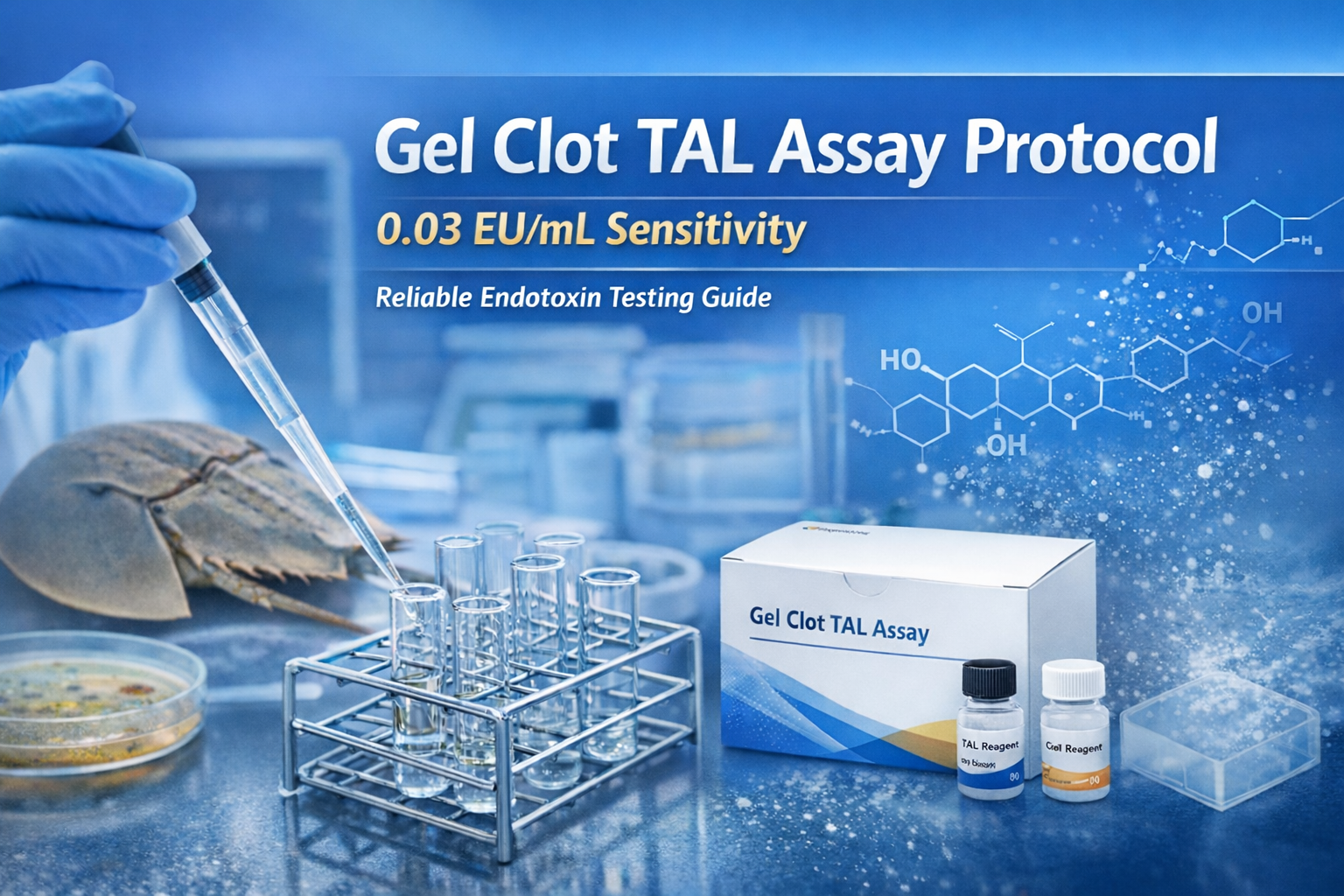
Bacterial endotoxin testing (BET) is a critical quality control step in the pharmaceutical, biotechnology, and medical device industries. Even trace amounts of endotoxin contamination from Gram-negative bacteria can trigger severe inflammatory reactions, fever, or septic shock when introduced into the bloodstream.
Researchers can access the product details here:
https://firegene.com/products/gel-clot-endotoxin-test-kit-tal-assay
Among several endotoxin detection technologies, the Gel Clot TAL/LAL assay remains the most widely recognized qualitative method in global pharmacopoeias such as USP <85>, EP 2.6.14, and JP. It is simple, robust, and highly reliable for determining whether endotoxin levels exceed a specified limit.
This protocol article describes the complete laboratory workflow for performing a Gel Clot TAL assay with a sensitivity of 0.03 EU/mL, including reagent preparation, sample dilution, incubation, and result interpretation.
Materials and Reagents
The following materials are required for the Gel Clot TAL endotoxin testing protocol:
- TAL reagent (0.03 EU/mL sensitivity)
- endotoxin control standard
- endotoxin-free water
- endotoxin-free test tubes
- calibrated micropipettes
- dry heat block or incubator (37°C ±1°C)
Researchers performing bacterial endotoxin testing can obtain standardized reagents through the FireGene Gel Clot Endotoxin Test Kit, which provides all essential components required for BET assays.
https://firegene.com/products/gel-clot-endotoxin-test-kit-tal-assay
1. Principle of the Gel Clot TAL Assay

The TAL/LAL test is derived from the natural immune response of horseshoe crab amebocytes. These blood cells contain enzymes that react strongly to lipopolysaccharide (LPS), a major component of Gram-negative bacterial endotoxin.
When endotoxin is present:
- Endotoxin activates Factor C
- A cascade of proteolytic enzymes is triggered
- The clotting protein coagulogen converts into coagulin
- A gel clot forms in the reaction tube
The Gel Clot assay therefore provides a qualitative result:
| Result | Interpretation |
|---|---|
| Gel remains intact after inversion | Endotoxin ≥ assay sensitivity |
| No stable gel formation | Endotoxin < assay sensitivity |
Because of its reliability and simplicity, the Gel Clot method is still widely used for:
- Injectable drugs
- Vaccines
- Dialysis equipment
- Medical devices
- Biotechnology reagents
2. Materials and Equipment
Reagents
- FireGene Gel Clot TAL reagent (Sensitivity: 0.03 EU/mL)
- Endotoxin standard (CSE or RSE)
- BET-grade endotoxin-free water
- Test samples
Laboratory Supplies
- Pyrogen-free glass test tubes
- Micropipettes with endotoxin-free tips
- Vortex mixer
- Tube rack
Equipment
- Water bath or dry block incubator (37 ± 1 °C)
- Timer
3. Preparation Before the Test
Proper preparation is essential to avoid false positive results caused by environmental endotoxin contamination.
Depyrogenation of Glassware
All glassware should be depyrogenated by:
- Dry heat at 250 °C for at least 30 minutes
or equivalent validated procedures.
Plastic consumables should be certified endotoxin-free.
Environmental Control
During the experiment:
- Avoid microbial contamination
- Use sterile technique
- Perform reagent preparation quickly
4. Preparation of Endotoxin Standard
Endotoxin standards are required to validate assay performance.
Procedure
- Open one vial of lyophilized endotoxin standard
- Reconstitute with endotoxin-free water according to instructions
- Mix thoroughly using a vortex mixer
- Prepare serial dilutions to obtain required concentrations
For sensitivity confirmation, prepare:
| Standard | Concentration |
|---|---|
| 2λ | 0.06 EU/mL |
| λ | 0.03 EU/mL |
| 0.5λ | 0.015 EU/mL |
| 0.25λ | 0.0075 EU/mL |
5. Sample Dilution and MVD Calculation
Some samples must be diluted to eliminate interference while maintaining detectable endotoxin levels.
The Maximum Valid Dilution (MVD) is calculated as:
Where:
- λ = reagent sensitivity (EU/mL)
- Endotoxin Limit = allowable endotoxin concentration
Example
If the endotoxin limit for a product is:
and the TAL sensitivity is:
Then:
Thus the maximum allowable dilution is 1:160.
6. Test Setup
Prepare 8 endotoxin-free test tubes for the assay.
| Tube Type | Number |
|---|---|
| Test sample | 2 |
| Negative control | 2 |
| Positive control | 2 |
| Sample positive control | 2 |
7. Reconstitution of TAL Reagent
- Add 1.1 mL endotoxin-free water to one vial of TAL reagent
- Gently mix until completely dissolved
- Avoid vigorous shaking
8. Reaction Setup
Add reagents to tubes as follows:
| Tube Type | TAL | Sample | Endotoxin Standard |
|---|---|---|---|
| Test Sample | 0.1 mL | 0.1 mL | — |
| Negative Control | 0.1 mL | — | 0.1 mL water |
| Positive Control | 0.1 mL | — | 0.1 mL (2λ) |
| Sample Positive Control | 0.1 mL | 0.1 mL sample | 2λ spike |
Then:
- Vortex gently for 3–5 seconds
- Place tubes vertically in incubator
9. Incubation Conditions
Incubate tubes at:
60 ± 2 minutes
Important precautions:
- Tubes must remain completely still
- Vibration may cause false negative results
10. Result Interpretation
After incubation:
- Carefully remove the tubes
- Invert each tube 180°
Interpretation
| Observation | Result |
|---|---|
| Firm gel remains intact | Positive (+) |
| Gel collapses or flows | Negative (-) |
11. Validity Criteria
The test is valid only if the following conditions are met:
| Tube | Expected Result |
|---|---|
| Negative control | Negative |
| Positive control | Positive |
| Sample positive control | Positive |
If these conditions are not satisfied, the test must be repeated.
12. TAL Sensitivity Verification
To confirm reagent sensitivity:
- Prepare endotoxin concentrations:
- 2λ
- λ
- 0.5λ
- 0.25λ
- Test multiple replicates
- Determine the endpoint concentration
- Calculate geometric mean sensitivity.
Acceptance criteria:
- 2λ tubes positive
- 0.25λ tubes negative
13. Common Troubleshooting Tips
False Positive Results
Possible causes:
- Environmental endotoxin contamination
- Non-depyrogenated glassware
- Sample matrix interference
False Negative Results
Possible causes:
- Sample inhibition of TAL cascade
- Vibration during incubation
- Incorrect reagent preparation
14. Applications of Gel Clot TAL Testing
The Gel Clot TAL method is commonly used for:
- Injectable drug release testing
- Vaccine production
- Dialysis equipment validation
- Water system monitoring
- Biotechnology reagent testing
The method is particularly valuable for limit tests, where the goal is to determine whether endotoxin levels exceed a regulatory threshold.
15. Advantages of the Gel Clot TAL Method
Key advantages include:
- Simple experimental workflow
- Minimal instrumentation required
- High specificity for endotoxin
- Widely accepted by global pharmacopoeias
For laboratories performing routine BET screening, the Gel Clot method provides a cost-effective and reliable endotoxin detection solution.
✅ Summary
The Gel Clot TAL assay (0.03 EU/mL sensitivity) remains one of the most reliable methods for detecting bacterial endotoxin contamination in pharmaceutical and biotechnology products.
By following the standardized protocol described above—covering reagent preparation, sample dilution, incubation, and gel interpretation—laboratories can perform accurate endotoxin testing consistent with international regulatory requirements.
Applications of Gel Clot Endotoxin Testing
The Gel Clot TAL assay remains one of the most widely accepted methods for detecting endotoxin contamination in laboratory and pharmaceutical environments.
Typical applications include:
- pharmaceutical endotoxin testing
- injectable drug quality control
- medical device endotoxin testing
- biotechnology research
- vaccine development laboratories
Many laboratories rely on standardized reagents such as the FireGene Gel Clot Endotoxin Test Kit to ensure reliable endotoxin detection across multiple experiments.
https://firegene.com/products/gel-clot-endotoxin-test-kit-tal-assay
Where to Purchase TAL Reagents for Endotoxin Testing
Laboratories seeking reliable BET reagent suppliers should prioritize reagent consistency, validated protocols, and stable sensitivity.
The FireGene Gel Clot Endotoxin Test Kit (TAL Assay) provides laboratories with a dependable endotoxin testing solution suitable for research and quality control environments.
Product page:
https://firegene.com/products/gel-clot-endotoxin-test-kit-tal-assay
FireGene supports global research laboratories with high-quality reagents, professional technical assistance, and efficient international shipping.


