
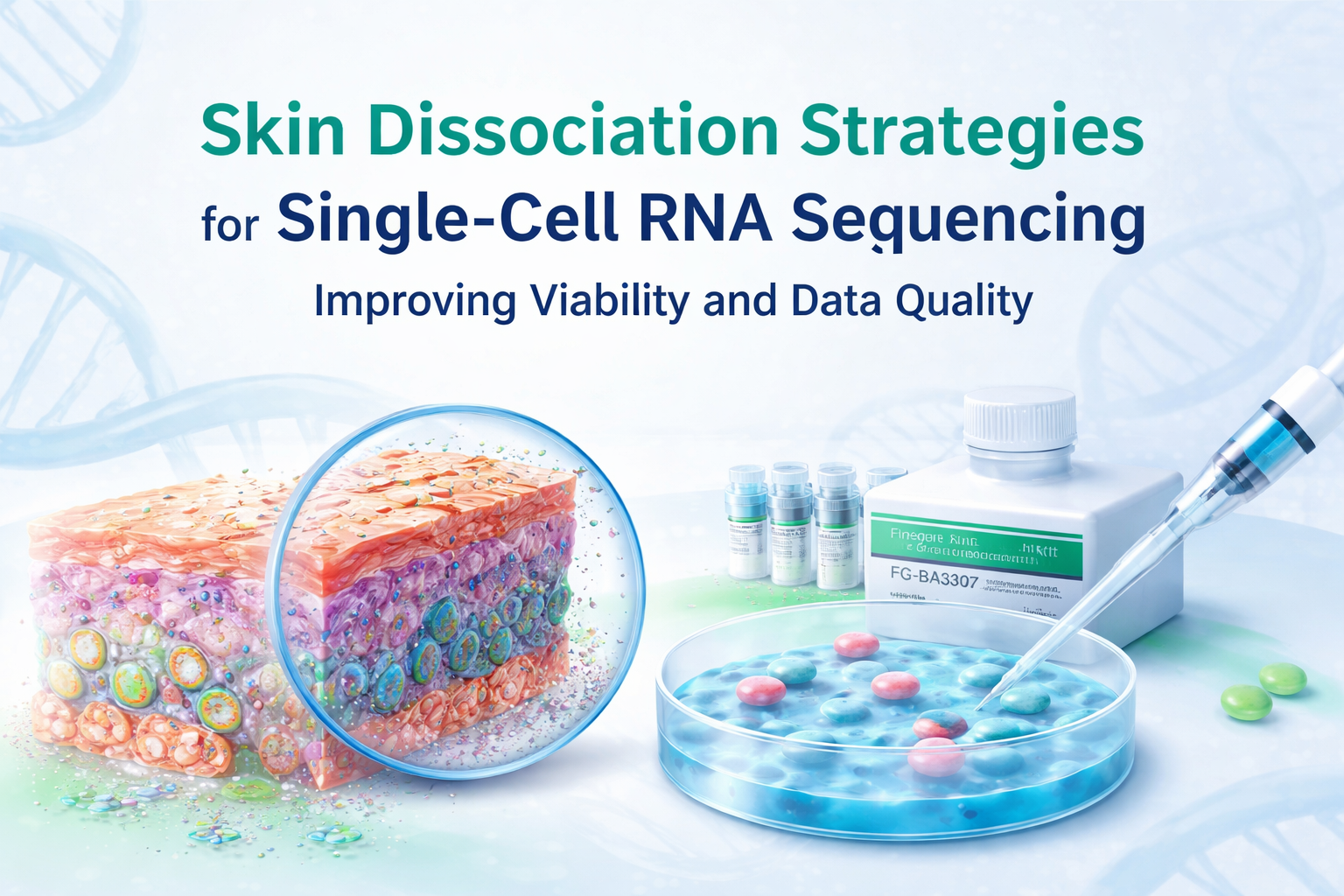
Introduction: Why Skin Tissue Is Challenging for Single-Cell Prep
Preparing high-quality single-cell suspensions from skin tissue remains one of the most challenging steps in modern single-cell workflows. Unlike softer tissues, skin is structurally complex and highly enriched in extracellular matrix (ECM) components such as collagen and elastin. This dense architecture creates strong cell–cell and cell–matrix interactions, making it difficult to efficiently dissociate tissue into viable, individual cells without causing damage.
Traditional mechanical or non-optimized enzymatic methods often fall short. Insufficient digestion can leave behind aggregates and reduce cell yield, while overly harsh conditions may compromise membrane integrity and lead to significant cell death. As a result, researchers frequently encounter low viability, increased debris, and inconsistent recovery of key cell populations such as keratinocytes, fibroblasts, and immune cells.
These challenges directly impact downstream applications, including single-cell RNA sequencing (scRNA-seq) and flow cytometry, where data quality heavily depends on the integrity and purity of the starting material. Poor dissociation not only reduces capture efficiency but can also introduce technical artifacts.
For this reason, developing or selecting an optimized skin dissociation strategy is essential for achieving reliable, high-resolution single-cell data.
The Hidden Problem: How Poor Dissociation Ruins Your Data
Even with advanced downstream technologies, the quality of single-cell data is fundamentally limited by sample preparation—especially tissue dissociation. Poorly optimized skin dissociation introduces a range of hidden issues that can severely compromise experimental outcomes. One of the most common problems is cell clumping, which reduces capture efficiency in single-cell platforms and leads to biased cell representation. At the same time, incomplete digestion often results in low cell yield, limiting the depth and diversity of analysis. Equally problematic is excessive cell death caused by harsh enzymatic or mechanical treatment. Dead and dying cells release ambient RNA into the suspension, creating background noise that interferes with accurate gene expression profiling in scRNA-seq. This contamination can distort clustering results and obscure true biological signals. Additionally, overdigestion may trigger stress responses or alter transcriptional profiles, introducing artifacts that misrepresent the native state of the cells.
In flow cytometry, debris and compromised cells can further reduce data clarity by increasing nonspecific signals and reducing gating precision. Altogether, these issues highlight a critical but often underestimated reality: ineffective dissociation is not just a technical inconvenience—it is a major source of data distortion. Ensuring high-quality, high-viability single-cell preparation is therefore essential for generating reliable and reproducible results.
What Makes a High-Quality Skin Dissociation Kit?
Not all dissociation methods are created equal—especially when working with complex tissues like skin. A high-quality skin dissociation kit must strike a careful balance between efficient tissue breakdown and preservation of cell integrity. One of the most important factors is enzyme specificity. Because skin is rich in collagen, elastin, and other extracellular matrix components, an effective kit should include optimized enzymes that can selectively degrade these structures without damaging the cells themselves.
Equally critical is the gentleness of the digestion process. Overly aggressive protocols may accelerate dissociation but often come at the cost of reduced viability and altered cellular states. In contrast, well-designed kits use controlled, stepwise digestion conditions that maintain membrane integrity and minimize cellular stress responses. This is essential for preserving true biological signals, particularly in sensitive applications like single-cell RNA sequencing.
Another key consideration is reproducibility. Variability in enzyme composition or protocol execution can lead to inconsistent results across experiments. High-quality kits address this by providing standardized formulations and clear workflows, ensuring reliable performance.
Finally, the ability to preserve cellular diversity is crucial. Skin contains a wide range of cell types, and an effective dissociation strategy should enable the recovery of both abundant and rare populations. Compared to generic enzyme mixes, tissue-specific kits are far better suited to meet these demands, making them a preferred choice for high-viability single-cell preparation.
Solution Spotlight: FireGene Skin Dissociation Kit
The FireGene Skin Dissociation Kit FG-BA3307 is specifically designed to address the challenges of preparing high-quality single-cell suspensions from skin tissue. Unlike generic dissociation methods, this kit features an optimized, tissue-specific enzyme formulation that efficiently breaks down the dense extracellular matrix while preserving cell viability and integrity.
 At the core of its performance is a carefully balanced enzymatic system that targets key structural components such as collagen and connective proteins without over-digesting or damaging fragile cell populations. This enables researchers to achieve a more complete and uniform dissociation, resulting in higher cell yield and reduced aggregation. Importantly, the protocol is designed to minimize cellular stress, helping maintain native gene expression profiles—an essential factor for accurate downstream analysis in scRNA-seq.
Another major advantage is its ability to preserve cellular diversity. Skin contains a complex mixture of cell types, including keratinocytes, fibroblasts, and immune cells. The FireGene kit supports the recovery of these populations with high viability, ensuring more representative and biologically meaningful datasets.
In addition, the streamlined workflow and standardized reagents improve experimental reproducibility, reducing variability between runs. For researchers seeking reliable, high-viability single-cell preparation from skin tissue, this kit provides a practical and effective solution.
Applications & Use Cases in Research
High-quality single-cell suspensions generated from skin tissue open the door to a wide range of advanced research applications. With improved viability and reduced debris, researchers can achieve more accurate and reproducible results across multiple platforms. One of the primary applications is single-cell RNA sequencing (scRNA-seq), where clean, intact cells are essential for capturing true gene expression profiles and identifying rare or functionally distinct cell populations.
In flow cytometry and cell sorting, high-viability samples enable clearer population separation, more precise gating, and reduced background noise. This is particularly important when studying heterogeneous tissues like skin, which contain diverse immune and structural cell types. Similarly, for primary cell culture, starting with healthy, well-dissociated cells significantly improves cell attachment, growth, and experimental consistency.
These capabilities make optimized skin dissociation especially valuable in several key research areas. In dermatology and skin biology, it supports studies on epidermal differentiation, barrier function, and tissue regeneration. In wound healing research, it enables detailed analysis of cellular dynamics during repair processes. For immunology, it facilitates the study of resident immune cells such as Langerhans cells and dermal macrophages. Additionally, in oncology, high-quality single-cell prep is critical for investigating tumor microenvironments in skin cancers.
By enabling reliable downstream analysis, effective skin dissociation becomes a foundational step in generating meaningful biological insights.
Conclusion: Elevate Your Single-Cell Data Quality
In single-cell research, the quality of your results is only as strong as the quality of your starting material. Skin tissue, with its dense and complex structure, presents unique challenges that cannot be reliably addressed with generic dissociation methods. As we’ve explored, poor dissociation can lead to low viability, high debris levels, and distorted data—ultimately limiting the accuracy and reproducibility of your findings.
By contrast, an optimized, tissue-specific approach enables efficient dissociation while preserving cell integrity and diversity. This directly translates into cleaner suspensions, higher capture efficiency, and more reliable downstream analysis in applications such as scRNA-seq and flow cytometry.
The FireGene Skin Dissociation Kit FG-BA3307 offers a practical solution by combining optimized enzymatic digestion with a standardized, user-friendly workflow. The result is consistent, high-viability single-cell preparation tailored specifically for skin tissue.
For researchers aiming to generate high-resolution, biologically meaningful data, investing in the right dissociation strategy is not optional—it is essential. Optimizing this critical first step can significantly enhance the overall success of your single-cell experiments and help you unlock deeper insights from complex skin biology.
FireGene, light your research with passion, innovation, and profession.
FireGene Single-Cell Sample Prep
Looking for validated dissociation kits?
FireGene's tissue dissociation kits are optimized for specific organ types — brain, tumor, liver, GI, reproductive, and more. Validated for 10x Genomics Chromium and BD Rhapsody workflows.


