
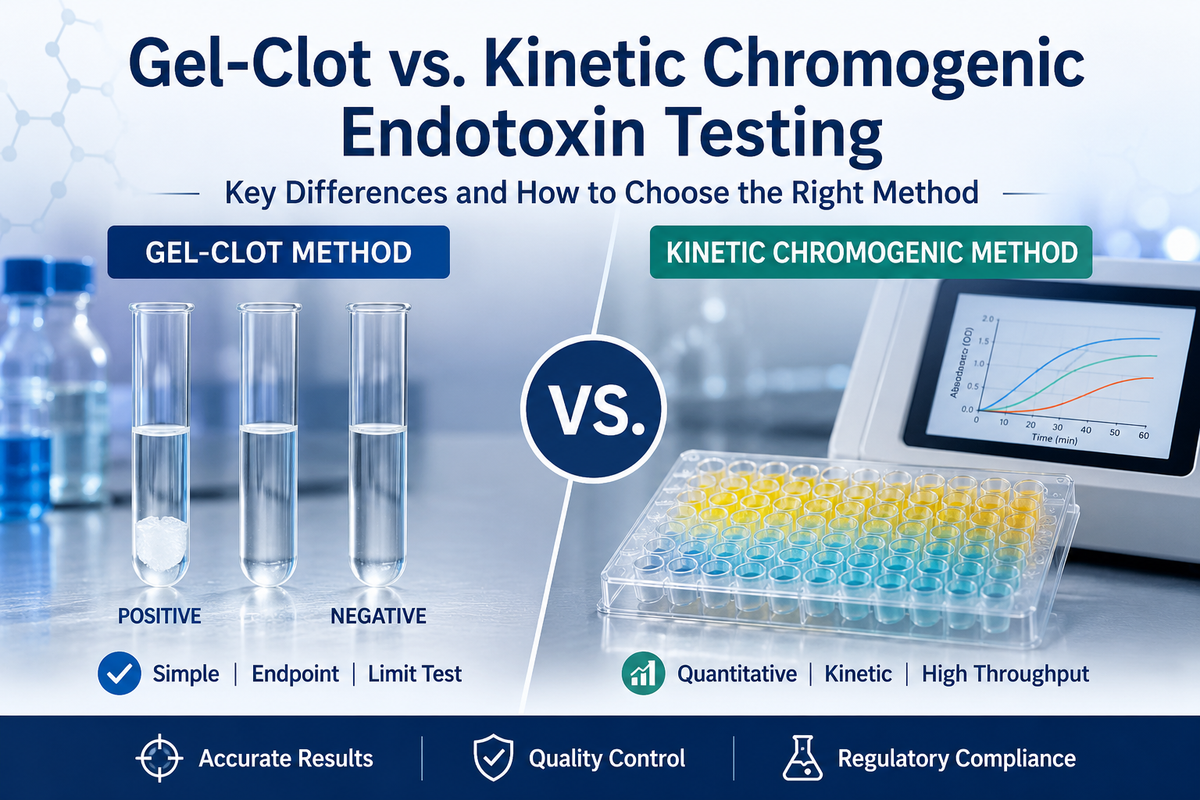
Bacterial endotoxin testing is an essential quality control step for many pharmaceutical products, biologics, medical devices, and laboratory materials. Among the established methods, the Gel-Clot method and Kinetic Chromogenic method are widely used for detecting and evaluating bacterial endotoxins.
Although both methods are based on endotoxin-triggered enzyme cascades, they differ significantly in detection principle, quantitative capability, instrumentation, throughput, and data analysis. Understanding these differences can help laboratories select an appropriate endotoxin testing method for routine quality control and research applications.
1. What Is the Gel-Clot Endotoxin Test?
The Gel-Clot method is one of the traditional approaches for bacterial endotoxin testing using Limulus Amebocyte Lysate (LAL) or related reagents.
When endotoxin is present in a sample, it activates a series of enzymatic reactions in the lysate reagent. The final reaction produces a gel-like clot.
The basic reaction can be summarized as:
Endotoxin → Enzyme Cascade → Coagulation → Gel Formation
After incubation, the test tube is examined for gel formation.
A stable gel indicates a positive reaction, while the absence of gel indicates a negative reaction under the specified test conditions.
Because the final result is generally based on whether a gel forms, the Gel-Clot method is primarily considered an endpoint detection method.
2. What Is the Kinetic Chromogenic Endotoxin Test?
The Kinetic Chromogenic method uses a similar endotoxin-triggered enzymatic cascade but detects the reaction through a chromogenic substrate.
When the activated enzymes react with the chromogenic substrate, a colored product is generated. A microplate reader measures the change in absorbance during the reaction.
The basic principle is:
Endotoxin → Enzyme Cascade → Chromogenic Substrate → Color Development → Optical Detection
Instead of simply determining whether a clot has formed, the kinetic method monitors the reaction over time.
The resulting kinetic signal can then be compared with an endotoxin standard curve to determine the endotoxin concentration in the sample.
This makes the Kinetic Chromogenic Endotoxin Test particularly useful when quantitative endotoxin data are required.
3. Gel-Clot vs. Kinetic Chromogenic: Key Differences
|
Feature |
Gel-Clot Method |
Kinetic Chromogenic Method |
|
Detection principle |
Gel formation |
Chromogenic reaction |
|
Detection type |
Endpoint |
Kinetic |
|
Typical result |
Positive/negative or limit-based |
Quantitative concentration |
|
Instrumentation |
Relatively simple |
Microplate reader required |
|
Standard curve |
Generally not required |
Required for quantitative analysis |
|
Data analysis |
Visual interpretation |
Instrument/software analysis |
|
Throughput |
Lower |
Higher |
|
Automation potential |
Limited |
High |
|
Sample quantification |
Limited |
Strong |
|
Operational complexity |
Relatively simple |
More instrument-dependent |
The most important distinction is therefore not simply the detection reagent, but how the reaction is measured and how the final result is interpreted.
4. Quantitative Endotoxin Detection
One of the major advantages of the Kinetic Chromogenic method is its quantitative capability.
A typical assay uses several known endotoxin concentrations to generate a standard curve. The response of the unknown sample is then compared with this curve.
For example:
Known endotoxin standards → Standard curve → Sample measurement → Endotoxin concentration
The final result can be expressed as a concentration such as EU/mL, depending on the validated assay conditions.
By comparison, the Gel-Clot method is often used to determine whether endotoxin is present above a specified test limit.
Therefore, laboratories requiring detailed quantitative data may prefer kinetic chromogenic testing.
5. Sensitivity and Assay Performance
Both methods can provide highly sensitive endotoxin detection when appropriately designed and validated.
However, it is important not to assume that the Kinetic Chromogenic method is automatically more sensitive than Gel-Clot testing.
Actual assay performance depends on factors such as:
· Reagent sensitivity
· Standard curve design
· Sample preparation
· Instrument performance
· Incubation conditions
· Sample matrix
· Interference
· Method validation
For this reason, laboratories should evaluate the actual performance characteristics of the selected endotoxin test kit rather than choosing a method based only on its detection format.
6. Why Is Sample Interference Important?
Sample matrix effects are an important consideration in both Gel-Clot and Kinetic Chromogenic endotoxin testing.
Certain sample components may interfere with the enzymatic reaction and potentially cause inaccurate results.
For example, a sample may produce:
Reaction inhibition → Lower apparent endotoxin result
or:
Reaction enhancement → Higher apparent endotoxin result
This is why appropriate controls and interference testing are important during endotoxin assay development and validation.
For kinetic chromogenic assays, Positive Product Control (PPC) or endotoxin spike recovery is commonly used to evaluate whether the sample matrix affects endotoxin detection.
In simple terms:
The standard curve verifies assay performance, while PPC helps evaluate sample-specific interference.
7. High-Throughput Endotoxin Testing
Another important difference is sample throughput.
The Gel-Clot method is commonly performed in individual reaction tubes. This makes the workflow straightforward but can require considerable manual handling when testing many samples.
Kinetic Chromogenic assays are commonly performed in 96-well microplates.
A single plate can contain:
· Endotoxin standards
· Negative controls
· PPC controls
· Multiple samples
· Sample replicates
This format can significantly improve laboratory workflow efficiency when a large number of samples must be analyzed.
It also provides a foundation for automated liquid handling and computerized data analysis.
8. Data Analysis and Laboratory Automation
Gel-Clot testing is relatively simple because the final result can be determined through direct observation of clot formation.
However, visual interpretation can introduce operator-dependent variability, particularly when the gel is weak or borderline.
Kinetic Chromogenic testing generates numerical data throughout the reaction.
A typical workflow is:
Sample Preparation → Plate Setup → Kinetic Measurement → Standard Curve → Data Analysis → Endotoxin Result
Because the process generates digital data, kinetic chromogenic assays can be more easily integrated into laboratory information systems, automated workflows, and electronic quality control processes.
9. Which Endotoxin Testing Method Should You Choose?
There is no single method that is ideal for every laboratory.
Gel-Clot may be suitable when:
· A straightforward endotoxin test is required
· Sample numbers are relatively low
· Limit-based testing is sufficient
· Simple equipment is preferred
· A traditional endpoint approach fits the laboratory workflow
Kinetic Chromogenic may be preferable when:
· Quantitative endotoxin measurement is required
· Many samples need to be tested
· High-throughput testing is important
· Automated data analysis is desirable
· Standard curves and numerical results are needed
· Digital data management is part of the laboratory workflow
The final selection should always consider the specific product, validated test procedure, regulatory requirements, sample matrix, and laboratory capabilities.
10. Conclusion
The Gel-Clot and Kinetic Chromogenic endotoxin tests are both valuable approaches for bacterial endotoxin detection, but they serve different laboratory needs.
The Gel-Clot method offers a simple, established, and practical endpoint approach, making it useful for routine testing where straightforward limit determination is sufficient.
The Kinetic Chromogenic method provides quantitative results, kinetic monitoring, higher microplate throughput, and greater potential for automation, making it attractive for modern analytical and quality control laboratories.
In short:
Gel-Clot = Simple, visual, endpoint detection
Kinetic Chromogenic = Quantitative, kinetic, microplate-based detection
Understanding these differences allows laboratories to select an endotoxin testing strategy that balances accuracy, workflow efficiency, quantitative capability, and laboratory requirements.


