
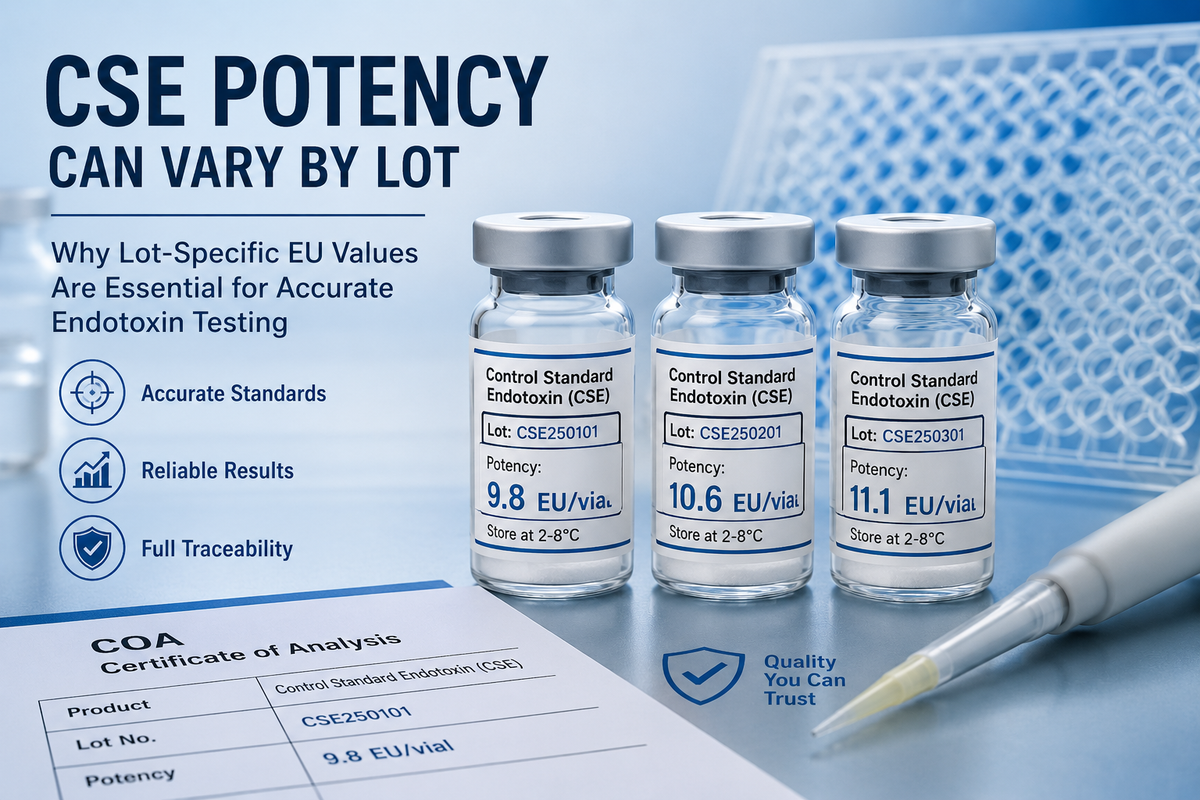
Control Standard Endotoxin (CSE) is widely used in bacterial endotoxin testing (BET) to prepare endotoxin standards, establish standard curves, and verify the performance of LAL or recombinant Factor C (rFC) assays. One important characteristic of CSE is that its endotoxin potency may vary from lot to lot.
For laboratories performing quantitative endotoxin testing, understanding and documenting the lot-specific potency of CSE is essential. If the actual potency of a CSE lot differs from its nominal value but the difference is not properly identified, it can introduce errors into standard preparation, endotoxin quantification, method validation, and routine quality control.
This article explains why CSE lot-specific EU values are important, what information should be included on the label and Certificate of Analysis (COA), and how laboratories can use this information correctly in endotoxin testing.
1. What Is Control Standard Endotoxin (CSE)?
Control Standard Endotoxin (CSE) is a standardized endotoxin preparation used as a reference material in bacterial endotoxin testing. CSE is commonly derived from a defined bacterial source, such as Escherichia coli, and is calibrated against a recognized Reference Standard Endotoxin (RSE).
The purpose of CSE is to provide a practical and consistent endotoxin standard for laboratory testing.
CSE can be used for:
Preparation of endotoxin standard solutions
Construction of standard curves
Verification of LAL assay performance
Validation and qualification of endotoxin testing methods
Routine bacterial endotoxin testing
Determination of endotoxin concentrations in pharmaceutical products and other samples
In quantitative assays such as the kinetic chromogenic LAL assay and kinetic turbidimetric LAL assay, accurate endotoxin standards are particularly important because the measured sample concentration is calculated from the relationship between assay response and known endotoxin concentrations.
Therefore, the accuracy of the CSE standard directly affects the reliability of the endotoxin result.
2. Why Can the EU Value Differ Between CSE Lots?
A common misconception is that every CSE vial labeled, for example, "10 EU/vial" necessarily contains exactly the same endotoxin activity.
In practice, the actual potency of different CSE lots may vary.
This is because CSE is a biological reference material rather than a chemically pure compound with an absolute, fixed potency. The endotoxin activity of a particular preparation is determined through calibration against a reference standard using an established procedure.
For example, different CSE lots could have assigned potencies such as:
|
CSE Lot |
Nominal Value |
Assigned Potency |
|
Lot A |
10 EU/vial |
9.8 EU/vial |
|
Lot B |
10 EU/vial |
10.6 EU/vial |
|
Lot C |
10 EU/vial |
11.1 EU/vial |
The nominal product specification may be the same, but the assigned potency for each lot can be different.
This is why laboratories should not assume that the actual endotoxin activity is identical across all CSE lots.
The lot number and corresponding assigned potency provide the traceability needed to prepare accurate endotoxin standards.
3. Why Is Lot-Specific CSE Potency Important?
3.1 Accurate Endotoxin Standard Preparation
The most direct reason for specifying CSE potency is to ensure accurate preparation of endotoxin standards.
Suppose a laboratory needs to prepare a 1 EU/mL endotoxin standard.
If the CSE potency is assumed to be 10 EU/vial, but the actual assigned potency is 11 EU/vial, using the nominal value without correction will result in an inaccurate standard concentration.
This error can propagate through the entire standard curve.
Because quantitative LAL assays calculate sample endotoxin concentration based on the standard curve, inaccurate standards can lead to inaccurate sample results.
Therefore:
Accurate CSE potency → Accurate standard preparation → Reliable standard curve → More reliable endotoxin quantification
3.2 Reliable Standard Curve Generation
The standard curve is one of the most important components of quantitative endotoxin testing.
In a kinetic chromogenic LAL assay, for example, different endotoxin concentrations produce different chromogenic responses. The instrument uses the standard curve to correlate assay response with endotoxin concentration.
If the actual concentration of the standards is incorrect because the CSE potency was not properly accounted for, the standard curve may be systematically shifted.
This can affect:
Standard curve accuracy
Sample concentration calculations
Recovery results
Assay precision
Method validation
Routine QC testing
Consequently, the CSE potency is not simply a labeling detail. It is an important parameter in the analytical process.
4. Why Should the CSE Lot Number and EU Value Be Clearly Identified?
Because CSE potency is lot-specific, laboratories need to know exactly which CSE lot was used for a particular test.
At minimum, the CSE documentation should allow the user to identify:
Product name
CSE lot number
Assigned endotoxin potency
Reference standard used for calibration
Expiration date
Storage conditions
Relevant certificate or calibration information
For example:
Control Standard Endotoxin (CSE)
Lot No.: CSE260801
Potency: 10.6 EU/vial
This information establishes a clear connection between the physical CSE material and its assigned endotoxin activity.
The same information should also be traceable through the product's Certificate of Analysis (COA) or applicable calibration documentation.
5. Does the EU Value Have to Be Printed on Every CSE Vial?
This question is particularly important for CSE manufacturers and suppliers.
The exact labeling requirements depend on the applicable regulatory framework, product configuration, and intended use. However, from a quality, traceability, and laboratory-use perspective, the assigned lot-specific potency should be readily available to the user.
A practical labeling system can include:
Product: Control Standard Endotoxin
Lot No.: XXXXX
Potency: XX EU/vial
Expiration Date: XXXXX
Storage: 2–8°C
If the physical vial has limited space, detailed information may be provided on the accompanying COA or certificate, provided that the relationship between the vial lot number and assigned potency is unambiguous.
The key principle is:
Users should be able to identify the exact CSE lot and obtain the corresponding assigned endotoxin potency.
This is particularly important for laboratories operating under GMP, GLP, or other quality systems where analytical traceability is required.
6. What Happens If the CSE EU Value Is Not Properly Identified?
Failure to properly identify the lot-specific CSE potency can create several problems.
6.1 Incorrect Standard Concentration
If a laboratory assumes a nominal value instead of the assigned lot-specific value, the prepared standard may not have the intended endotoxin concentration.
6.2 Incorrect Quantitative Results
Because sample concentrations are calculated using the standard curve, an inaccurate standard can contribute to inaccurate sample results.
6.3 Poor Traceability
If the CSE lot number is not recorded, it may be difficult to determine which endotoxin standard was used during a particular test.
6.4 Difficult Investigation of Out-of-Specification Results
When an unexpected endotoxin result occurs, laboratories need to investigate potential causes, including reagent and standard performance.
Without clear lot-specific CSE information, troubleshooting becomes more difficult.
6.5 Problems During Audits
For regulated laboratories, documentation and traceability are important components of quality systems. Incomplete CSE documentation may therefore create questions during internal or external audits.
7. CSE Lot Number vs. Nominal EU Value: What Is the Difference?
It is useful to distinguish between a nominal value and an assigned lot-specific potency.
Nominal Value
The nominal value describes the intended or approximate activity associated with the product format.
For example:
10 EU/vial
This is useful for identifying the general product specification.
Lot-Specific Assigned Potency
The assigned potency represents the calibrated activity of a particular CSE lot.
For example:
Lot CSE260801: 10.6 EU/vial
This is the value that should be used when accurate preparation of endotoxin standards requires consideration of the actual lot potency.
Therefore, a better documentation approach is:
Nominal: 10 EU/vial
Lot-specific potency: 10.6 EU/vial
Lot No.: CSE260801
This provides both product-level information and batch-level traceability.
8. How Should Laboratories Record CSE Information?
When preparing endotoxin standards, laboratories should record sufficient information to reconstruct the standard preparation process.
Recommended information includes:
|
Information |
Example |
|
CSE product |
Control Standard Endotoxin |
|
CSE lot number |
CSE260801 |
|
Assigned potency |
10.6 EU/vial |
|
Expiration date |
2028-08 |
|
Reconstitution volume |
According to manufacturer's instructions |
|
Standard concentration |
1 EU/mL |
|
Dilution series |
1, 0.5, 0.25, 0.125 EU/mL |
|
LAL reagent lot |
XXXXX |
|
Test date |
XXXXX |
|
Analyst |
XXXXX |
This documentation creates a traceable connection between the CSE material, standard preparation, assay run, and final test result.
For laboratories performing routine QC testing, maintaining this information can significantly simplify troubleshooting and batch-to-batch comparison.
9. Why Is This Especially Important for Quantitative LAL Testing?
The importance of CSE potency becomes particularly apparent in quantitative endotoxin assays.
For example, in a kinetic chromogenic LAL assay, the analytical system generates a response that is correlated with endotoxin concentration through a standard curve.
The workflow can be simplified as:
CSE → Standard Preparation → Standard Curve → Sample Measurement → Endotoxin Concentration
An error at the first stage can affect subsequent stages.
This is why laboratories should treat the CSE potency as an important analytical input rather than simply a product-label parameter.
For qualitative gel-clot testing, the interpretation is different because the result is primarily based on whether a clot is formed at a defined sensitivity level. Nevertheless, accurate endotoxin standards remain important for assay sensitivity verification and related testing procedures.
10. Best Practices for CSE Manufacturers and Suppliers
For manufacturers and suppliers of Control Standard Endotoxin, clear lot-specific documentation can improve both product quality and customer confidence.
Recommended practices include:
1. Assign a Unique Lot Number
Each production batch should have a traceable lot number.
2. Determine the Lot-Specific Potency
The assigned endotoxin activity should be established according to the applicable calibration procedure.
3. Provide a COA
The COA should clearly identify the CSE lot and corresponding potency.
4. Maintain Traceability to the Reference Standard
Where applicable, documentation should identify the reference standard or calibration basis used for potency assignment.
5. Clearly Define Storage Conditions
Because endotoxin reference materials can be affected by handling and storage conditions, appropriate storage information should be provided.
6. Keep Product and Documentation Consistent
The lot number printed on the vial, package, COA, and other relevant documents should be consistent.
These practices help laboratories use CSE correctly and support better analytical traceability.
11. Conclusion
Control Standard Endotoxin (CSE) is a critical reference material for bacterial endotoxin testing, and its potency should be treated as a lot-specific parameter.
Although multiple CSE lots may share the same nominal specification, their assigned endotoxin activities can differ. For example, products described as "10 EU/vial" may have different lot-specific assigned potencies after calibration.
Therefore, laboratories should be able to identify the CSE lot number and corresponding EU potency when preparing endotoxin standards and performing quantitative LAL or rFC testing.
Clear lot-specific CSE information helps ensure:
Accurate endotoxin standard preparation
Reliable standard curves
More consistent quantitative results
Better batch-to-batch traceability
Easier investigation of unexpected results
Stronger laboratory quality documentation
In short, the EU value associated with a specific CSE lot is not merely a labeling detail—it is an important part of endotoxin testing accuracy and analytical traceability.


