
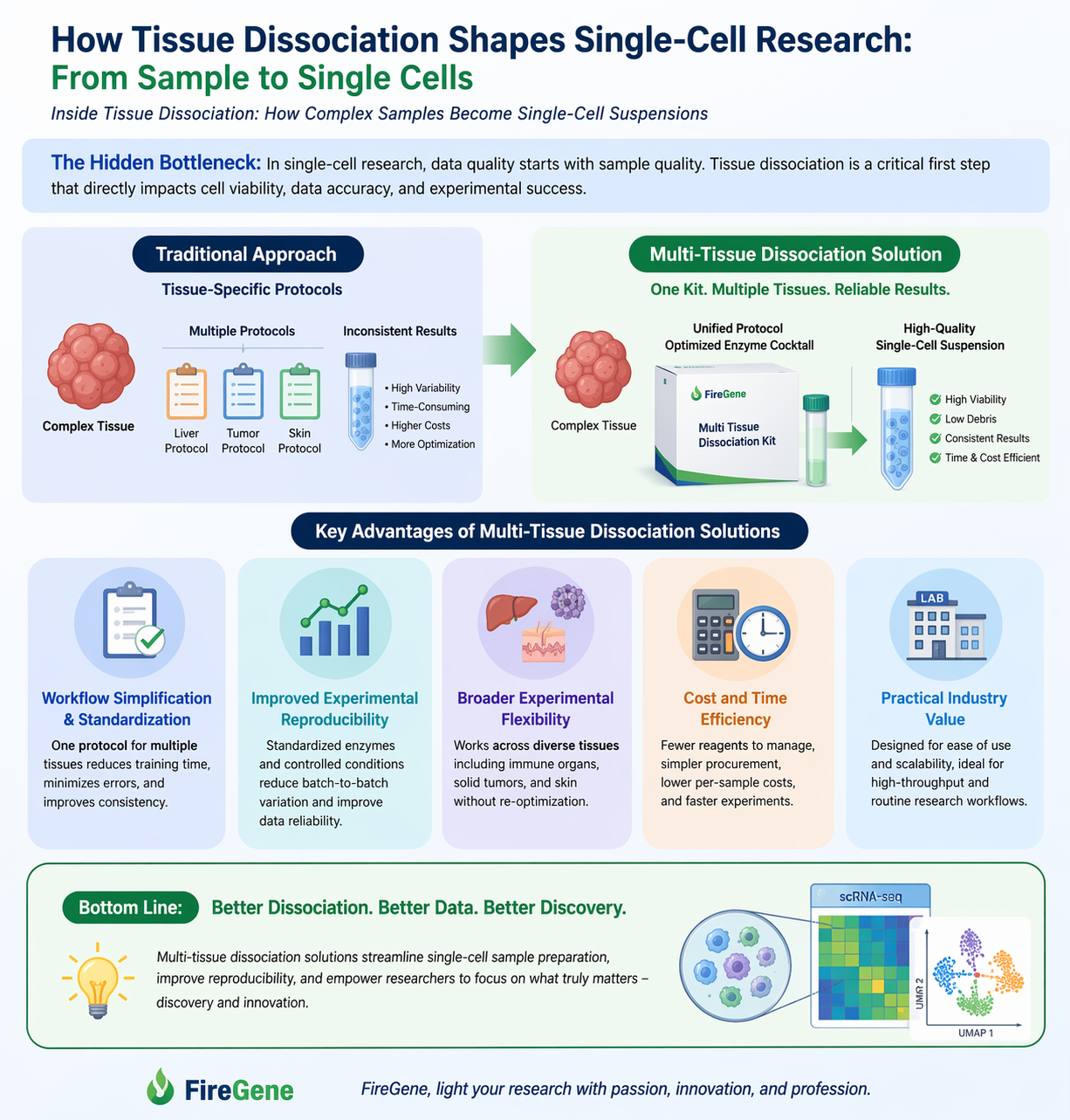
Introduction: The Hidden Bottleneck in Single-Cell Research
In recent years, single-cell technologies such as Single-cell RNA sequencing have revolutionized the way researchers study biology, enabling unprecedented insights into cellular heterogeneity, disease mechanisms, and therapeutic targets. From immunology to oncology, the ability to analyze individual cells has become a cornerstone of modern life science research.
However, behind every successful single-cell experiment lies a critical yet often overlooked step: tissue dissociation. Before any downstream analysis—whether it is Flow Cytometry, cell sorting, or sequencing—complex tissue samples must first be converted into viable, high-quality single-cell suspensions.
This step is far from trivial. Poor dissociation can lead to low cell viability, increased cell stress, and biased representation of cell populations. Aggregated cells or incomplete digestion may compromise data accuracy, while over-digestion can damage delicate cell types. In many cases, the quality of the final dataset is determined not by the sequencing platform or analytical tools, but by how well the tissue was initially processed.
Despite its importance, tissue dissociation is frequently treated as a routine or secondary procedure. Researchers often rely on multiple tissue-specific protocols, leading to inconsistent results, increased complexity, and higher costs.
As single-cell research continues to scale, there is a growing need for more standardized, efficient, and versatile approaches. This is where multi-tissue dissociation solutions are beginning to reshape workflows—offering a more streamlined and reliable starting point for high-quality single-cell analysis.
Why Tissue Dissociation Is So Challenging
Tissue dissociation is inherently complex because biological tissues vary dramatically in structure, composition, and cellular organization. Some tissues, such as liver or spleen, are relatively soft and easier to process, while others—like skin or tumors—contain dense extracellular matrices (ECM) and strong cell-cell interactions that make dissociation much more difficult. These differences require carefully balanced conditions to effectively release cells without causing damage.
One of the primary challenges lies in breaking down the ECM, a network of proteins such as collagen and proteoglycans that provide structural support. Efficient digestion typically relies on enzymatic treatment, often referred to as an enzyme cocktail, but finding the right combination and conditions is not straightforward. Insufficient digestion can result in low cell yield and cell clumping, while overly aggressive conditions may reduce viability and alter cellular states.
Common issues during tissue dissociation include low recovery of viable cells, high levels of debris, and aggregation that interferes with downstream applications. These problems directly impact techniques like Flow Cytometry and Single-cell RNA sequencing, where uniform, high-quality single-cell suspensions are essential for accurate results.
Traditional approaches often rely on tissue-specific protocols, requiring researchers to optimize conditions for each sample type. This not only increases workload but also introduces variability between experiments. As a result, achieving consistent, reproducible outcomes remains a significant challenge—especially for laboratories working with diverse or unpredictable tissue samples.
What Is a Multi-Tissue Dissociation Kit?
A multi-tissue dissociation kit is a standardized enzymatic solution designed to convert a wide range of biological tissues into high-quality single-cell suspensions. Instead of requiring separate, tissue-specific protocols for each sample type, it provides a unified workflow that can be applied across multiple organs and tissue structures.
At its core, the system relies on a carefully optimized enzyme cocktail that breaks down key components of the extracellular matrix (ECM), such as collagen and adhesion proteins, while preserving cell integrity. This balance between effective digestion and gentle handling is critical for maintaining high cell viability and minimizing stress-induced transcriptional changes, which is especially important for downstream applications like Single-cell RNA sequencing.
Unlike traditional approaches that require separate reagents for each tissue type, a multi-tissue system is designed for versatility. It can typically be applied to soft tissues such as liver and spleen, as well as more structurally complex samples like tumors or skin, reducing the need for constant protocol switching and optimization.
For example, solutions such as the FireGene Multi Tissue Dissociation Kit are developed to simplify this process by offering a ready-to-use, standardized workflow. This allows researchers to focus more on experimental design and data analysis rather than protocol troubleshooting.
Compared with traditional single-tissue kits, multi-tissue solutions aim to improve efficiency, reduce experimental variability, and enhance reproducibility across different sample types. In essence, they represent a shift from highly specialized, fragmented workflows toward more integrated and scalable approaches in modern cell biology research.
Key Advantages of Multi-Tissue Dissociation Solutions
Multi-tissue dissociation kits are increasingly adopted because they address several long-standing inefficiencies in single-cell sample preparation. Their main value lies not only in performance, but also in simplifying how laboratories handle diverse biological materials.
✔ Workflow Simplification and Standardization
One of the most significant advantages is the ability to use a single protocol across multiple tissue types. Instead of maintaining separate dissociation conditions for each organ, researchers can follow a unified workflow. This reduces training time, minimizes protocol errors, and improves consistency between users and experiments.
✔ Improved Experimental Reproducibility
Variability in tissue dissociation is a major source of inconsistency in downstream data. By using a standardized enzyme formulation and controlled digestion conditions, multi-tissue systems help reduce batch-to-batch variation. This is particularly important for sensitive applications such as Single-cell RNA sequencing, where small differences in sample preparation can significantly impact clustering and gene expression results.
✔ Broader Experimental Flexibility
Research laboratories often work with diverse sample types, ranging from immune tissues to solid tumors. Multi-tissue kits allow the same system to be applied across different projects without switching reagents or optimizing new protocols each time. This flexibility is especially valuable in core facilities and translational research environments.
✔ Cost and Time Efficiency
Maintaining multiple tissue-specific kits increases both operational cost and inventory complexity. A universal solution reduces the number of reagents required, streamlines procurement, and lowers per-sample costs. It also saves valuable experimental time by reducing protocol optimization steps.
✔ Industry Positioning and Practical Value
Compared with more specialized systems from providers such as Miltenyi Biotec and STEMCELL Technologies, multi-tissue solutions prioritize accessibility and operational simplicity, making them particularly suitable for high-throughput and routine research workflows.
Conclusion: A Smarter Approach to Single-Cell Sample Preparation
As single-cell technologies continue to advance, the importance of upstream sample quality has become increasingly clear. Methods such as Single-cell RNA sequencing and Flow Cytometry rely heavily on the initial quality of single-cell suspensions, meaning that tissue dissociation is no longer a routine preparatory step—it is a determinant of data quality.
Traditional workflows often require researchers to navigate multiple tissue-specific protocols, each with its own optimization requirements, enzyme conditions, and handling nuances. While effective in controlled settings, these fragmented approaches can introduce variability, increase operational complexity, and limit scalability in modern research environments.
In contrast, multi-tissue dissociation solutions represent a shift toward simplification and standardization. By enabling a single, adaptable workflow across diverse tissue types, they reduce experimental burden while improving reproducibility and efficiency. This is particularly valuable in high-throughput laboratories, core facilities, and translational research settings where consistency and speed are essential.
Solutions such as the FireGene Multi Tissue Dissociation Kit exemplify this trend, offering researchers a practical way to streamline the transition from complex tissue samples to high-quality single-cell suspensions. Rather than spending time optimizing multiple protocols, scientists can focus on experimental design, data interpretation, and downstream discovery.
Ultimately, the adoption of multi-tissue dissociation strategies reflects a broader evolution in life science research: moving away from fragmented, labor-intensive workflows toward integrated, scalable, and reproducible systems that better support the demands of modern biology.
FireGene, light your research with passion, innovation, and profession.
FireGene Single-Cell Sample Prep
Looking for validated dissociation kits?
FireGene's tissue dissociation kits are optimized for specific organ types — brain, tumor, liver, GI, reproductive, and more. Validated for 10x Genomics Chromium and BD Rhapsody workflows.


