
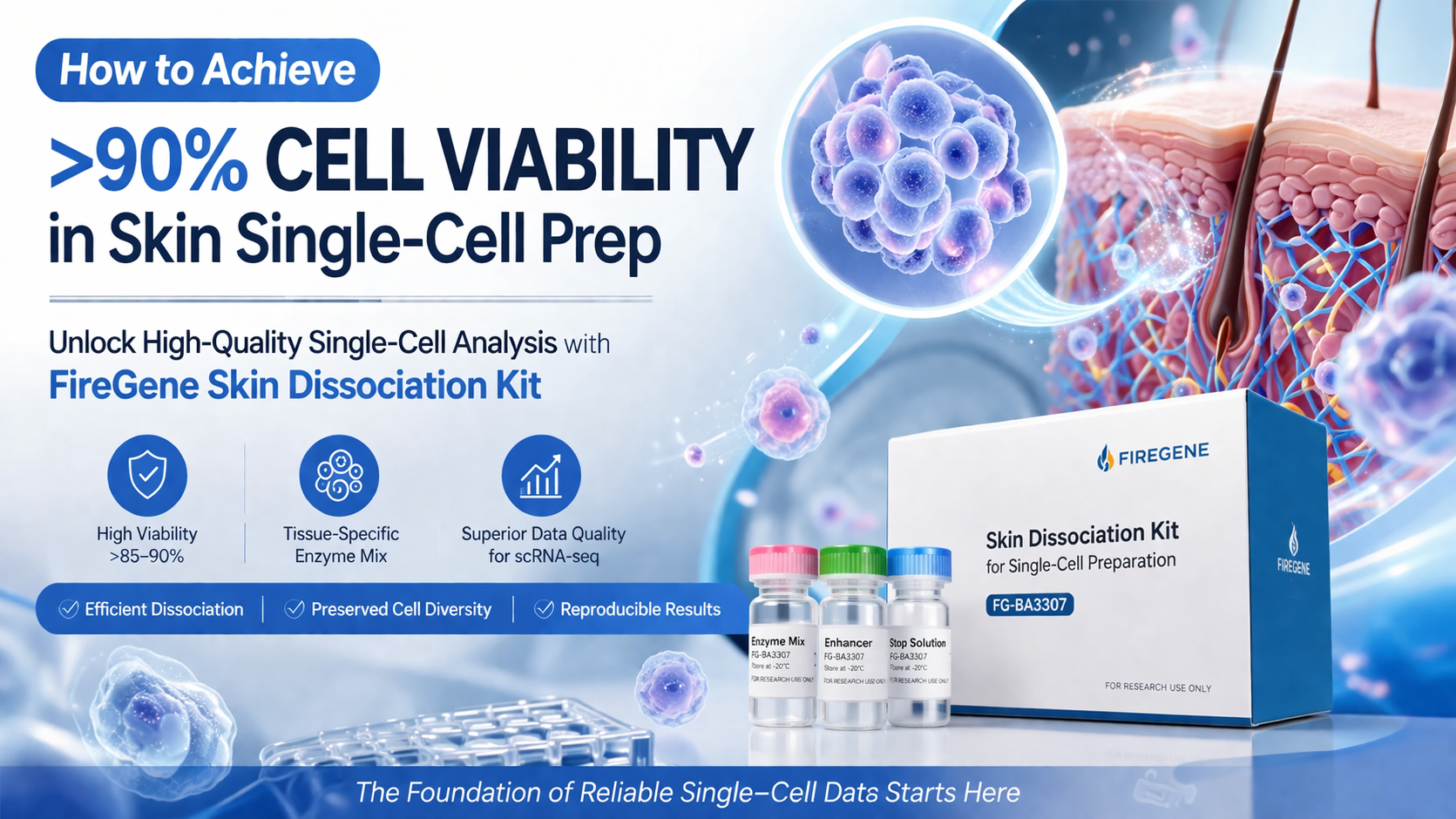
Abstract:High-quality single-cell preparation is essential for reliable downstream analysis in modern life science research. Skin tissue presents unique challenges due to its dense extracellular matrix and complex cellular composition, often leading to low yield and reduced viability with conventional methods. The FireGene Skin Dissociation Kit provides a tissue-specific solution that enables efficient digestion while preserving cell integrity and diversity. By achieving high cell viability and minimizing debris, it significantly improves the performance of applications such as scRNA-seq and flow cytometry. Combined with optimized handling practices, this approach ensures reproducible results and supports deeper insights into skin biology and disease mechanisms.
Keywords:Skin dissociation;Single-cell preparation;Cell viability;scRNA-seq;Tissue dissociation kit
Introduction: Why High-Quality Single-Cell Prep Matters
Single-cell technologies such as single-cell RNA sequencing (scRNA-seq) and flow cytometry have transformed modern life science research by enabling high-resolution analysis of cellular heterogeneity. These approaches allow researchers to uncover subtle differences between cell populations, identify rare cell types, and better understand complex biological systems. However, the reliability of these techniques depends heavily on one critical factor: the quality of the starting single-cell suspension.
High cell viability and integrity are essential for generating accurate and reproducible data. Damaged or stressed cells can introduce transcriptional artifacts, while excessive debris or dead cells may compromise downstream analysis. This challenge becomes even more pronounced when working with skin tissue. As one of the most structurally complex organs, skin contains a dense extracellular matrix rich in collagen and connective proteins, making it difficult to dissociate efficiently without harming delicate cells.
Traditional or generic dissociation methods often fall short when applied to skin samples. They may either under-digest the tissue, resulting in low yield, or over-digest it, leading to reduced cell viability and loss of important cell populations such as keratinocytes and immune cells.
To address these limitations, specialized solutions like the FireGene Skin Dissociation Kit have been developed. Designed specifically for skin tissue, this kit enables efficient dissociation while preserving cell health, providing a strong foundation for high-quality single-cell analysis and more reliable experimental outcomes.
Key Challenges in Skin Tissue Dissociation
Dissociating skin tissue into a high-quality single-cell suspension presents unique technical challenges that are not typically encountered with softer or less complex tissues. The skin is a highly structured organ composed of multiple layers, including the epidermis and dermis, each containing diverse cell populations such as keratinocytes, fibroblasts, endothelial cells, and resident immune cells. These cells are embedded within a dense extracellular matrix (ECM) rich in collagen, elastin, and other structural proteins, which makes efficient dissociation particularly difficult.
 One of the primary challenges is achieving a balance between sufficient tissue digestion and preservation of cell viability. Inadequate enzymatic digestion can result in incomplete dissociation, leading to low cell yield and cell clumping. On the other hand, overly aggressive digestion can damage cell membranes, reduce viability, and alter gene expression profiles—ultimately compromising downstream analyses such as single-cell RNA sequencing.
Another critical issue is the loss or underrepresentation of sensitive cell populations. Fragile cells, including certain immune subsets, are especially vulnerable to harsh processing conditions and may be selectively depleted during dissociation. Additionally, the accumulation of dead cells and debris can interfere with cell sorting, reduce data quality, and increase background noise.
Generic dissociation protocols are often not optimized for the complexity of skin tissue, making them unreliable for consistent results. These limitations highlight the need for tissue-specific approaches that can effectively break down the ECM while maintaining the integrity and diversity of the cellular landscape.
Solution Spotlight: FireGene Skin Dissociation Kit
To overcome the limitations of conventional methods, the FireGene Skin Dissociation Kit (FG-BA3307) offers a purpose-built solution tailored specifically for skin tissue processing. Unlike generic dissociation reagents, this kit features a carefully optimized enzymatic formulation designed to efficiently break down the dense extracellular matrix (ECM) while preserving cell viability and structural integrity.
At the core of its performance is a balanced combination of enzymes that target key ECM components such as collagen and connective proteins without causing excessive cellular stress. This controlled digestion process enables effective tissue breakdown while minimizing damage to delicate cell populations. As a result, researchers can achieve high-quality single-cell suspensions with viability levels typically exceeding 85–90%.
In addition to its optimized chemistry, the FireGene Skin Dissociation Kit is designed with ease of use in mind. The streamlined workflow reduces hands-on time and variability between experiments, helping ensure reproducible results across different samples and operators. This consistency is particularly valuable for studies requiring high-throughput processing or comparative analysis.
Another key advantage is its ability to preserve a broad range of cell types, including keratinocytes, fibroblasts, and immune cells. Maintaining this cellular diversity is essential for accurately capturing the biological complexity of skin tissue in downstream applications.
Overall, the FireGene Skin Dissociation Kit provides a reliable, efficient, and user-friendly solution for researchers seeking high-viability single-cell preparations, making it an ideal choice for advanced skin biology and single-cell analysis workflows.
Applications & Performance Benefits
The FireGene Skin Dissociation Kit is designed to support a wide range of downstream applications that rely on high-quality single-cell suspensions. Its ability to generate highly viable and well-preserved cells makes it particularly valuable for advanced techniques such as single-cell RNA sequencing (scRNA-seq), flow cytometry, and primary cell culture. In each of these applications, the quality of the input material directly impacts the accuracy, sensitivity, and reproducibility of the results.
 One of the key performance benefits of this kit is its ability to preserve the diversity of cell populations within skin tissue. By maintaining the integrity of keratinocytes, fibroblasts, and immune cells, researchers can obtain a more comprehensive and representative view of the tissue microenvironment. This is especially important in studies focused on disease mechanisms, immune responses, or skin regeneration, where subtle differences between cell types can be critical.
High cell viability also translates into improved data quality. In scRNA-seq workflows, healthier cells produce more reliable gene expression profiles, leading to clearer clustering and more meaningful biological insights. Similarly, in flow cytometry, reduced debris and fewer dead cells enhance signal clarity and sorting efficiency.
Additionally, the consistency of the FireGene Skin Dissociation Kit helps minimize experimental variability. Researchers can achieve reproducible outcomes across multiple samples, which is essential for comparative studies and large-scale projects. Overall, the kit not only simplifies the dissociation process but also significantly enhances the performance and reliability of downstream single-cell applications.
Best Practices & Conclusion
Achieving optimal results in skin tissue dissociation requires not only the right reagents but also careful attention to handling and workflow. Even with a high-performance solution like the FireGene Skin Dissociation Kit, following best practices can significantly improve cell yield, viability, and overall data quality.
First, proper tissue handling is essential. Fresh samples should be processed as quickly as possible to minimize cell degradation. If immediate processing is not feasible, tissues should be stored under appropriate conditions to preserve viability. During preparation, cutting the tissue into small, uniform pieces can enhance enzyme accessibility and ensure more efficient digestion.
Second, digestion conditions must be carefully controlled. Over-digestion can damage cells and alter gene expression, while under-digestion may result in incomplete dissociation and low yield. Optimizing incubation time and temperature based on sample type and size is key to maintaining a balance between efficiency and cell integrity.
Gentle mechanical handling is equally important. Excessive pipetting or harsh mixing can disrupt fragile cells, particularly immune populations. Using wide-bore pipette tips and minimizing shear stress can help preserve cell diversity.
In conclusion, the FireGene Skin Dissociation Kit provides a reliable, tissue-specific solution for generating high-viability single-cell suspensions from skin. When combined with optimized handling practices, it enables researchers to overcome common dissociation challenges, improve reproducibility, and obtain more accurate and meaningful results in downstream single-cell applications.
FireGene, light your research with passion, innovation, and profession.
FireGene Single-Cell Sample Prep
Looking for validated dissociation kits?
FireGene's tissue dissociation kits are optimized for specific organ types — brain, tumor, liver, GI, reproductive, and more. Validated for 10x Genomics Chromium and BD Rhapsody workflows.


