
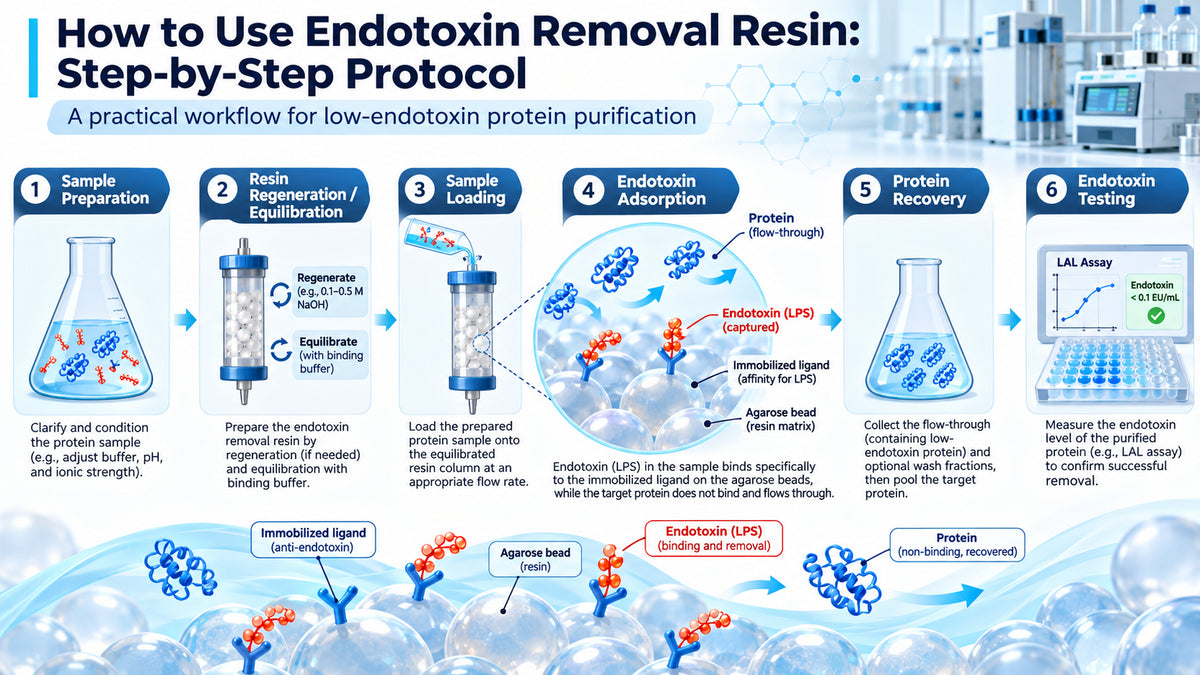
Endotoxin removal is an important step in preparing recombinant proteins, antibodies, and other biological reagents for endotoxin-sensitive research applications. Affinity-based endotoxin removal resins provide a practical approach for reducing bacterial lipopolysaccharide (LPS) contamination while retaining valuable target proteins. However, successful purification depends on appropriate resin preparation, sample compatibility, adsorption conditions, and analytical verification. This article presents a step-by-step overview of the endotoxin removal resin workflow, covering sample preparation, resin regeneration and equilibration, sample loading, endotoxin adsorption, protein recovery, and endotoxin testing. It also discusses important parameters affecting purification performance and provides troubleshooting recommendations for improving endotoxin clearance and sample recovery.
1. Introduction
Endotoxin contamination is a persistent challenge in recombinant protein production and biological sample preparation.
Bacterial endotoxins, primarily lipopolysaccharides (LPS) from the outer membrane of Gram-negative bacteria, can remain in protein preparations even after conventional purification procedures.
These contaminants are particularly problematic when purified proteins are used in cell culture, immune signaling studies, cytokine assays, or other biological experiments sensitive to inflammatory stimulation.
Although techniques such as affinity chromatography, ion exchange chromatography, and size-exclusion chromatography can remove many process-related impurities, they do not necessarily provide sufficient endotoxin clearance.
Endotoxin removal resin offers an additional purification strategy based on affinity interactions between LPS molecules and immobilized binding ligands.
For example, Polymyxin B-based endotoxin removal resins employ immobilized affinity ligands to capture endotoxins under suitable conditions.
The effectiveness of this approach depends on proper resin handling, sample characteristics, and process optimization.
A carefully designed protocol can help researchers reduce endotoxin contamination while limiting unnecessary protein loss.
2. Understanding the Principle of Endotoxin Removal Resin
Before performing an endotoxin removal procedure, it is useful to understand how affinity resin captures bacterial endotoxins.
2.1 Structure and Function of the Resin
A typical affinity-based endotoxin removal resin consists of a solid chromatographic matrix and immobilized endotoxin-binding ligands.
For example, FireGene High-Efficiency Endotoxin Removal Purification Resin uses modified Polymyxin B attached to 4% agarose microspheres.
The agarose matrix supports the immobilized ligands and allows sample solutions to pass through the packed resin bed.
Polymyxin B interacts with structural features of LPS, particularly the lipid A region.
These interactions involve electrostatic attraction and hydrophobic binding.
When a contaminated protein solution contacts the resin, accessible endotoxin molecules can bind to the immobilized ligands.
Under suitable conditions, the desired protein remains primarily in the liquid phase and can be recovered with a reduced endotoxin concentration.
2.2 Important Resin Specifications
The following specifications describe FireGene High-Efficiency Endotoxin Removal Purification Resin.
|
Parameter |
Specification |
|
Matrix |
4% agarose microspheres |
|
Affinity ligand |
Modified Polymyxin B |
|
Bead size |
45–165 μm |
|
Listed binding capacity |
>2,000,000 EU/mL resin matrix |
|
Operating pH range |
5–10 |
|
Maximum pressure |
0.1 MPa (1 bar) |
|
Storage solution |
20% ethanol |
|
Storage temperature |
2–8°C |
These characteristics provide a starting point for selecting appropriate processing conditions.
The manufacturer reports endotoxin removal of up to 99% and protein recovery of up to 90% under suitable conditions.
Actual results depend on the sample matrix, initial endotoxin burden, protein properties, and purification parameters.
3. Materials and Equipment Required
Before starting the endotoxin removal procedure, prepare the materials needed for sample processing and analytical verification.
3.1 Essential Materials
A typical workflow requires:
Endotoxin removal purification resin
Protein sample requiring endotoxin reduction
Compatible equilibration buffer
Manufacturer-specified regeneration solution
Endotoxin-controlled water
Suitable chromatography column or recommended processing vessel
Low-endotoxin sample collection tubes
Pipettes and appropriate laboratory consumables
Endotoxin detection reagents, such as an LAL assay kit
Additional equipment may include a chromatography system, centrifuge, spectrophotometer, or protein concentration assay.
The exact requirements depend on the resin format and sample preparation workflow.
3.2 Sample Assessment Before Purification
Before processing the sample, record the following information:
Sample volume: Determine the total volume requiring endotoxin removal.
Protein concentration: Measure the protein concentration using a suitable assay.
Initial endotoxin level: Quantify the starting endotoxin concentration whenever possible.
Buffer composition: Record the solution pH, salt concentration, and relevant additives.
Sample stability: Evaluate whether the protein remains stable under the proposed purification conditions.
These measurements provide a baseline for evaluating the effectiveness of the endotoxin removal procedure.
4. Step-by-Step Endotoxin Removal Resin Protocol
The following workflow describes the general procedure for affinity-based endotoxin removal.
Specific regeneration solutions, wash volumes, and operating conditions must be obtained from the current manufacturer's instructions.
Step 1: Prepare the Protein Sample
Begin by preparing a clarified protein solution.
Remove visible particulate matter or insoluble aggregates using a sample-compatible clarification method.
Highly aggregated protein preparations may produce inconsistent purification behavior or interfere with chromatography.
Measure the initial endotoxin concentration using a suitable assay.
If possible, determine the total endotoxin burden by multiplying the measured concentration by the sample volume.
For example, a 10 mL protein sample containing 1,000 EU/mL has a total measured endotoxin burden of 10,000 EU.
This information helps estimate the amount of resin required.
The sample pH and buffer composition should also be evaluated before loading.
Step 2: Determine the Required Resin Volume
Selecting sufficient resin volume is important for effective endotoxin adsorption.
The required quantity depends on several factors, including:
Initial endotoxin concentration
Total sample volume
Resin-binding capacity
Target residual endotoxin concentration
Protein–endotoxin interactions
The manufacturer's stated binding capacity can provide an initial reference.
However, practical working capacity may differ from the maximum reported capacity because of sample-specific conditions.
For FireGene resin, the product guidance identifies resin-to-sample volume ratios of 1:1 or 1:2 as possible starting points for small-scale evaluation when the endotoxin content is unknown.
These ratios should not be interpreted as universal operating requirements.
Whenever possible, resin loading should be established through preliminary experiments and confirmed using endotoxin testing.
Step 3: Regenerate and Equilibrate the Resin
Proper resin preparation is essential for reliable endotoxin removal.
FireGene indicates that its endotoxin removal purification resin requires regeneration before first use.
The product is supplied in 20% ethanol, which must be appropriately removed during resin preparation.
Begin by preparing the chromatography column or purification vessel according to the manufacturer's instructions.
Use the specified regeneration procedure to prepare the resin for sample treatment.
After regeneration, equilibrate the resin using a compatible low-endotoxin buffer.
The equilibration buffer should be compatible with both the resin and the target protein.
Avoid introducing contaminated water, improperly prepared buffers, or laboratory consumables that may contribute additional endotoxin.
Important: Do not substitute regeneration or equilibration conditions from an unrelated resin product. Different affinity resins may require different preparation procedures.
Step 4: Load the Protein Sample
After equilibration, introduce the prepared protein sample to the resin.
For column-based purification, the sample passes through the resin bed, allowing endotoxin molecules to interact with the immobilized affinity ligands.
Appropriate sample loading is important because excessively rapid flow may reduce adsorption efficiency.
The flow rate should provide sufficient contact time between the sample and the resin.
For example, FireGene's product guidance recommends a contact time greater than 10 minutes for a particular column application.
In that example, a 40 mL resin bed corresponds to a maximum recommended flow rate of 4 mL/min.
This is a manufacturer-provided example rather than a universal flow-rate specification.
Actual operating conditions should be selected according to the resin volume, column dimensions, sample properties, and product instructions.
Step 5: Allow Endotoxin Adsorption
During the adsorption stage, bacterial endotoxins interact with immobilized Polymyxin B ligands.
The interaction depends on electrostatic and hydrophobic forces associated with the molecular structure of LPS.
When the process conditions are suitable, endotoxins remain associated with the resin while the target protein can pass through.
Several factors may influence adsorption performance.
Contact time: Insufficient contact can reduce endotoxin capture.
Solution pH: Changes in pH may influence molecular charge and binding interactions.
Ionic strength: Salt concentration may affect both endotoxin adsorption and nonspecific protein binding.
Protein characteristics: Some proteins interact strongly with endotoxin, potentially complicating separation.
These variables should be optimized when the initial purification result does not meet the intended endotoxin specification.
Step 6: Collect the Endotoxin-Reduced Protein
Collect the product-containing flow-through using suitable low-endotoxin tubes.
If the manufacturer's procedure calls for additional buffer collection, collect the appropriate fractions separately.
The recovered preparation should be evaluated for both protein content and endotoxin concentration.
Careful fraction collection helps minimize sample loss and supports the calculation of total protein recovery.
Avoid pooling all collected fractions before verifying their suitability, particularly when fraction-specific endotoxin concentrations may differ.
Step 7: Measure Residual Endotoxin Levels
After purification, measure the residual endotoxin concentration using an appropriate bacterial endotoxins test.
Common analytical approaches include:
LAL gel-clot assays
Kinetic chromogenic LAL assays
Kinetic turbidimetric LAL assays
Suitable recombinant Factor C assays
The selected method should be compatible with the sample matrix.
Certain proteins, buffers, detergents, and other sample components may interfere with endotoxin testing.
Appropriate positive product controls and interference assessments are therefore important.
Where applicable, sample dilution should remain within the assay's validated limits.
Endotoxin concentrations should be reported in suitable units, such as EU/mL or EU/mg protein, depending on the experimental requirements.
5. How to Calculate Endotoxin Removal Efficiency and Protein Recovery
Analytical measurements before and after treatment provide quantitative information about resin performance.
5.1 Endotoxin Removal Efficiency
Endotoxin removal efficiency can be calculated using:
Endotoxin Removal (%) = [(Initial Total Endotoxin − Final Total Endotoxin) / Initial Total Endotoxin] × 100
For example, suppose the initial sample contains 10,000 EU of endotoxin, while the recovered preparation contains 100 EU.
The calculated endotoxin removal efficiency is:
[(10,000 − 100) / 10,000] × 100 = 99%
This indicates a 99% reduction in measured total endotoxin.
When sample volumes differ before and after purification, use total endotoxin amounts rather than directly comparing concentrations.
5.2 Protein Recovery
Protein recovery measures how much target protein remains after purification.
Protein Recovery (%) = (Recovered Protein Mass / Initial Protein Mass) × 100
For example, if the initial sample contains 20 mg of protein and the recovered preparation contains 18 mg:
Protein Recovery = (18 / 20) × 100 = 90%
High endotoxin clearance is desirable, but protein recovery and biological activity are also important.
A purification method that removes endotoxin while causing substantial protein loss may not be suitable for the intended application.
6. Factors Affecting Endotoxin Removal Performance
6.1 Buffer pH
Solution pH can influence interactions among endotoxin molecules, proteins, and resin ligands.
Although some affinity resins tolerate relatively broad pH ranges, optimal endotoxin adsorption may occur under more specific conditions.
FireGene's product FAQ suggests evaluating pH 7–8 when endotoxin removal is insufficient.
Protein stability should always be considered when adjusting sample pH.
6.2 Salt Concentration
Ionic strength affects electrostatic interactions during affinity purification.
Increasing NaCl concentration may help reduce nonspecific protein adsorption in some systems.
However, changes in salt concentration can also affect endotoxin binding or protein stability.
Salt optimization should therefore be based on experimental results.
6.3 Sample Composition
Biological samples may contain detergents, glycerol, imidazole, reducing agents, or other additives.
Some resins tolerate selected additives, but compatibility depends on concentration and operating conditions.
For example, highly viscous samples may exhibit reduced flow performance or inconsistent recovery.
Assess buffer additives before processing valuable samples.
6.4 Protein–Endotoxin Association
Some target proteins may bind endotoxin strongly.
These interactions can reduce the accessibility of LPS to the immobilized ligand.
As a result, endotoxin removal may be less efficient even when the resin has sufficient nominal binding capacity.
Small-scale optimization may be necessary for proteins with substantial endotoxin association.
7. Troubleshooting Common Endotoxin Removal Problems
7.1 Low Endotoxin Removal Efficiency
Possible causes:
Insufficient resin capacity
Inadequate sample contact time
Suboptimal buffer pH
Strong protein–endotoxin interactions
Endotoxin contamination introduced during processing
Recommended approaches:
Measure the initial endotoxin burden, review resin loading, and evaluate whether the contact time is sufficient.
Confirm the compatibility of the sample buffer and ensure that all processing materials are appropriately controlled for endotoxin contamination.
7.2 Low Protein Recovery
Possible causes:
Nonspecific adsorption to the resin
Protein aggregation
Incompatible buffer conditions
Protein loss during sample collection
Recommended approaches:
Evaluate protein recovery in individual fractions.
Where compatible with the target protein and resin, consider adjusting ionic strength to reduce nonspecific interactions.
Protein concentration and functional activity should be evaluated after purification.
7.3 Inconsistent Endotoxin Test Results
Possible causes:
Sample matrix interference
Contaminated consumables
Improper sample dilution
Variability in assay preparation
Inadequate analytical controls
Recommended approaches:
Use suitable positive and negative controls, verify sample dilution suitability, and perform the required inhibition/enhancement assessment.
Repeated measurements should be interpreted together with the assay's acceptance criteria.
7.4 Unexpected Endotoxin Contamination After Purification
If endotoxin levels increase after treatment, investigate possible contamination sources.
These may include buffers, collection tubes, processing equipment, and previously used resin.
FireGene advises against using previously used resin to process different samples because of potential carryover contamination.
A fresh resin preparation may be preferable when cross-sample contamination cannot be adequately controlled.
8. Applications of Endotoxin Removal Resin
8.1 Recombinant Protein Purification
Proteins expressed in E. coli may contain residual endotoxin following conventional purification.
An affinity-based endotoxin removal step can help prepare compatible recombinant proteins for downstream cell-based research.
8.2 Antibody and Fc-Fusion Protein Research
Antibody preparations may require additional endotoxin control after Protein A/G purification.
Resin-based endotoxin removal can be evaluated as a polishing step, provided the antibody or Fc-fusion protein remains stable and recoverable.
8.3 Research Reagent Preparation
Selected peptides and protein-based biological reagents may benefit from endotoxin reduction before functional assays.
The suitability of a specific resin should be confirmed for each reagent type.
8.4 Biopharmaceutical Process Development
Endotoxin removal resins may also be investigated during biological purification process development.
In such applications, endotoxin clearance, target recovery, material compatibility, ligand leaching, and process reproducibility require consideration.
Research-use performance alone does not establish suitability for GMP manufacturing.
9. Frequently Asked Questions
Q1. How long does endotoxin removal take?
Processing time depends on sample volume, resin quantity, and the required contact time. Larger sample volumes or slower flow rates may increase processing duration. Follow the manufacturer's guidance for the selected configuration.
Q2. Can endotoxin removal resin be used more than once?
Some affinity resins can be regenerated and reused under validated conditions. However, the allowable reuse strategy depends on the product instructions and contamination-control requirements.
Q3. How much resin is required for protein purification?
Resin quantity should be determined using the total endotoxin burden, practical binding capacity, sample volume, and required clearance. Small-scale studies can help establish suitable operating conditions.
Q4. Can endotoxin removal resin affect protein activity?
Some proteins may undergo nonspecific adsorption, aggregation, or other changes during purification. Protein recovery and biological activity should be evaluated when these properties are critical to the experiment.
Q5. Is endotoxin removal necessary after Ni-NTA purification?
Not every Ni-NTA-purified protein requires the same endotoxin removal treatment. The need depends on the residual endotoxin concentration and the intended application. Endotoxin-sensitive experiments may require additional testing and purification.
10. Conclusion
Effective endotoxin removal requires more than simply passing a biological sample through an affinity resin.
Researchers should carefully evaluate the initial endotoxin burden, prepare and equilibrate the resin correctly, optimize sample loading and adsorption conditions, and verify the final product using an appropriate endotoxin assay.
Equally important is maintaining acceptable protein recovery and biological activity throughout the purification process.
By combining affinity-based endotoxin removal with reliable analytical verification, researchers can prepare higher-quality protein samples for endotoxin-sensitive biological experiments.
For compatible protein purification applications, FireGene High-Efficiency Endotoxin Removal Purification Resin provides a modified Polymyxin B-based affinity material designed for endotoxin reduction.


