
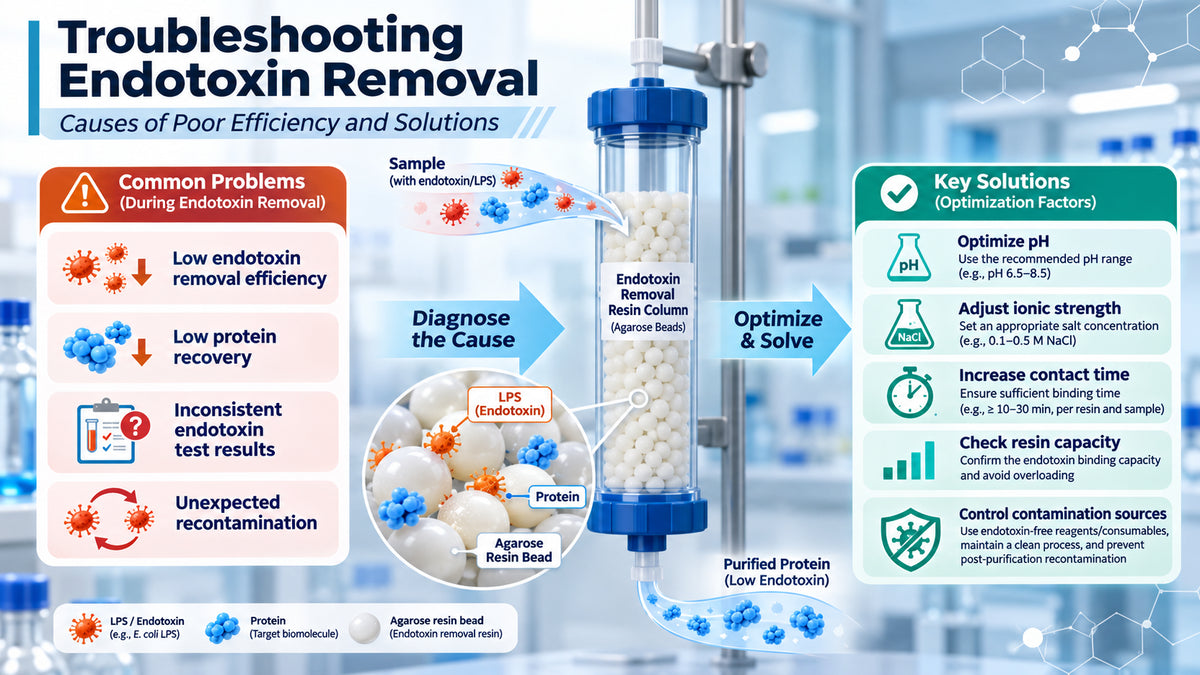
Endotoxin removal is an important purification step for recombinant proteins, antibodies, and biological reagents intended for endotoxin-sensitive research. However, affinity-based endotoxin removal does not always achieve the expected reduction in bacterial lipopolysaccharides (LPS). Poor performance may result from insufficient resin capacity, unsuitable buffer conditions, inadequate contact time, strong protein–endotoxin interactions, or contamination introduced during processing. In addition, low protein recovery and interference with endotoxin detection assays can complicate the interpretation of purification results. This article examines common endotoxin removal problems, explains their underlying causes, and provides practical troubleshooting strategies to improve endotoxin clearance while maintaining sample quality and protein recovery.
1. Introduction
Bacterial endotoxins are persistent contaminants in recombinant protein purification and biological sample preparation.
These molecules, primarily lipopolysaccharides (LPS) derived from Gram-negative bacteria, can remain in biological preparations even after conventional chromatographic purification.
Endotoxin contamination is particularly problematic for experiments involving immune cells, inflammatory signaling, cytokine production, and other endotoxin-sensitive biological systems.
Affinity-based endotoxin removal resins provide a practical approach for reducing LPS contamination from compatible protein solutions.
However, achieving high endotoxin removal efficiency is not always straightforward.
Researchers may encounter several problems:
Endotoxin concentrations remain high after resin treatment.
Protein recovery decreases significantly.
Endotoxin test results are inconsistent.
Previously purified samples become contaminated again.
Purification performance varies between different protein preparations.
These problems can arise from differences in sample composition, resin characteristics, purification conditions, or analytical methods.
Understanding the underlying causes is essential for developing a reliable endotoxin removal workflow.
2. Why Does Endotoxin Removal Sometimes Fail?
2.1 Complex Structure and Aggregation of LPS
Lipopolysaccharides contain both hydrophobic and hydrophilic regions.
Their amphiphilic structure allows them to associate with proteins, membranes, and other molecules.
In aqueous solutions, endotoxins can form aggregates with properties that differ from those of individual LPS molecules.
Aggregation may influence endotoxin accessibility, adsorption behavior, and separation efficiency.
Consequently, the effectiveness of an endotoxin removal method may vary depending on the physical state of LPS in the sample.
2.2 Strong Protein–Endotoxin Interactions
Certain recombinant proteins interact strongly with endotoxins through electrostatic or hydrophobic forces.
These interactions may limit the ability of an affinity resin to capture LPS independently of the protein.
For example, endotoxin associated with a protein surface may be less accessible to immobilized Polymyxin B ligands.
Strong protein–endotoxin associations can therefore complicate purification even when sufficient resin is available.
2.3 Differences Between Samples
Endotoxin removal conditions optimized for one protein may not work equally well for another.
Proteins differ in molecular weight, surface charge, hydrophobicity, solubility, and structural stability.
The composition of the purification buffer can further influence these properties.
Therefore, endotoxin removal should be evaluated as a sample-specific process rather than a universally standardized procedure.
3. Problem 1: Low Endotoxin Removal Efficiency
Low endotoxin removal efficiency is one of the most common problems encountered during resin-based purification.
The final endotoxin concentration may remain above the desired level despite treatment.
Several factors should be investigated.
3.1 Insufficient Resin Capacity
Every endotoxin removal resin has a finite binding capacity.
If the total endotoxin burden exceeds the practical adsorption capacity of the resin, a portion of the endotoxin may remain in the recovered sample.
Possible indicators:
High residual endotoxin levels after treatment
Increasing endotoxin breakthrough during column processing
Improved clearance when additional resin is used
Recommended solutions:
Determine the initial endotoxin concentration and calculate the total endotoxin burden.
Review the manufacturer's stated resin-binding capacity and evaluate whether the selected resin volume is sufficient.
If necessary, compare different resin loadings in a small-scale study.
Importantly, the manufacturer's maximum reported binding capacity should not be treated as a guaranteed working capacity under all sample conditions.
3.2 Inadequate Contact Time
Affinity adsorption requires sufficient interaction between endotoxin molecules and immobilized binding ligands.
When the sample passes through a resin column too quickly, the available contact time may be insufficient for effective endotoxin capture.
Recommended solutions:
Review the sample flow rate and resin bed volume.
Evaluate whether the contact time meets the manufacturer's recommendations.
For example, FireGene provides a column-processing example in which a 40 mL resin bed is operated at no more than 4 mL/min to achieve a nominal contact time greater than 10 minutes.
This recommendation applies to the specified configuration and should not be treated as a universal flow-rate requirement.
3.3 Unsuitable Buffer pH
Solution pH can influence molecular charge and interactions between endotoxins, proteins, and affinity ligands.
Although Polymyxin B-based affinity resins may operate across a broad pH range, endotoxin-binding performance can vary with the sample environment.
Recommended solutions:
Measure the actual sample pH before processing.
Confirm that the buffer falls within the resin's recommended operating range.
For FireGene High-Efficiency Endotoxin Removal Purification Resin, the listed operating range is pH 5–10.
Its troubleshooting guidance suggests evaluating pH 7–8 when removal efficiency is low.
However, this range is a starting point for evaluation, not a universal optimum. Protein stability must also be considered.
3.4 Strong Protein–Endotoxin Association
Some proteins bind LPS strongly, preventing efficient separation under standard conditions.
Recommended solutions:
Investigate whether sample-specific interactions are limiting endotoxin accessibility.
Evaluate compatible adjustments to buffer pH or ionic strength.
Compare protein recovery and endotoxin clearance after each adjustment.
Avoid conditions that may cause protein denaturation, precipitation, or loss of biological activity.
4. Problem 2: Low Protein Recovery After Endotoxin Removal
High endotoxin removal efficiency is valuable only when the target protein remains sufficiently intact and recoverable.
A purification step that removes most endotoxin but causes substantial protein loss may not be suitable for the intended application.
4.1 Nonspecific Protein Adsorption
Although affinity resins are designed to capture endotoxins, certain proteins may also interact with the resin matrix or immobilized ligands.
These nonspecific interactions can reduce the amount of protein recovered in the flow-through.
Recommended solutions:
Measure protein concentration before and after resin treatment.
Evaluate protein recovery in individual fractions.
Where compatible with the protein and resin, investigate whether increasing NaCl concentration reduces nonspecific adsorption.
FireGene's product guidance recommends evaluating NaCl concentration in both the sample and equilibration buffer when protein recovery is low.
4.2 Protein Aggregation or Precipitation
Changes in pH, ionic strength, or buffer composition may alter protein solubility.
Some proteins are especially sensitive to changes in their surrounding environment.
Aggregation may lead to lower recovery, inconsistent chromatography, or reduced biological activity.
Recommended solutions:
Inspect samples for visible precipitation or increased turbidity.
Evaluate protein stability before changing purification conditions.
When appropriate, use suitable analytical techniques, such as SEC, to investigate aggregation.
Avoid unnecessarily prolonged processing or incompatible buffer conditions.
4.3 Protein Loss During Sample Collection
Protein loss can also occur during sample transfer, fraction collection, or handling.
For small-volume preparations, adsorption to laboratory consumables may contribute to reduced recovery.
Recommended solutions:
Use sample-compatible collection materials.
Record the volume and protein concentration of each collected fraction.
Avoid unnecessary transfer steps.
Calculate total protein recovery using mass rather than concentration alone.
5. Problem 3: Inconsistent Endotoxin Test Results
Unexpected endotoxin test results do not always indicate that the removal resin has failed.
Analytical interference can produce misleading results, particularly when testing complex protein formulations.
5.1 Sample Matrix Interference
Endotoxin detection assays, including LAL-based methods, may be affected by sample composition.
Potential interfering factors include:
Extreme pH
High ionic strength
Detergents and certain buffer additives
Colored or turbid samples
Components that inhibit or enhance the assay reaction
These factors may cause endotoxin concentrations to appear lower or higher than their actual values.
5.2 Understanding Spike Recovery
Positive product controls are used to evaluate potential inhibition or enhancement of endotoxin detection.
A known quantity of endotoxin is added to a sample aliquot, and the measured recovery is compared with the applicable acceptance criteria.
For commonly used quantitative bacterial endotoxins tests, a spike recovery range of 50–200% is specified under relevant compendial conditions.
Recovery below 50% may indicate assay inhibition.
Recovery above 200% may indicate assay enhancement or another analytical problem.
Results outside the applicable acceptance range require investigation before the endotoxin concentration can be considered reliable.
5.3 Recommended Troubleshooting Strategies
If endotoxin assay results are inconsistent:
Review the standard curve and negative controls.
Confirm that the sample dilution is appropriate.
Evaluate positive product control recovery.
Check the sample's pH and buffer composition.
Investigate possible optical interference in chromogenic or turbidimetric assays.
Repeat testing under established, suitable analytical conditions.
Where dilution is used to overcome interference, it must remain within the applicable maximum valid dilution (MVD).
A low endotoxin reading should not automatically be interpreted as successful endotoxin removal when assay inhibition has not been excluded.
6. Problem 4: Endotoxin Contamination After Purification
Sometimes, endotoxin concentrations increase after treatment or during subsequent handling.
This may indicate that contamination was introduced from another source.
6.1 Contaminated Buffers or Water
Water and buffer solutions can introduce endotoxins if they are not appropriately controlled.
This is particularly important when preparing regeneration solutions, equilibration buffers, or sample diluents.
Recommended solutions:
Use water and reagents suitable for endotoxin-sensitive procedures.
Prepare buffers using appropriately controlled laboratory containers.
Evaluate potential contamination sources when unexpected results occur.
6.2 Contaminated Laboratory Consumables
Collection tubes, pipette tips, glassware, and processing equipment may contribute endotoxin contamination.
Recommended solutions:
Use certified low-endotoxin or depyrogenated materials where appropriate.
Maintain suitable sample-handling practices.
Avoid transferring purified samples into containers of unknown endotoxin status.
6.3 Cross-Contamination from Previously Used Resin
Reusing endotoxin removal resin across different samples may introduce cross-contamination.
Even when a resin is regenerable, its reuse strategy should consider sample carryover, cleaning effectiveness, and loss of performance.
FireGene specifically advises against using previously used resin to process different samples because of contamination risks.
When cross-contamination cannot be adequately controlled, a fresh resin preparation is preferable.
7. Problem 5: Reduced Efficiency Due to Buffer Additives
Protein purification buffers often contain additives intended to maintain protein stability or support previous purification steps.
Common examples include glycerol, imidazole, reducing agents, and detergents.
Although certain endotoxin removal resins tolerate these components, their effects on purification performance depend on concentration and sample characteristics.
7.1 High Glycerol Concentrations
Glycerol is frequently used to stabilize proteins.
However, high glycerol concentrations increase solution viscosity.
Increased viscosity may affect resin flow behavior and sample recovery.
FireGene recommends a glycerol concentration no greater than 5% for its endotoxin removal workflow, despite listing tolerance to higher concentrations under certain conditions.
This distinction illustrates why chemical compatibility does not necessarily guarantee optimal purification performance.
7.2 Detergents and Other Additives
Detergents can influence endotoxin aggregation and protein–endotoxin interactions.
Some additives may also interfere with subsequent endotoxin testing.
Recommended solutions:
Review the manufacturer's buffer compatibility specifications.
Evaluate potentially problematic additives in small-scale experiments.
When necessary, consider a protein-compatible buffer exchange step before endotoxin removal.
Confirm that any buffer modification preserves protein stability and does not compromise the analytical method.
8. Practical Troubleshooting Checklist
When endotoxin removal performance is unsatisfactory, a systematic investigation is more effective than changing multiple conditions simultaneously.
|
Problem |
Possible cause |
Recommended action |
|
Low endotoxin clearance |
Insufficient resin capacity |
Review endotoxin loading and resin volume |
|
High residual LPS |
Insufficient contact time |
Evaluate flow rate and residence time |
|
Poor endotoxin adsorption |
Unsuitable sample pH |
Optimize pH within compatible conditions |
|
Low protein recovery |
Nonspecific adsorption |
Evaluate salt concentration |
|
Protein precipitation |
Incompatible buffer |
Assess protein stability and solubility |
|
Inconsistent assay results |
LAL inhibition or enhancement |
Perform appropriate interference testing |
|
Unexpected endotoxin increase |
Recontamination |
Examine buffers, equipment, and consumables |
|
Variable column performance |
High viscosity or sample aggregation |
Review sample preparation and additives |
A useful optimization strategy is to change one major parameter at a time while measuring both endotoxin reduction and protein recovery.
This approach helps identify the variables responsible for changes in purification performance.
9. How to Evaluate Endotoxin Removal Performance
Two measurements are particularly important when assessing an endotoxin removal process.
9.1 Endotoxin Removal Efficiency
Endotoxin removal efficiency can be calculated as:
Endotoxin Removal (%) = [(Initial Total Endotoxin − Final Total Endotoxin) / Initial Total Endotoxin] × 100
For example, consider a sample initially containing 10,000 EU of endotoxin.
If the recovered sample contains 100 EU after treatment:
Endotoxin Removal = 99%
This demonstrates a 99% reduction in measured total endotoxin.
When sample volumes differ, total endotoxin amounts should be calculated rather than comparing concentrations directly.
9.2 Protein Recovery
Protein recovery can be calculated as:
Protein Recovery (%) = (Recovered Protein Mass / Initial Protein Mass) × 100
For example, if a preparation initially contains 20 mg of protein and 18 mg is recovered:
Protein Recovery = 90%
These measurements should be considered together.
High endotoxin clearance accompanied by unacceptable protein loss may indicate that further optimization is necessary.
For proteins used in functional assays, biological activity and structural integrity may also require evaluation.
10. Frequently Asked Questions
Q1. Why is endotoxin removal efficiency low even when sufficient resin is used?
Low efficiency may result from inadequate contact time, unsuitable buffer conditions, strong protein–endotoxin interactions, or analytical interference. Resin capacity alone does not determine purification performance.
Q2. Can increasing the amount of resin improve endotoxin removal?
Additional resin may improve clearance when binding capacity is limiting. However, increasing resin volume does not necessarily resolve problems caused by unsuitable pH, inaccessible endotoxin, or analytical interference.
Q3. How can protein loss during endotoxin removal be reduced?
Evaluate nonspecific adsorption, buffer composition, protein aggregation, and sample collection losses. Compatible adjustments to ionic strength may improve recovery in some systems.
Q4. Why are endotoxin test results different before and after buffer exchange?
Buffer exchange may alter sample pH, ionic strength, additive concentrations, or endotoxin aggregation behavior. These changes can affect both endotoxin availability and assay response. Method suitability should be assessed for the relevant sample matrices.
Q5. Can endotoxin removal resin be reused for different recombinant proteins?
Reuse depends on the resin's validated regeneration and contamination-control procedures. FireGene advises against processing different samples with previously used resin because of potential carryover contamination.
11. Conclusion
Troubleshooting endotoxin removal requires careful evaluation of both purification conditions and analytical results.
Poor endotoxin clearance may result from insufficient resin capacity, inadequate contact time, unsuitable pH, or strong protein–endotoxin interactions.
Low protein recovery may reflect nonspecific adsorption, aggregation, or incompatible buffer conditions.
Inconsistent endotoxin measurements may result from assay inhibition, enhancement, or contamination introduced during sample handling.
Successful optimization therefore requires a systematic approach that combines appropriate resin selection, compatible purification conditions, reliable endotoxin testing, and quantitative protein recovery assessment.
For compatible recombinant protein and antibody preparations, FireGene High-Efficiency Endotoxin Removal Purification Resin provides a modified Polymyxin B-based affinity material that can be evaluated for endotoxin reduction.
Combining resin treatment with suitable LAL or recombinant endotoxin detection methods can help researchers establish more reproducible purification workflows and prepare higher-quality biological samples.


