
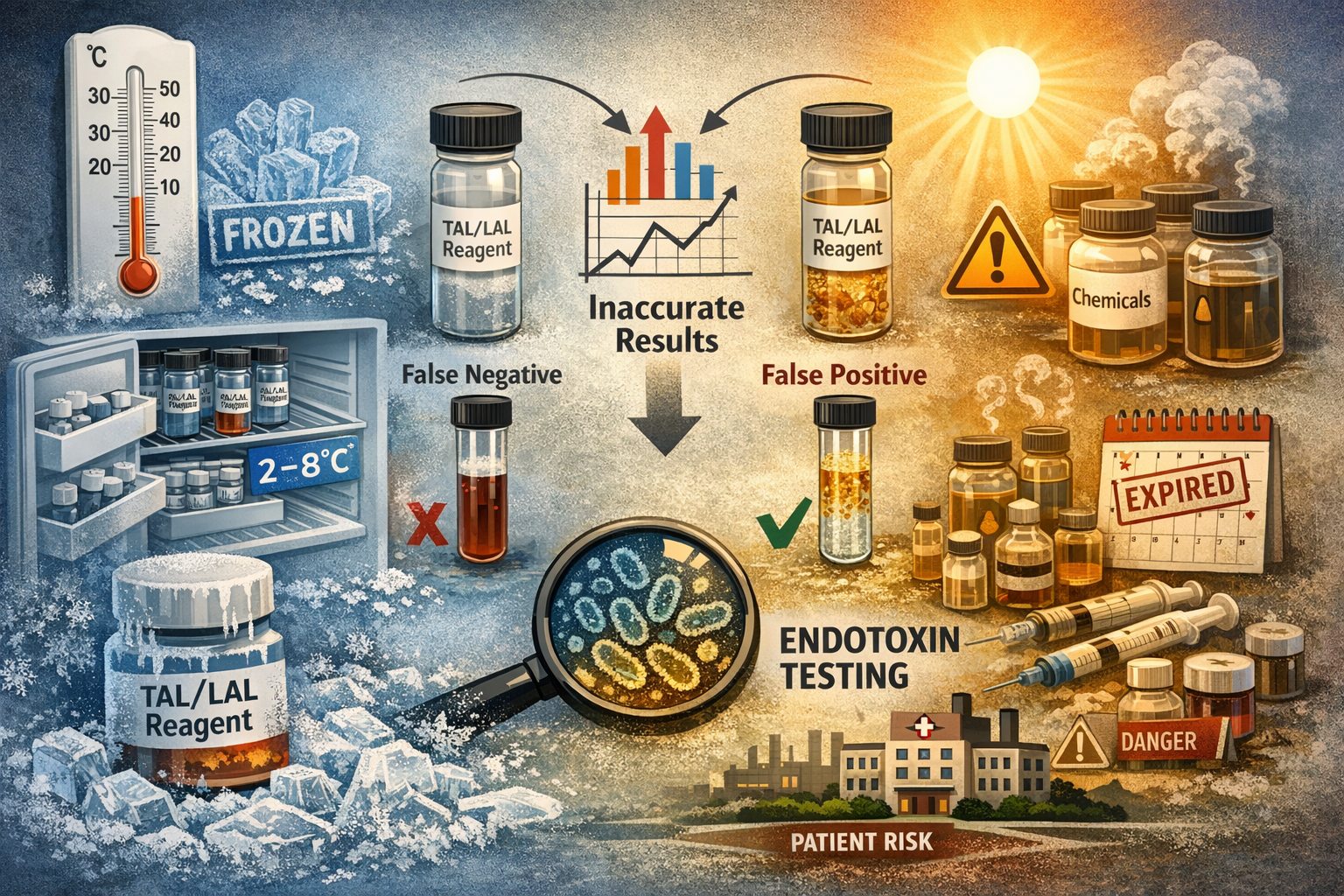
The TAL/LAL Reagent is the core reagent used in Bacterial Endotoxins Testing (BET). Its activity depends on the stability of coagulation factors present in the blood extract, and storage conditions directly determine the integrity of these biologically active components. As a biological product, the TAL/LAL Reagent is highly sensitive to environmental factors such as temperature, humidity, and light. Improper storage at any stage can lead to reduced activity, loss of function, or altered reaction characteristics, resulting in distorted test outcomes—including false negatives, false positives, and quantitative deviations. These issues ultimately affect product quality decisions and pose potential risks to safety control in the medical, pharmaceutical, food, and cosmetic industries.
The following sections analyze the core storage requirements and explain in detail how improper storage impacts test results and the underlying mechanisms.
I. Core Storage Requirements for TAL/LAL Reagents
Standard storage conditions for TAL/LAL Reagents are clearly defined by manufacturers based on reagent composition and stability characteristics. The key requirements include the following points.
First, temperature must be strictly controlled. Most TAL/LAL Reagents should be stored at 2–8°C under refrigerated conditions, while certain high-sensitivity chromogenic reagents require storage at –20°C. Repeated freeze–thaw cycles must be avoided, and frozen reagents should be used immediately after thawing.
Second, the storage environment should be dry and protected from light. Relative humidity should be kept below 60%, and reagents should be stored away from volatile chemicals, microbial contamination sources, and strong magnetic fields.
Third, once opened, reagents must be used within the specified time frame, typically 24–48 hours. Unopened reagents should be used within their labeled shelf life, and excessive vibration during storage and handling should be avoided.
The fundamental purpose of these requirements is to preserve the native conformation and activity of key coagulation factors—such as proclotting enzyme and coagulogen—ensuring that the endotoxin-triggered cascade reaction proceeds accurately and consistently.
II. Common Improper Storage Scenarios and Their Impact on Test Results
I) Temperature Deviation: The Most Critical Factor
Temperature is the single most important factor affecting the activity of TAL/LAL Reagents. Both excessive heat and improper freezing can directly damage biological activity.
When reagents that require refrigeration at 2–8°C are stored at room temperature (above 25°C) or higher for extended periods, coagulation factors undergo thermal denaturation. Elevated temperatures alter protein conformation and damage enzyme active sites, significantly reducing the reagent’s ability to bind endotoxin and catalyze the cascade reaction.
As a result, two major outcomes may occur. One is a false-negative result, where endotoxin is present in the sample but the reduced reagent activity fails to trigger gel formation, turbidity change, or chromogenic signal, leading to an incorrect pass result. The other is reduced sensitivity in quantitative methods, such as turbidimetric or chromogenic assays, where measured endotoxin levels are lower than the true concentration. For example, a gel-clot TAL/LAL Reagent stored at 30°C for 48 hours may lose more than 50% of its activity, causing a positive sample containing 0.25 EU/mL endotoxin to be misclassified as negative.
Conversely, placing reagents intended for refrigeration into freezing conditions below 0°C, or subjecting frozen reagents to repeated freeze–thaw cycles, can also be detrimental. Ice crystal formation physically disrupts coagulation factor structures, while osmotic stress during thawing further accelerates loss of activity. Such reagents may show abnormal reactions, including delayed gel formation beyond the standard incubation time or non-specific reactions in which endotoxin-free samples produce gel or color development, resulting in false-positive outcomes and unnecessary product rejection.
II) Humidity and Contamination: Causes of Reagent Failure and Interference
TAL/LAL Reagents are typically packaged in sealed glass vials. If stored in environments with excessive humidity (relative humidity above 60%), or if packaging is damaged or not properly sealed after opening, the reagent may absorb moisture and form clumps.
Moisture absorption not only dilutes active components but also promotes microbial growth. Microbial metabolites or endotoxins introduced through contamination can directly trigger the coagulation reaction, causing false-positive results even when the test sample itself is endotoxin-free.
In addition, volatile chemicals such as disinfectants or organic solvents in the storage environment may react with coagulation factors and inhibit enzyme activity, leading to false-negative results. Cross-contamination from other samples or microbial sources can further disrupt the reaction system and generate unstable or misleading signals. For example, storing TAL/LAL Reagents in the same cabinet as alcohol-based disinfectants may allow solvent vapors to penetrate packaging and degrade reagent activity, resulting in test failure.
III) Light Exposure and Vibration: Effects on Reagent Stability
The biologically active components of TAL/LAL Reagents are sensitive to ultraviolet radiation and strong light. Prolonged exposure to sunlight or continuous laboratory lighting can induce oxidative damage to proteins, compromising the structural integrity of coagulation factors and gradually reducing reagent activity.
Such degradation often manifests as poor repeatability. Test results from the same batch may show excessive variability, preventing the establishment of stable standard curves and undermining the accuracy of quantitative assays.
In addition, severe vibration during storage or transport can cause uneven distribution of reagent components. Mechanical stress may lead to aggregation of active substances, resulting in non-uniform reactions. During testing, this may produce incomplete gel formation, unstable turbidity changes, or uneven chromogenic signals, all of which impair result interpretation.
IV) Use Beyond Expiration Date: Activity Loss and Result Distortion
The shelf life of a TAL/LAL Reagent is determined by manufacturer stability studies and represents the period during which activity is guaranteed. Even under proper storage conditions, coagulation factor activity naturally declines after the expiration date.
Expired reagents exhibit significantly reduced sensitivity and elevated detection limits, making them incapable of detecting low-level endotoxin contamination. This leads primarily to false-negative results. For example, a chromogenic TAL/LAL Reagent with a labeled sensitivity of 0.001 EU/mL may only achieve 0.01 EU/mL after being six months past expiration, failing to meet the stringent requirements of biological products and posing hidden safety risks.
III. Chain Risks of Improper Storage and Preventive Measures
Distorted test results caused by improper storage of TAL/LAL Reagents can trigger a series of serious consequences. In medical applications, false-negative results may allow endotoxin-contaminated injectable drugs or medical devices to reach patients, causing pyrogenic reactions or even septic shock. In the food and cosmetic industries, false-positive results may lead to unnecessary rejection of compliant products and economic losses, while false negatives may allow contaminated products to enter the market and threaten consumer health.
Furthermore, inaccurate test data can mislead internal quality control processes, preventing timely identification of contaminated raw materials or inadequate sanitation procedures, thereby allowing contamination risks to persist.
To avoid these outcomes, several preventive measures should be strictly implemented. First, storage temperature requirements in the reagent instructions must be followed precisely, with refrigerated reagents kept continuously at 2–8°C and frozen reagents stored separately without repeated freeze–thaw cycles. Cold-chain protection should be used during transport. Second, storage humidity should be controlled, reagents should be kept dry and well ventilated, and opened reagents should be used promptly or resealed and refrigerated for short-term storage with opening dates clearly labeled. Third, reagents should be stored in dedicated cabinets protected from light, vibration, odors, and chemical contamination. Fourth, a reagent inventory system should be maintained to ensure first-in, first-out use and strict prohibition of expired reagents. Finally, reagent appearance should be inspected before use, and any vial showing clumping, discoloration, or turbidity should be discarded immediately.
IV. Conclusion
The quality of TAL/LAL Reagent storage directly determines the accuracy and reliability of endotoxin testing. The stability of its biological activity is highly dependent on environmental conditions. Temperature deviation, excessive humidity, light exposure, contamination, and use beyond expiration can all disrupt coagulation factor structure, reduce reagent activity, or interfere with the reaction system, leading to false-negative results, false-positive results, or quantitative bias. These issues pose serious risks to quality assurance across multiple industries.
Therefore, whether in laboratory testing or industrial quality control, proper storage of TAL/LAL Reagents must be treated as a critical control point. By strictly following manufacturer instructions and implementing scientific storage management practices, reliable test results can be ensured, providing robust protection for product quality and public health.


